
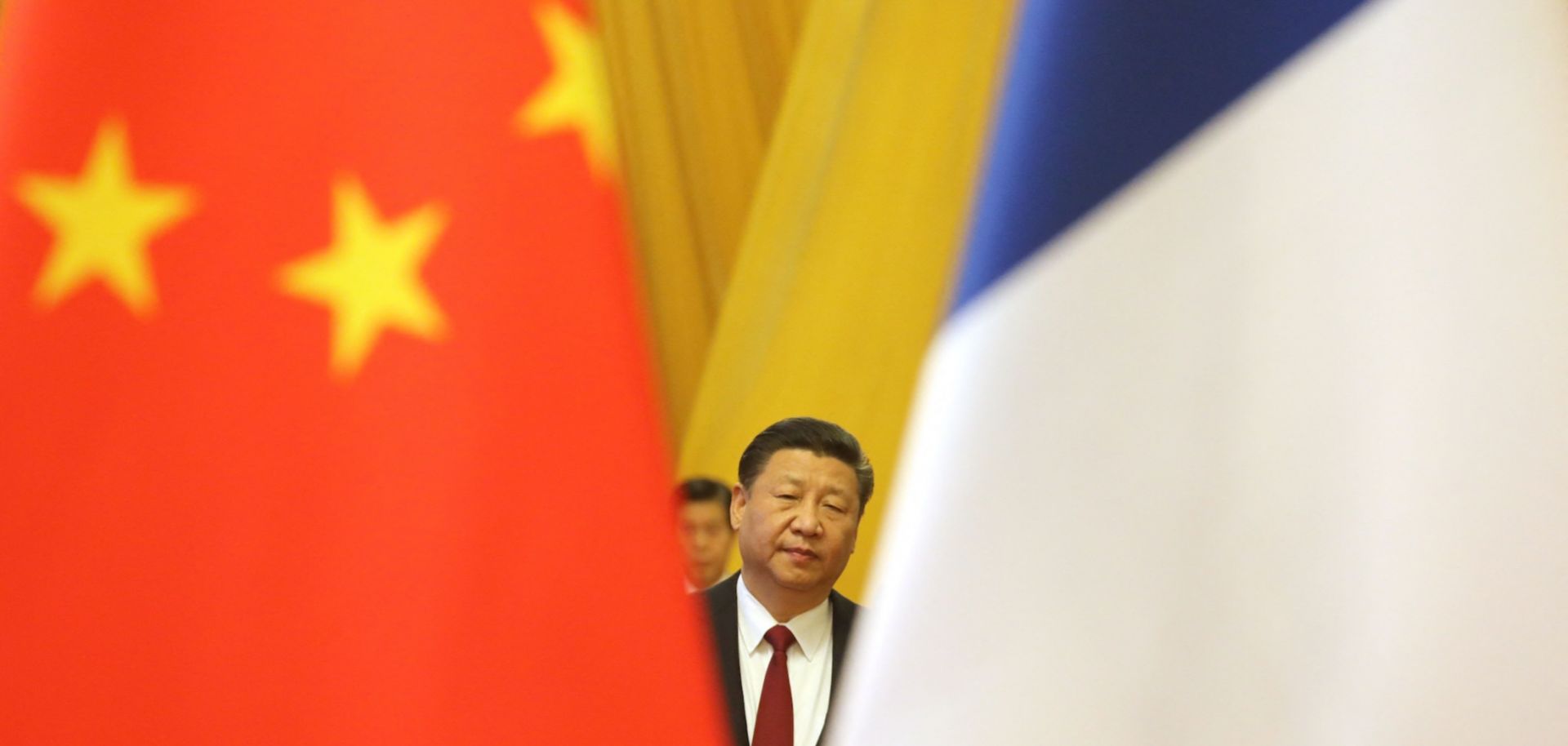
During his upcoming trip to Europe, Chinese President Xi Jinping will seek to ease EU trade tensions and provide new momentum to Chinese economic presence and influence in Central and Eastern Europe by announcing new investment and infrastructure projects. Xi will travel to Europe for the first time since 2019 for a five-day visit starting May 5 that will take him to Paris, Budapest and Belgrade. In France, Xi will meet French President Emmanuel Macron for a bilateral meeting and again for a trilateral one alongside European Commission President Ursula von der Leyen, during which the Chinese president will seek to downplay China's role in supporting Russia's military effort in Ukraine while promoting the benefits of maintaining positive trade and economic relations with China for France and Europe as a whole. Macron will, in turn, use his meeting with Xi to discuss maritime security and promote de-escalation between China and the United States in the Indo-Pacific. The French president will also seize the opportunity to showcase his political leadership on Ukraine and European security, thus taking a firmer stance against China's support for Russia. At the same time, Macron will present the case for increased Chinese investment in France's green tech sector, particularly electric vehicle (EV) battery manufacturing. During Xi's visits to Hungary and Serbia, the Chinese leader will likely unveil new minor investments under Beijing's Belt and Road Initiative (BRI) in both countries, including further financial support for the delayed Budapest-Belgrade railway line project.
- Macron held an unofficial meeting with German Chancellor Olaf Scholz in Paris on May 2 to coordinate their positions regarding EU-China relations ahead of Xi's trip to France.
- Xi also met with Scholz and Dutch Prime Minister Mark Rutte in Beijing in April and March, respectively.
- Xi's visit to Serbia (which is not an EU member state) on May 7 will coincide with the 25th anniversary of NATO's bombing of the Chinese embassy in Belgrade, in which three Chinese journalists were killed — a symbolic event showcasing both countries' grievances with the West.
- The BRI's Belgrade-Budapest high-speed railway project was launched in 2019, but construction on the Hungarian side has been slow going. Xi will likely announce financial aid to accelerate the project during his upcoming meetings in both countries. Greece also announced in February that it would join the project, expanding the line to its capital Athens.
- Macron met with Xi in Guangzhou, China, in April 2023, where the French president denounced Western decoupling from China and lauded France's strategic autonomy. He and European Commission chief von der Leyen also urged Xi to ''reason'' with Russian President Vladimir Putin about ending the war in Ukraine.
Beijing is seeking to undermine Brussels's push to ''de-risk'' economic relations with China by exploiting internal differences among EU member states. Xi's trip to Europe comes nearly a year after the European Union formally launched its ''de-risking'' campaign vis-a-vis China as part of the bloc's economic security strategy, which aims to reduce the European Union's economic vulnerabilities and critical dependencies on adversarial countries while enhancing its own industrial competitiveness and manufacturing capacity for strategic technologies. Since then, Brussels has actively sought to shield domestic industries against subsidized Chinese competition. The European Union has also pushed back against China's manufacturing overcapacity, massive trade surplus and lack of reciprocity for European companies operating in China. However, while the European Union is increasingly aligning its China-related rhetoric and policy objectives with the United States' hawkish approach, EU countries do not always agree on how to deal with Beijing. Indeed, many member states favor a more balanced approach (including France and Germany, although to different extents) for fear that excessive restrictions could have an outsized impact on their economic ties with the East Asian giant. Against this backdrop, Beijing is seeking to preserve positive economic and trade relations with the European Union by exploiting underlying political and economic divisions among individual EU member states. In doing so, China has been pursuing a ''divide and conquer'' strategy in which it employs a combination of targeted economic coercion and co-option to exploit divisions within the bloc and effectively prevent it from adopting significant economic restrictions against China.
- Xi's visit to Europe underscores the importance of improving ties with key EU member states for Beijing, or at least preventing them from deteriorating further — especially in light of the Chinese president's significantly reduced international travel following the COVID-19 pandemic. This is a priority for China because many of the emerging industries in which China hopes to become a global leader (and thus propel its economy to high-income status) are the same industries (e.g., green technologies, high-end medical devices and advanced semiconductors) for which Europe is considering imposing trade barriers on China. Maintaining such a key export market for these high-end goods is central to China's industrial development strategy.
- In recent months, the European Commission has launched multiple anti-dumping and anti-subsidy investigations into imports of Chinese green technologies into the bloc, highlighting Brussels' increasingly assertive stance against China's alleged unfair trade practices. This has included anti-dumping investigations into imports of Chinese electric vehicles and biodiesel. The commission has also launched anti-subsidy probes against imports of Chinese wind turbines into the bloc, as well as Chinese solar panel manufacturers and a Chinese train maker in public tenders in Romania and Bulgaria, respectively. Additionally, for the first time, the European Commission opened an investigation into China's medical device market using the European Union's so-called International Procurement Instrument. Brussels has also accused China of unfair market practices and of encouraging industrial overcapacity that is damaging EU companies, as well as of opaque market-access terms and lack of reciprocity for EU companies operating in China.
- Macron supports a more aggressive EU stance on Chinese subsidies, while his German counterpart Scholz has been significantly less supportive of ongoing EU probes into Chinese imports, fearing they could trigger retaliation from Beijing and end up hurting German exports to China.
During his trip to France, Xi will try to convince Macron to push for a more pragmatic EU-China policy, but this is highly unlikely to yield any concrete commitments from Paris toward that end. Beijing's divide-and-conquer strategy is unlikely to yield any positive outcome in Paris on trade. In fact, France has been the main country pushing for the European Commission to launch its investigation into Chinese EV subsidies. Despite this, Xi still broadly views Macron as a key interlocutor in convincing the European Union to pursue a more pragmatic approach toward Beijing, given the French president's past calls for Europe to pursue an independent China policy instead of following the United States' lead on issues such as tech restrictions, relations with Taiwan, or an expanded NATO role in Asia. Nonetheless, Macron remains highly unlikely to explicitly call for a detente in the Indo-Pacific or commit to easing up on EU-China economic decoupling during his meeting with Xi.
In Hungary and Serbia, Xi will focus on economic cooperation to solidify China's image as a key partner in Central and Eastern Europe, which will likely include the announcement of new (albeit limited) Chinese investments and infrastructure projects. Meanwhile, during Xi's trips to Hungary and Serbia — two countries that have long had close ties with China — the Chinese president will seek to expand economic cooperation to showcase China's continued importance as a key partner for Central and Eastern Europe. However, given China's shrinking international finance footprint, as well as its waning ambitions for BRI (which has seen Beijing recently shift its focus to ''small but beautiful'' projects in lieu of massive infrastructural projects), any new projects announced during Xi's meetings in Hungary and Serbia will likely be small in scope. Hungary, in particular, is a key piece of Beijing's divide-and-conquer strategy in the European Union, given Hungarian Prime Minister Viktor Orban's typical role as a spoiler in EU decision-making (Orban's ability to disrupt EU trade restrictions, however, is limited since trade measures in the bloc only require a qualified majority of member states for approval). During Xi's upcoming visit to Hungary, the two countries are expected to announce the opening of production facilities from Chinese automakers Great Wall Motor and BYD in Hungary (including an EV manufacturing facility in Szeged to serve the European market), as well as new BRI initiatives. Such initiatives serve, on the one hand, as a gesture of appreciation for Hungary's political alignment with Beijing, which has seen Budapest systematically oppose EU criticism of Beijing's human rights record and Taiwan policy. But they also highlight the geographic and strategic importance of Eastern Europe as a valuable thoroughfare for BRI projects connecting Asia to Europe.
- Under Orban, Hungary has been a vocal critic of the European Union and has embraced a pragmatic stance toward economic relations, as showcased by the country's continued (and growing) reliance on Russian natural gas supplies despite the ongoing war in Ukraine and Brussels' concurrent push to reduce the bloc's reliance on Russian energy. This makes Budapest an ideal partner for Beijing in the European Union.
- Partly as a sign of China's appreciation for its favorable political stances, Hungary has received significant Chinese investment over the years, including under the BRI infrastructure initiative, which Hungary joined in 2015.
- Serbia is also a strategic partner for Beijing in the Western Balkans, having signed a free trade agreement with China in October 2023 that will enter into force in July, with the majority of Serbia's exports to China consisting of copper ores and concentrates. In recent years, China has become Serbia's largest trading partner and provider of foreign direct investment (second only after the EU, as a whole), as well as a key partner in infrastructure development.
