
Editor's Note: For geopolitically significant elections, RANE publishes detailed scenario analyses that outline potential outcomes of the vote and their various domestic and international implications. Our previous scenario analyses have covered elections in Germany, Canada, Australia, Poland, South Korea, Japan (twice), Guyana, Norway, Moldova, the Netherlands, Chile and Bangladesh.
Denmark will hold parliamentary elections on March 24. The campaign has been shaped by debates over welfare, taxation, migration and the pace of the green transition, as well as tensions surrounding U.S. demands over Greenland. Prime Minister Mette Frederiksen called the election while seeking to capitalize on a partial rebound in support linked in part to her defiant handling of Washington's pressure on Greenland. However, any new government will likely adopt a somewhat more conciliatory tone in an effort to contain tensions, prevent further escalation and reach a compromise if possible. Meanwhile, the governing center-left Social Democrats, center-right Venstre and centrist Moderates remain weakened by years of cross-bloc compromise and voter fatigue. Polling suggests the election is unlikely to produce a clean or ideologically cohesive majority, leaving coalition-building dependent on broad alliances or issue-based support from smaller and potentially opposition parties.
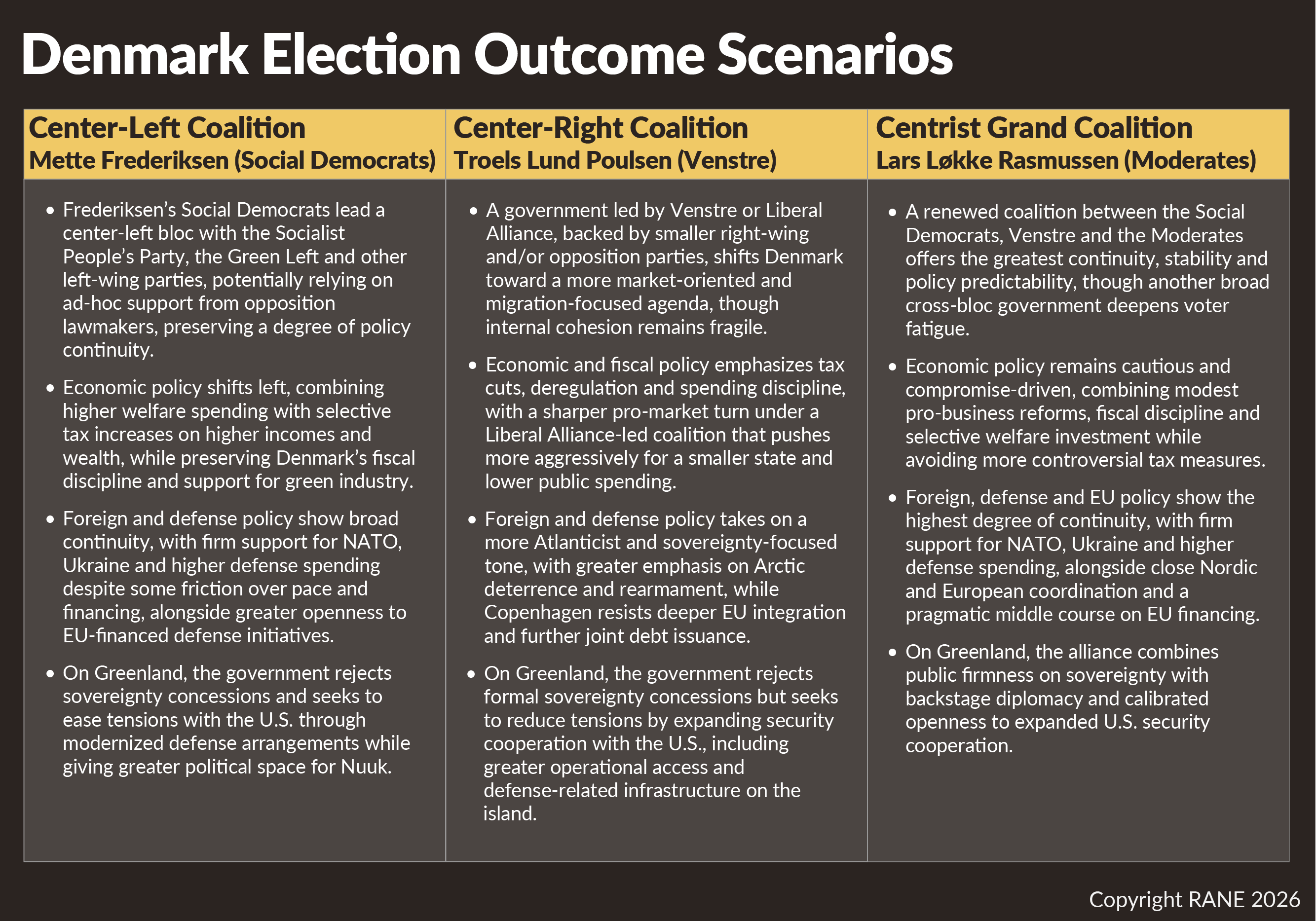
One potential outcome is a return to a more traditional center-left governing formula led by Frederiksen's Social Democrats together with other left-wing parties. Such a government would preserve broad continuity on foreign, security and migration policy while shifting leftward on welfare, income redistribution and the role of the state in supporting households and the green transition. It would also likely prove somewhat more positive toward closer EU coordination on defense, climate and industrial policy than Denmark's outgoing government. However, support for steps such as larger common EU borrowing or permanent shared fiscal tools would remain constrained by Denmark's long-standing preference for budget discipline and national flexibility.
A second scenario would see a center-right bloc take power under Venstre or the Liberal Alliance, shifting Denmark toward a more market-oriented and more explicitly anti-migration agenda. Compared with the center-left option, such a coalition would prioritize tax cuts, deregulation and tighter spending discipline. It would take a more cautious approach to climate implementation out of concern about competitiveness, agriculture and household purchasing power. This government would maintain a high degree of continuity on foreign and security policy. A center-right government would remain strongly pro-NATO but would probably place an even greater emphasis on Arctic deterrence, defense spending and practical security coordination with the United States. It would probably resist deeper EU integration and additional joint EU debt issuance.
Finally, a renewed centrist grand coalition between the Social Democrats, Venstre and the Moderates remains possible despite its declining popularity. This would be the strongest continuity scenario, preserving Denmark's current blend of fiscal caution, moderate pro-business reform, restrictive migration policy, gradual green implementation and strong support for NATO, Ukraine and higher defense spending. It would also likely offer the greatest policy predictability and the clearest commitment to cross-bloc crisis management at a time of heightened external pressure. On EU policy, this government would continue to occupy a pragmatic middle ground, supporting deeper defense-industrial coordination and selective common EU financing for strategic priorities but remaining cautious on broader fiscal integration.
A Center-Left Coalition
The Social Democrats lead a center-left coalition that includes the Socialist People's Party, the Green Left and other left-wing parties, likely as a minority Cabinet reliant on ad hoc support from centrist parties and/or lawmakers from Greenland and the Faroe Islands to pass legislation and secure parliamentary majorities. Such an outcome would imply a degree of continuity under Frederiksen while shifting policy somewhat toward a more traditional left-wing alignment and preserving Denmark's tradition for pragmatic cross-party bargains on security and foreign policy. On domestic policy, the government would emphasize welfare, health care, education, cost-of-living support and Frederiksen's already restrictive line on migration. Economic policy would include modestly higher public spending, selective tax increases on wealth or higher incomes and continued industrial support for the green transition, though Denmark's culture of fiscal discipline limits any major loosening of fiscal policy. On defense and foreign policy, broad continuity would prevail, with sustained support for NATO, Ukraine and higher military spending despite some friction among coalition partners over pace and financing. On Greenland, the government would maintain the outgoing government's firm but calibrated line toward Washington, rejecting any U.S. pressure for special control or sovereignty concessions while seeking to lower tensions through multilateral Arctic, NATO and Nordic frameworks. It would offer Nuuk greater political space within the Danish Realm and a more credible long-term pathway to independence. EU relations remain positive, with the government backing closer coordination on defense and climate and showing greater openness to joint financing for defense and other strategic priorities.
Implications
- Economic policy combines selective tax increases on high incomes and wealth, including a 5% levy on fortunes above 25 million kroner ($3.8 million), creating a less attractive environment for top earners and business owners. Coming on top of Denmark's already high tax burden, this could drive some wealthy individuals and executives to lower-tax jurisdictions like Switzerland, complicating firms' efforts to attract and retain senior talent.
- The government increases welfare, health care and education spending, partly financed by tax increases. This boosts household purchasing power, easing pressure on public services and supporting workforce skills and labor participation, which in turn strengthens domestic demand and social stability.
- Continued support for offshore wind, industrial decarbonization and carbon reduction measures preserves opportunities in green manufacturing, grid upgrades, clean power, storage, energy efficiency and related infrastructure. On the other hand, a slightly faster transition path also raises compliance and adjustment costs for energy-intensive industries, freight and other transport-dependent sectors.
- Migration policy remains restrictive, meaning the government does not use immigration as a potential labor-supply tool. This leaves lingering workforce pressures in sectors such as care and some skilled occupations largely unaddressed, keeping pressures on wages and operating costs for labor-intensive businesses.
- The coalition sustains Denmark's strong support for NATO, Ukraine and higher defense spending, preserving demand for air defense, ISR, munitions and maritime surveillance and Arctic-capable platforms. However, modest fiscal loosening and resistance from some left-wing partners constrain the scope for major new defense spending beyond projects already in the pipeline.
- Denmark deepens defense cooperation with Nordic and European allies on Arctic and Baltic security, which increases demand for joint surveillance, maritime domain awareness, cyber defense and dual-use infrastructure. This creates opportunities for European and non-European contractors able to position themselves within multinational procurement frameworks.
- Copenhagen continues to reject any outright transfer of sovereignty over Greenland but seeks to defuse tensions with Washington by modernizing existing defense arrangements, including expanded U.S. access, upgraded radar and surveillance infrastructure, dual-use airport and port investment and closer Arctic coordination under NATO or bilateral frameworks, offering the Trump administration a tangible political win without formal sovereignty concessions.
- By giving Greenland a greater say over security, infrastructure and foreign commercial engagement while preserving a gradual and negotiated path to statehood, the government increases Nuuk's involvement and leverage, raising the likelihood of independence over the medium term while also creating a more complex and slower approval environment for investors and defense planners.
- If U.S. pressure over Greenland were to significantly intensify, the government would be more likely to harden diplomatically and politically than to reward pressure with major new concessions. This would further internationalize the crisis through NATO, Nordic and EU channels. A stronger Greenlandic push for independence would likely be met with greater openness to a gradual negotiated process.
- Potential internal divisions and the need for ad hoc parliamentary bargaining in case of a minority government create periodic friction on budgets, taxation, migration and Greenland-related policy. Decision-making slows, causing occasional regulatory uncertainty, even as the overall political and financial environment remains stable by European standards.
- The government takes a somewhat friendlier line on EU integration, supporting closer coordination on defense, climate and industrial policy and showing greater openness to common EU financing for strategic priorities, representing a softening from one of the bloc's traditionally skeptical and fiscally conservative voices. This modestly strengthens the case for deeper EU-level defense and industrial coordination. Eurozone membership remains off the table.
A Center-Right Coalition
The center-right bloc forms a government led either by Venstre's Troels Lund Poulsen or Liberal Alliance leader Alex Vanopslagh, supported by smaller right-wing and far-right parties and relying, when needed, on ad hoc backing from the Moderates, Greenland and Faroe Islands seats and selected centrist parties. Such a coalition would shift Denmark toward a more market-oriented and migration-focused agenda. A Venstre-led government would likely pursue tax relief, deregulation, labor supply reforms and tighter spending discipline. A Liberal Alliance-led Cabinet would push even more aggressively for a smaller state, sharper tax cuts and a more ideologically liberal economic model. On migration, the coalition would further tighten Denmark's already restrictive approach, emphasizing deportations, border enforcement and stricter integration requirements. On energy and climate, it would preserve core climate commitments but slow implementation of measures seen as too costly for households, agriculture or business competitiveness. It would expand support for technological neutrality, carbon capture, offshore wind and possibly nuclear power. On defense and foreign policy, the government would remain strongly Atlanticist and pro-NATO, while placing even greater emphasis on Arctic deterrence, defense spending and capability-building in and around Greenland. Seeking to de-escalate tensions with Washington, the government would pursue closer strategic coordination with the United States, arguing that stronger Danish and allied security commitments are the most effective way to protect Danish sovereignty over Greenland. While rejecting any formal concessions on Danish or Greenlandic sovereignty, it would indicate openness to practical security arrangements that expand Washington's operational latitude in Greenland. The government would also remain broadly pro-EU but resist deeper integration, oppose further joint EU debt issuance and seek to preserve Danish flexibility on migration, fiscal and other regulatory matters.
Implications
- The government prioritizes tax relief, deregulation and labor supply reforms, leading to a more business-friendly operating environment and somewhat stronger private-sector confidence. Tighter spending discipline limits the scale of public stimulus outside strategic sectors such as defense, infrastructure and selected energy projects.
- The coalition further tightens Denmark's already restrictive migration regime through stricter deportation rules, border enforcement and integration requirements, which responds to domestic political demand for control. The controls exacerbate labor shortages in construction, agriculture, care and logistics, slightly increasing wage pressures and recruitment costs.
- Climate policy becomes more industry-sensitive. The government preserves headline climate commitments but slows implementation where costs to households, farmers and manufacturers are deemed too high. Short-term compliance pressure on business is reduced. Some green investment decisions are delayed and regulatory uncertainty in energy-intensive sectors and clean-tech manufacturing is extended.
- The coalition places greater emphasis on technological neutrality, carbon capture, offshore wind and potentially nuclear energy. This creates opportunities in carbon management, grid infrastructure and baseload-oriented energy planning, though a lack of clarity over the ultimate technology mix slows long-horizon capital allocation.
- Defense spending rises decisively, with a stronger focus on Arctic deterrence, ISR, maritime surveillance, air defense, munitions and infrastructure in and around Greenland. This leads to a more attractive procurement environment for European and other Western aerospace and defense firms with relevant Arctic, missile defense, radar, space and maritime capabilities.
- The government pursues closer strategic coordination with the United States while rejecting formal concessions on Danish or Greenlandic sovereignty. The likelihood of practical security arrangements that expand U.S. operational latitude in Greenland grows, creating opportunities for defense, logistics and dual-use infrastructure providers.
- A more security-focused Greenland policy strengthens Denmark's position within NATO and improves alignment with a more transactional U.S. administration. However, it also raises the risk of domestic criticism in Denmark and Greenland if closer military cooperation with Washington is perceived as undermining local autonomy, de facto ceding Greenland's sovereignty to the United States or accelerating the militarization of the Arctic.
- The government gives Nuuk a visible consultative role in talks while retaining de facto control over negotiations with Washington, using Greenlandic inclusion to legitimize expanded U.S.-Danish security cooperation. It offers the United States greater operational latitude on the island, potentially increasing intra-realm tensions and further strengthening the push for Greenlandic independence.
- If U.S. pressure on Greenland intensifies significantly, the government is likely to keep trying to manage escalation through a security bargain for longer than the other scenarios. However, its position would harden quickly if Washington were to cross into overt coercion by freezing bilateral negotiations and it would likely pivot back toward an EU-backed response. The government might react to a stronger Greenlandic push for independence with some resistance on strategic and political grounds, seeking to slow and condition the process.
- Political cohesion remains somewhat fragile. Although a center-right coalition is more coherent than a center-left government on tax, migration and Atlanticism, some internal divisions on welfare spending, the pace of climate and energy measures, relations with the EU and the balance between Danish sovereignty and security coordination with Washington over Greenland create recurring bargaining risk. Pro-business procurement and regulatory decisions are left vulnerable to coalition friction and early-election pressure.
- The government remains broadly pro-EU but resists deeper political and fiscal integration. It opposes further joint EU debt issuance for defense and seeks to preserve Danish flexibility on migration, fiscal and regulatory matters. Denmark's support for more ambitious EU-wide financing mechanisms remains limited, which may slow progress on collective defense-industrial initiatives despite continued backing for practical security cooperation.
A Centrist Grand Coalition
A repeat of the incumbent alliance between the Social Democrats, Venstre and the Moderates takes office again as a formal majority coalition or as a minority centrist government dependent on issue-based third-party support. Despite some internal ideological tensions, the government would provide stability, broad parliamentary legitimacy and cross-bloc crisis management at a time of heightened external pressure. On economic and fiscal policy, the coalition would blend center-left welfare priorities with center-right emphasis on pro-business reforms, fiscal discipline and labor supply measures. The government's agenda would be cautious and compromise-driven, centered on modest market-oriented reforms and selective welfare investment within an overall disciplined fiscal framework. Migration policy would remain restrictive, without significant further tightening or meaningful liberalization. On climate and energy, the alliance would preserve Denmark's green leadership credentials while phasing implementation in ways that protect competitiveness, support industrial decarbonization and avoid excessive burdens on farmers and energy-intensive sectors. Defense and foreign policy would display the highest degree of continuity under a renewed grand coalition, with firm support for NATO, Ukraine and higher defense spending, alongside close alignment with Nordic and European partners. On Greenland, the alliance would maintain a dual-track strategy of public firmness and backstage diplomacy. It would reject any U.S. challenge to Danish sovereignty and seek to deny Washington opportunities to exploit divisions between Denmark and Greenland through more institutionalized consultation with Nuuk and calibrated openness to expanded security and economic cooperation, stopping short of formal sovereignty concessions. On EU policy, the alliance would maintain a pragmatic middle ground, supporting deeper defense-industrial coordination and selective common EU financing for strategic priorities while remaining cautious about broader fiscal integration.
Implications
- The government maintains a high degree of political continuity, institutional stability and policy predictability. Compared with either a narrower left- or right-leaning government, it reduces the likelihood of abrupt policy shifts and creates a more stable and predictable operating environment for businesses, contractors and strategic partners.
- Economic and fiscal policy remains cautious, combining modest pro-business reforms with selective welfare investment. These policies support steady growth and preserve Denmark's reputation for sound public finances but limit the scope for major new spending initiatives outside agreed strategic priorities. The Social Democrats, led by Frederiksen or not, drop flagship campaign proposals like a wealth tax, reassuring higher-income taxpayers and investors.
- Migration policy stays restrictive without significant further tightening or meaningful liberalization, preserving continuity for employers and local authorities. However, it does little to alleviate labor shortages in sectors such as care, logistics, construction and lower-skilled services.
- The coalition phases in climate and energy measures more gradually than the current government's trajectory to protect competitiveness and industrial decarbonization, preserving Denmark's green leadership while reducing the risk of abrupt regulatory shifts for business. Slower implementation delays some emissions cuts and prolongs uncertainty in sectors exposed to transition costs.
- Defense and foreign policy display the greatest continuity under this scenario, with firm support for NATO, Ukraine and higher defense spending, leading to a stable multi-year procurement outlook in areas such as maritime security, ISR, cyber, air defense and Arctic-enabling capabilities that benefit long-cycle planning for defense firms.
- Denmark continues to align closely with Nordic and European partners on Baltic and Arctic security, supporting joint exercises, regional coordination and interoperable procurement. This strengthens opportunities for contractors that can partner with European industry and fit into multinational programs.
- On Greenland, the government maintains a dual-track strategy of public firmness and backstage diplomacy, rejecting any U.S. challenge to Danish sovereignty while keeping channels open for expanded security and economic cooperation. The risk of a major transatlantic rupture is lower, as are the chances of rapid breakthroughs on U.S. military access.
- The coalition balances Arctic sovereignty concerns with practical cooperation on surveillance, infrastructure and defense, creating a relatively stable framework for U.S. engagement in Greenland so long as projects are structured in ways that respect both Danish authority and Greenlandic political sensitivities.
- Should U.S. pressure over Greenland intensify significantly, the government would be slower than a center-left coalition to abandon negotiations but less willing than a center-right one to expand U.S. latitude under overt coercion and threats. A stronger Greenlandic push for independence would likely be handled through incremental concessions rather than accelerated separation.
- Despite its overall stability, the grand coalition still contains ideological tensions over taxation, welfare, climate implementation and the balance between sovereignty signaling and accommodation toward the United States on Greenland. Divisions cause some policy drift and occasional delays, but not enough to significantly undermine Denmark's political stability, financial credibility or attractiveness as a defense and strategic partner. The main risk remains political fatigue, as another broad coalition deepens voter frustration with the establishment and strengthens parties at the extremes on both the left and right.
- The government maintains a pragmatic middle course on EU relations, backing deeper defense-industrial coordination and selective common EU financing for strategic priorities while remaining cautious about broader fiscal integration. Denmark's position as a constructive but fiscally conservative partner in Brussels is reinforced, while Copenhagen supports incremental progress on joint European defense and industrial initiatives without endorsing major federalizing steps.
