
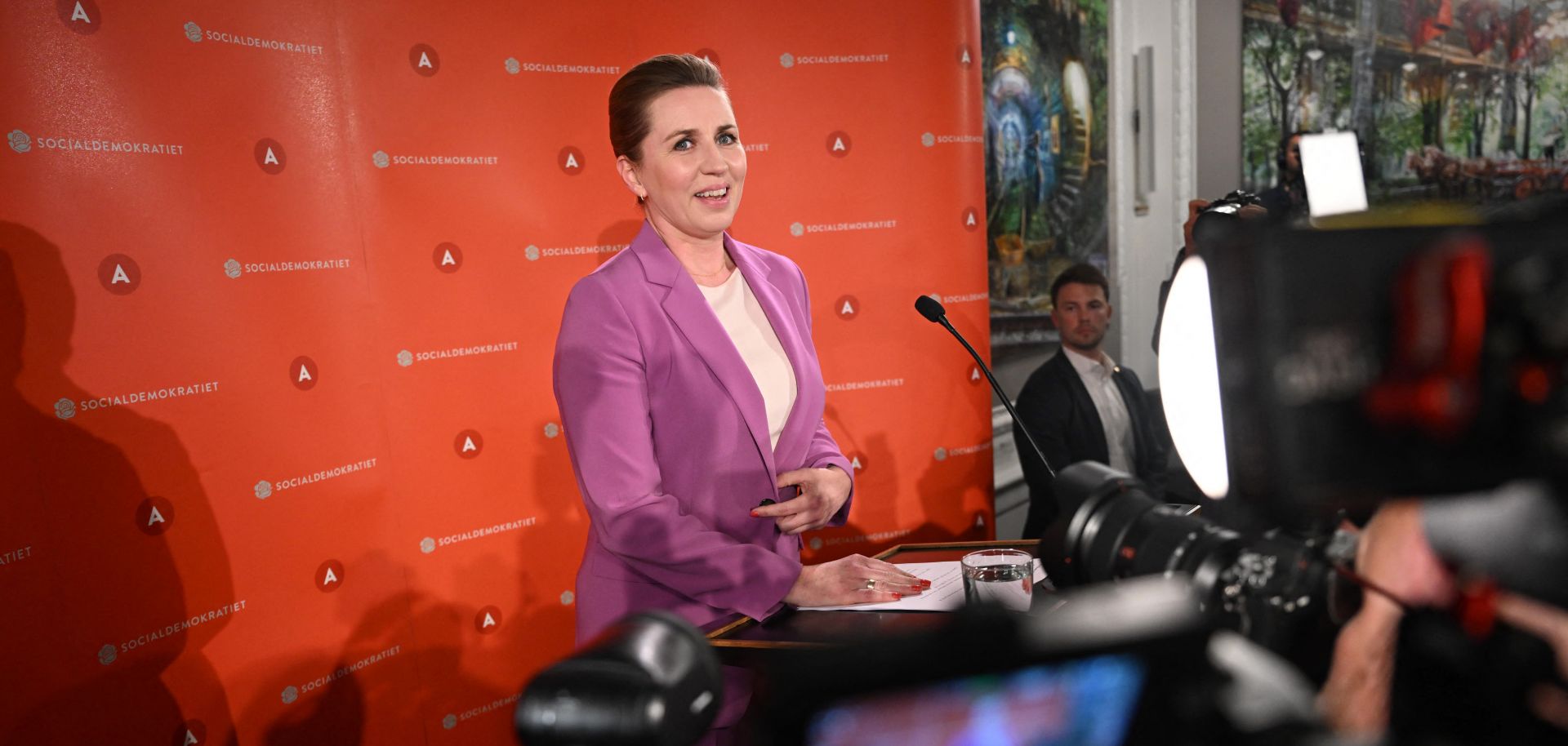
Danish Prime Minister Mette Frederiksen speaks to journalists in Copenhagen on June 1, 2022, after the initial results of a historic referendum on Denmark's EU defense opt-out were announced.
Denmark's decision to join the European Union's defense and security cooperation framework marks another step in deepening Nordic countries' military integration with the rest of Europe in response to Russia's invasion of Ukraine. Aside from potentially giving a political boost to the ruling party, the move will give Copenhagen more influence over, and access to, European defense cooperation, while allowing the European Union to complete its security architecture. On June 1, two-thirds of Danish voters in a referendum supported joining the European Union's Common Security and Defence Policy (CSDP), ending their country's 30-year-long opt-out from the bloc's defense cooperation mechanism. This decision ends one of many exemptions that Copenhagen obtained when it signed the Maastricht Treaty that created the EU in 1993.
- The final results showed almost 67% of voters were in favor of greater EU cooperation on defense and security, while around 33% of voters were opposed.
- The CSDP is the EU's policy framework in the field of defense and crisis management, including defense cooperation and coordination between member states. It focuses on strengthening civil and military crisis management and intensifying EU cooperation in the field of arms research and development.
- The defense opt-out allowed Denmark to avoid participating in EU foreign policy where defense is concerned and contributing troops to EU military missions if Copenhagen so chose. Denmark was the only EU member that negotiated a defense opt-out, which it has used 235 times over the course of three decades.
Following Sweden and Finland's bid to join NATO, the referendum in Denmark confirms that Russia's invasion of Ukraine is pushing the Nordic region to deepen its integration with European security structures. The Danish government called for the referendum in March, two weeks after Russia's Feb. 24 invasion of Ukraine and amid calls for Nordic countries to deepen their ties on security and defense with the rest of Europe. Germany's announcement in February that it would reverse decades of defense policy with a massive increase in military spending, coupled with the growing debate in Sweden and Finland over NATO membership, all played a key role in the Danish decision to call a referendum on the opt-out. In fact, the Danish referendum happened two weeks after Sweden and Finland formally submitted their NATO applications, which highlights the extent to which the ongoing war in Ukraine has motivated Nordic European countries to reassess their security and defense strategies.
- As it announced the referendum in March, Denmark also decided to increase its defense spending to gradually reach 2% of GDP by 2033, which means the country's annual defense spending will increase by around 18 billion Danish crowns ($2.65 billion).
- Furthermore, the country's parliament agreed on the allocation of an additional 7 billion Danish crowns ($1.01 billion) over the next two years to strengthen the country's defense, diplomacy and humanitarian missions.
- Sweden and Finland formally applied to join NATO on May 18. While Turkey, a NATO member, is currently threatening to veto both applications unless it receives concessions, a compromise between Ankara, Stockholm and Helsinki to unblock the process is probable.
The result of the referendum is a break from long-standing Danish reluctance toward further European integration and could give a political boost to the ruling center-left party. This is a major win for Prime Minister Mette Frederiksen, who is now the first Danish prime minister to succeed in removing an EU opt-out, which could boost her popularity ahead of the country's 2023 general elections. Most importantly, the vote also represents a significant rupture from 30 years of Euroscepticism in Denmark. The strong support to end Denmark's opt-out strengthens a trend that sees a general shift in support of EU membership from the Danish public and parties of recent years, which the war in Ukraine has accelerated. Still, Denmark is likely to keep its opt-outs on other EU issues, most notably regarding eurozone membership, as economic integration (and particularly abandoning the Danish krone to adopt the euro) would be a harder sell for Danish politicians.
- Prime Minister Frederiksen may need such a popularity boost as her image was dented by an ongoing inquiry into her government's decision to illegally cull the country's entire mink population in 2020 in response to Covid-19 outbreaks.
- 11 of Denmark's 14 parties have campaigned for a ''yes'' vote in the referendum to end the opt-out on common defense and security – representing more than 75% of seats in parliament – leaving the ''no'' campaign to just three parties, two on the far right and one on the far left.
- Denmark had held referendums on abolishing its other two opt-outs — from the bloc's common currency in 2000 and common justice and home affairs policies in 2015 — but the majority of Danes voted no in both cases.
Denmark's decision will unlock funds and opportunities to increase its influence over Europe's defense and security decisions, while the European Union will be able to complete its defense and security architecture. Copenhagen will gain more influence on matters of importance for its national security concerns, as well as for its defense industry interests. Denmark will also gain access to the EU's defense cooperation (including the Permanent Structured Cooperation (PESCO), the main EU framework for the deepening of European defense cooperation beyond individual missions and projects), as well as capacity development initiatives in areas such as cybersecurity, military mobility and hybrid threats. As part of the CSDP, Denmark will now also be able to participate in the European Union's joint military operations (such as the ones currently taking place in Somalia, Mali, and Bosnia and Herzegovina). Additionally, Copenhagen will be able to oppose or negotiate new operations, as well as cooperate on the acquisition of joint military capabilities. For the European Union, a Danish membership in the bloc's common defense policy has a relatively small impact in terms of bolstering the bloc's military capabilities. However, in addition to bringing a modest informational and cybersecurity know-how, Denmark will allow Brussels to fill the last gap in its defense and security makeup and strengthen military cooperation in Europe. Finally, the end of the Danish opt-out offers Nordic countries the opportunity to increase their relative weight within Europe's security and defense matters. Sweden, Finland and Denmark will soon be members of both NATO and CSDP, which will increase coordination and eliminate discrepancies in the three countries' security alliances. In addition, Norway — which is not a member of the European Union but is a member of NATO — already has close cooperation with CSDP. Altogether, this will lead to a significant consolidation of the Nordic region's influence over military affairs in Europe.
- With Denmark's vote, 26 of the European Union's 27 member states now fully participate in EU common security and defense policy (Malta is de-facto excluded due to its neutrality status).
