
Editor's Note: This article is part of an ongoing RANE series on the shifting patterns of global trade. The first installment provided a broad overview of the geopolitical and economic implications of these shifts. Other installments have examined trade patterns in the Americas, the Strait of Hormuz, Japan and South Korea, India, Turkey, ASEAN countries, the data flows, Mercosur, maritime chokepoints (part one and part two), digital trade and Congo.
Kenya will likely remain East Africa's leading trade gateway in the medium term, but Tanzania will likely narrow this lead over the coming decade as it capitalizes on larger transport infrastructure investments, growing international demand for minerals from Central Africa's "Copper Belt" and Kenya's challenges in developing Lamu port. Africa's geography and history have denied many countries on the continent direct access to the sea, leaving landlocked states struggling to reach global markets and support their economic development. East Africa is no stranger to these challenges, with Ethiopia, South Sudan, Uganda, Rwanda, Burundi, Zambia and Malawi all lacking direct sea access. Against this backdrop, China's state-owned China Civil Engineering Construction Corp., or CCECC, signed on Sept. 29 a $1.4 billion deal with Zambia and Tanzania to refurbish the Tazara rail line, which connects Zambia's Copperbelt province to the Tanzanian port of Dar es Salaam. This came after Tanzanian Prime Minister Kassim Majaliwa and Burundian President Evariste Ndayishimiye inaugurated on Aug. 16 the start of works on a new $2.15 billion, 240 kilometer (149 mile) Standard Gauge Railway that will connect Tanzania's eastern town of Uvinza to Burundi's nickel-rich town of Musongati. Once completed, the line will connect the Burundian town to Dar es Salaam, from where Burundi's goods will be exported to international markets. These developments are only the latest milestones in East Africa's ongoing transport infrastructure boom.
- The construction of the Uvinza-Musongati line will be led by China's state-owned China Railway Engineering Group Corp. and China Railway Engineering Design and Consulting Group Co., with financing support from the African Development Bank. The project is scheduled to take six years to build, with a planned start of services in 2031 and a possible extension to Gitega, Burundi's capital. The Uvinza-Musongati line is expected to reduce transport times between Dar es Salaam and Bujumbura, Burundi's economic capital, from 96 to 20 hours.
Kenya and Tanzania have launched major infrastructure projects over the past two decades to cater to rapidly growing trade volumes across East Africa and tackle port congestion, which remains the main trade bottleneck in the region. Spurred by relative political stability and security, deeper levels of regional integration and often sounder macroeconomic management than many of their peers on the continent, East African states have enjoyed rapid economic growth since the turn of the millennium, resulting in rising trade volumes. However, this growth has also increased pressure on the region's transport infrastructure, causing congestion at Kenya's Mombasa and Tanzania's Dar es Salaam, East Africa's two main ports, to remain the primary bottleneck for regional supply chains. In response, Kenya and Tanzania have launched major transport infrastructure projects over the past two decades to cater to growing trade volumes and rising demand for port services. This infrastructure buildup has locked Kenya and Tanzania in a competition for investments in their port and rail upgrades as they look to serve a catchment area covering over 200 million inhabitants. Kenya's infrastructure push has centered around the construction of a Standard Gauge Railway along the Mombasa-Nairobi-Kampala axis, known as the Northern Corridor, as well as the development of Lamu port. Meanwhile, Tanzania launched its own Standard Gauge Railway project, pressed ahead with port upgrades in Dar es Salaam and unveiled plans for a new deepwater port at Bagamoyo in 2013. In both countries, China's Belt and Road Initiative played an important role in extending financing pledges through the 2010s, such as for the construction of Kenya's Standard Gauge Railway and the development of Tanzania's Bagamoyo port. However, both projects faced a series of setbacks, with the expansion of Kenya's Standard Gauge Railway from the town of Naivasha to the border with Uganda suspended in 2019 after China refused to extend funding, while former Tanzanian President John Magufuli scrapped Bagamoyo port's development the same year — though Magufuli's successor relaunched the project in 2021.
- Between 2010 and 2024, Rwanda, Tanzania, Uganda and Kenya averaged GDP growth rates of 7%, 6.1%, 5.1% and 4.8%, respectively. Estimates from the International Monetary Fund forecast that each country's growth rate will average 7.1%, 6.3%, 6.8% and 5%, respectively, between 2025 and 2030.
- In 2024, Mombasa port processed 41 million tons of cargo, compared with Dar es Salaam's 18 million tons. Despite having higher average transport costs and port tariffs than Dar es Salaam, Mombasa is favored by many businesses across East Africa owing to its more seamless customs procedures and faster ship turnarounds, which local reports indicate average 1.25 days compared with five days in Dar es Salaam. As of 2022, around 89% of total transit volumes through Mombasa were imports, while the remaining 11% were exports.
- In 2013, the Tanzanian government signed a memorandum of understanding with China's state-owned China Merchants Port Holdings and Oman's State General Reserve Fund for the development of Bagamoyo port. The $10 billion project would have seen the development of a large port with an annual capacity of 20 million twenty-foot equivalent units, or TEUs, and would have been constructed over a 10-year period. However, Magufuli scrapped the project in 2019 over China's allegedly "exploitative terms."
Kenya will likely maintain its status as East Africa's leading trade gateway through the end of the 2020s, and its government will focus on mitigating potential trade bottlenecks by extending the Standard Gauge Railway to Uganda and optimizing port operations, notably by advancing port concessioning efforts. Mombasa enjoys a dynamic hinterland that includes the urban hubs of Nairobi and Kampala, as well as rich croplands on the northern shores of Lake Victoria. Moreover, Mombasa has a more developed logistics ecosystem than Dar es Salaam, whose hinterland is less populated and has a less well-developed urban network than its northern rival. These factors suggest that Kenya will likely maintain its status as East Africa's leading trade gateway through the end of the decade. While this will support Kenya's economic growth, the continued expansion of trade volumes through Mombasa will further strain transport infrastructure along the Northern Corridor. To tackle these challenges, Kenyan President William Ruto has redoubled efforts to extend Kenya's Standard Gauge Railway to the border with Uganda, with construction works currently scheduled to begin by the end of 2025. While these efforts could be delayed, this push has been complemented by Uganda's plans to construct its own Standard Gauge Railway line from the town of Malaba on the Kenya-Uganda border to Kampala. Meanwhile, the Kenyan government is supporting a range of upgrades at Mombasa port, including dredging works and the construction of new berths, to ensure that it can keep up with growing demand. Ruto has also backed plans to optimize port operations through trade digitalization and launched port concessioning efforts. Although the latter initiative stalled in November 2023 after regional lobby groups successfully petitioned Kenyan courts to halt the tendering process, the Kenyan government resumed concessioning efforts in March following an out-of-court settlement, in which it pledged to ensure public participation and the use of local content.
- The planned extension of Kenya's Standard Gauge Railway is scheduled to take place in two phases. The first will extend the Standard Gauge Railway to Kisumu, while the second will run from Kisumu to Malaba. China and Kenya reportedly reached a preliminary agreement to finance the extension, according to which the Kenyan state and China's state-owned Export-Import Bank of China will each finance 30% of the project, with the remaining 40% due to be financed by a consortium of Chinese infrastructure lenders and Kenyan banks. The consortium is expected to operate the railway for several years.
- In October 2024, the Ugandan government signed a $2.2 billion contract with Turkish construction company Yapi Merkezi for the construction of the Malaba-Kampala Standard Gauge Railway. Construction works are scheduled to begin in April 2026 and last four years, even though preliminary works have already taken place.
- On March 25, Kenya's National Treasury issued a request for proposal regarding transaction advisory services for the development and upgrade of berths and container terminals in both Lamu and Mombasa, as well as dredging work. Reports indicate the Kenyan government is now looking to forward a 30-year public-private partnership model that would also involve concessioning Mombasa's container terminal 1 and berths 11 to 14, as well as Lamu's berths 1 to 3, between different operators.
Potential delays to Ruto's port concessioning push, space constraints facing Mombasa port's expansion and Lamu port's development hurdles pose long-term threats to Kenya's status as East Africa's leading trade gateway. Despite its recent out-of-court settlement, the Kenyan government's planned shift to a concession-based model threatens to trigger significant backlash. Concerns that future operators' rationalization plans would result in significant job losses and sideline politically connected businesses will draw opposition from trade unions and certain politicians, potentially resulting in strikes and lawsuits that set back the process by at least several months. Additionally, parts of Kenya's Gen Z protest movement will likely oppose the shift on the basis that the management of public assets should not be handed over to large multinational companies. This significant risk of backlash suggests that Ruto could slow-walk, if not halt, the port concessioning process as he seeks to secure reelection in Kenya's 2027 general election, a move that would hinder efforts to optimize Kenyan ports' operations. Meanwhile, Mombasa is at serious risk of failing to meet growing trade volumes over the coming decades, as its location at the end of a narrow channel and in the immediate vicinity of dense urban neighborhoods will hinder its long-term expansion due to space constraints. While successive Kenyan governments have supported Lamu port's development to ease pressure on Mombasa, the new port has struggled to attract trade flows due to underdeveloped transport infrastructure and activity by al Qaeda-linked al Shabaab militants in the area, which has compounded costs and threatened goods transiting through Lamu. With al Shabaab likely to sustain, if not escalate, operations over the next few years, Lamu port's development is likely to remain slow, which, given Mombasa's own challenges, will compound long-term threats to Kenya's status as East Africa's leading trade gateway.
- Only three of Lamu port's 23 planned berths have been completed, while just 10% of the Lamu-Garissa road has reportedly been tarmacked. Meanwhile, plans to link Lamu to Kenya's Standard Gauge Railway network are currently stalled, with little indication that they will resume in the next few years.
- Al Shabaab has capitalized on communal tensions in Lamu county to recruit from the Bajuni community, many members of which perceive ethnic Kikuyu settled in the area following independence as being favored by the government. The jihadist group maintains a presence in the neighboring Boni forest, and its attacks killed an estimated 30 people in Garissa and Lamu counties between January and November 2024.
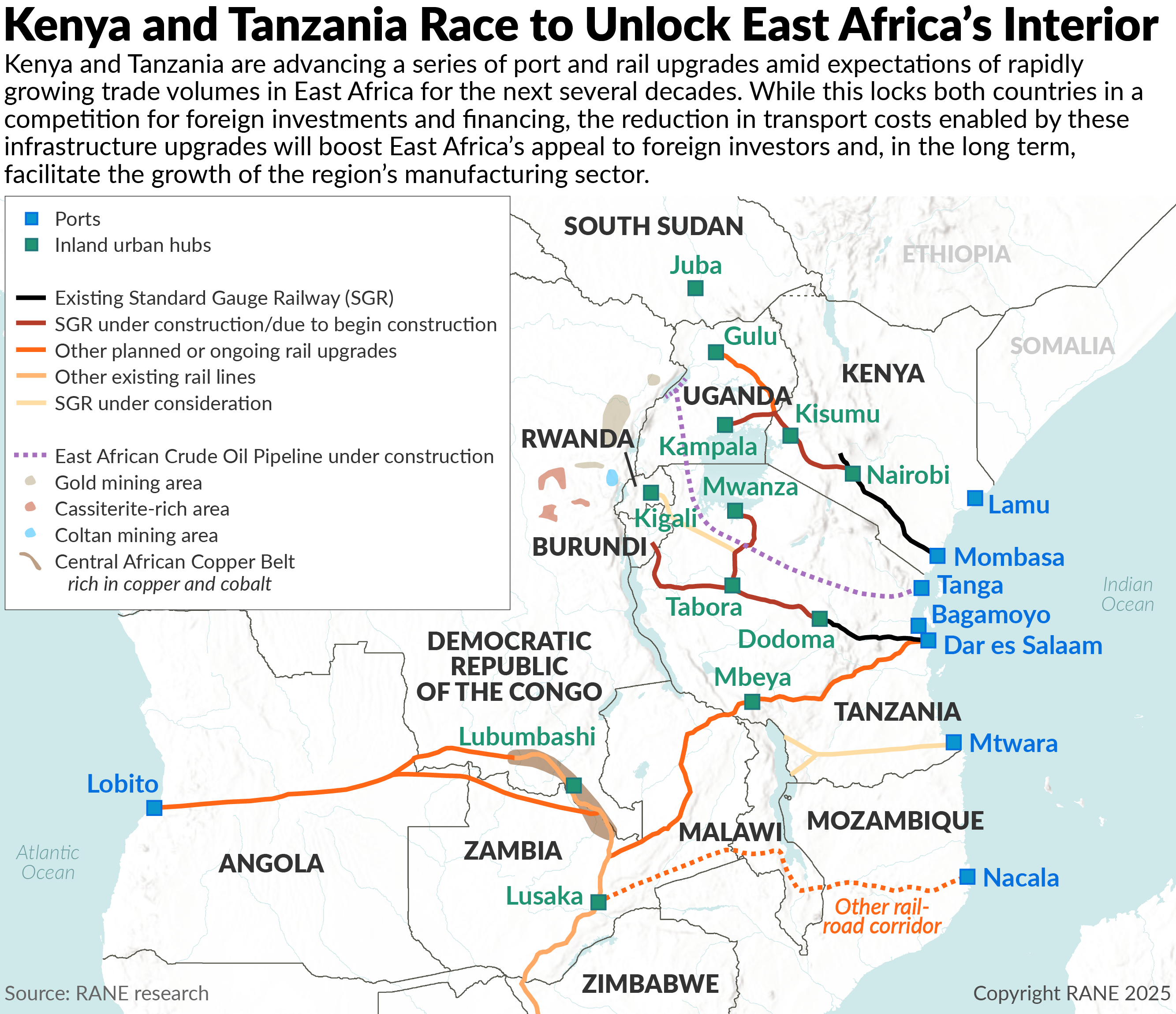
In Tanzania, infrastructure upgrades near Dar es Salaam and the recent concessioning of most of the port's berths will help increase throughput in the coming years, but the government's development of Bagamoyo port is likely to be slower and less extensive than initially announced due to financing uncertainties. Successive Tanzanian governments have overseen significant upgrades to decongest Dar es Salaam port over the past decade, and President Samia Suluhu Hassan's government plans to construct up to 10 new berths at the port with the support of foreign investors. Meanwhile, Hassan also completed port concessioning efforts since taking office in 2021, with Emirati logistics giant DP World and India's Adani Group securing 30-year leases at Dar es Salaam's berths 4-7 and container terminal 2, respectively. This will help optimize port operations and increase throughput in the years ahead, setting the stage for faster ship turnarounds. However, the Tanzanian government will likely gradually shift its focus to developing other ports over the coming decade, given that Dar es Salaam faces similar physical constraints for long-term expansion as Mombasa. To that end, Hassan scored an important success in overseeing the long-awaited start of preliminary works for Bagamoyo port this year after rebooting the project in 2021. However, Bagamoyo's development is likely to be slow amid uncertainties over the project's financing, as China Merchants Port Holdings and Oman's State General Reserve Fund — Bagamoyo port's initial backers — now appear to be out of the project. These funding uncertainties also apply to the rail connection between Bagamoyo and the rest of Tanzania's Standard Gauge Railway network, without which the port is all but certain to be underutilized. Moving forward, the Tanzanian government will likely press ahead with a phased development of Bagamoyo port and resort to blended finance, which will mitigate financial risks and ensure the project can progress, albeit at a smaller scale than first anticipated.
- In 2017, the Tanzanian government launched the Dar es Salaam Maritime Gateway Project, with infrastructure upgrades such as a Roll-on/Roll-off terminal that can accommodate post-Panamax vessels. The World Bank is financing the project, alongside smaller contributions from the Tanzanian government and the United Kingdom. Meanwhile, the Kwala dry port will also help decongest Dar es Salaam port.
- The Tanzanian government disbursed 22 billion Tanzanian shillings (around $9.3 million) to begin preliminary construction works for Bagamoyo port in 2025, which includes the construction of berth foundations and access roads. The government also reportedly completed land compensation for residents in 2024. In February 2025, Tanzania signed memorandums of understanding regarding Bagamoyo port's development with companies from China, Egypt and Saudi Arabia.
Tanzania is set to capitalize on growing demand for copper and cobalt from Zambia and the Democratic Republic of the Congo following China's planned refurbishment of the Tazara railway, though competing transport initiatives across southern Africa will limit this economic windfall. Tanzania's recent agreement with China's CCECC regarding the Tazara line's refurbishment marks a major win for Dodoma, as the line's upgrade is set to quadruple rail freight volumes between Dar es Salaam and the Central African "Copper Belt," which straddles the Zambia-Congo border. Against the backdrop of rising global demand for copper and cobalt, of which Congo and Zambia are both important global producers, the upgrade — which is set to take three years to complete — will provide Tanzanian ports a decisive edge over their Kenyan competitors. However, Tanzania's efforts to capitalize on its proximity to the Central African Copper Belt will be challenged by other southern African countries, which are developing their own trade corridors in a bid to capitalize on the Copper Belt's expected emergence in the years ahead amid growing international demand for copper and cobalt. Western concerns about China's hold over critical mineral supply chains have prompted the United States and the European Union to back the Lobito Corridor, which will increase connectivity between the Copper Belt and the Angolan port of Lobito. Meanwhile, Japan is lending its support to Mozambique's Nacala Corridor, while the European Union is financing infrastructure upgrades along the Lubumbashi-Durban Corridor, keeping South Africa in the race. These competing transport initiatives mean the economic windfall associated with growing demand for Zambian and Congolese copper and cobalt over the coming decade will not be exclusive to Tanzania — and could be smaller than anticipated if Dodoma fails to ensure that its ports remain competitive with those of its peers across southern Africa.
- In the Stated Policies Scenario of its 2025 Global Critical Minerals Outlook, the International Energy Agency foresees global demand for copper rising from 26.7 million tons to 34.1 million tons between 2024 and 2040, a 27% increase. Meanwhile, the report foresees global demand for cobalt rising from 221,000 tons to 330,000 tons over the same period, a 49% increase. The report also forecasts that Congo will provide 62% of global cobalt supply and 16% of global copper by 2030, compared with 75% and 14% in 2024, according to the U.S. Geological Survey's 2025 mineral commodity summaries.
- The Tazara railway was first built with Chinese support and began operations in 1974. However, the line now suffers from frequent delays and breakdowns that have reduced its average annual transport capacity to 500,000 tons. CCECC's refurbishment of the line plans to increase this figure to 2 million tons and involves the purchase of new rolling stock.
- CCECC first pledged to invest in the Tazara line's refurbishment in February 2024, after which China, Tanzania and Zambia signed a memorandum of understanding at the ninth Forum on China-Africa Conference in Beijing in September 2024.
- On Sept. 11, Japan confirmed $7 billion in financial commitments to support the Nacala Corridor initiative, including $5.5 billion through a joint program with the African Development Bank and $1.5 billion in support from Japan's development agency. The initiative aims to grow the corridor's throughput to facilitate the transit of Zambian and Congolese critical minerals through Malawi and Mozambique. However, there are currently no plans to extend rail lines between Lusaka, Zambia, and the Zambia-Malawi border, which will constrain transport capacity and threaten road congestion.
