
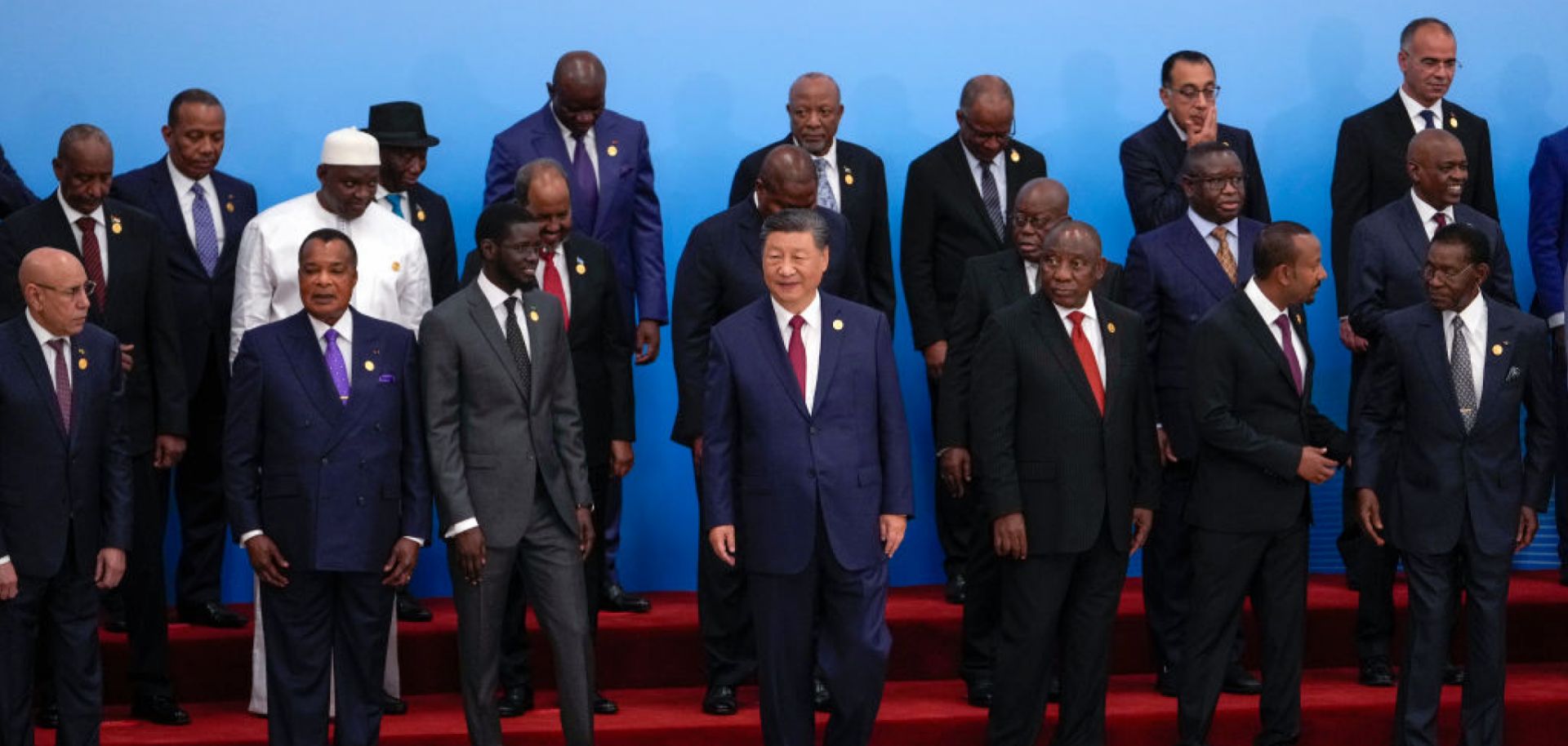
A recent speech by Chinese President Xi Jinping indicates China's long-term commitment to economic engagement with Africa, partly as a hedge against strategic competition with the West. But fiscal and security constraints will limit Beijing's ability to make good on its fiscal pledges to African nations. On Sept. 5, Xi gave a keynote speech in Beijing at the 2024 Forum on China-Africa Cooperation (FOCAC) summit. At this triennial summit, China outlines its plans for engagement with Africa — particularly through the Belt and Road Initiative (BRI), China's program to expand its international trade, political and infrastructure links that started in 2013. During his speech, Xi denigrated Western modernization efforts in the developing world as bringing ''great suffering,'' juxtaposed China's support as providing Africa with a ''new type of international relations'' with ''modernization that suits national conditions,'' and posed China-Africa modernization as a model for the Global South. In addition, Xi laid out a 10-point plan for China-Africa cooperation over the next three years, with a focus on technology, agriculture, trade and transportation infrastructure, as well as humanitarian and security engagement. At the end of his speech, Xi laid out a $51 billion funding pledge, including $30 billion in credit funds, $10 billion in investment by Chinese companies, and $11 billion in ''various types of assistance.''
- In the 10-point plan, Xi pledged to grant ''zero tariff treatment'' to most goods from least developed African countries; build a China-Africa tech cooperation center and 20 digital demonstration projects; implement 30 infrastructure connectivity projects ''to integrate land and sea'' (likely railway and road projects), as well as 1,000 ''livelihood projects'' and 500 ''public welfare'' projects (probably housing, agricultural, and water projects); provide vocational education and build 60,000 workplace training locations; implement 30 clean energy projects and establish a joint nuclear technology forum and 30 joint research labs; and provide $141 million in military assistance, train 6,000 military and 1,000 police personnel, as well as train 500 African officers in China.
- In his speech, Xi also proposed to upgrade all bilateral relations with least-developed African countries to ''strategic relations,'' and to upgrade relations with the continent as a whole to an ''all-weather China-Africa community.'' In Chinese diplomatic parlance, ''all-weather'' is a descriptor that is reserved for China's oldest and most enduring partnerships, like those with Russia and Pakistan. This upgrade to China-Africa ties thus signifies that Beijing sees Africa as a key partner — including in Beijing's economic, military and political competition with the West — for the foreseeable future.
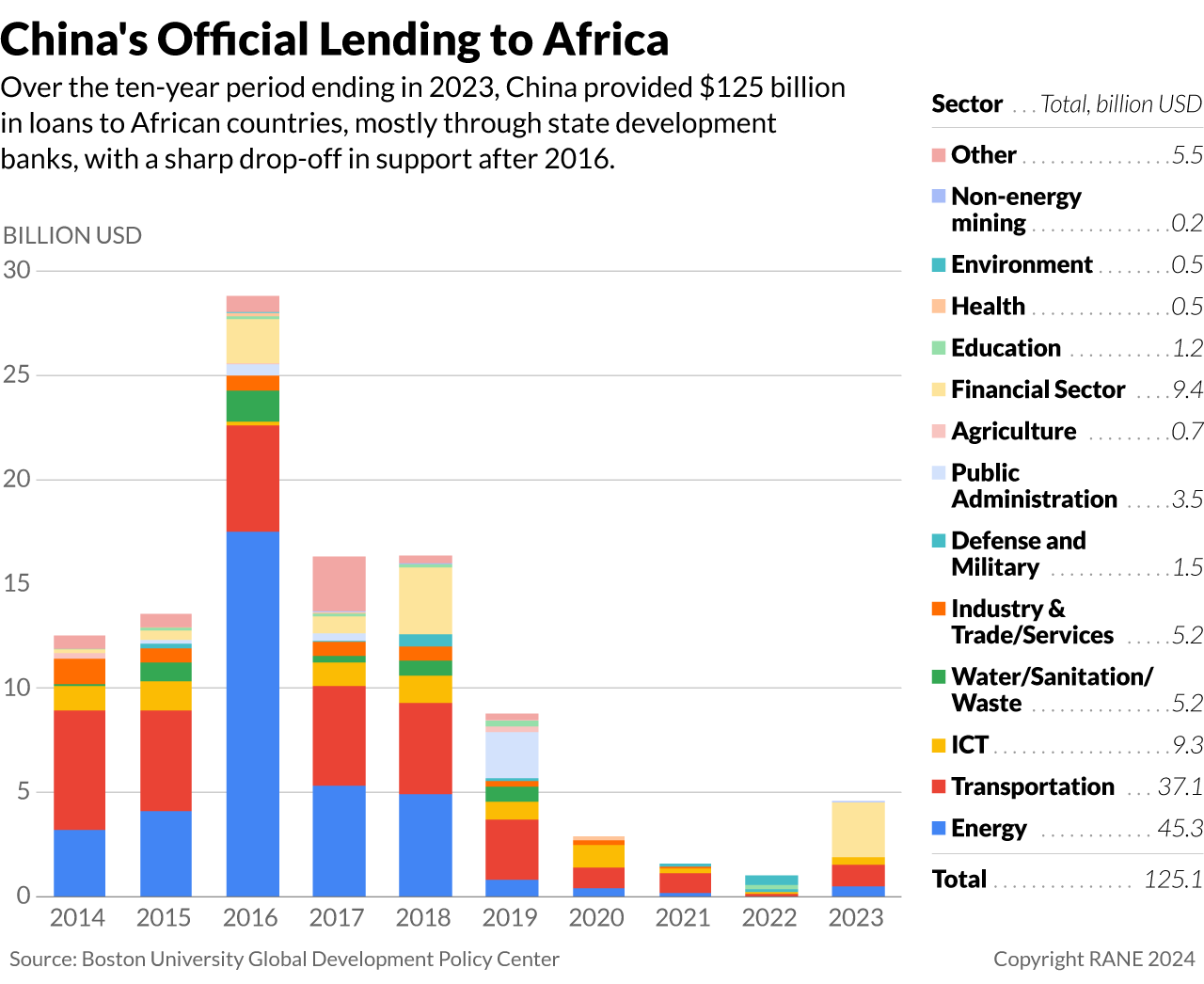
Chinese economic engagement with Africa, including via loans for BRI projects, will likely slowly increase in the coming years, but fiscal and security constraints make a return to the heavy engagement of the mid-2010s highly unlikely. The BRI is Xi's flagship foreign policy initiative, and Beijing is not ignorant of complaints in the United States and Europe — and increasingly Global South countries — that the BRI is either a debt trap or a series of false promises. Thus, partly in an effort to revive the BRI's image, Chinese engagement in Africa from 2024-2026 will likely rise relative to 2021-2023 — a period that overlapped with China's economic and societal struggle against COVID-19, which reduced Chinese foreign engagement overall. In fact, this already seems to be the trend, with Chinese loans to Africa (almost entirely public funds) up from $1 billion in 2022 to $4.6 billion 2023, the highest since 2019. Moreover, a number of the top sectors for development finance support — e.g. telecommunications, green energy, and transportation infrastructure — remain among Beijing's domestic industrial priorities, with the aim being for China to become a global leader in next-generation industries and to ensure future access to industrial inputs that are abundant in Africa, like petroleum products, aluminum and copper. However, there are still significant constraints on China's ability to follow through on its plans for the development of and economic engagement with Africa. First, there is precedent for China significantly underdelivering on financial pledges at previous FOCAC summits, partly because private sector engagement tends to be a tough sell outside of commodity sectors. Second, Chinese lenders and companies will likely take a more conservative approach to development support in the coming years given that a lack of investment opportunities has already caused China's investment in Africa to fall precipitously since its high in 2016, when China provided $26.6 billion in loans. Early BRI engagement led to many incomplete or unprofitable projects while African recipient governments ran into troubles with debt or slowed engagement with BRI projects due to local economic equity concerns. Third, security issues in many African BRI signatory countries, like the Democratic Republic of the Congo, are still significant and China is unwilling to commit militarily beyond hiring private security contractors — who so far have been unable to protect key mining projects — and engaging with U.N. peacekeeping missions.
- Like Xi's 2024 speech, Xi's pledges at the 2021 FOCAC included 10 infrastructure connectivity projects and $40 billion in funds for China-Africa cooperation. However, Chinese loans to Africa (the lion's share of Chinese financial support) in 2021-2023 only totaled $7.2 billion, including $2.1 billion of support for eight transportation projects and $2.6 billion in trade finance, liquidity support and credit lines, according to Boston University's Global Development Policy Center.
Even if it does not match its pledged scale, further Chinese economic engagement with Africa will give Beijing useful near-term influence in international fora, while in the future it will provide Chinese firms with a leg-up on Western competitors in the Global South as Beijing prepares for long-term strategic competition with the West. In the near term, economic engagement with African partners provides China with political cover via diplomatic support statements and votes in favor of China on matters of little direct importance to Africa, like rejecting Western allegations of Chinese human rights violations against minority Muslim Uyghurs in Xinjiang or Western efforts to integrate Taiwan in global fora. Though China remains uninterested in getting militarily entangled in African conflict zones, Beijing highly values military-diplomatic ties and the propagation of Chinese training techniques and political ideals, like ''public stability maintenance'' (e.g. suppressing political opposition) among African security forces as investments in China's long-term political relations on the continent. To this end, Xi's speech shows that China still sees the BRI and FOCAC as vectors to push Chinese diplomatic and political objectives amid its strategic competition with the West. Xi's explicit condemnation of Western development efforts and lauding of China's ''alternative model,'' as well as his characterization of China as a leader of the Global South and an ''all-weather'' partner of Africa, show Beijing's long-term commitment to ideological competition with Western liberal democracies and fostering international acceptance for development models that promote economic growth without democratization. Both in terms of magnitude of trade and consumption of high-end goods, Africa cannot currently make up for the slow erosion of China's trade ties with the United States or Europe, but Beijing is betting that developing regions like Africa, Southeast Asia and Latin America will be much larger consumer markets with greater trade and investment capacities in the coming decades. Thus, another one of Beijing's goals through BRI is to diversify China's trade and investment ties to Africa and other developing regions to make China less vulnerable to strategic competition, especially Western technology restrictions and economic and financial sanctions.
- During the 2019/2020 and 2020/2021 U.N. debate cycles, communiques critical of China on issues like Xinjiang or Taiwan did not receive signatures of support from any African countries. In October 2022, a U.N. Human Rights Council motion to hold a debate on China's human rights activities in Xinjiang was also narrowly rejected (17 in favor, 19 against), with several African nations supporting China.
