
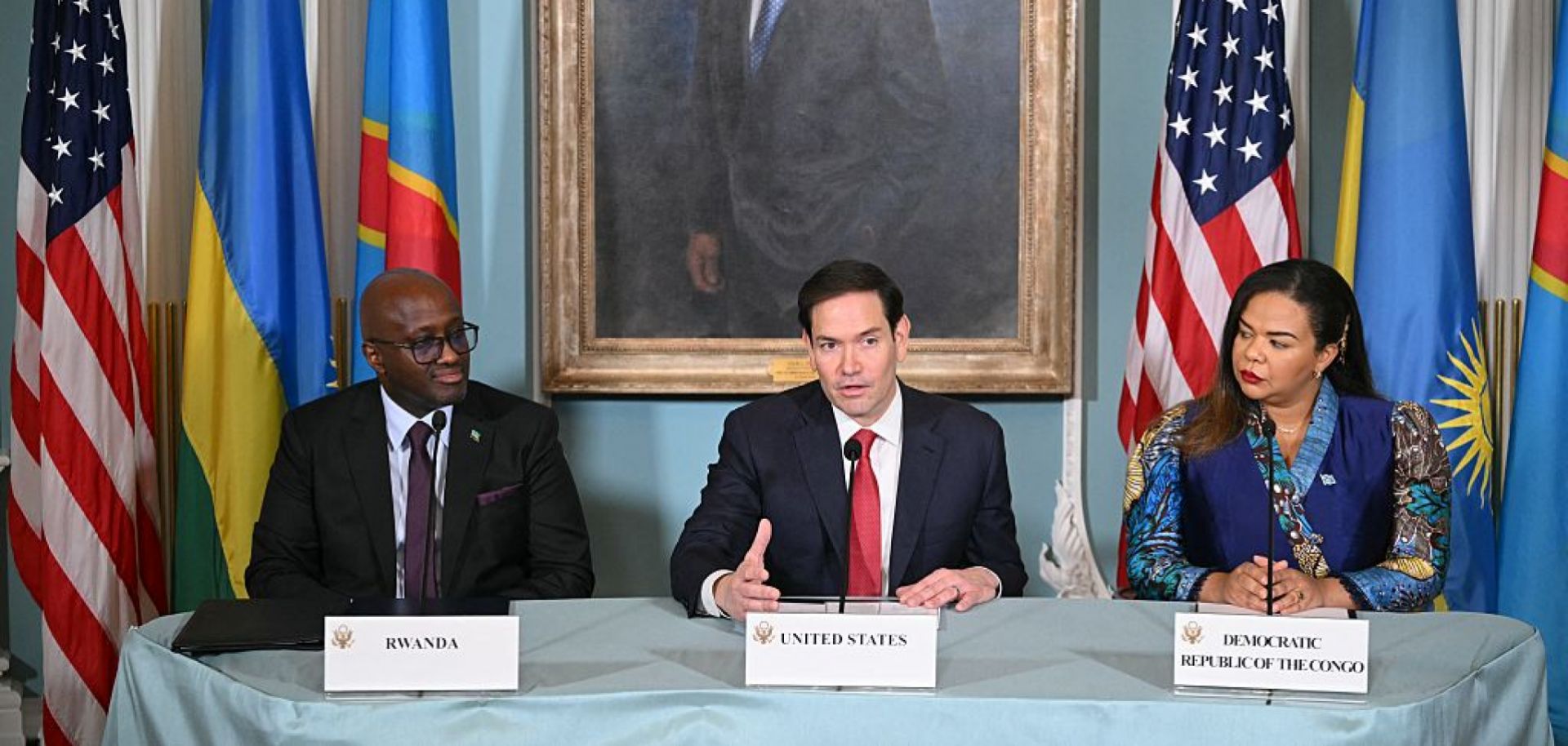
The Congo-Rwanda peace agreement has significant economic upsides for both countries, but full implementation of the deal risks stalling due to disagreements over its interpretation and will likely require progress towards a separate peace agreement between the Congolese government and the Rwandan-backed M23. On June 27, the foreign affairs ministers of the Democratic Republic of the Congo and Rwanda signed a bilateral peace agreement in Washington in the presence of U.S. Secretary of State Marco Rubio. The agreement commits both countries to respecting each other's territorial integrity, including through the disengagement of Rwandan forces from eastern Congo and Congo's neutralization of the radical Hutu group Democratic Forces for the Liberation of Rwanda, or FDLR, many of whose members were involved in the 1994 Rwandan genocide. In practice, both countries agreed not to undermine the other's sovereignty or allow hostile activities against the other's territory, including by "immediately and unconditionally" halting their support to nonstate armed groups, "except as necessary to facilitate implementation" of the peace agreement. Importantly, both countries agreed to launch within three months a regional economic integration framework to formalize and de-risk cross-border mineral value chains under a separate agreement.
- The deal establishes a Joint Security Coordination Mechanism to ensure an "irreversible and verifiable" end to all support for the FDLR and "associated militias" in Congo. Congo and Rwanda also committed to peacefully resolving disputes regarding the deal's implementation through a Joint Oversight Committee, which will include U.S., Qatari and African Union officials.
- The peace agreement includes provisions for reintegrating nonstate armed group fighters into the Congolese military and police, conditional on the "absence of serious violations of international humanitarian law and loyalty to the State and its institutions."
- The agreement commits both parties to advancing the implementation of U.N. Security Council Resolution 2773, which explicitly requires Rwanda to halt its support to the M23 and withdraw its troops from eastern Congo. Estimates from the first half of 2025 suggest that Rwanda has between 7,000 and 12,000 troops in eastern Congo.
- Both Rwanda and Congo can withdraw from the peace agreement by giving six months' notice to the other party.
The agreement reflects the U.S. government's conflict-resolution agenda and Washington's interest in stabilizing Congo to facilitate large-scale U.S. investment in its mineral sector, and will be implemented in stages. Beginning in early April, U.S. President Donald Trump tasked his special adviser, Massad Boulos, with mediating the conflict between Congo and Rwanda. This came just months after the M23 — by and large a proxy of the Rwandan government — captured the cities of Goma and Bukavu in eastern Congo, which effectively compelled Kinshasa to enter talks with the rebels, a long-standing demand from Kigali. U.S. mediation efforts fit within Trump's broader narrative of ending open conflicts, but Washington also likely sees the agreement as a necessary condition for a future minerals deal with Kinshasa to attract U.S. investors in the country's mining sector at scale. The June 27 peace agreement builds on previous initiatives from the African Union and Angola to end the conflict. With the deal now in force, the Rwandan and Congolese governments are scheduled to begin assessing the capabilities and location of the FDLR and associated groups over the next two weeks, following which the Congolese military is due to begin neutralizing them in exchange for Kigali beginning to withdraw its forces from eastern Congo. This second phase is scheduled to last around three months, after which the Congolese and Rwandan governments must determine if the neutralization of the FDLR and withdrawal of Rwandan forces have indeed been implemented. The neutralization of the FDLR is expected to involve a mix of coercive measures and incentives, including "targeted action" against the group and the launch of a demobilization program for FDLR combatants. The phased and conditional withdrawal of Rwandan forces from eastern Congo marks a win for Kigali, as Congolese President Felix Tshisekedi's government insisted until days before the agreement's signing that the latter would involve a preemptive withdrawal of Rwandan forces.
- The Congolese government has been in talks with the Trump administration over a bilateral minerals deal since at least March, when Kinshasa proposed granting the U.S. preferential access to Congo's mineral wealth in exchange for security assistance against the M23.
- In November 2024, Congo and Rwanda agreed to a "concept of operations" outlining the road map for neutralizing the FDLR and withdrawing Rwandan forces.
A likely continuation of clashes between the M23 and Congolese militias, as well as disagreements between Congo and Rwanda, will threaten to stall the implementation of the peace deal, while unlocking the agreement's economic potential will likely require progress toward a separate peace deal between the Congolese government and the M23. Congo and Rwanda must now operationalize the bodies set up in the peace deal, as well as sign a separate agreement to establish a bilateral regional economic integration framework. While the latter has significant upside economic potential, its launch will likely require progress toward the neutralization of the FDLR and the withdrawal of Rwandan troops from eastern Congo, which will prove challenging to implement. First, clashes between Wazalendo militias, which support the Congolese government but operate with significant autonomy, and the M23 will likely continue at least sporadically, keeping mistrust high between Kinshasa and Kigali. Most importantly, the Rwandan government appears likely to demand the neutralization of several Wazalendo militias, as many engage in at least ad-hoc cooperation with the FDLR, while Kinshasa will likely resist these demands. These disagreements mean Rwanda could refuse to withdraw its forces from eastern Congo on the basis that Kinshasa has failed to neutralize certain militias it considers associated with the FDLR, which would threaten to stall the peace deal. Conversely, the Congolese government's decision to crack down on the Wazalendo would expose it to a new insurrection that could enjoy significant popular support. In addition, Kinshasa appears willing to delay signing the regional economic integration framework until the M23, which is not a party to the June 27 peace deal, makes concessions in separate Qatar-mediated peace talks. Negotiations between the two sides have progressed more slowly than U.S.-led mediation efforts due to deep disagreements regarding the control of Goma and Bukavu, amnesty for rebel leaders and the demobilization of the M23. However, a peace deal between the Congolese government and the M23 now appears more likely as the Trump administration pressures both sides, as well as Rwanda, to consolidate its still fragile diplomatic success.
- The regional economic integration framework offers substantial economic opportunities to Congo and Rwanda. By facilitating the de-risking and formalization of mineral trade between the two countries, the framework could attract new investment in Congo's mining sector and mineral processing in Rwanda. Moreover, it would position Rwanda to strengthen its position within the global mineral supply chain by enabling local processing plants to meet eligibility criteria for more international traceability programs for critical minerals.
- On June 20, news outlet Radio France Internationale reported that the White House may host a new summit in July at which Rwandan President Paul Kagame and Congolese President Felix Tshisekedi would sign the peace framework. The same article noted that negotiators were currently seeking to finalize a deal between the Congolese government and the M23 in mid-July.
