
The Democratic Republic of Congo and Rwanda will likely sign a peace agreement in the coming months, along with bilateral mineral deals with the United States, but even if both sides reach a peace deal, its implementation would face major challenges, thus sustaining the prospect of a new military escalation in eastern Congo. On May 21, Senior Adviser to U.S. President Donald Trump, Massad Boulos, said that the United States was in "the process of finalizing" a draft peace agreement between the Democratic Republic of Congo and Rwanda. This came after the foreign ministers of the two neighboring African countries signed a U.S.-mediated Declaration of Principles on April 25 in which Congo and Rwanda made non-binding pledges to refrain from interfering in each other's internal affairs, tackle non-state armed groups and make progress toward a draft peace agreement. Both countries also committed to a "phased regional integration framework" that would ensure "expanded foreign trade and investment." This came as the Congolese government entered direct talks with the Rwanda-backed M23 militant group in April, with both sides jointly committing on April 23 to an "immediate cessation of hostilities" that would "facilitate a broader ceasefire." While skirmishes between the two sides have since continued in eastern Congo, the M23 and the Congolese government's joint statement enabled a reduction in the intensity of clashes in the region and showcased the start of a detente between Kinshasa and Kigali that raises the prospect of the two countries signing a peace deal.
- The M23 is the latest incarnation of Tusti-led and Rwandan-backed insurgencies that have operated in eastern Congo since the 1994 Rwandan genocide. After first emerging in 2012-2013, the M23 resumed its insurgency against the Congolese government in late 2021. Multiple reports from U.N. experts have found that Rwanda has deployed around 4,000 troops in eastern Congo in support of the M23 and provided advanced military equipment to the group, although Kigali publicly denies these accusations to this day.
- On May 6, Rwandan Foreign Affairs Minister Olivier Nduhungirehe said that a peace deal was expected to be signed at the White House in mid-June.
- Congolese officials quoted in a May 25 article published in the Financial Times said a peace deal with Rwanda could be struck "by the end of June."
Progress toward a peace agreement between Congo and Rwanda comes as the M23 has shown signs it might be overextended and Kinshasa has shored up its bargaining power by strengthening ties with the Trump administration. The M23 rapidly expanded its territorial control in eastern Congo between January and March by capturing the cities of Goma and Bukavu, but its progress has since largely ground to a halt. While this can be partly explained by the start of the rainy season in late March — which renders many roads in the region inoperable — the M23 has shown signs that it might be overextended, as seen with its failure to fully secure the Goma-Bukavu axis, where clashes with wazalendo militias still occur. These difficulties likely played an important role in the M23 and Rwanda more seriously considering diplomatic options to lock in their recent gains by having Kinshasa accept the M23's de facto control of Goma and Bukavu, at least temporarily. Moreover, Congolese President Felix Tshisekedi has shored up his bargaining power by strengthening ties with the Trump administration, notably by proposing to strike a bilateral minerals deal that would grant U.S. companies preferential access to Congo's bountiful mineral wealth in exchange for military support, such as the provision of military equipment. Importantly, this rapprochement with the White House has provided space for Tshisekedi to depart from his previous stance of refusing to hold direct talks with the M23, which is one of Rwanda's key conditions for a peace agreement. Moreover, Tshisekedi's strengthening ties with Washington have also raised the prospect of further U.S. economic retaliation against Rwanda should the White House deem Kigali uncooperative. This has likely prompted Rwandan President Paul Kagame and the M23 to, at least temporarily, halt their pursuit of more maximalist objectives in Congo — such as advancing toward central or southern Congo — and put a greater emphasis on reinforcing ties with the United States by, for example, making progress toward a peace deal with Kinshasa, offering to take migrants entering the United States, and striking a U.S.-Rwanda minerals deal.
- The Congolese government's decision to close all banking services in M23-held territory in late January 2025 has resulted in major cash shortages and rising inflation in those territories. This has led to surging poverty levels and fuelled already worsening insecurity in Goma and Bukavu, where the M23 only maintained a light security presence due to the concentration of its forces on military operations.
- On April 17, Reuters reported that the founder of U.S. private military company Blackwater, now known as Constellis, and Trump ally Erik Prince had agreed to help the Congolese government secure mining revenue and crack down on cross-border smuggling. This agreement could be expanded on the back of a U.S.-Congo minerals deal.
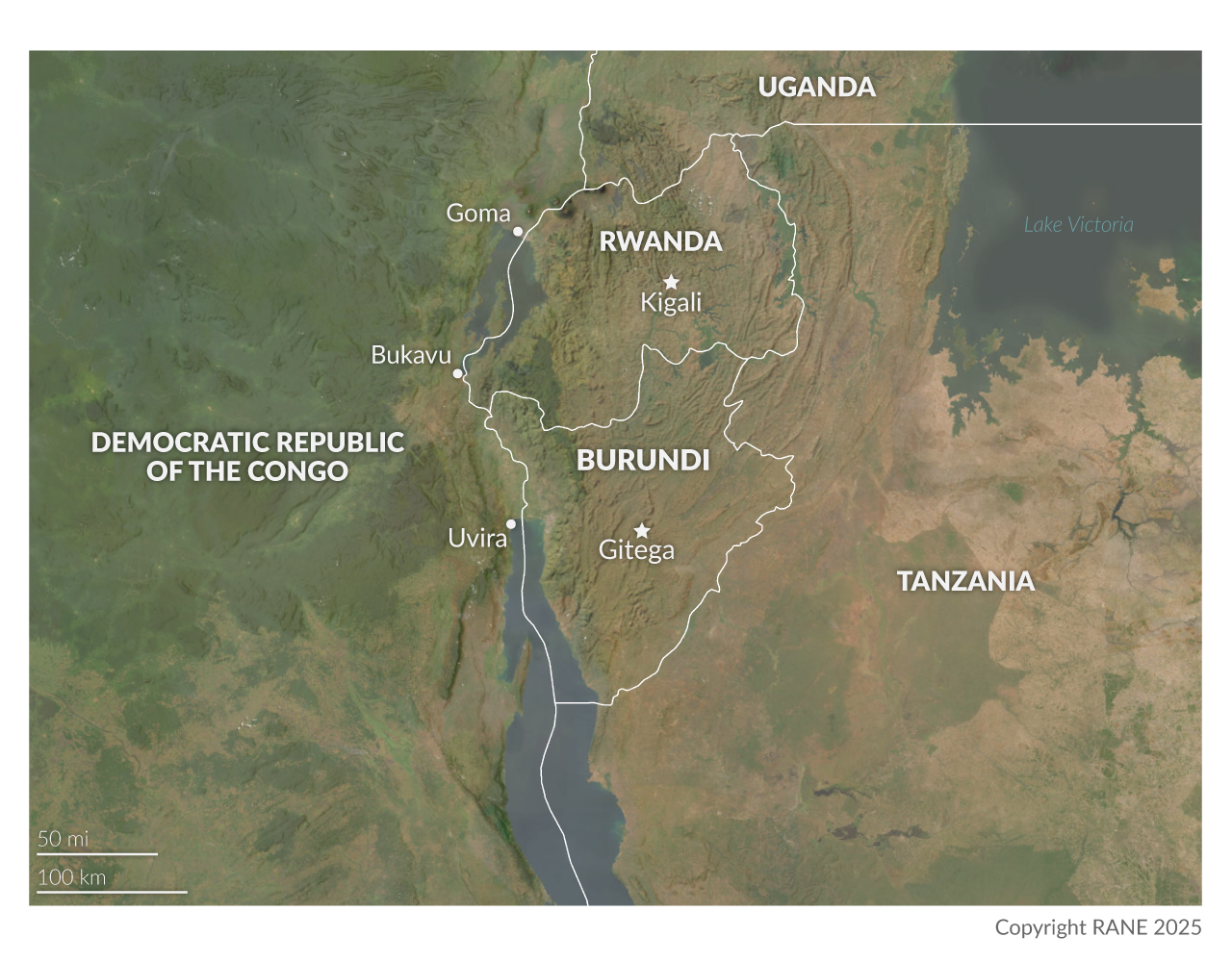
Recent progress in negotiations and pressure from the Trump administration suggest that Congo and Rwanda will likely sign a peace agreement in the coming months, which will be accompanied by both countries striking mineral deals with the United States that grant U.S. firms preferential investment terms in their mining industries. Comments from U.S., Congolese and Rwandan officials suggest that a Congo-Rwanda peace deal is possible as early as June. Such an agreement would likely include provisions stipulating that Rwanda end its military presence in eastern Congo under the condition that Kinshasa cracks down on radical Hutu groups in the region and advances negotiations with the M23 toward a separate peace deal. Moreover, Trump adviser Massad Boulos said that the signing ceremony of a Congo-Rwanda peace deal would be accompanied by both countries signing bilateral minerals agreements with the United States on the same day. Congo's minerals deal will likely grant U.S. firms preferential access to the country's vast mineral wealth, which includes the bulk of global cobalt production, as well as copper, coltan, uranium, lithium, manganese and rare earth elements. As for a U.S.-Rwanda minerals deal, the Trump administration appears intent on securing preferential terms for U.S. companies to invest in Rwanda's mineral processing sector, as well as formalizing much of the illicit mineral trade that runs from Congo to Rwanda. However, it will prove politically challenging for Congolese President Tshisekedi to accept such a dispensation, as it would reinforce widespread domestic narratives that Rwanda is exploiting Congo's mineral wealth to its own advantage, given that such a deal would enable Kigali to secure much of the revenue derived from value-addition. Together with likely disagreements between Kinshasa and Kigali regarding certain clauses within a hypothetical peace deal, such as on the timeline or the conditions for Rwanda to withdraw its forces, this could delay the June-July timeline for a peace agreement. Nonetheless, Rwanda and Congo currently still appear likely to ultimately reach an agreement in the next several months, given both sides' limited ability to resist pressure from the Trump administration.
- On May 1, Boulos said that Rwanda's mining sector presented "a lot" of potential regarding mineral processing and refining activities. This came as the April 25 Declaration of Principles saw both Congo and Rwanda commit to "licit end-to-end mineral value chains (from mine to processed metal) that link both countries, in partnership with the U.S. government and U.S. investors."
- Congolese officials quoted in a May 25 Financial Times article said they will oppose Rwanda's involvement in Congo's mining sector so long as the M23 and the Rwandan military remain present in eastern Congo.
If a Congo-Rwanda peace agreement is signed, its implementation will face major challenges due to high mistrust between the two countries, a likely continuation of clashes between the M23 and wazalendo militias, and the elevated risk of a deadlock in talks between the M23 and the Congolese government, which will sustain the risk of a new military escalation in eastern Congo in the second half of 2025. A first challenge to the implementation of a Congo-Rwanda peace deal will be the likely continuation of clashes in eastern Congo between pro-government forces and the M23. While a peace deal may be accompanied by the announcement of a consolidated ceasefire between the Congolese government and the M23, wazalendo militias would be unlikely to fully comply with it. This will likely result in sustained clashes in eastern Congo that could collapse a hypothetical ceasefire by prompting the M23 to accuse the Congolese government of ceasefire violations — or vice versa. In addition to threatening a fresh military escalation in eastern Congo, offensive operations by wazalendo militias could prompt Rwanda to pause the withdrawal of troops from the region — which would likely be a condition of any peace deal — on the basis that Kinshasa is not abiding by the provisions of the deal. Securing an agreement between the Congolese government and the M23 will also prove challenging due to high levels of mistrust and disputes over key issues, such as the control of Goma and Bukavu, amnesty for rebel leaders and the demobilization of the M23, which will be major sticking points. The M23 has continued to question Tshisekedi's legitimacy, and the rebel group's apparent rapprochement with his archrival, former Congolese President Joseph Kabila, will only exacerbate tensions between the two sides. Taken together, this raises the prospect of a deadlock in talks between the Congolese government and the M23, which will, in turn, sustain the possibility for a new military escalation in eastern Congo in the second half of 2025, even if Congo and Rwanda sign a peace agreement.
