
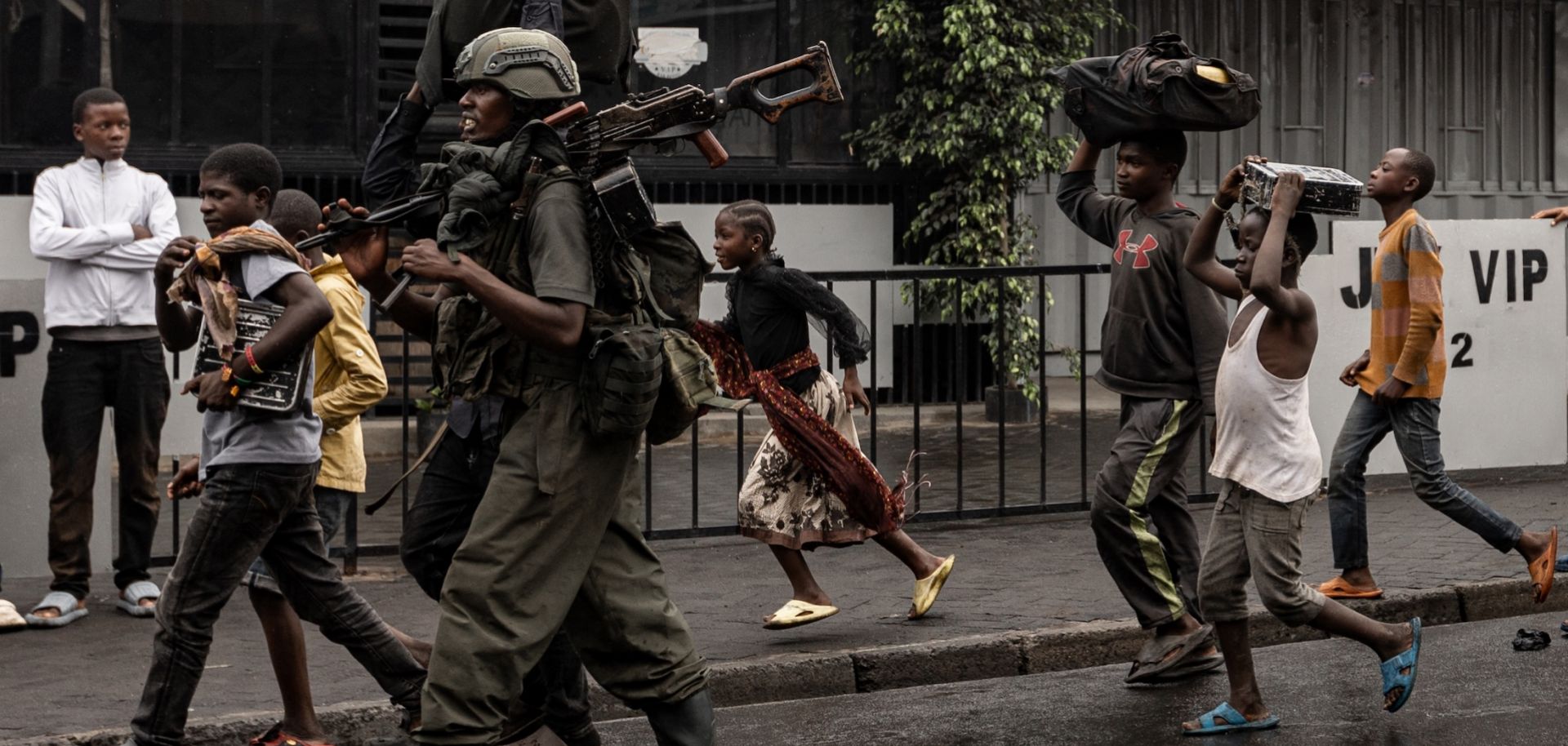
In the Democratic Republic of the Congo, M23 rebels' entry into Goma will intensify pressure on President Felix Tshisekedi to engage in talks with the Rwanda-backed group, potentially triggering a political crisis in Kinshasa; but if Tshisekedi instead maintains his stance against negotiations with the group, the conflict could geographically expand and potentially trigger a direct military confrontation with Rwanda. On the night of Jan. 26-27, the Rwandan-backed M23 rebel alliance entered Goma, the provincial capital of Congo's eastern North Kivu province, after effectively besieging the city and capturing the nearby strategic towns of Sake and Minova. According to local reports, Rwandan special forces have been deployed to parts of Goma, where Congolese forces have also allegedly begun surrendering to the M23. However, the situation in the city remains volatile, with Congolese and Rwandan soldiers reportedly clashing near the two countries' shared border on Jan. 27. The M23's rapid advance toward Goma prompted the Congolese government to call for an emergency meeting of the U.N. Security Council on Jan. 26, during which Congolese Foreign Minister Therese Kayikwamba accused Rwanda of sending additional troops to support the M23 offensive in what she said was tantamount to a ''declaration of war.'' Amid the rapid escalation of tensions between Congo and Rwanda, Kenyan President William Ruto, who chairs the East African Community (EAC), announced on Jan. 26 that the EAC would hold an emergency summit within 48 hours, stating that both Congolese President Tshisekedi and his Rwandan counterpart Paul Kagame had agreed to partake in the meeting. However, a spokesperson for the Congolese president told news outlet Jeune Afrique that Tshisekedi ''could not'' take part in the summit given developments on the ground. Following reports of the rebels' entry into Goma, anti-M23 demonstrations have erupted in Kinshasa, the Congolese capital, and Bukavu, the capital of the eastern South Kivu province.
- On Jan. 25, Congo severed diplomatic ties with Rwanda and gave 48 hours for Rwandan diplomatic personnel to leave the country, after a spokesperson for the Congolese military accused Rwandan snipers of killing North Kivu governor Peter Cirimwami on Jan. 24 near Sake.
- The M23's advance toward Goma killed at least six U.N. peacekeepers and seven South African soldiers deployed in Congo under the Southern African Development Community (SADC) mission. The U.N. peacekeeping mission in eastern Congo began in 1999, while the SADC mission, which mostly involves military personnel from South Africa, Malawi and Tanzania, began in December 2023.
- U.N. sources told Jeune Afrique that at least 500 Congolese soldiers had surrendered to the United Nations at the M23's request. But continued gunfire exchanges in Goma in the afternoon of Jan. 27 suggest not all Congolese forces in the city have surrendered.
The M23's entry into Goma follows the collapse of Angolan-led peace talks between Rwanda and Congo in December, which Rwanda has blamed on Congo's refusal to enter direct negotiations with the M23. Following a first rebellion in 2012-2013, the M23 took up arms once again against the Congolese government in late 2021, claiming to protect Tutsi communities in eastern Congo. Since then, the M23 has consolidated control over large swaths of the North Kivu province, with Congo accusing Rwanda of directly supporting the rebel group. While Kigali has rejected these accusations, U.N. reports found that Rwanda has deployed around 4,000 troops to eastern Congo, including special forces. Despite this, Angolan-led mediation efforts between the two countries made progress in the second half of 2024, with Angola brokering a ceasefire in July 2024 and the two sides making strides toward an agreement that would have seen Rwanda withdraw its forces from eastern Congo in exchange for Kinshasa cracking down on the radical Hutu Democratic Forces for the Liberation of Rwanda, or FDLR. However, talks collapsed in December 2024 after Kagame pulled out of a scheduled meeting with Tshisekedi at the last minute, citing Kinshasa's alleged reneging of pledges to hold direct talks with the M23. This was strongly rejected by Congolese officials, who accused Rwanda of moving the goalpost and reiterated their refusal to engage in direct negotiations with the M23 due to the group's status as a Rwandan proxy. Since the stalling of Angolan-led mediation efforts, the M23 has expanded offensive operations, making further territorial gains that have hampered Congolese military morale. Against this backdrop, the group announced on Jan. 24 that it aimed to seize Goma, which marked a sharp escalation of the M23's stated objectives and raises the risk of a severe military escalation in the region.
- In December 2023, the M23 formed a partnership with the Alliance for the Congo River, or AFC. Unlike the M23, the AFC is a political coalition with objectives that expand beyond eastern Congo, and notably involve removing Tshisekedi from power.
For the Congolese government, entering talks with the M23 may result in a pause in fighting, but it would also risk triggering protests in Kinshasa, fracturing the ruling coalition and increasing the likelihood of a military coup. The M23's entry into Goma will exacerbate already high anti-Rwandan sentiment in Congo. This will put Tshisekedi under severe political pressure amid calls for retribution against Kigali from the public and parts of the political establishment. However, the Congolese military's low morale, poor logistics and limited resources will constrain his government's ability to kinetically retaliate against Rwanda for backing the M23. This means that Kinshasa may still consider diplomatic options, which could involve leveraging Western pressure on Rwanda to secure the M23's withdrawal from Goma and nearby areas. However, the M23 will likely condition pausing further offensives and any hypothetical exit from Goma on starting negotiations with the Congolese government for political representation in eastern Congo. Moreover, it remains unclear whether Western countries will be willing to impose maximum pressure on Rwanda, given the United States' limited interest in the conflict under President Donald Trump and Kigali's growing importance in peacekeeping efforts across Africa. This puts Tshisekedi in a no-win situation by forcing him to choose between reneging on his key pledge to not hold talks with the M23 or maintaining his current stance at the risk of allowing the rebel group to make further advances in eastern Congo. If Tshisekedi agrees to initiate negotiations with the M23 in exchange for a pause in fighting, it would likely undermine his domestic legitimacy and risk triggering anti-government protests in Kinshasa that could turn violent. Such a decision would also prove unpopular within Tshisekedi's ruling Sacred Union coalition, which could prompt certain factions to distance themselves from Tshisekedi and potentially even halt their support to his government. In turn, severe unrest in Kinshasa and/or a fracturing of the ruling coalition could prompt the M23 to further expand its control over eastern Congo. Moreover, a severe political crisis in Congo would risk laying the groundwork for an eventual military coup, which could see Tshisekedi's government replaced with a new junta that either reaches a settlement with the M23 or escalates the conflict with Rwanda.
- Although Tshisekedi won Congo's December 2023 presidential election with over 70% of the vote, his Union for Democracy and Social Progress party only secured 69 out of 500 seats in the legislative election, making him heavily reliant on other parties within his Sacred Union coalition, which regroups over 35 parties, to govern.
- Talks between the Congolese government and the M23 could result in M23 members being integrated into eastern Congo's local administration. This would likely entrench the group's control over the trade of the region's minerals, including tin, tantalum and tungsten, which are critical components in electronic goods. While it cannot be ruled out that the group would press for the region's independence, the M23's status as a Rwandan proxy means that such a move would come at a high cost for Rwanda, making such a scenario less likely as it would threaten to result in Kigali facing cuts to foreign aid and economic sanctions.
- In late 2012, the M23 seized Goma for 10 days before unilaterally withdrawing from the city due to Western pressure.
If Tshisekedi rejects talks with the M23 and leverages nationalistic sentiment to shield himself from domestic political pressure, it would portend a geographical expansion of M23 offensives and open the door to a direct military confrontation with Rwanda. Despite the Congolese military's apparent setback in Goma, Tshiskedi may continue to refuse to initiate talks with the M23. Such a move would be aimed at mitigating threats to his domestic political legitimacy, though Tshisekedi's position will remain fragile, especially if his government fails to halt further M23 offensives. To that end, the Congolese government could launch limited air and/or artillery strikes inside Rwanda to shore up support from the Congolese public and pressure Rwanda to halt the M23's advance. However, this could prompt Kigali to further increase its military support to the M23, which would raise the prospect of a severe military escalation between the two countries that could result in Congo formally declaring war on Rwanda in a less likely, high-impact scenario. Even if a direct military confrontation is avoided, Kinshasa's continued refusal to enter talks with the M23 would portend a geographical expansion of rebel offensives as the group would be able to redeploy a significant number of troops to other fronts against Congolese forces. While the M23 may halt a major offensive in the immediate future as it consolidates control over Goma, the group may eventually launch a fresh thrust into Congo's South Kivu province that could again result in the M23 making rapid territorial gains, given the Congolese military's low morale.
- In December 2023, Tshisekedi publicly stated that he would declare war on Rwanda and ''march on Kigali'' if the country continued to support M23 advances in eastern Congo.
