
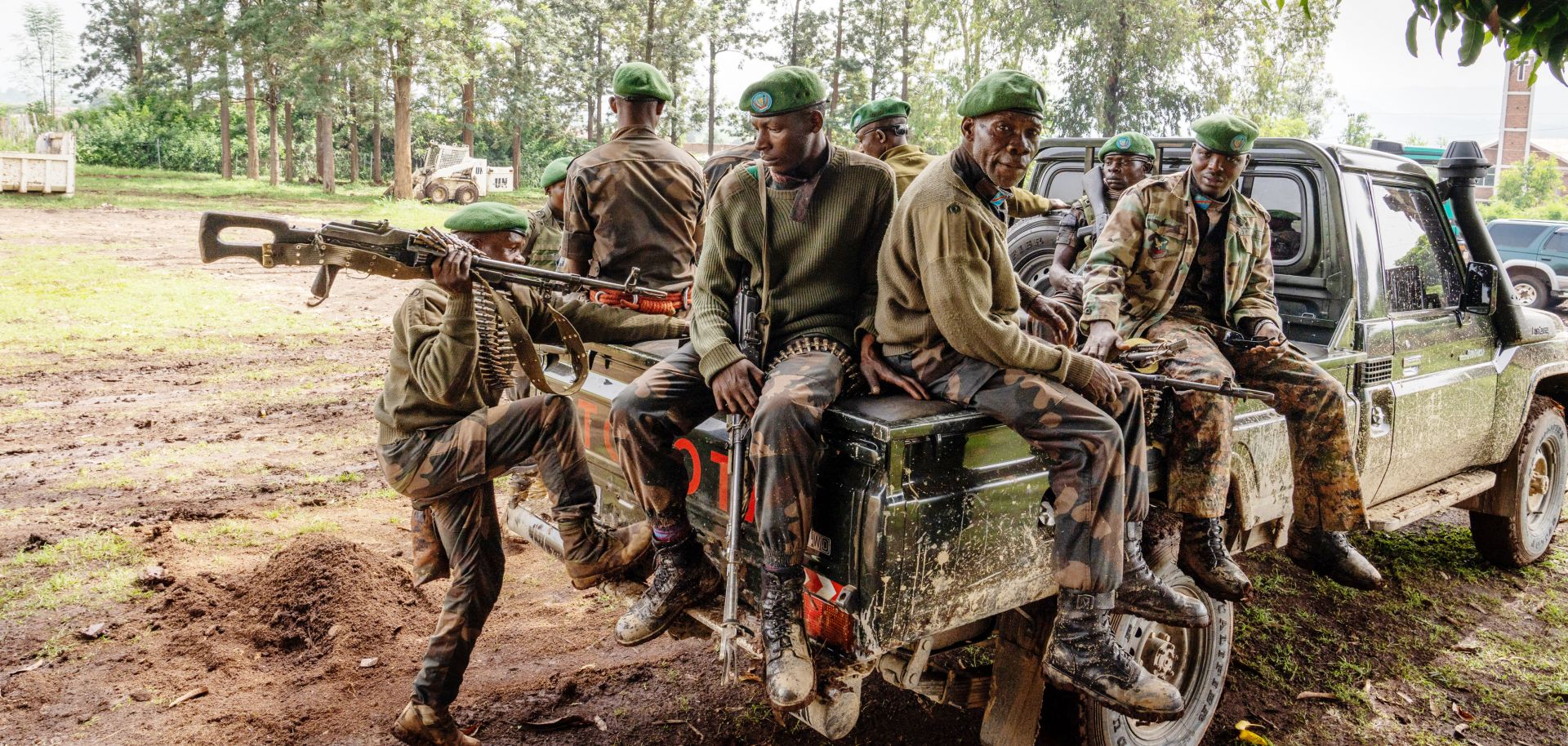
The continuation of intense fighting in eastern Congo could prompt a military escalation between Congo and Rwanda that would threaten to splinter Congolese President Felix Tshisekedi's ruling coalition, while providing opportunities for unrest to emerge in the country's mineral-rich Katanga region. On April 1, President Tshisekedi appointed Judith Suminwa Tuluka as prime minister. Tuluka's appointment comes as Tshisekedi secured reelection for a second term in Congo's contested December 2023 presidential election, which most outside observers concluded was marred with significant irregularities. But while official results saw Tshisekedi secure the presidency in a landslide, his Union for Democracy and Social Progress (UDPS) party only secured 69 out of 500 seats in the legislative elections, making Tshisekedi heavily reliant on other parties within his Sacred Union coalition, which regroups over 35 parties, to govern. In this context, Tshisekedi's appointment of Tuluka — a UDPS member who is widely considered to be a Tshisekedi loyalist — can be understood as the Congolese president looking to avoid potential frictions with his premier, as he tries to strengthen his command over the fractious Sacred Union coalition, at a time when the Congolese government is facing heightened political pressure amid an intensification of fighting in the country's east.
- According to official results, Tshisekedi secured 73.47% of votes in Congo's December 2023 presidential election, with his main opponents Moise Katumbi and Martin Fayulu securing 18.32 and 4.32% of votes, respectively. Turnout stood at 42.65%.
Tuluka's appointment comes amid an intensification of fighting in eastern Congo between pro-government forces and Rwandan-backed M23 rebels, which has been leveraged by allies of former President Joseph Kabila to push back against Tshisekedi's consolidation of power. Following an eight-year truce, fighting resumed between M23 rebels and the Congolese government in November 2021. Amid a string of military setbacks, the Congolese government quickly blamed Rwanda for supporting the group, which heightened tensions between the two countries. Separately, Tshisekedi's government reinforced its military cooperation with a myriad of militias known as ''wazalendo'' to resist further M23 advances, including with the radical Hutu Democratic Forces for the Liberation of Rwanda (FDLR). Although a truce was agreed to in December 2023, fighting between the two sides has intensified in recent months amid the M23's offensive toward the strategically-located town of Sake. Further compounding Tshisekedi's challenges has been the December 2023 formation of the Alliance of the Congo River (known by its French acronym, the AFC), which struck a partnership with the M23 with the explicit aim of toppling the Congolese government. Importantly, the AFC was formed by allies of former President Kabila, which has prompted UDPS cadres to blame Kabila for supporting the M23. While these claims are questionable, Kabila allies' rallying of the AFC is significant and likely comes in response to Tshisekedi sidelining the former president's largely Katangan entourage since the end of his coalition with Kabila's People's Party for Reconstruction and Democracy, or PPRD, in 2020.
- According to Western intelligence sources, Rwanda has deployed around 3,000 troops in eastern Congo to support the M23 as of early 2024, and is providing training and advanced weaponry to the rebel group.
- Wazalendo militias include vigilante and former rebel groups with strong anti-Rwandan sentiment that have sided with the government amid the M23's military advances. The Congolese military has provided financial assistance, training and military equipment to wazalendo militias.
- In August 2023, the Southern African Development Community agreed to deploy a 7,000-strong force to eastern Congo composed of South African, Tanzanian and Malawian troops. South Africa confirmed that it would deploy 2,900 troops in February.
- On March 28, three PPRD cadres appeared at an M23 meeting in the locality of Kiwanja, North Kivu. Nonetheless, PPRD chair Ferdinand Kambere has denied any links between Kabila's party and the AFC.
Despite Angolan-led mediation efforts, intense fighting between the M23 and pro-government forces will likely persist in the coming months, raising the risk of border skirmishes between Congo and Rwanda. While the Congolese army command publicly prohibited contact with the FDLR in November 2023, the Congolese military has become increasingly reliant on wazalendo militias in countering the M23 since the latter's offensive in February. Given these groups' strongly anti-Rwandan views, Kigali will likely sustain its military support to the M23, which appears to have grown in recent months and has enabled the rebel group to impose a de facto land siege on North Kivu's regional capital of Goma. Amid growing concerns of a broader escalation, Angolan-led mediation efforts secured an agreement between Tshisekedi and his Rwandan counterpart, Paul Kagame, to meet. However, Tshisekedi's insistence that Rwandan troops first withdraw from eastern Congo means de-escalation talks could face significant delays, as Rwanda continues to deny the presence of Rwandan security forces in the region. Intense fighting in North Kivu between pro-government forces and the M23 thus appears likely to persist in the short term, which, in turn, will raise the prospect of border skirmishes between Congo and Rwanda — likely due to Congolese soldiers or militiamen acting outside of the country's chain of command or accidentally crossing the border. Even if Tshisekedi and Kagame reach a de-escalation agreement, it would prove challenging to implement given Congo and Rwanda's lack of direct control over wazalendo militias and the M23, likely resulting in a continuation of clashes.
- While the Congolese military deployed three Chinese-made CH-4B attack drones to Goma in November 2023, the drones are now all defunct. Two of the drones were successfully shot down by the M23, which recently acquired WZ-551 infantry vehicles equipped with surface-to-air missiles, most likely from Rwanda.
- Congo accused Rwanda of launching drone strikes on Feb.16-17 on the Goma airport. While Rwanda did not claim responsibility for the attack, it thereafter publicly stressed that it reserved the right to take ''any legitimate measure'' to defend itself, including degrading offensive air capabilities within Congo.
- Following a Feb. 27 meeting with Angolan President Joao Lourenco, Tshisekedi agreed to meet Kagame on the condition that Rwanda withdraw its troops from eastern Congo and that M23 fighters resettle into government-approved military garrisons.
High-profile border incidents between Congo and Rwanda will risk triggering a military escalation, and Tshisekedi's failure to retaliate accordingly in the eyes of the Congolese public would threaten to splinter his ruling coalition. Despite several border incidents occurring with neighboring Rwanda over the last two years, Congo has so far shown caution by not kinetically retaliating against its eastern neighbor. However, the ongoing departure of U.N. peacekeepers means that Tshisekedi now has few scapegoats on which to divert public discontent over the Congolese military's continued setbacks against the M23. If ongoing clashes between pro-government forces and M23 rebels result in a high-profile border incident with Rwanda, it would likely cause an uproar from the Congolese public, which would risk compelling the Congolese government to kinetically retaliate — especially if Tshisekedi faces pressure from members of his own Sacred Union coalition, some of whom would likely capitalize on the consequent upsurge in anti-Rwandan sentiment to further their own political careers and call for a military response. Congo's military response would likely be restricted to cross-border shellings and/or limited incursions into Rwandan territory at first, but this will still risk triggering a tit-for-tat escalation cycle that could devolve into a broader conflict between Congo and Rwanda. Conversely, if Tshisekedi refuses to retaliate against a border incident with Rwanda, it would threaten to undermine his power base, and portend heightened political instability in Kinshasa as Sacred Union members could exit the ruling coalition over Tshisekedi's alleged failure to defend the country from perceived Rwandan aggression.
- U.N. peacekeepers, which have been present in eastern Congo since 1999, began a phased withdrawal from the region in March and are due to leave the country by the end of 2024. This followed demands by Tshisekedi for the United Nations to leave the country amid growing discontent from the Congolese public over the peacekeepers' failure to stamp out M23 rebels.
A military escalation between Congo and Rwanda would increase pressure on the European Union to pause funding to Kigali's military mission in Mozambique, while the resulting political turmoil in Kinshasa would threaten to disrupt Congo's cobalt exports. Congo will likely seek to avoid triggering a full-blown war with Rwanda, as this would likely result in major setbacks for the Congolese military that would threaten Tshisekedi's hold on power. But even if a full-blow war is averted, a military escalation would likely damage Rwanda's international reputation by highlighting Kigali's involvement in eastern Congo's ongoing conflict. This could, in turn, prompt the European Union to pause the release of additional funding aimed at supporting Rwanda's military mission in northern Mozambique, which would curb Rwanda's ability to expand operations against Islamic State militants in the Cabo Delgado region amid the departure of Southern African Development Community forces. As for Congo, Tshisekedi's failure to either respond to Rwandan-provoked border skirmishes accordingly or emerge from a military escalation without losing face would risk triggering a mass exodus of lawmakers from Tshisekedi's Sacred Union coalition, which could result in legislative gridlock in Kinshasa. Strong public backlash against Tshisekedi would also likely spur large-scale anti-government protests in Congo, especially in the country's cobalt-rich Katanga region, where the AFC and other opposition groups enjoy significant support. While Tshisekedi would likely try to violently crack down on such protests, heightened political tensions in Katanga would risk disrupting Congo's crucial cobalt exports, which comprised over 70% of global demand as of 2022.
- Highlighting growing tensions in Katanga, Chief of Staff of the Congolese military Christian Tshiwewe announced on April 15 the arrest of an unspecified number of army officers in Lubumbashi, the capital of the Haut-Katanga province.
- While Tshisekedi won the December 2023 presidential election in a landslide, Katanga's four provinces of Haut-Lomami, Tanganyika, Lualaba and Haut-Katanga massively backed opposition candidate Moise Katumbi. While Tshisekedi secured 73% of the nationwide vote, he secured only 10% to 32% in these four provinces.
- Congo is by far the world's largest producer of cobalt, which is a key component in the lithium-ion batteries used to power electric vehicles. Disruptions to the country's cobalt exports would thus risk causing a surge in cobalt prices that would hamper the global energy transition.
