
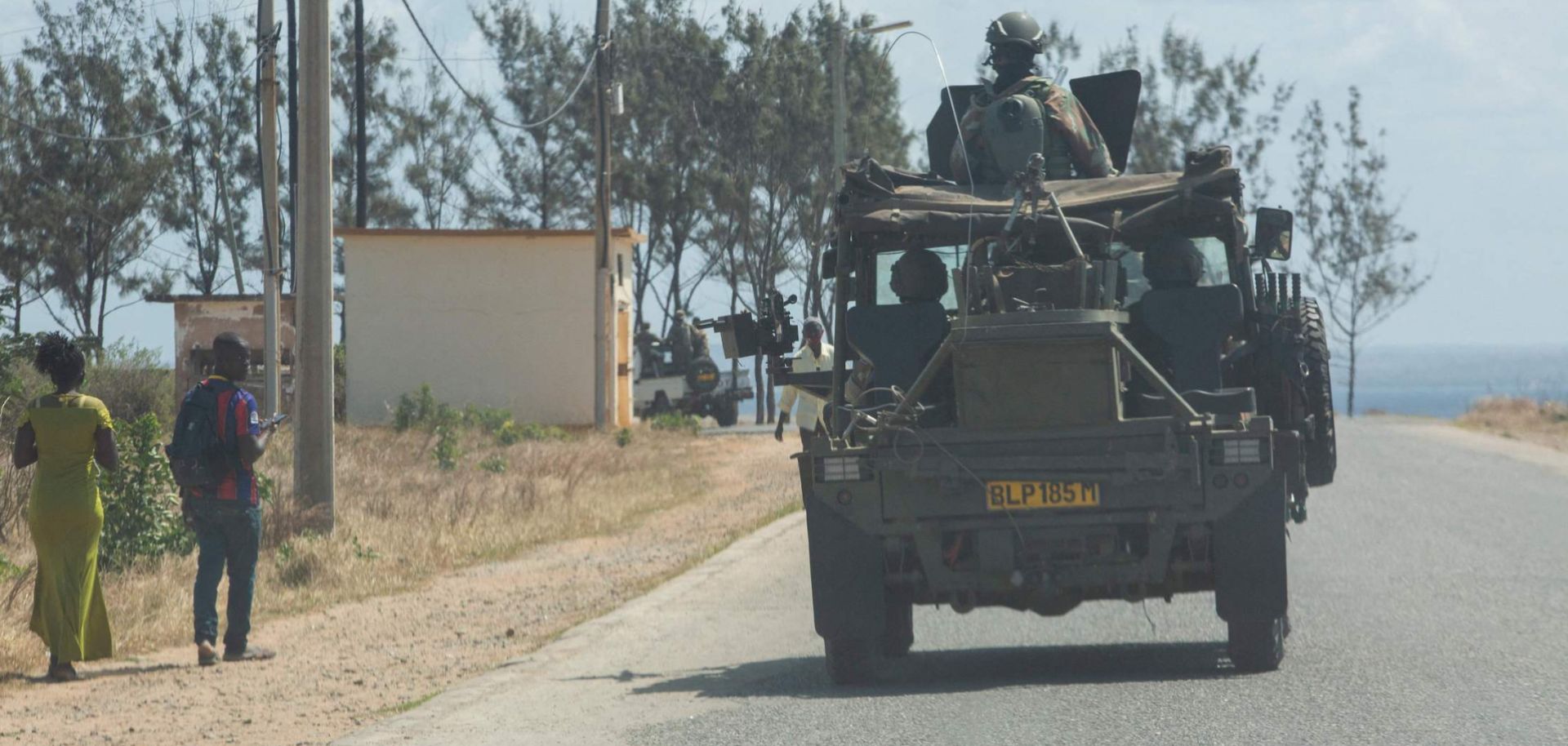
A military convoy from a multinational intervention force on Aug. 5, 2021, in Pemba, Mozambique.
Editor's Note: This security-focused assessment is one of many such analyses found at Stratfor Threat Lens, a unique protective intelligence product designed with corporate security leaders in mind. Threat Lens enables industry professionals and organizations to anticipate, identify, measure and mitigate emerging threats to people, assets and intellectual property the world over. Threat Lens is the only unified solution that analyzes and forecasts security risk from a holistic perspective, bringing all the most relevant global insights into a single, interactive threat dashboard.
Mozambican and Rwandan forces on Aug. 8 captured the strategic port town of Mocimboa da Praia in Mozambique's northern province of Cabo Delgado from the Islamic State-backed Ahlu Sunnah Waljamaah (ASWJ), Reuters reported Aug. 8. The capture of ASWJ's stronghold comes a month after Rwandan forces arrived in Mozambique. Meanwhile, the Southern African Development Community's (SADC) military intervention, which is separate from non-SADC member Rwanda's intervention, continues to scale up. Mozambican President Filipe Nyusi and Botswanan President Mokgweetsi Masisi on Aug. 9 formally launched the SADC Mission in Mozambique, which includes plans to deploy at least 2,100 troops to the country.
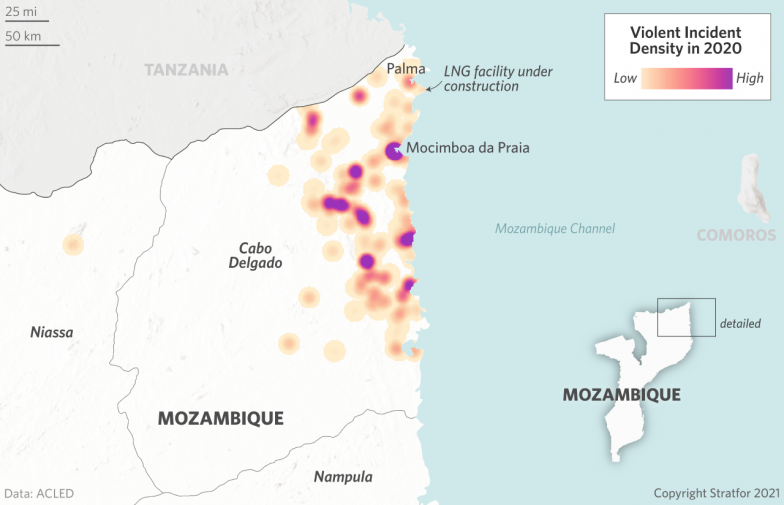
The quick capture of Mocimboa da Praia, a town that ASWJ captured in August 2020 and used as a base of operations, highlights Rwanda's and Mozambique's military superiority in a conventional fight with the militants, many of whom appear to have fled the town ahead of the arrival of the more well-equipped and -trained soldiers. The Rwandan and Mozambique personnel, as well as the SADC's forces once they are fully deployed, have significantly more training; equipment; and intelligence, surveillance and reconnaissance capabilities than ASWJ militants. These qualities would be on display in a conventional fight in an urban environment, like Mocimboa da Praia. In recognition of this, many ASWJ fighters appear to have withdrawn to more densely forested areas outside of Mocimboa da Praia, where they will likely transition their operations to more of a guerrilla-style insurgency. Such a strategy would be a repeat for ASWJ, which withdrew from Palma after seizing the northern Cabo Delgado town in March and forcing TotalEnergies to suspend construction on a nearby natural gas export project.
The intervention's quick success is a necessary step for foreign oil companies to resume activities in Cabo Delgado, where TotalEnergies and ExxonMobil are planning liquefied natural gas export facilities on the Afungi Peninsula. Total has said the next month that the project was delayed "at least a year," and that it will only resume activities once the security situation improves around the site without providing a timetable. In a best-case scenario involving further gains by the SADC, that might happen sometime during the first half of 2022. Oil companies are likely to wait to see the militants' next move before proceeding. If new guerrilla-style attacks mainly occur far from energy interests, company operations may resume. Mozambican and allied forces are likely to concentrate on consolidating control over sites like an LNG plant, and while they may harden the perimeter, doing so risks alienating local populations. This will prove especially true if the intervention is perceived as focusing on protecting installations that primarily benefit foreign interests while militants continue to carry out deadly attacks on rural villages.
The next stage for Mozambique and its allies will be consolidating control over the towns and villages surrounding Mocimboa da Praia before pressing northward and southward into the countryside, where ASWJ militants can still operate relatively freely. Although Mozambique, Rwanda and the SADC will probably be able to capture nearby smaller towns and villages, they will likely struggle to prevent ASWJ from launching insurgent attacks on both civilians and troops deployed to the region due to the difficult terrain and agile nature of an insurgency that will challenge foreign forces' greater intelligence, surveillance, and reconnaissance and other capabilities. Thus far, ASWJ has not displayed very sophisticated capabilities other than being able to mass a large number of lightly armed fighters who can overrun unprotected villages. Most of ASWJ's equipment and supplies appear to have been secured during raids on villages and Mozambican police stations and military bases, so the SADC and Rwanda probably will concentrate on securing these facilities to limit ASWJ's access to such resources. Unlike most other Islamic State or al Qaeda franchises, ASWJ has not demonstrated sophisticated bomb-making or other tactical skills akin to groups like the Somalia-based al Shabaab. Although an evolution toward suicide bombing and other more aggressive terrorist attack styles is possible, ASWJ will probably need to strengthen its ties to outside jihadist groups for training, supplies and manpower in order to become more sophisticated. More likely, it will continue to carry out ambushes that could prove deadly, but will remain incapable of launching significant attacks through the use of explosives and heavy equipment on what will become increasingly hardened strategic targets in northern Mozambique.
Beyond Mozambique, the interventions' successes may prove a double-edged sword that spurs domestic threats in the countries that are involved. While curtailing the growth of ASWJ and its ability to control territory in Cabo Delgado is positive, every intervening country is putting itself at risk of attacks by Islamic State (or al Qaeda) sympathizers or sleeper cells, similar to how Somalia's al Shabaab launched an attack in Kampala, Uganda, in 2010 in retribution for the country's involvement in the intervention in Somalia. South Africa, which has sent 1,495 troops to the SADC mission, and Tanzania, which has already been dealing with a growing number of refugees fleeing the violence in Mozambique, may be at the greatest risk. South Africa is the military bulwark behind the SADC intervention and it is already concerned about sleeper cells on its territory. In 2016, it charged two twins over a plan to join Islamic State and attack the U.S. Embassy in South Africa, and in 2018 two dual British-South African nationals were kidnapped and killed by local extremists with suspected Islamic State ties. For its part, Tanzania has a history of terrorism, including the 1998 U.S. Embassy bombing in Dar es Salaam, and any overt support of the intervention — Tanzania has not confirmed it will send troops — risks reprisal attacks. Moreover, ASWJ has carried out attacks along the Mozambique-Tanzania border and has also sought refuge at times and carried out recruitment, training and other activities in Tanzania. The foreign interventions may also push some of ASWJ's fighters into Tanzania. If ASWJ can strengthen its communication and supply lines to other jihadist groups, Tanzania is perhaps the most likely transit route.
