
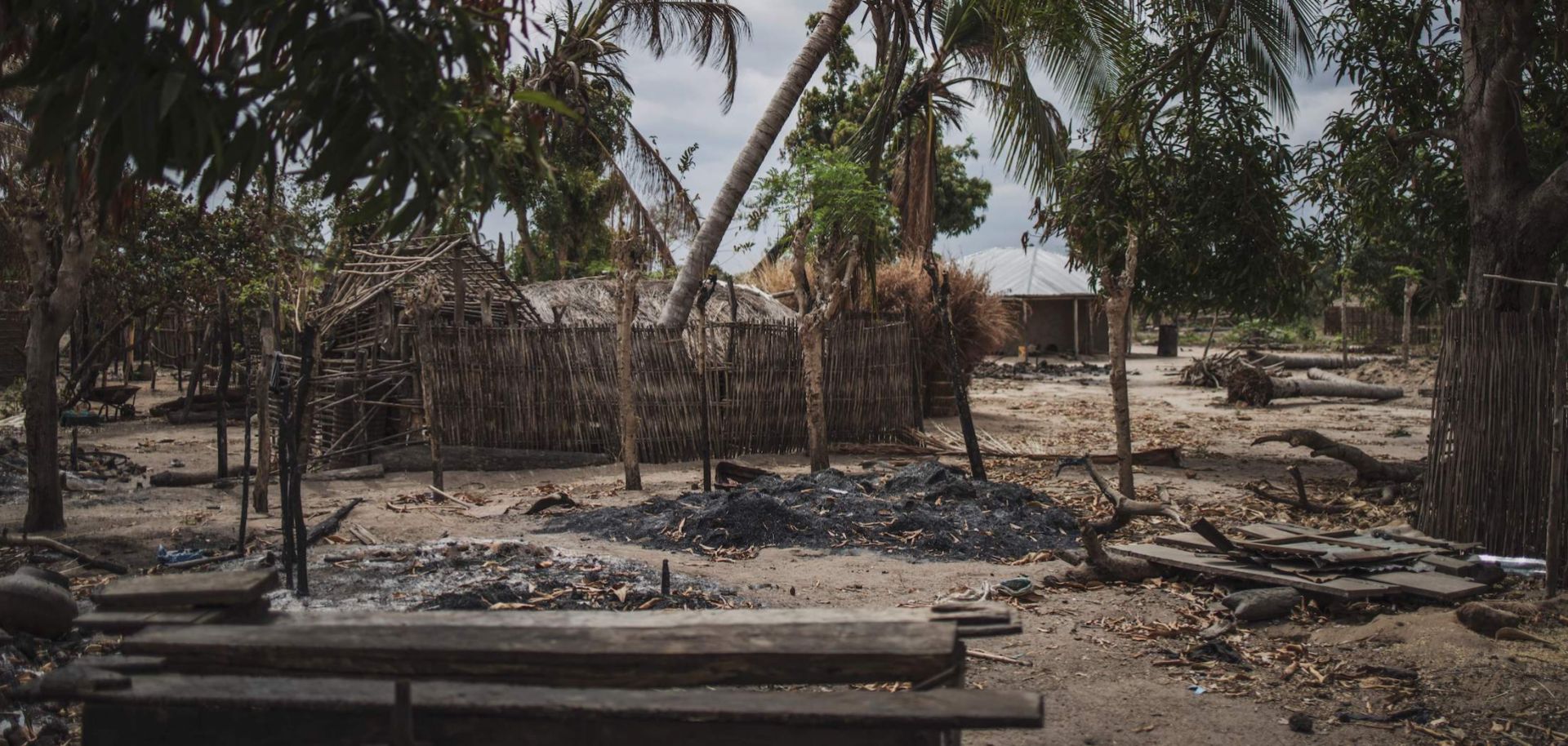
Destroyed homes are seen in the village of Aldeia da Paz outside Macomia, Mozambique, after a militant attack on Aug. 24, 2019.
Militants in Mozambique will continue to gain ground near the liquified natural gas (LNG) park under construction in the country’s north until the government deems the economic and political threat large enough to warrant foreign support. On Jan. 1, the French supermajor Total evacuated some of its personnel from its $20 billion LNG project being built on the Afungi Peninsula in Mozambique’s northernmost province of Cabo Delgado, effectively freezing work at the site. The decision came after the Islamic State affiliate in Mozambique, Ahlu Sunnah Wa-Jama (ASWJ) — which is also a part of Islamic State’s Central African Province — attacked a village less than one kilometer from the facility’s airstrip.
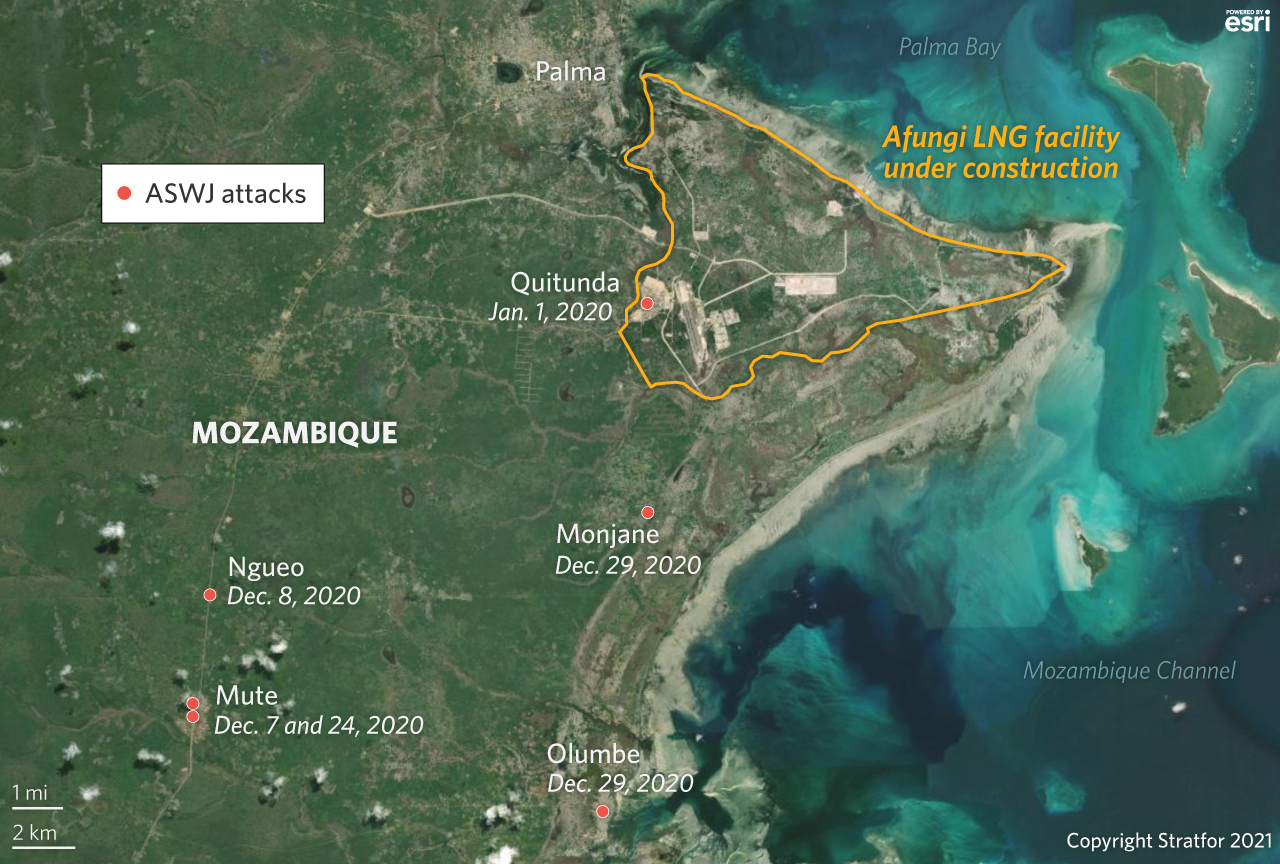
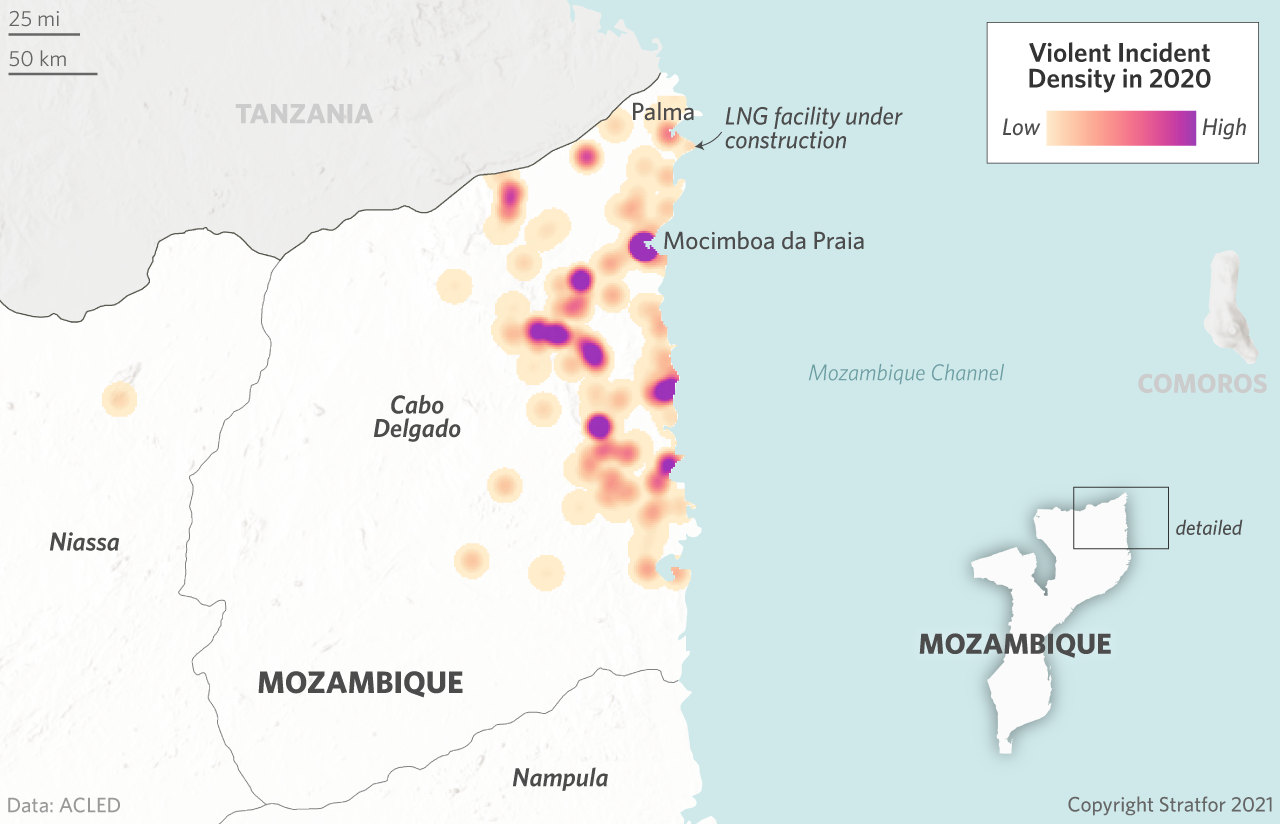
ASWJ has gained considerable strength over the course of 2020, resulting in the Afungi Peninsula being closer to the zone of ASWJ’s operations. ASWJ, which became an Islamic State franchise in 2020, was involved in more than 400 security incidents in 2020 — more than double the number seen in 2019, according to the Armed Conflict Location & Event Data Project. In October, ASWJ claimed its first attack in Tanzania across the Rovuma River, which runs adjacent to the country’s border with Mozambique.
The Mozambican security forces deployed against ASWJ have so far proven to be ill-equipped in curtailing the group’s growth. The Mozambican government, which is in dire financial straits, has struggled to expand the Mozambique Defence Armed Forces (FADM)’s capabilities to deal with the threat without jeopardizing the army’s ability to also contain rebel groups active in central Mozambique. The FADM has also largely failed to disrupt ASWJ’s control of the northern port town of Mocimboa da Praia, which the group seized in August. ASWJ’s control of the strategic town has since granted it greater unfettered access to supplies, as well as roadways to the Afungi Peninsula.
But despite this growing threat, President Felipe Nyusi has continued to pursue only limited military assistance due to concerns about infringement on sovereignty. The Mozambican government has faced growing pressure to accept outside support, including a potential military intervention led by the Southern African Development Community (SADC). Nyusi has signed off on deals with individual countries related to increased training and funding for the FADM, and has even entertained the possibility of limited foreign deployments that Maputo would be better able to control. But he has continued to reject the SADC’s offer of significant multilateral support for fear it could empower counties carrying out the intervention to make political demands that Mozambique is unwilling to accept, such as setting up a more equitable power-sharing arrangement with opposition forces. Nyusi’s ruling Mozambique Liberation Front party (commonly referred to as Frelimo) is also concerned that a counterterrorism intervention could threaten its place in power by exacerbating the security challenges and balance of ethnic powers in northern Mozambique.
- The SADC and neighboring countries intervened heavily during Mozambique’s civil war in the 1970s, which saw Frelimo first come to power. During the intervention, Rhodesia and South Africa backed the militant Mozambique National Resistance Movement (Renamo), which Mozambique’s Frelimo-led government continues to scuffle with as a rebel group in central Mozambique.
- The SADC is considering deploying its Standby Brigade to help contain the growing militant threat in Mozambique, which Maputo has continued to oppose. The SADC will hold another extraordinary summit focused on the Cabo Delgado conflict in January.
- Landlocked Malawi and Zimbabwe — who both rely heavily on Mozambique for access to the sea — have also said that they are willing to directly contribute forces to the conflict.
Mozambique is unlikely to accept multilateral assistance until ASWJ begins to seriously threaten Frelimo’s place in power and/or Total's operations on the Afungi Peninsula. Long neglected by the federal government, Cabo Delgado has limited power in the Mozambican political system. ASWJ’s violent operations in the northern province, while deadly and a black eye on Mozambique’s image, do not alone represent a strategic threat to the Mozambique government. The LNG projects on the Afungi Peninsula, however, are the financial future of the Mozambican economy.
- The three LNG projects currently underway in Mozambique are expected to generate the government as much as $100 billion in revenue and add $300 billion to the country’s economy over the projects’ lifespans (for perspective, Mozambique’s GDP was $14.9 billion in 2019).
- The export facilities of the two largest LNG projects are being built on the Afungi Peninsula. A bigger onshore footprint, both on the peninsula itself and in terms of the logistics of moving equipment to and from the site for construction, will occur in the coming months, increasing ASWJ’s potential target set.
- ExxonMobil is also considering building an onshore terminal on the Afungi Peninsula at the same site as Total’s, but has yet to make a final investment decision on the project.
Currently, ASWJ does not appear to pose as potent of a threat to the territory around the Afungi Peninsula. But left unchecked, the group certainly has the potential to expand its operational tempo in the region and become more of a sustained threat. In recent months, ASWJ has become more deadly in terms of the scope and scale of its attacks (mainly armed assaults targeting security forces or civilians), though the group has not yet demonstrated the ability to hit relatively hardened targets, including Total’s LNG project, nor have they frequently used explosives such as improvised explosive devices (IEDs). The group has, however, launched attacks against islands off the coast of mainland Mozambique. A future evolution to targeting offshore vessels working on the LNG project’s offshore components is thus possible. Indeed, Total’s recent decision shows the company is concerned enough about the rise in attacks around the facility that it will delay the project and evacuate staff as necessary.
- Total and other oil companies developing the LNG facility in Cabo Delgado have used private military contractors, which are generally better trained and better equipped than the FADM, to help protect their assets. This, along with logistical constraints, has made the facility harder and more costly for ASWJ militants to target compared with remote villages in the region.
Maputo will likely eventually accept more assistance from other countries, but the process will be slow, making ASWJ a greater security risk to LNG projects in 2021. Any kind of material support — whether it be a foreign intervention or supplying the FADM with more training and funding — will take months, if not years, to organize and actually deploy. The Mozambican government will likely try to disrupt ASWJ’s expansion in the meantime, with a focus on defusing any threats posed to the country’s LNG projects. But without external help, Maputo will be unable to significantly contain the group’s operations outside the immediate area of those projects. For Total and its partners, this means that they will face a rising threat in the short-term, which will force them to temporarily delay construction or development on parts of the projects, as well as devote more resources to containing the threat from ASWJ.
- The security risks will not push Total and ExxonMobil to abandon their lucrative projects in Mozambique. But the rising insurgency will increasingly hamper their operations.
