
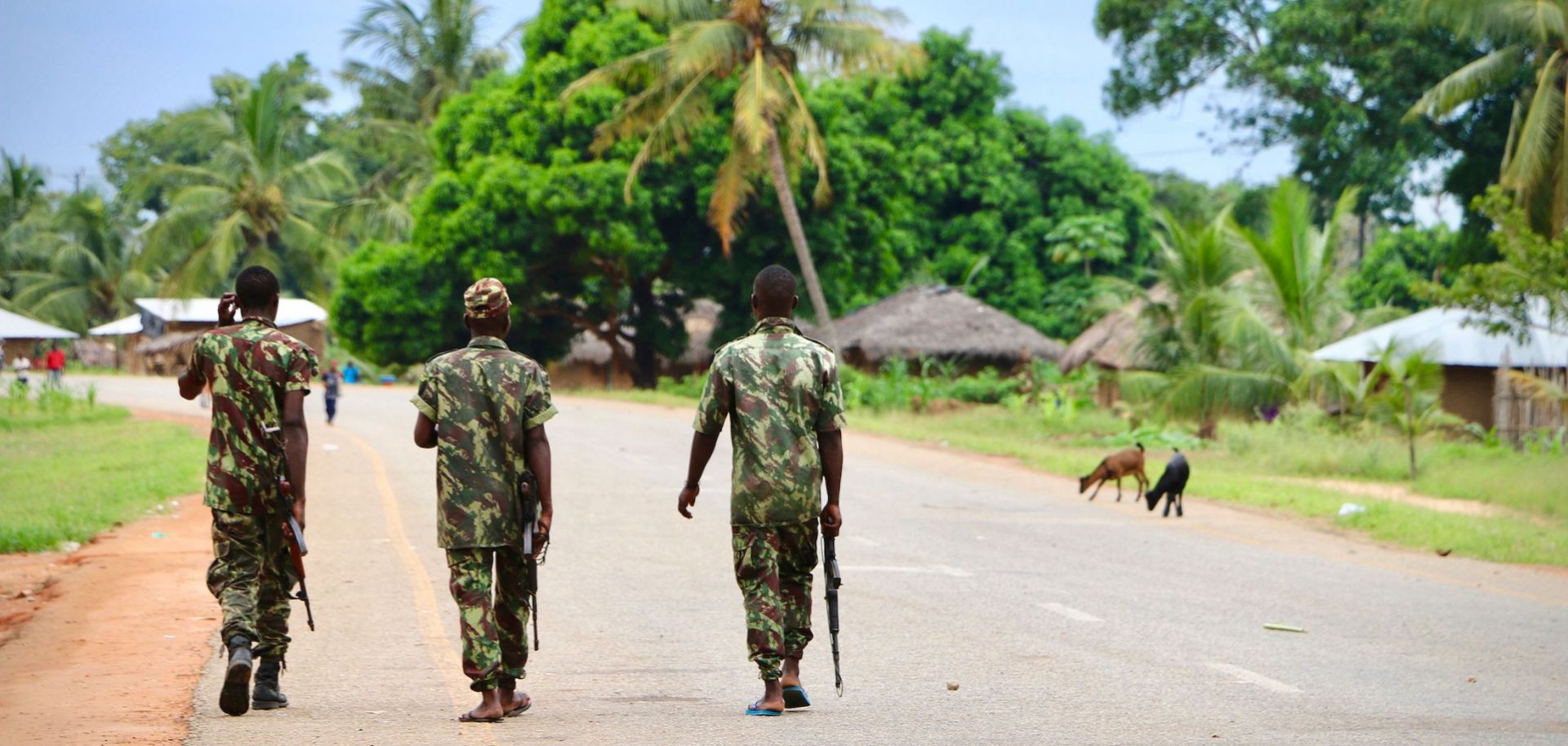
Soldiers patrol the streets in Mocimboa da Praia, Mozambique.
Recent insurgent activity in northern Mozambique suggests a possible evolution of capabilities that could eventually grow to threaten liquified natural gas (LNG) operations in Cabo Delgado. Militants of Islamic State's Central Africa Province (ISCAP) have captured parts of the port town of Mocimboa da Praia in an offensive that consisted of coordinated attacks and interdiction of government reinforcements. Without an effective counteroffensive by government forces, or an intervention by regional forces, ISCAP could secure greater freedom of movement in Cabo Delgado and expand to directly threaten the country's LNG export projects located less than 40 miles north.
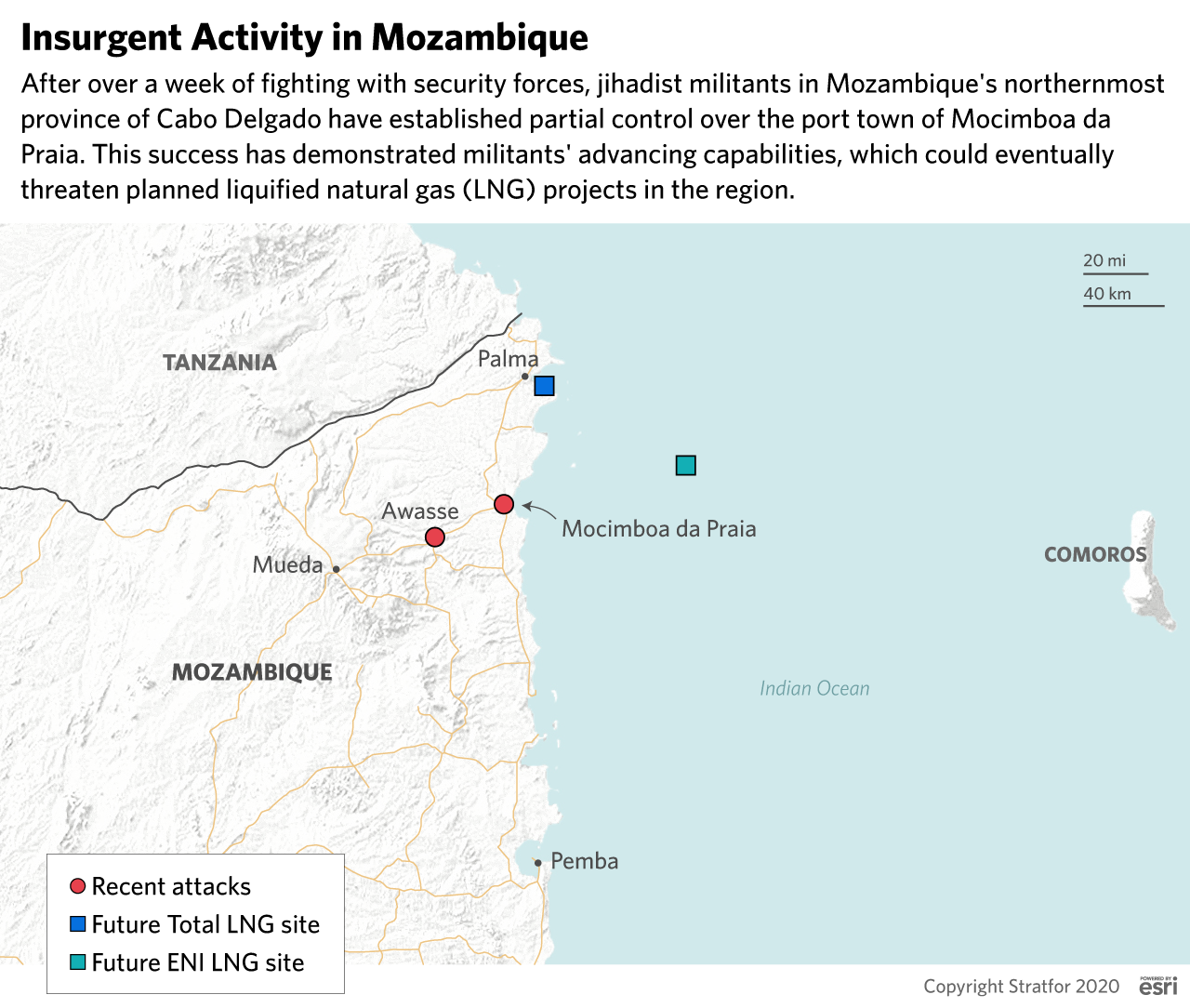
In stark contrast to previous attacks, which were limited in both duration and complexity, the current offensive on Mocimboa da Praia suggests that the insurgents may be evolving towards more effective territorial claims. The offensive initially started on the evening of Aug. 5, with multiple coordinated attacks against separate military positions around the port town of Mocimboa da Praia. Following days of fighting in the periphery of the town, on Aug. 8, government forces were allegedly forced to withdraw from their position, opening up the access routes to the town itself. As of Aug. 10, insurgents are now believed to have established control over the port area after initially fighting their way into the northern outskirts of the town. Militants are also sustaining territorial control over important crossroads outside of Mocimboa da Praia, such as Awasse, where they claimed to have ambushed a military convoy of 15 vehicles, likely coming to reinforce Mocimboa da Praia from the northeastern town of Mueda (a regional hub for military operations).
Government forces have struggled to erode the capabilities of jihadist insurgents in Cabo Delgado, and while a counteroffensive is certain, the effectiveness of the Mozambican military in such operations remains highly questionable. Government forces apparently proved unable to pose much resistance against militants during the fighting around the town of Mocimboa da Praia. According to accounts from the ground, the Mozambican marines that were defending the port area quickly ran out of ammunition, and efforts to resupply them from the air failed. South African private military contractors with the Dyck Advisory Group have provided air support to the Mozambican military, but have been unable to significantly impact the fight against insurgents in the country due to the distance of their operations and their limited firepower. The military will likely mount a counterattack to recapture lost areas in and around Mocimboa da Praia, though this will be a costly and difficult endeavor.
With greater control over Mocimboa da Praia, as well as greater freedom of movement in the surrounding areas, ISCAP militants could continue to expand their reach to potentially threaten the operation of natural gas projects in Cabo Delgado. The gas fields that are currently being developed are located off the coast of Cabo Delgado. But ExxonMobil and Total are also developing onshore liquefaction facilities to export LNG, and will soon have a large and concentrated onshore presence 40 miles north of Mocimboa da Praia on the Afungi Peninsula, near the town of Palma. The port of Mocimboa da Praia itself was initially slated to be integral in this development, but recurring attacks are making the use of the port more costly and could force companies to consider alternatives within the region. Following the recent fighting, government forces have already reinforced their positions in Palma with 200 men. But over time, insurgents' expanding reach could eventually put the safety of this facility at risk. Other foreign projects in the region, such as Eni's plans to build a floating LNG terminal out at sea, will be less directly exposed to militant activity, but could still face significant risk in moving personnel or equipment to and from their operations.
A greater threat of militant expansion and risks posed to Southern Africa's economic development could strengthen existing calls for a regional military intervention. The Southern African Development Community (SADC), the intergovernmental organization that coordinates regional economic and security initiatives, has been heavily debating Mozambican President Filipe Nyusi's call for a foreign military intervention in Mozambique. Tanzania has already announced military operations on its own side of the border, where it plans to sweep the forests for potential infiltration attempts by jihadist militants, though this effort will likely stop short of installing actual operations into Mozambique. As a leading state in the SADC, South Africa, in particular, is exploring ways to efficiently tip the balance in the fight against insurgents in northern Mozambique. But despite rumors of a limited South African special operations presence in Mozambique, Pretoria has made no official decision in favor of a meaningful intervention. Though if the perceived threat emanating from ISCAP continues to grow, through either territorial claims or an expansion toward the region's economically lucrative energy projects, the possibility of such an intervention by Mozambique's neighbors will become much more realistic.
