
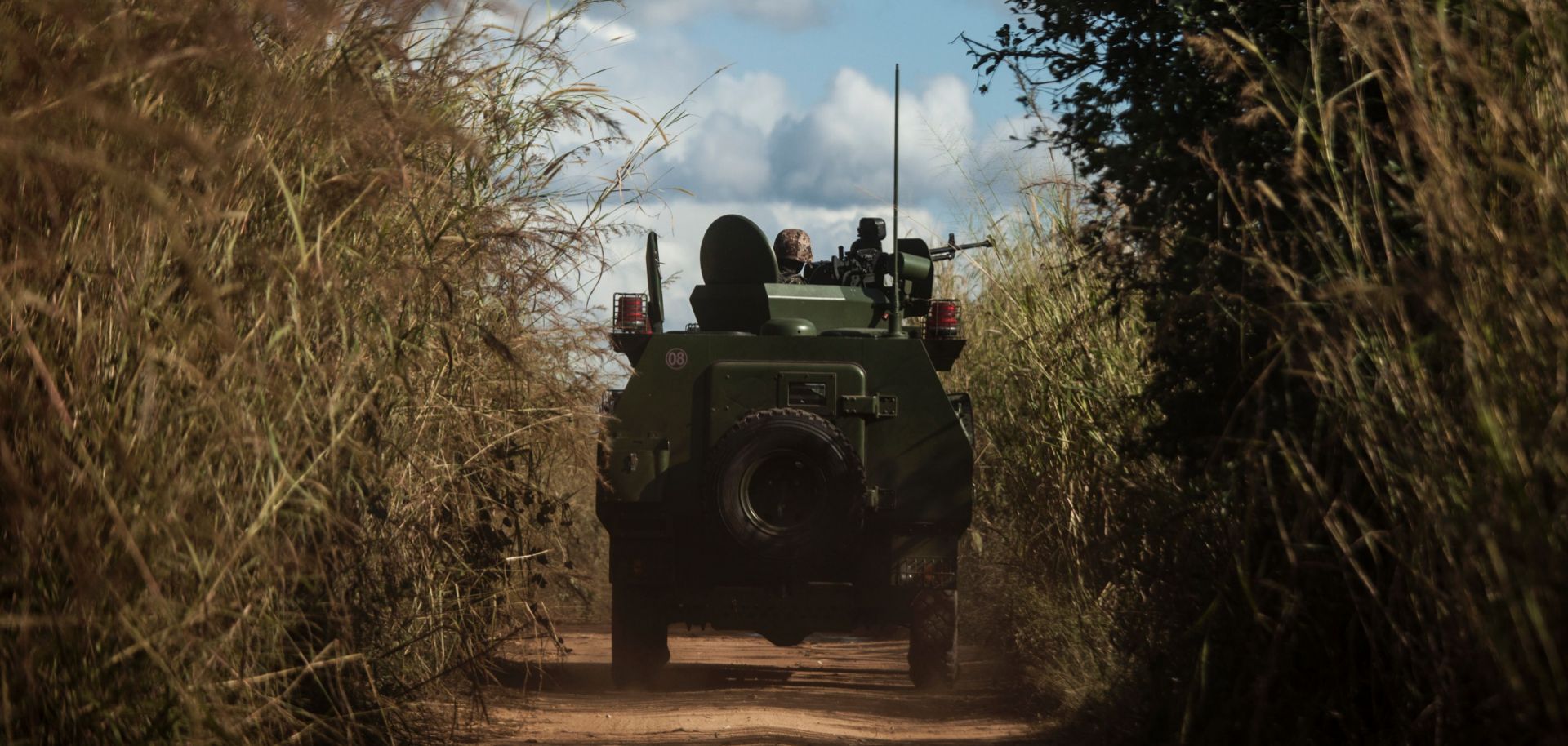
Army vehicles patrol the roads on the outskirts of a village in northern Mozambique on May 26, 2016.
Total's decision to support Mozambique's fight against insurgents may help protect its energy facilities from direct attacks, even as it risks the French oil major's reputation while doing little to reduce escalating militant activity in the country's north. On Aug. 24, Total signed a security agreement with the Mozambican government to protect the $20 billion liquified natural gas (LNG) project it's developing in the country's northernmost province of Cabo Delgado. Under its new pact, Total has agreed to provide logistical support to a newly established joint task force focused guaranteeing the protection of the company’s planned onshore LNG facility, which is located in the Afungi Peninsula near the northern town of Palma.
Both Total and the Mozambican government are seeking to shield their energy investments from militant activity in northern Mozambique, which has faced growing security threats since 2018. In early August, militants of Islamic State's Central Africa Province (ISCAP) mounted an offensive near Mocimboa da Praia, and continue to control areas within and near the northern port town. This offensive has since significantly impacted the security of both the port (which is meant to serve as a logistical node for offshore energy projects), as well as Total's planned LNG facility (which is located just 40 kilometers north).
The proposed security agreement will probably reduce threats to Total's project in Palma and on Afungi Peninsula, rather than erode militants' capabilities across the wider region, leaving the rest of Cabo Delgado vulnerable to insurgent attacks. So far, insurgents have not directly targeted Total's LNG development, and the Mozambican government has already reinforced its military presence around Palma following the recent surge of attacks near Mocimboa da Praia. But without significantly disrupting their activities across the broader Cabo Delgado region, militants' capabilities will likely continue to grow and could eventually present an even greater threat to Total and other oil and gas companies' onshore operations.
The Mozambican government has struggled to contain the insurgency in Cabo Delgado, limiting the military resources it commits while leaning heavily on private security providers to address security conditions. In March, contractors with Russia's Wagner Group reportedly withdrew from Mozambique after only several months following losses on the battlefield and problematic interactions with Mozambican forces. Contractors with South Africa's Dyck Advisory Group have since been providing aerial surveillance and air support to Mozambican forces, but have failed to prevent ISCAP from expanding their activities and control. A military intervention by regional actors from the Southern African Development Community (SADC) could provide a more meaningful capacity boost to Mozambique's fight against insurgents, but diplomatic efforts have yet to yield any pragmatic planning for such a force.
Providing support to the Mozambican military, which has a vast record of alleged human rights infringements, will force Total to walk a fine line between guaranteeing security for its operations in the country and tarnishing its reputation. During counter-insurgency operations in Cabo Delgado, Mozambican forces have repeatedly been accused of violence against civilians, including illegal detainments. Association with such activity could not only harm Total's international standing among partners and investors, but can also affect its standing with local populations who already have little trust in their country's military — potentially creating a more hostile work environment by emboldening ISCAP and other militant groups, along with more alienated locals for militants to potentially recruit. The details on the level of support Total has agreed to provide to military operations under the deal remain unknown. But such support could take many different forms, ranging from financial support to government budgets and the hiring of private military corporations, to gifting essential equipment such as vehicles and providing use of Total's existing transport infrastructure. Depending on how directly Total involves its own assets in security operations, additional risks for energy operators in the region could arise as well, as their assets could also start to be perceived as part of the government security capacity.
