
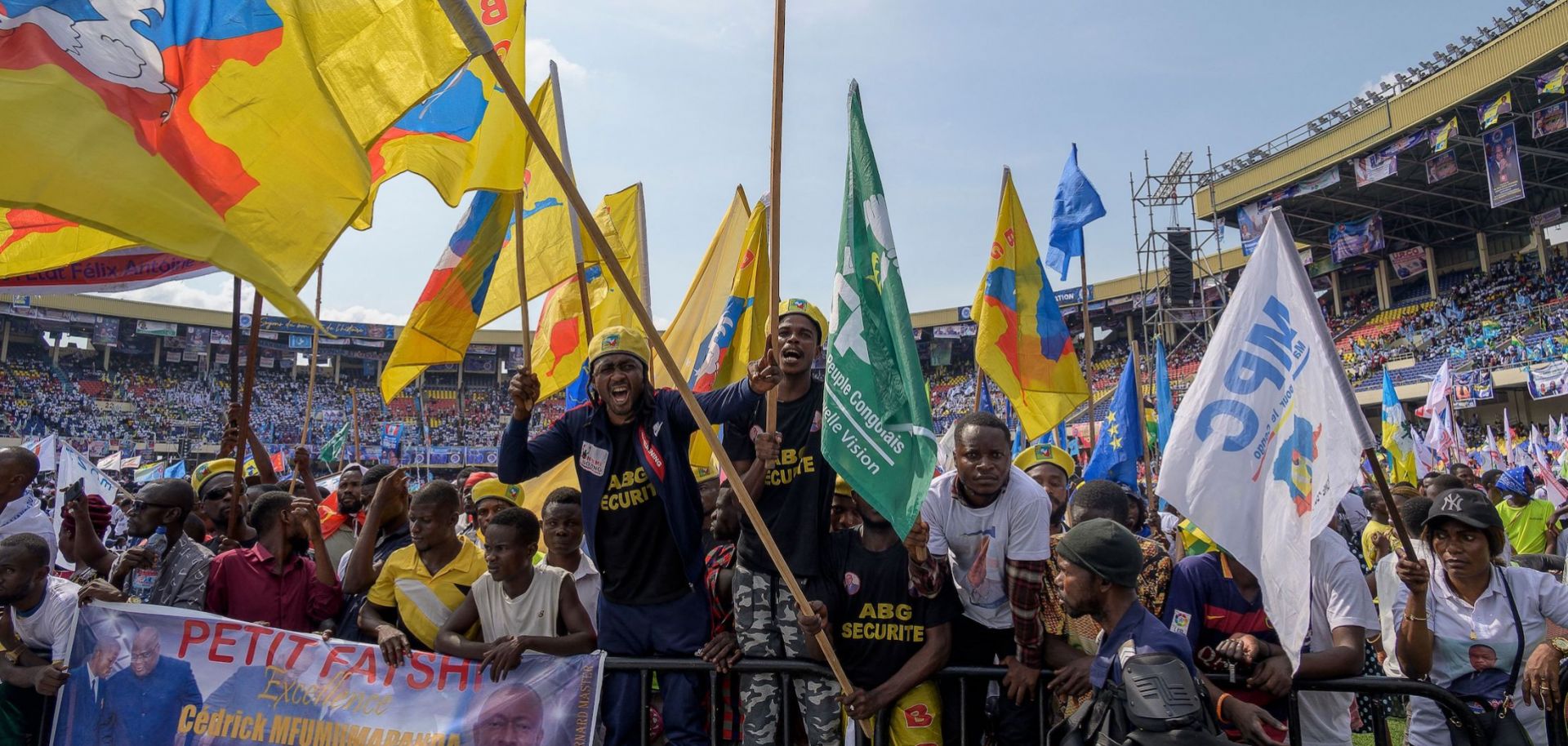
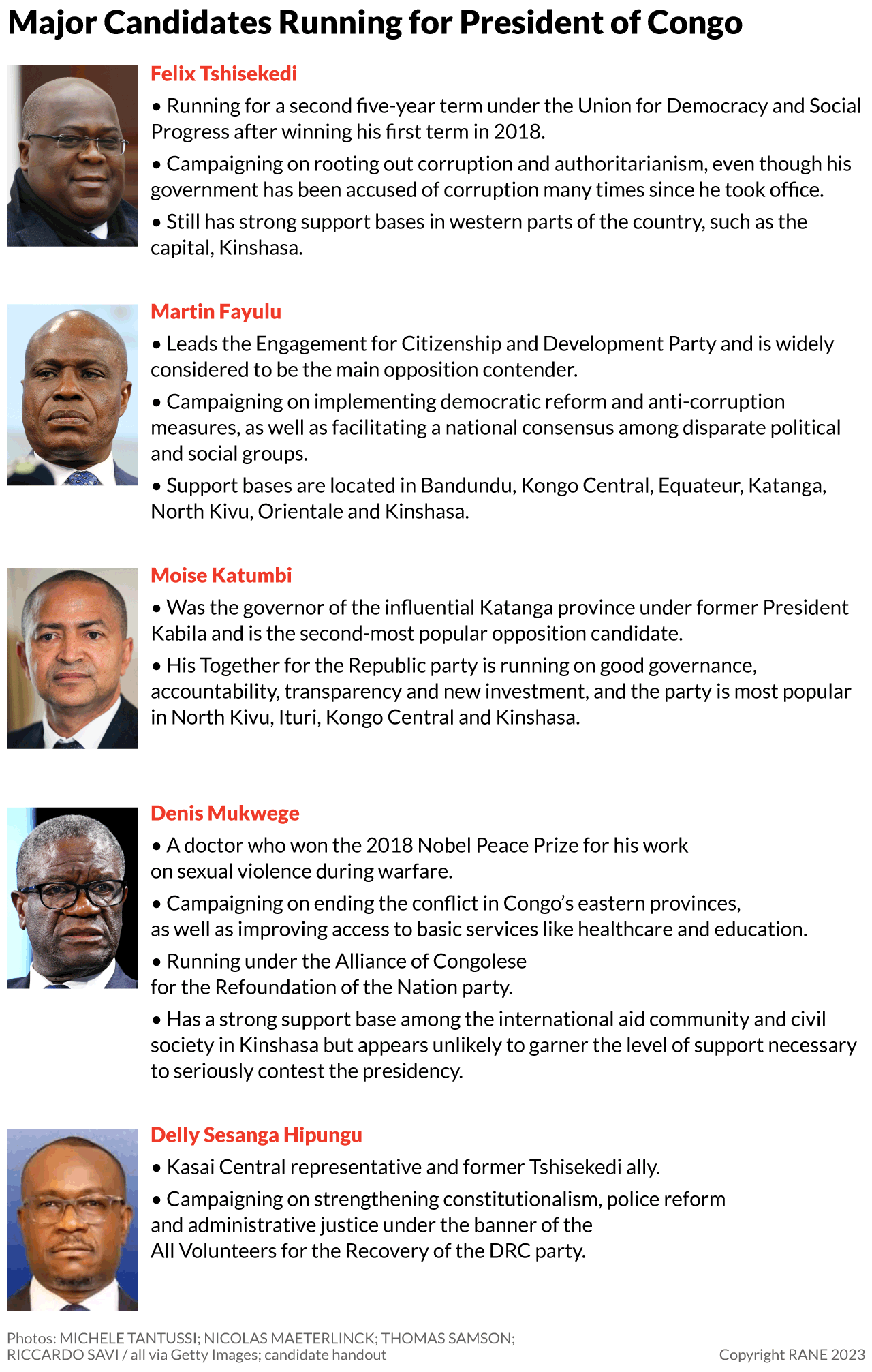
Congolese President Felix Tshisekedi's control over state institutions will make an opposition victory during the December presidential election difficult, likely portending a violent and highly contested election that ushers in five more years of state capture, underdevelopment and fragile regional relations. The Democratic Republic of the Congo, Africa's fourth most populous country, will hold general elections on Dec. 20 during which Congolese will elect their next president, as well as their parliamentary, provincial and municipal representatives. Twenty-four candidates have registered to contest the presidency, although current President Felix Tshisekedi has a significant incumbent advantage due to his access to and control over state institutions. Among the opposition candidates, former oil executive Martin Fayulu and former Katanga province Governor Moise Katumbi are the frontrunners. Congolese elections follow a first-past-the-post plurality system, which means the candidate with the most votes wins the election.
- The 2018 election is widely considered to have been fraudulent; the National Episcopal Conference of the Congo, a highly respected civil society organization and one of several election observers deployed to the country's 70,000 polling stations, indicated that Fayulu won nearly 60% of votes. However, the electoral commission named Tshisekedi the winner after an apparent deal with former President Joseph Kabila, who controlled the commission at the time.
- Former President Kabila's pick for president has been widely anticipated, as he still wields considerable political power through business deals and patronage networks. However, Kabila told senior members of his People's Party for Reconstruction and Democracy that he will not take part in elections until the electoral commission has been reconstituted. Tshisekedi overhauled the commission during his first term after breaking with Kabila in 2021.
Conflict remains a huge barrier to electoral participation in the country's eastern provinces due to ongoing violence and a government state of siege. Congo has suffered a long history of conflict, and successive interventions by neighboring countries and the United Nations have done little to quash the tens of active insurgencies in the region. About 7 million citizens are currently displaced, while in 2022 alone more than 1,800 people were killed and thousands more injured in North Kivu, South Kivu and Ituri provinces. Congolese authorities blame the ongoing violence on M23, a Rwandan-backed rebel group whose activity has resurged in recent years, but perpetrators also include rebel groups like the Cooperative for the Development of Congo and the Islamic State-affiliated Allied Democratic Forces, as well as the Congolese military itself. As in past years, fighting among rebel groups, the Congolese military and intervening forces has disrupted voter registration: more than one million voting-age civilians in North Kivu alone are without voter cards. The government's state of siege has further exacerbated barriers to political enfranchisement, as it prevents demonstrations and political gatherings from taking place, meaning Congolese living in eastern provinces are generally less aware of opposition candidates or even that a vote is taking place. So far, the state of siege has not reduced violence in any of the eastern provinces.
- Congo's government enacted the state of siege in May 2021 in North Kivu and Ituri provinces when Tshisekedi declared marshall law in order to undermine armed groups and restore security.
Even in areas of the country where voters are registered and can reach polling locations, the Tshisekedi government's interference in electoral, judicial and security institutions sets the stage for an irregular election of dubious integrity. The Tshisekedi administration has used its access to state institutions and resources to strengthen its own political power and its prospects for the upcoming election. Tshisekedi overhauled the electoral commission in 2021, appointing a host of loyalists to key positions, including the ruling party's own strategist Denis Kadima as the commission's president. The electoral commission has since refused to adopt international norms for electoral best practices that would mandate tallying and announcing results at each polling center, which generally improves transparency and reduces opportunities for vote rigging during the aggregation process. The electoral commission also appears to have fabricated registration numbers in the lead-up to December elections: in January, the electoral commission reported that it enrolled 7 million voters from 10 provinces and then refused to release voter registration rolls as required by the constitution when opposition parties and civil society organizations decried suspected fraud (over 38 million Congolese registered to vote in the 2018 elections in 26 provinces). In April, the electoral commission announced that it registered 47 million out of 49 million eligible voters, further fueling allegations of fraud. Tshisekedi also issued an executive order in October 2020 that enabled him to appoint three justices to the Constitutional Court, which rules on electoral disputes. As a result, Tshisekedi loyalists now dominate the court. The government has also utilized the judiciary and state security services to repress and intimidate the opposition, most recently in September when presidential candidate Jean-Marc Kabund was sentenced to seven years in prison on charges including insulting the president. Security services routinely crack down on opposition demonstrations, like on May 29 when police broke up protests against police brutality organized by Fayulu, Katumbi and Sessanga in Kinshasa, injuring over 30 people. In June, military intelligence arrested Katumbi's top advisor Salomon Kalonda and brought him to the Ndolo military prison, where he is serving time on treason charges for allegedly being in contact with the M23 rebel group, even though it is illegal for civilians to be held in military facilities.
- Security crackdowns on opposition demonstrations are common, although they vary in severity. On the more extreme side, in late August Congolese troops killed more than 50 civilians at a church and radio station in the eastern city of Goma who were preparing to protest the ongoing U.N. peacekeeping mission. Security crackdowns will likely persist well after the December election.
Tshisekedi's control over state institutions and the fragmented opposition give the president an advantage in — although not a guarantee of — securing a second term, which would likely portend continued state capture, underinvestment in human development and corruption in the mining sector. Despite the presence of election observer missions from the Southern African Development Community, the African Union and the European Union, all indicators suggest that Tshisekedi will use every state resource available to him to secure his own victory. Therefore, his authority over the electoral commission, the judiciary and state security institutions gives him a significant leg up over opposition leaders like Fayulu and Katumbi. Divisions within the opposition also support a second Tshisekedi term, as competition among Fayulu, Katumbi and others undermines support for Tshisekedi's main challenger Fayulu. In the event of a Tshisekedi victory, not much appears poised to change regarding the composition of the legislature, governance, economic priorities or foreign relations. Tshisekedi's ruling Sacred Union coalition appears likely to maintain its strong majority in the National Assembly, which would support Tshisekedi's second-term agenda and the continuity of patronage networks. In terms of governance, corruption and patronage would very likely remain hallmarks of the Tshisekedi administration, inhibiting trust in state institutions, Western foreign investment and financial allocations to social projects. While economic growth is expected to remain high due to Congo's robust extractive exports, mining revenue is highly unlikely to fund an expansion of development projects under a second Tshisekedi term, as the majority of mining revenue would likely continue to flow to infrastructure projects and self-enrichment. As a result, poor services, failing public infrastructure and high costs of living will very likely continue to drive high poverty rates. Although Tshisekedi may also promise to see through mining sector reforms that he began during his first term, little is expected to change in practice, as the government will likely continue to award disproportionate deals in the copper and cobalt industries to mining companies willing to pay off officials and operate in an opaque business environment.
- According to the Inspectorate General of Finance (which provides technical assistance to the Ministry of Finance), the Congolese state pays almost $800 million a year (about 5% of its annual budget) to fictitious employees — money that is actually used for self-enrichment, patronage networks or otherwise corrupt government contracts.
- Additionally, Congo's classified security budget has increased in size almost 10 times over since Tshisekedi took power, adding to concerns of embezzlement leveled against the country's security establishment.
- Corruption watchdog groups, civil society groups and civilians have criticized the Tshisekedi administration's lack of court action against Kabila-era officials accused of corrupt mining deals. These groups also point to a lack of transparency over negotiations involving a $6 billion resources-for-infrastructure deal between the government and various Chinese state-owned companies that would allow them to mine cobalt, copper and other minerals in exchange for infrastructure investments. The deal was negotiated under Kabila.
- Sacred Union has a large majority in the National Assembly with 391 of the total 500 seats. The Common Front for Congo, which is primarily made up of Kabila's People's Party for Reconstruction and Democracy, holds 69 seats, and the opposition Lamuka Coalition holds the remaining 40 seats. The composition of the 120-member Senate is less favorable for Tshisekedi, as each of Congo's 25 provinces elects four senators and Kinshasa elects eight. The ruling party holds 22 senate seats, while the allied Movement for the Liberation of Congo holds another 22 seats. Several opposition parties occupy the remaining 76 seats.
Under a second Tshisekedi term, Congo's relations with its neighbors will likely remain strained. Accusations of Rwandan support for M23 will very likely continue to pit Tshisekedi against Rwandan President Paul Kagame, while border tensions and intermittent clashes will likely create diplomatic spats that stop short of direct clashes between the two countries. M23's continued presence and violent activity in North Kivu and Ituri provinces will likely inhibit growth and development in the east, keeping millions of Congolese locked in a cycle of conflict and poverty for years to come. Congo will likely continue to pursue enhanced trade opportunities with East African Community members, and while it appears poised to stick to newly minted deals with countries like Kenya, disputes over tariffs, quality control and border activity will likely continue to serve as pain points.
- The Congolese government, the United Nations and other Western powers have all accused Rwanda of supporting the rebel group M23, but Rwanda denies the allegations. Tensions between Congo and Rwanda have spurred several rounds of negotiations, all of which have failed to stem M23 violence.
- The East African Community admitted Congo on March 29, increasing the regional bloc's market by 90 million people. Regional leaders celebrated the expected increase in annual economic output by 25% and bloc members' new access to the Atlantic Ocean through Congo's Matadi and Boma ports.
While a united ticket would increase the opposition's chances of victory, Tshisekedi would still likely use his influence over electoral institutions to hold on to power. Representatives of Congo's leading opposition parties met in Pretoria, South Africa, the week of Nov. 13 to decide on a potential joint candidate. While Fayulu appears to be the obvious choice given his electoral success in 2018 and his popularity, the negotiations will still likely be contentious and may not produce a consensus. If, however, a single opposition candidate can consolidate support from disparate coalitions during the campaign period that opens on Nov. 20, Tshisekedi will face a much steeper electoral challenge. But even if an opposition candidate like Fayulu wins a majority of votes and the results reach the public, the likely ensuing unrest and contestation by the Tshisekedi administration would risk triggering a broader crisis and/or still resulting in a second term for the incumbent president. While any losing opposition candidate could also contest the election results, they are less likely to do so since the Constitutional Court would likely rule in Tshisekedi's favor. Some external blocs or mediation bodies may attempt to intervene and/or ensure integrity and impartiality, but these entities — like the Southern African Development Community, the African Union, the United Nations and the European Union — lack enforcement mechanisms, so even if allegations of government interference in an election court process are widely accepted, international and regional bodies are unlikely to do anything to stop Tshisekedi from remaining in power. Taken together, this suggests that the opposition would also have to secure support within key institutions — like the judiciary and/or security establishment — in order to actually win the presidency, even if it secures electoral victory.
- Seth Kikuni and Franck Diongo — two former presidential aspirants — announced on Nov. 21 that they will support Katumbi’s candidacy, although Katumbi will still likely need to garner more support to challenge Tshisekedi.
- The Southern African Development Community observed the August general elections in Zimbabwe, which did not meet the bloc's minimum thresholds of credibility and involved state violence against opposition leaders and supporters. Even so, the organization has not taken any action to reject the results or demand a rerun. Similarly, despite overwhelming evidence of fraud during Congo's 2018 election, Western governments including the United States accepted the Kabila-Tshisekedi deal that nullified Falyulu's electoral victory, undercutting the electoral process.
- Amid typical levels of election-related unrest and violence, which usually include violent clashes between demonstrators and police, losing parties and their supporters could attempt to inflame tensions if they believe a national crisis could produce a more favorable result.
