
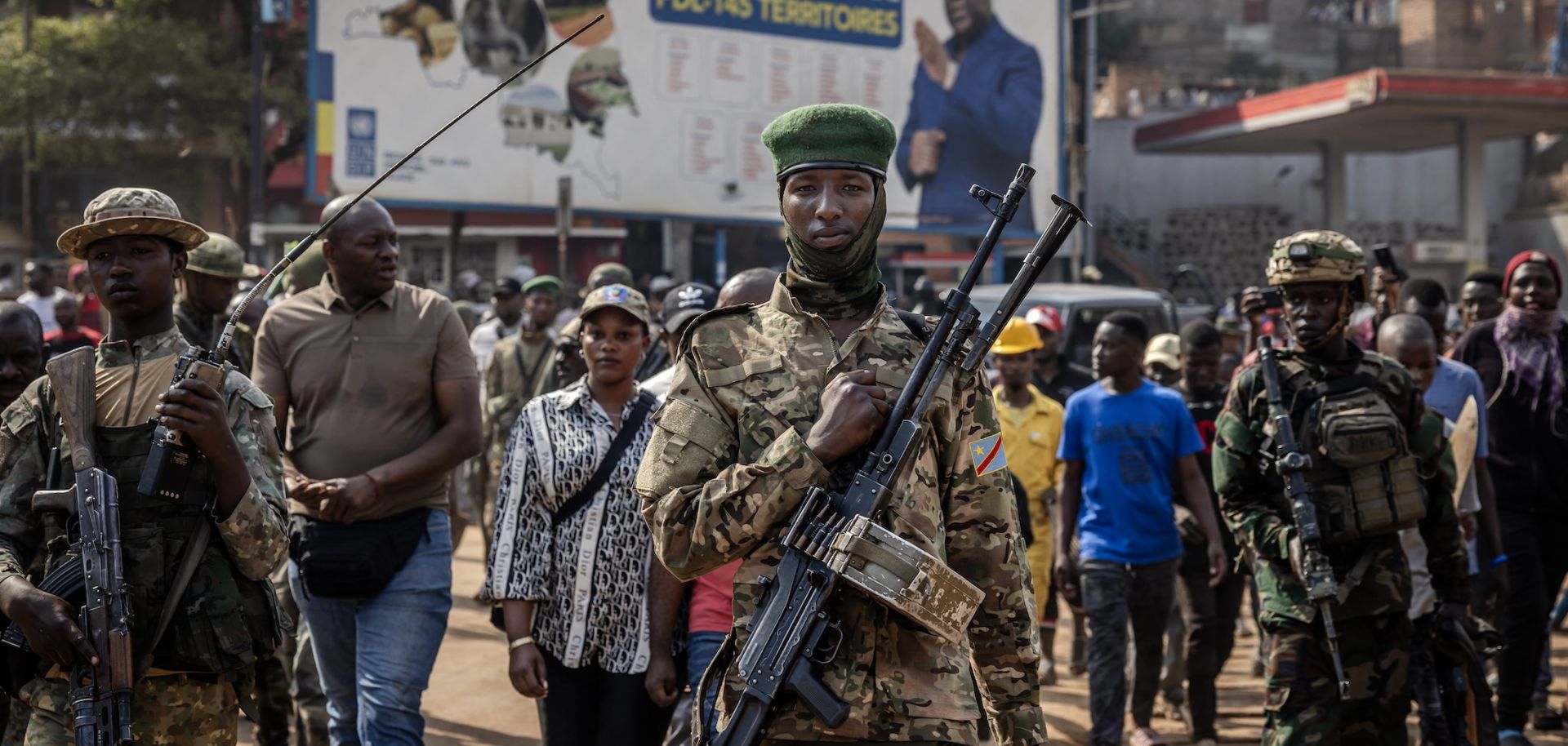
In eastern Congo, Burundi's reported troop withdrawal and Uganda's apparent unwillingness to intervene against the AFC/M23 rebel group mitigate the risk of an interstate conflict in the immediate future. However, a large-scale westward offensive by the AFC/M23 would reignite this threat as it could prompt an intervention from southern African countries in support of Congo. On Feb. 16, the Alliance for the Congo River (AFC), a political-military alliance led by the Rwanda-backed M23 rebel group, captured the city of Bukavu, the provincial capital of the Democratic Republic of the Congo's eastern South Kivu province. Congolese and Burundian troops had already vacated the city on the evening of Feb. 14 after the rebels seized Bukavu airport, which is located 30 kilometers to the north, earlier that day. Disagreements between the Congolese military and pro-government wazalendo militias, who reportedly opposed withdrawing from Bukavu, resulted in clashes between the two sides on Feb. 17-18 south of the city. Meanwhile, an estimated 10,000 Burundian forces deployed to eastern Congo to help combat the AFC/M23 have reportedly begun to withdraw back to Burundi. Amid mounting tensions surrounding Bukavu's fate, the chief of Uganda's defense forces, General Muhoozi Kainerugaba, said on Feb.15 that the Ugandan military would attack Congolese forces in Bunia, the capital of Congo's northeastern Ituri province — located along Uganda's western border — if they did not surrender within 24 hours. This came after CODECO militants, who oppose the Congolese government and claim to fight in the name of the Lendu ethnic group, killed over 50 civilians in Ituri's Djugu territory on Feb. 11. While Uganda did not attack Congolese forces, Ugandan troops were deployed to Bunia on Feb. 16-17, with talks taking place between local Ugandan and Congolese military commanders on Feb. 18-19.
- Congo's Ituri province has faced a long-standing conflict between the Lendu and Hema ethnic groups. The conflict centers around control and access to land, as many Lendu claim to be the region's original inhabitants. Uganda has historically sided with the Hema, who Muhoozi has referred to as ''my people.''
- On Feb. 18, Reuters reported that Burundi was withdrawing its forces from eastern Congo. While a spokesperson for the Burundian government denied this, the news was also confirmed by a diplomatic source speaking to news outlet Jeune Afrique.
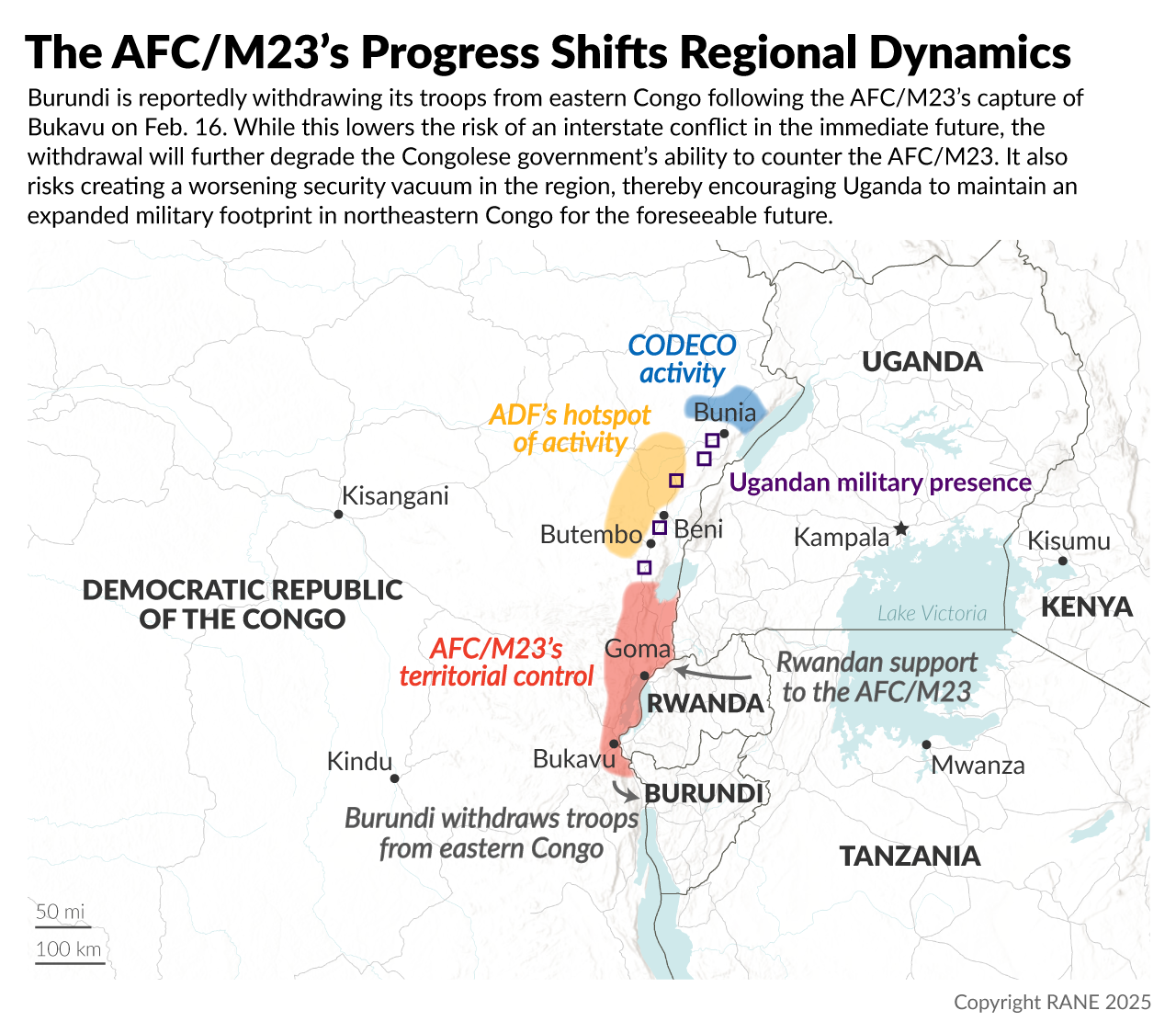
Burundi's reported troop withdrawal from eastern Congo reduces the likelihood of interstate conflict in the immediate future, as Uganda is unlikely to decisively confront the AFC/M23 in the coming weeks, but the risk of spillover violence to Burundi will persist in the coming months. Burundi's troop deployment to eastern Congo posed the most imminent risk of interstate conflict breaking out, as clashes between Burundian forces and AFC/M23 militants along the Congo-Burundi border would have had a high risk of spilling over into Burundi. But while Burundi's reported withdrawal reduces the likelihood of an escalating interstate conflict in the coming weeks, the departure of Burundian forces will likely enable the rebel coalition to secure control over the entire Congo-Burundi border. This could notably ease operational constraints on the RED-Tabara, a Burundian rebel group alleged to be supported by Rwanda, to launch cross-border attacks into Burundi over the coming weeks and months. Despite this, short-term risks of interstate conflict remain limited as Burundi appears to have shifted to a defensive posture within its territory. Uganda is also unlikely to decisively confront the AFC/M23, at least for the next few weeks, which will further mitigate the immediate risk of a regional escalation. While the Rwandan-backed rebels' hypothetical advance northward toward the city of Butembo, near the Ugandan border, could result in sporadic clashes with the Ugandan military, Muhoozi's close ties with Rwandan President Paul Kagame and the Butembo-Beni area's limited strategic value to Kigali means that a severe escalation between the two sides will likely be averted.
- The RED-Tabara is a Burundian rebel group that aims to topple Burundi's Hutu-led government, and it has launched several deadly attacks from South Kivu into Burundi in recent years. However, the Congolese government had allowed the Burundian military to launch a series of counter-insurgency operations against the group in South Kivu, in exchange for providing support against the AFC/M23.
- Muhoozi has repeatedly expressed his affinity for Rwanda's president, referring to him as ''Uncle Paul'' and stating that ''anyone'' threatening him was ''in danger'' and ''looking for direct confrontation with Uganda and with me.''
- On Feb. 21, Ugandan President Yoweri Museveni confirmed that Uganda's troop presence in Congo has ''nothing to do with fighting the M23 rebels''
Making Sense of Uganda's Approach to Congo
Uganda's expanded troop presence and operational remit in northeastern Congo reflect its growing concern of hostile militant groups exploiting security vacuums in the region amid the Congolese military's prioritization of the AFC/M23. Increased militant activity near its shared border with Congo poses security threats to western Uganda, where major oil and gas projects are currently in development. To mitigate these threats, Kampala will likely seek to maintain an expanded military presence in northeastern Congo for the foreseeable future, resorting to intimidation to pressure Kinshasa into effectively giving Uganda a free hand to conduct counterinsurgency operations in Ituri and the northern parts of Congo's North Kivu province. As his government struggles to stem the AFC/M23's advances, Congolese President Felix Tshisekedi will likely yield to this pressure to discourage Uganda from deepening its ties with Rwanda and the AFC/M23.
The AFC/M23's capture of Bukavu and Burundi's troop withdrawal raises the prospect of the Congolese government entering direct talks with the rebels, which could temporarily de-escalate the conflict. In addition to likely enabling the AFC/M23 to capture the entire Congo-Burundi border, Burundi's reported troop withdrawal from eastern Congo will further weaken the Congolese government's defensive posture in the region. This new reality could finally compel Congolese President Felix Tshisekedi to enter direct talks with the Rwanda-backed rebel coalition, which he has refused to do since the conflict began in late 2021, given the risk that it could trigger domestic backlash due to widespread anti-Rwandan sentiment in Congo. However, the AFC/M23's recent military victories have seen the group impose itself as a necessary party to any resolution of the conflict, and resulted in a growing number of political and social actors in Congo accepting the idea of direct negotiations with the AFC/M23, either mediated by the church or regional political actors. This, in turn, eases the domestic constraints that Tshisekedi has faced, thereby increasing the likelihood of direct talks between the two sides beginning in the coming weeks and months.
Even if Tshisekedi enters direct talks with the rebels, the AFC/M23 and Rwanda will likely still launch fresh offensives to strengthen their leverage in negotiations, but the risk of inter-state conflict will likely remain limited to Burundi in the short term long as the AFC/M23 remains in the North Kivu and South Kivu. Even if the Congolese government enters negotiations with the AFC/M23, this is unlikely to result in a stable ceasefire, as the rebels will likely seek to leverage their military advantage to force Kinshasa into making politically challenging concessions, such as amnesty for rebel leaders, greater autonomy for Congo's eastern regions or a shift toward federalism. Rwanda, for its part, is now less incentivized to support further offensive operations, given that the rebel coalition has already secured the entirety of its border with Congo. However, the United States and other Western countries' weak response to the AFC/M23's recent territorial gains will likely embolden Kigali to endorse continued offensive operations as a means of securing its maximalist objectives, such as ensuring that M23 members are integrated into eastern Congo's local administration. These operations will, in turn, likely result in further rebel gains in the North Kivu and South Kivu provinces. While this would further undermine Congo's political stability and heighten the risk of a military coup, it would likely prove insufficient to prompt a large-scale intervention by the Southern African Development Community (SADC) or other allies of the Congolese government, as it would mark the continuation of eastern Congo's long-standing conflict. However, the conflict could still spill over into Burundi, whether due to a rapid uptick in RED-Tabara attacks or due to Burundian forces launching operations across the Congolese border to disrupt the RED-Tabara, portending renewed clashes with the AFC/M23.
Chad and SADC countries are more likely to intervene in support of Congo if the AFC/M23 launches an offensive toward the central parts of the country, given the risk this would pose to regional stability in central and southern Africa. If further rebel advances in North Kivu and South Kivu fail to break the political deadlock between the Congolese government and the AFC/M23, Rwanda may ultimately endorse offensive operations westward towards the cities of Kindu and Kisangani. The AFC/M23 could also seek to rapidly advance in these directions in the event of a coup attempt in Kinshasa, as it would seek to exploit Congolese soldiers' confusion to its own advantage. However, a large-scale AFC/M23 offensive outside of the North Kivu and South Kivu provinces would threaten to destabilize the entirety of Congo for the foreseeable future. This would have ripple effects in neighboring countries, as it would likely result in fresh refugee flows, as well as facilitate cross-border activity for rebel and criminal groups alike. Such a scenario would raise the likelihood of other African countries intervening to stabilize the Congolese state. Key contenders would include Chad, whose president has close ties with Tshisekedi, as well as SADC countries. While a regional military intervention could bring the AFC/M23's gains to a halt and stabilize the frontline, it would result in more actors becoming involved the longer the conflict remains unresolved and outside of the Kivu regions. Nonetheless, a decisive intervention by African countries in support of Kinshasa would require the Congolese military to maintain a minimal degree of cohesion, as its failure to do so would be a major constraint for Chad or SADC countries to intervene in support of Kinshasa.
- Fears of overextending their supply lines could deter the AFC/M23 and Rwanda from launching large-scale operations in Congo. However, there is precedent for such operations, as Rwanda supported offensives deep into central and even western Congo during the late 1990s and early 2000s. The AFC/M23 would also be able to feasibly conduct a large-scale operation following several months of preparation.
- On Feb. 18, the Congolese government requested military support from Chad.
