
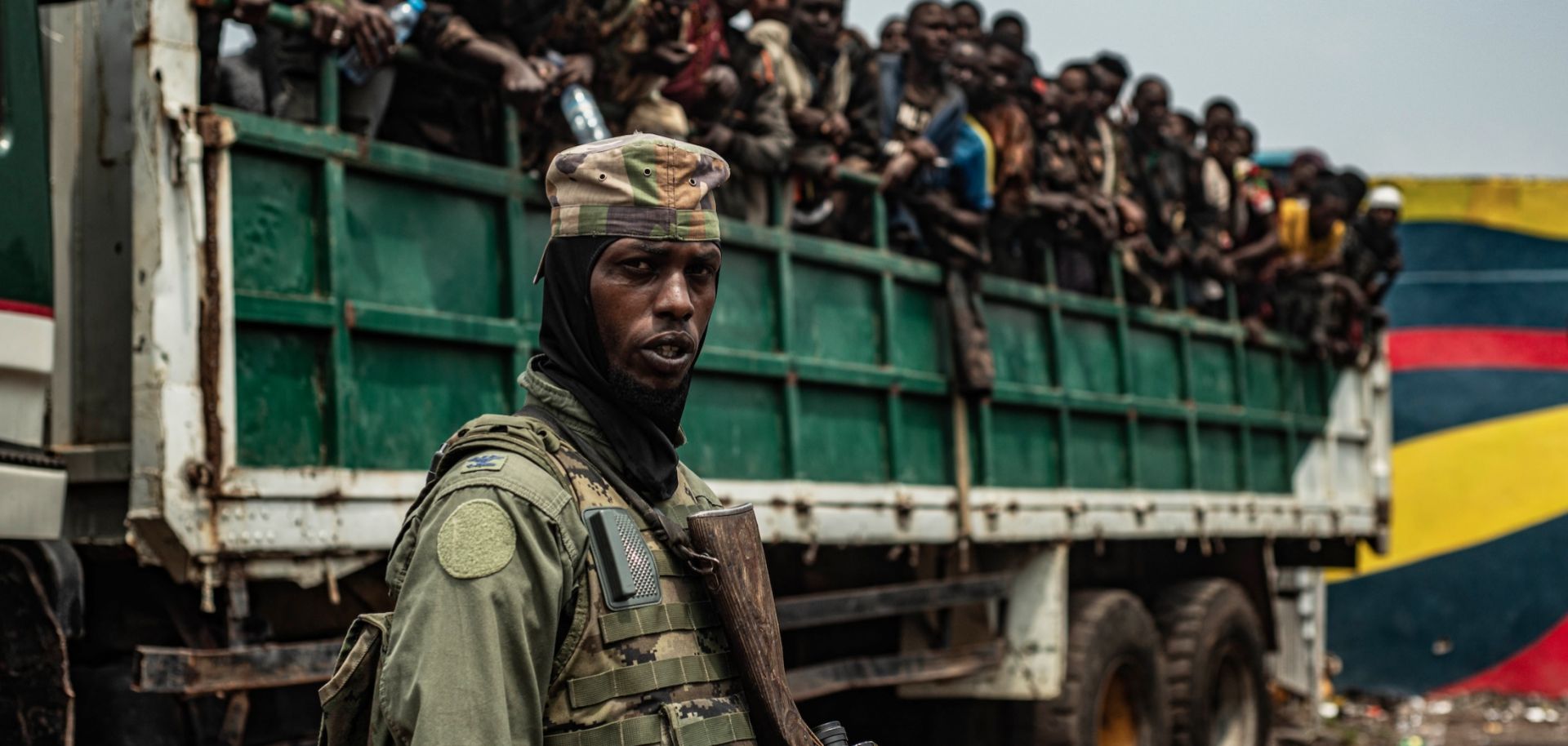
Growing international pressure could temporarily ease fighting between the Rwanda-backed AFC/M23 rebel coalition and pro-government forces in eastern Congo, but a consolidated ceasefire remains unlikely unless the Congolese government enters direct talks with the rebels; otherwise, the AFC/M23 will likely sustain/resume its push toward the city of Bukavu, whose fall would expose Congo to mounting instability, including nationwide unrest and a potential military coup. On Feb. 8, the East African Community (EAC) and the Southern African Development Community (SADC) held a joint summit aimed at easing fighting in the eastern Democratic Republic of the Congo. Following the summit, the EAC and SADC issued a joint statement calling for an ''immediate and unconditional'' ceasefire between the AFC/M23 rebel coalition and the Congolese government, as well as for both sides to engage in direct negotiations. In addition, the statement called for the neutralization of the Democratic Forces for the Liberation of Rwanda, a radical Hutu group known by its French acronym FDLR, and for Rwanda, which is widely acknowledged as backing the AFC/M23, to disengage its forces from eastern Congo. SADC and EAC leaders also agreed to merge the Luanda and Nairobi peace processes, both of which have unsuccessfully tried to secure a resolution to the conflict between Congo and Rwanda in recent years. The joint EAC/SADC summit came nearly two weeks after the AFC/M23 captured Goma, the capital of Congo's North Kivu province. The rebels have since continued to advance southward despite having unilaterally declared a ceasefire on Feb. 3, and clashes were reported in the locality of Ihusi on Feb. 11, which is located around 60 kilometers north of the city of Bukavu, the provincial capital of South Kivu.
- The joint EAC/SADC statement instructed defense chiefs from both blocs' member countries to meet within five days to provide direction on the implementation of a ceasefire, as well as plans to ensure the ''securitization of Goma,'' the opening of supply routes to the city, and the reopening of Goma's airport.
- The Luanda process was established in 2022 and focused on settling bilateral tensions between Congo and Rwanda. The process gained momentum in the second half of 2024, during which Congo reportedly agreed to neutralize the FDLR in exchange for Rwanda terminating its ''defensive measures'' in eastern Congo, namely by ending its military presence in the region. However, a summit in Luanda slated for December 2024 was scrapped after Rwandan President Paul Kagame refused to attend due to Congolese President Felix Tshisekedi's alleged decision to back-track from holding direct talks with the AFC/M23.
- The Nairobi process was established in 2022 and focused on ending the conflict between the Congolese government and armed groups in eastern Congo through several rounds of intra-Congolese dialogue. However, the Congolese government consistently refused to hold direct talks with the M23 and the AFC, while the Islamic State-linked Allied Democratic Forces, or ADF, was excluded from the process due to its extremist ties.
Growing pressure from the EAC and SADC, as well as Western countries, raises the prospect of a temporary de-escalation in fighting between the AFC/M23 and the Congolese government, which would enable both sides to reorganize their forces, while also easing international backlash against Rwanda. Rwanda's support for the AFC/M23 is first aimed at ensuring the long-term removal of the FDLR and other radical Hutu groups from its western border, but Kigali holds the broader objective of entrenching its influence over large swaths of eastern Congo, to secure a de facto buffer zone and strengthen its control over the region's lucrative trade of tin and coltan. However, Rwanda needs to balance the pursuit of these objectives against the risk of a severe breakdown of relations with Western countries, as well as diplomatic isolation from its neighbors. Since the AFC/M23's capture of Goma, Rwanda has faced mounting international backlash, with growing calls in Western countries for a pause in foreign aid and economic cooperation with Kigali. To mitigate this backlash, Rwanda thus has growing incentives to instruct the rebel coalition to broadly abide by the EAC/SADC's ceasefire proposal, at least temporarily. Moreover, the EAC/SADC's proposals would enable the AFC/M23 to reorganize and resupply its forces by pausing offensive operations. EAC/SADC plans would also enable the rebel coalition to consolidate its control over Goma by facilitating the entry of crucial humanitarian aid into the city, which could help AFC/M23 rebels strengthen their support base among the local population. Meanwhile, the Congolese government may also endorse a temporary ceasefire in order to improve its military preparedness, most immediately to strengthen its defenses of the city of Bukavu amid rebel advances and potentially to prepare a large-scale offensive to recapture Goma. However, any ceasefire would remain highly vulnerable to localized clashes between the two sides. Moreover, the AFC/M23 may continue to advance southward while blaming the Congolese military for the continuation of hostilities in order to pressure Kinshasa to agree to hold direct talks, which Tshisekedi has so far rejected.
- A June 2024 report from U.N. experts noted that Rwanda held ''de facto'' control over the M23 rebel group. While Rwanda's direct control over the AFC is likely more limited, the importance of M23 and Rwandan forces in the rebel coalition's overall force structure suggests that the AFC would likely be unable to successfully launch a large-scale offensive by itself.
- Around 40% of Rwanda's budget is financed through foreign aid, either in the form of grants or loans, with the United States, Germany, Japan and the United Kingdom acting as the country's top foreign aid partners. Moreover, foreign investments in Rwanda from Europe and the United States amounted to around $300 million in 2023, representing over 30% of total foreign investments in the country.
- Following the AFC/M23's capture of Goma, Congolese Transport Minister Jean-Pierre Bemba, a former rebel leader, said that he sought to mobilize around 20,000 men from each of Congo's 26 provinces. However, this target will prove highly challenging to meet and new recruits are unlikely to be adequately equipped due to a lack of modern material. But even achieving only a fraction of this objective could still deliver a major manpower boost to the Congolese military, whose active personnel was estimated at around 134,000 as of 2023.
Although a de-escalation in fighting could offer an avenue to mediate the conflict between Congo and Rwanda, Tshisekedi will remain constrained to initiate direct talks with the AFC/M23, and the rebel coalition is likely to resume offensive operations if direct talks do not emerge. Even if a complete ceasefire fails to materialize, a reduction in the intensity of clashes will provide the EAC and SADC an opportunity to sketch plans for a mediation of the conflict between Congo and Rwanda. The merger of the Nairobi and Luanda peace processes will likely help in that regard by uniting what had previously been two separate mediation tracks. This could, in turn, provide a comprehensive mediation architecture that helps tackle bilateral disputes between Congo and Rwanda while simultaneously facilitating dialogue between the Congolese government and other armed groups in eastern Congo, including the AFC/M23. However, the starting point for such an initiative would be direct negotiations between Kinshasa and the AFC/M23, a move that Tshisekedi has opposed since the start of the conflict, as widespread anti-Rwandan sentiment in Congo means that holding talks with the Rwandan proxy would expose him to significant domestic backlash. However, mounting pressure from the SADC and EAC for direct talks could make the Congolese government more open to negotiating with the AFC/M23 to avoid diplomatic isolation. Nonetheless, engaging in such negotiations would still risk severely eroding Tshisekedi's domestic legitimacy, suggesting that he is still likely to insist that the rebel coalition first make significant concessions, such as withdrawing from Goma, as a precondition for talks to begin. However, the AFC/M23 appears unlikely to voluntarily hand over Goma to the Congolese government before a long-term political settlement takes shape, as the group will likely seek to leverage its control of the city during the negotiation process to secure concessions from Tshisekedi. Should the deadlock surrounding the start of direct talks between the two sides persist, the AFC/M23 will likely resume offensive operations against the Congolese military, in a bid to force Tshisekedi to the negotiating table.
- Since capturing Goma, the AFC/M23 has said that it has no plans to withdraw from the city. While it issued similar statements following its brief 10-day seizure of Goma in late 2012, the rebel coalition's appointment of local officials for Goma and North Kivu on Feb. 5-6 suggests the movement is intent on administrating the city for the foreseeable future.
- Plans by SADC and EAC defense chiefs to lay out a ''securitization plan'' for Goma could help ease the deadlock regarding the city's control. Such a plan could, for example, see the AFC/M23 hand over the control of Goma to a joint SADC/EAC/U.N. force, while the Congolese military would remain outside of the city. However, low trust between different actors in the conflict means such a proposal would be highly challenging to implement.
- Key demands by the M23 include the full implementation of the 2013 Nairobi peace deal, which the group claims the Congolese government breached by failing to protect Tutsi communities in eastern Congo. However, the M23's objectives in any negotiation are now likely to include cementing control over captured territory, for example through AFC/M23 fighters' inclusion in the local administration of North Kivu and/or through Kinshasa granting greater autonomy to territories in eastern Congo, something Tshisekedi would likely strongly reject.
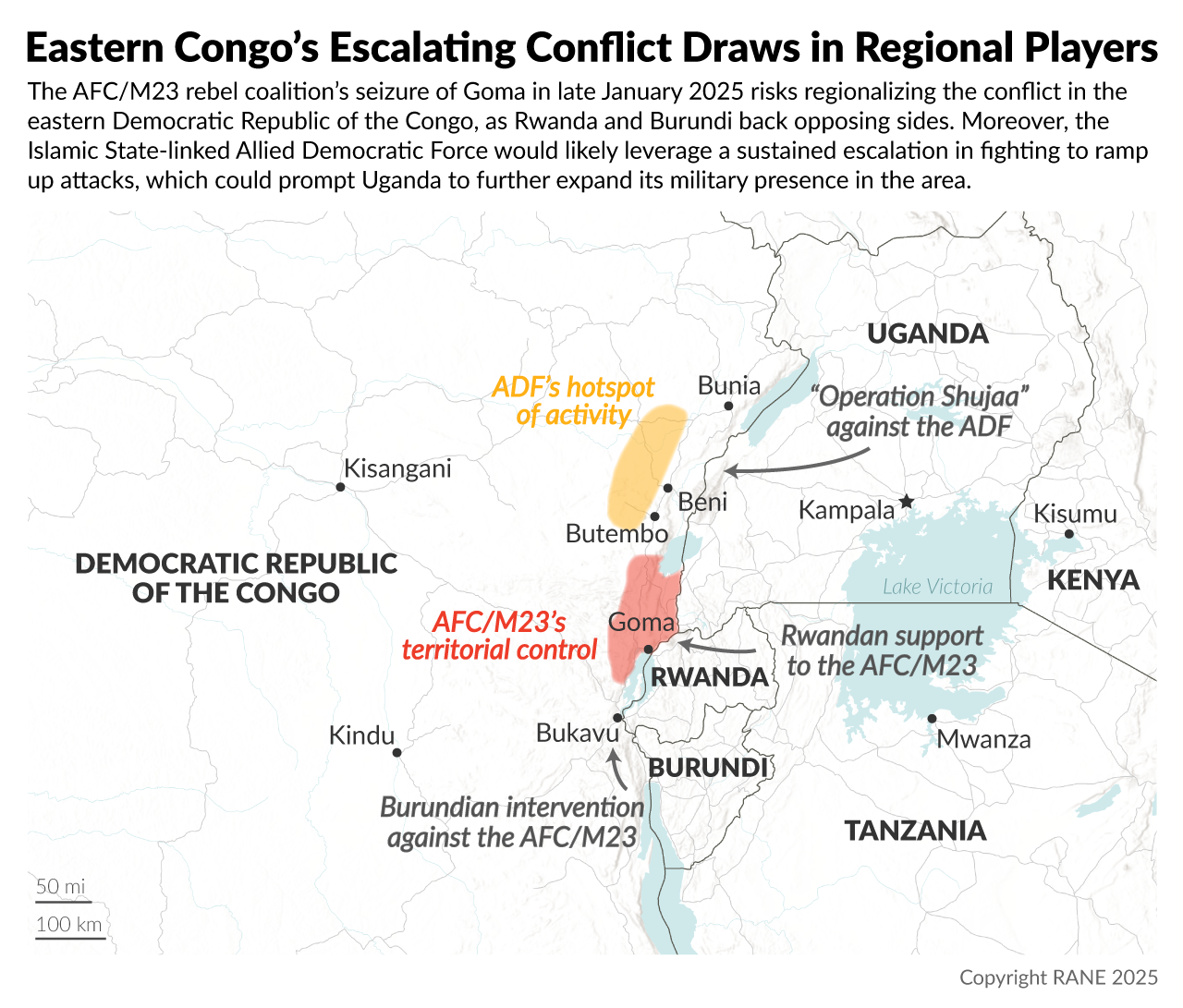
If the AFC/M23 sustains or resumes offensive operations against the Congolese military, it will likely focus on advancing toward Bukavu; but to mitigate international backlash, Rwanda may direct the rebel coalition to refrain from capturing the city prior to making a final push to secure direct talks between the AFC/M23 and Tshisekedi's government. Should the rebel coalition decide to sustain/resume large-scale offensive operations in response to the Congolese government's continued refusal to enter direct talks, it will likely focus on progressing toward Bukavu, which holds symbolic and strategic importance as it is the second largest city in the Kivu region and is located directly on the border with Rwanda. The group's first objective would likely be capturing the town of Kavumu, which is located an estimated 40 kilometers south of the current frontline and 30 kilometers north of Bukavu. Importantly, capturing Kavumu would enable the AFC/M23 to deny the Congolese military access to Bukavu airport, which is located in the town. This would reinforce the rebel coalition's advantage over the Congolese military by forcing it to launch airstrikes from airports located further afield, leading to slower response times, while also hindering the Congolese government's efforts to reinforce its defensive position in Bukavu. However, Rwanda may instruct the group to stop short of launching a full-scale offensive on Bukavu itself before attempting a last push to secure the start of direct talks between the AFC/M23 and the Congolese government. Indeed, the Rwanda-backed rebels' capture of Bukavu could potentially have a highly destabilizing impact on the Congolese government, for example by triggering violent unrest and mounting divisions within Tshisekedi's parliamentary coalition, which could result in Western countries cutting aid and curbing economic cooperation with Rwanda. This means Kigali would likely only approve an offensive on Bukavu if Tshisekedi maintains his opposition to direct talks. Moreover, the mere prospect of Bukavu's capture could prompt Tshisekedi to finally agree to hold direct negotiations with the rebel coalition, as the loss of the city could deal an even more damaging blow to his domestic legitimacy.
The AFC/M23's launch of a large-scale offensive to capture Bukavu would likely prompt Burundi to expand its military intervention in support of the Congolese government, while the rebel coalition's capture of the city would expose Congo to mounting domestic instability, including nationwide unrest, a fracturing of the government coalition and the rising risk of a military coup. If the Congolese government maintains its opposition to direct talks with the AFC/M23 despite the rebel coalition being at striking distance from Bukavu, Kigali will likely ultimately give its go-ahead for an offensive on the city. In defending Bukavu, Kinshasa will be able to count on the military support of neighboring Burundi, which has deployed thousands of troops to the area as it considers the AFC/M23's expanding territorial control a threat to its national security. Moreover, the Burundian government will likely expand its military deployment in South Kivu should the AFC/M23 launch an offensive on Bukavu. Together with the Rwandan military's likely involvement in an offensive on the city, this means that an AFC/M23 attack on Bukavu would threaten to regionalize the conflict, potentially leading to clashes spilling over into Rwanda's western Rusizi district. If the AFC/M23 ultimately captures Bukavu, the domestic fallout could rapidly destabilize the Congolese government. As seen following the fall of Goma, violent unrest would likely erupt in Kinshasa; while Tshisekedi's Sacred Union would also risk fracturing amid disputes over the future course of the war, as certain elements within the coalition would likely favor direct talks with the AFC/M23 while others would double down on nationalistic rhetoric. Most importantly, the AFC/M23's capture of Bukavu would worsen already low morale among Congolese soldiers, potentially leading to mutinies and/or a military coup. In a low-likelihood, high-impact scenario, coup leaders could fail to establish control over the entirety of the country due to fractures within Congo's military and political establishment. This would de facto divide Congo between different regional brokers vying for power and likely severely deteriorate the security environment nationwide. Against this backdrop, regional countries other than Rwanda, such as Uganda and potentially Angola, may rapidly expand their engagement inside Congo, including militarily, to mitigate the risk of violence spilling into their territory.
- The Burundian government has reportedly deployed around 10,000 troops to eastern Congo. Burundi closed its border with Rwanda in January 2024 after it accused Kigali of supporting the RED-Tabara rebel group, which has launched deadly attacks inside Burundi. While Rwanda has rejected these accusations, U.N. experts have found that the RED-Tabara has benefited from support from Kigali, including through recruitment, logistics and the movement of militants through Rwanda.
- Uganda has led joint operations with the Congolese military against the ADF in the North Kivu and Ituri provinces since 2021 through ''Operation Sujaa.'' The Ugandan military has also expanded its military presence in northeastern Congo since the start of 2025 in coordination with the Congolese military following the recent AFC/M23 advances. However, Uganda could unilaterally expand its military presence within Congolese territory should it consider the Congolese government uncooperative or on the brink of collapse.
- Angola does not currently have a fighting force deployed in Congo, but the country played an active role during the First and Second Congo wars in the 1990s and the early 2000s. Angola could notably seek to secure a buffer zone along its border with Congo and strengthen ties with regional power brokers in the mineral-rich Katanga region, which is critical to the development of the Lobito Corridor — a flagship project that aims to upgrade the railway connecting the region to Angolan ports.
