
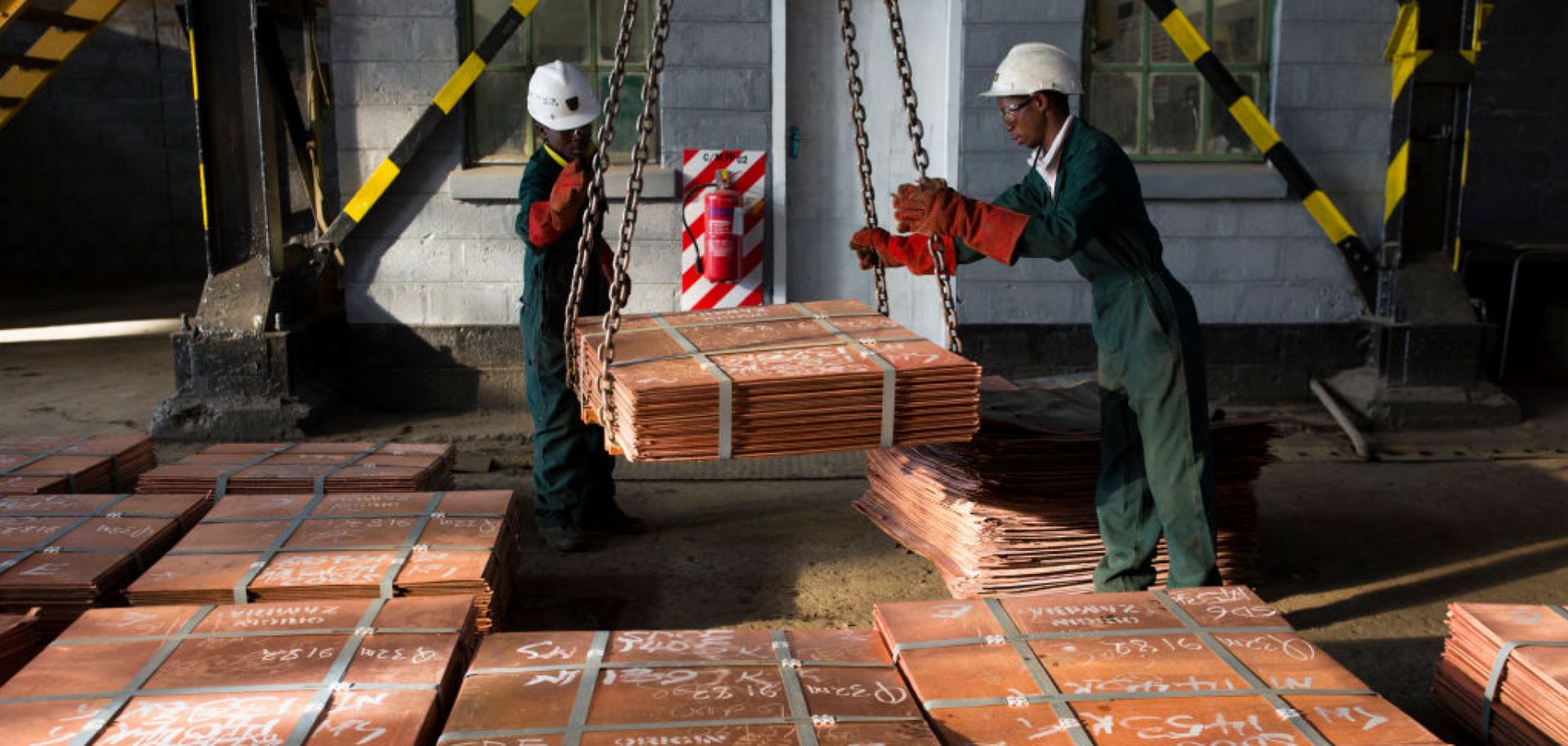
Zambia's copper output will likely steadily increase by the late 2020s on the back of a more stable tax environment and a global rush for critical minerals, but the country faces an uphill battle to meet its 2032 copper production target amid power supply shortfalls and lingering investor concerns about government interventionism. On Oct. 16, reports emerged that Saudi Arabia's Manara Minerals was in advanced talks to press ahead with a $1.5 billion to $2 billion investment for a stake in Canadian miner First Quantum's copper and nickel assets in Zambia. This comes amid growing interest by international investors in the southern African country's copper sector, as shown by Canadian miner Barrick Gold’s announcement of a $2 billion investment to expand its Lumwana mine in October 2023 and a $1 billion investment by Chinese miner CNMC in the Chambishi and Luanshya mining projects in September 2023. Moreover, U.S.-based miner KoBold Metals signaled its intent in February to fast-track the development of the $2.3 billion Mingomba copper mine, which would produce 300,000 tons of copper yearly once fully operational. These pledges align with the Zambian government's goal to increase copper production from around 700,000 tons in 2023 to 3.2 million tons in 2032, which based on 2023 production levels would make Zambia the world's second-largest producer of copper behind Chile.
- Zambia's 2023 copper output represents 4% of global supply and makes the country the world's 10th largest copper producer and the second largest in Africa after neighboring Democratic Republic of Congo.
- Zambia's total copper reserves remain unknown, as around 45% of the country is still geologically unmapped, while the other 55% was mapped before 1998. However, fresh exploration efforts are being advanced by both the government and private sector.
Resurging investor interest in Zambia's copper sector comes as the green energy transition is set to fuel a rapid increase in global copper demand, which the Zambian government has sought to capitalize on by stabilizing the country's tax regime. Recent findings by Australian mining giant BHP project that global demand for copper is due to increase by more than 40% through 2035 from 2021 levels, requiring $250 billion in investments over the next 10 years to meet the supply gap. Expectations of rapidly rising copper demand, together with an already 80% increase in copper prices since early 2020, have prompted miners to seek opportunities in frontier markets. In this context, the high grade of copper deposits found in Zambia's Copperbelt Province makes the country a particularly attractive destination for international investors, especially given the progressive decline in output of higher-grade mines in more advanced economies. While copper has shaped Zambia's economy since its independence in 1964 and remains the main source of export revenue, President Hakainde Hichilema's plans to more than quadruple production come as the country's copper output has broadly stagnated since 2010 due to resource nationalism and underinvestment. During his time in office from 2015-2021), former President Edgar Lungu raised taxation on miners and severely undermined investor confidence by effectively nationalizing the Copperbelt's two largest copper mines, Konkola and Mopani. To regain mining companies' trust, Hichilema's government reduced tax levels and pledged to maintain a stable taxation regime with the goal of attracting fresh investments to boost copper production. In doing so, the government is looking to increase fiscal revenue, which would shore up Zambia's finances as it recovers from its 2020 debt default while also providing fresh cash flow to expand development initiatives.
- In 2023, copper products, including copper ore, refined copper and copper wires, represented over 70% of Zambia's export earnings.
- Mines producing high-grade copper are on average cheaper to operate, have a smaller carbon footprint and are more resilient to volatility on international copper markets, as less ore needs to be mined to produce a similar quantity of copper, causing less energy to be consumed compared to mines with lower-grade ore. This plays a critical role in investors' interest in Zambia's Copperbelt Province, as the region's copper ore is generally higher grade than that in the country's Northwestern Province.
- In 2019, the Lungu government put a subsidiary of India’s Vedanta Resources in provisional liquidation after accusing it of lying about expansion plans and paying too few taxes. In 2023, the Hichilema government agreed to return the mine to the Indian mining company.
Zambia will face an uphill battle in meeting its 2032 copper production target as concerns over government interventionism and challenges facing its power sector will likely lead to lingering hesitancy from some investors. While Hichilema has attracted some fresh investment in Zambia's copper sector, concerns about government interventionism persist. More confident of its bargaining position owing to higher copper prices, the Zambian government announced in August that it would set up a special purpose vehicle that will hold a stake of at least 30% in critical mineral mines, including copper. Zambian Mines Minister Paul Kabuswe later said the government would retain majority ownership of certain "promising" mining licenses identified in an ongoing aerial geophysical survey. The government's efforts to capitalize on an expected increase in copper production risk deterring international investors from advancing new mining projects, which are critical to the government's ability to reach its 2032 copper production goal. Leading mining companies have warned the government that passing legislation that is currently under consideration and would grant the state free carried interest in the mining projects deemed critical would deliver a "fatal blow" to the country's plans to ramp up its copper output above 3 million metric tons annually by 2032. Adding to the copper sector's challenges, mining companies are also concerned about the reliability and affordability of electricity. Zambia generates more than 80% of its electricity using hydropower, leaving the country exposed to severe power shortages during droughts. Although Hichilema's government has advanced plans to diversify Zambia's power supply by rolling out wind and solar power, the country's heavy reliance on hydropower will persist for the next several years. Given the rising frequency of severe droughts due to climate change, this portends persistent hurdles for international miners, as disruptions to Zambia’s domestic power production will force miners to rely on more expensive power imports or diesel generators if they wish to keep operating.
- Zambia has experienced severe drought since the start of 2024 that has seen some households in the dark for more than 20 hours. While the government has sought to shield the copper sector, state-owned utilities company Zesco warned miners that 40% of their power supply was subjected to emergency restrictions.
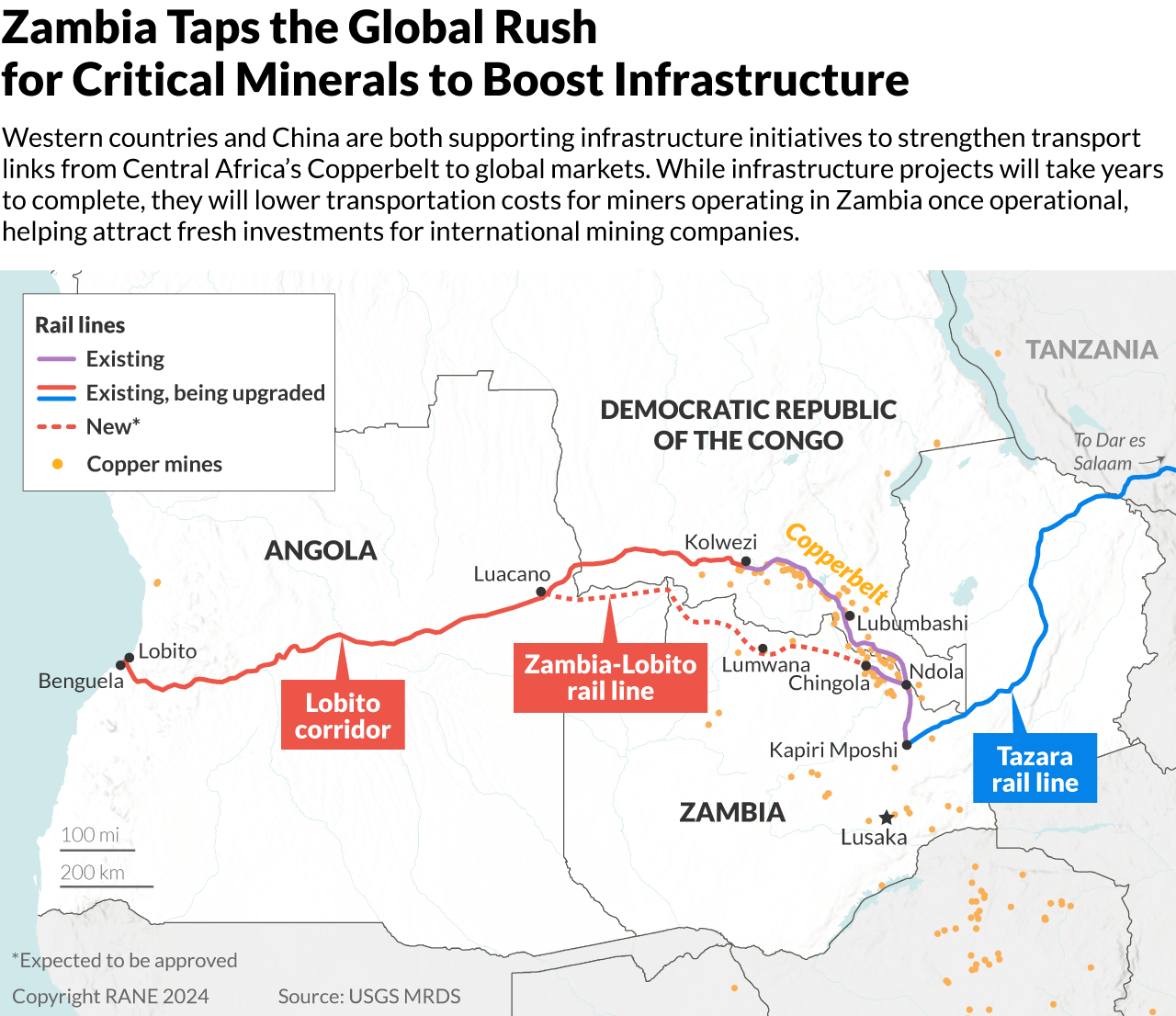
Despite steep challenges to meeting its 2032 copper production target, Zambia's copper output is likely to steadily rise through the late 2020s amid fresh investments prompted by expectations of rising copper prices and declining transport costs owing to U.S., European and Chinese investment initiatives in regional rail and port infrastructure. Copper prices are likely to remain elevated and could rise further despite China's slowing economic growth as the energy transition progresses in advanced and middle-income economies. While concerns about government interventionism in Zambia are likely to linger, the growing supply gap on international copper markets is set to gradually tilt mining companies' cost-benefit analysis in favor of investing in the country's copper sector. Investment initiatives led by the United States, the European Union and China to upgrade regional transport infrastructure are likely to further strengthen the sector's appeal. The global race for critical minerals, many of which are found in Zambia and the neighboring Democratic Republic of the Congo, has prompted the United States and the European Union to support the development of a transport initiative known as the Lobito Corridor project. The initiative, which first focused on renovating the railway that connects Congo's mineral-rich Katanga region to the Angolan port of Benguela, has now been extended to Zambia through the Lobito-Zambia rail project, for which construction is due to begin in early 2026 and be completed by 2029. In parallel, Beijing signed in September a $1 billion agreement with Tanzania and Zambia to refurbish the aging Tazara railway, a critical supply route that connects central Zambia to the port of Dar es Salaam, by late 2026. The two projects will play a decisive role in providing cheaper, faster and more reliable transport to miners operating in Zambia by reducing their reliance on road transport and South Africa's railways, which have faced growing traffic bottlenecks in recent years. Hichilema's commitment to a stable tax regime, expectations of declining transportation costs and persistently high copper prices will likely prompt foreign investors to expand existing mines and pursue greenfield projects, meaning Zambia will likely experience a steady increase in its copper output through the end of the decade, enabling it to shore up the country’s finances and advance new development initiatives.
- In September, the Africa Finance Corp. signed concession agreements with Angola and Zambia regarding the financing, construction, ownership and operation of the Benguela-Zambia rail line. Prior to that, the U.S. Trade and Development Agency forwarded the Africa Finance Corp. a $2 million grant to complete environmental and social impact assessments.
Zambia is likely to capitalize on its growing strategic importance to Western countries and China to expand mineral beneficiation that will likely enjoy some success in the long-term, but progress is set to be slow. If Lusaka responds with more coercive measures to increase processing and refining, this would undermine the country's plans to meet its 2032 copper production targets. In addition to expanding Zambia's copper production, Hichilema's government has sought to develop mineral beneficiation, for example by increasing cathode production. Efforts to move up the value chain have involved advancing plans for a joint special economic zone for the production of electric vehicles and batteries with neighboring Congo, from which more than 70% of cobalt is sourced globally. While unlikely to meet its lofty goals, the initiative is likely to enjoy some support from China and Western countries as both curry favor with the Zambian government to secure mining contracts for their respective companies. Lower transport costs and a more reliable power supply will help Zambia inch up global green supply chains by the early 2030s, for example through the production of copper wires and cables. Moreover, the joint initiative with Kinshasa is likely to disproportionately benefit Zambia as most investors continue to minimize investments in Congo beyond mineral extraction due to the country's degraded security environment, political instability and corruption. However, progress in advancing copper processing and refining is likely to be slow, as improvements to electricity and transport costs will take several years to materialize. This is likely to be a source of frustration for Zambian officials, and could prompt Lusaka to depart from its current incentives-based approach to support mineral beneficiation to a more coercive one involving local transformation requirements or higher taxes on the export of unprocessed copper ore. While miners will likely be willing to accept some local transformation requirements, a rapid pivot to resource nationalism would deter many foreign investors from pressing ahead with investments in the country's copper sector, threatening to put Zambia's 2032 copper production target out of reach.
- In October 2023, the European Union signed a critical mineral partnership with Zambia in Congo that included plans to support the development of critical mineral value chains between the signatories and advance knowledge sharing regarding the processing of critical minerals.
