
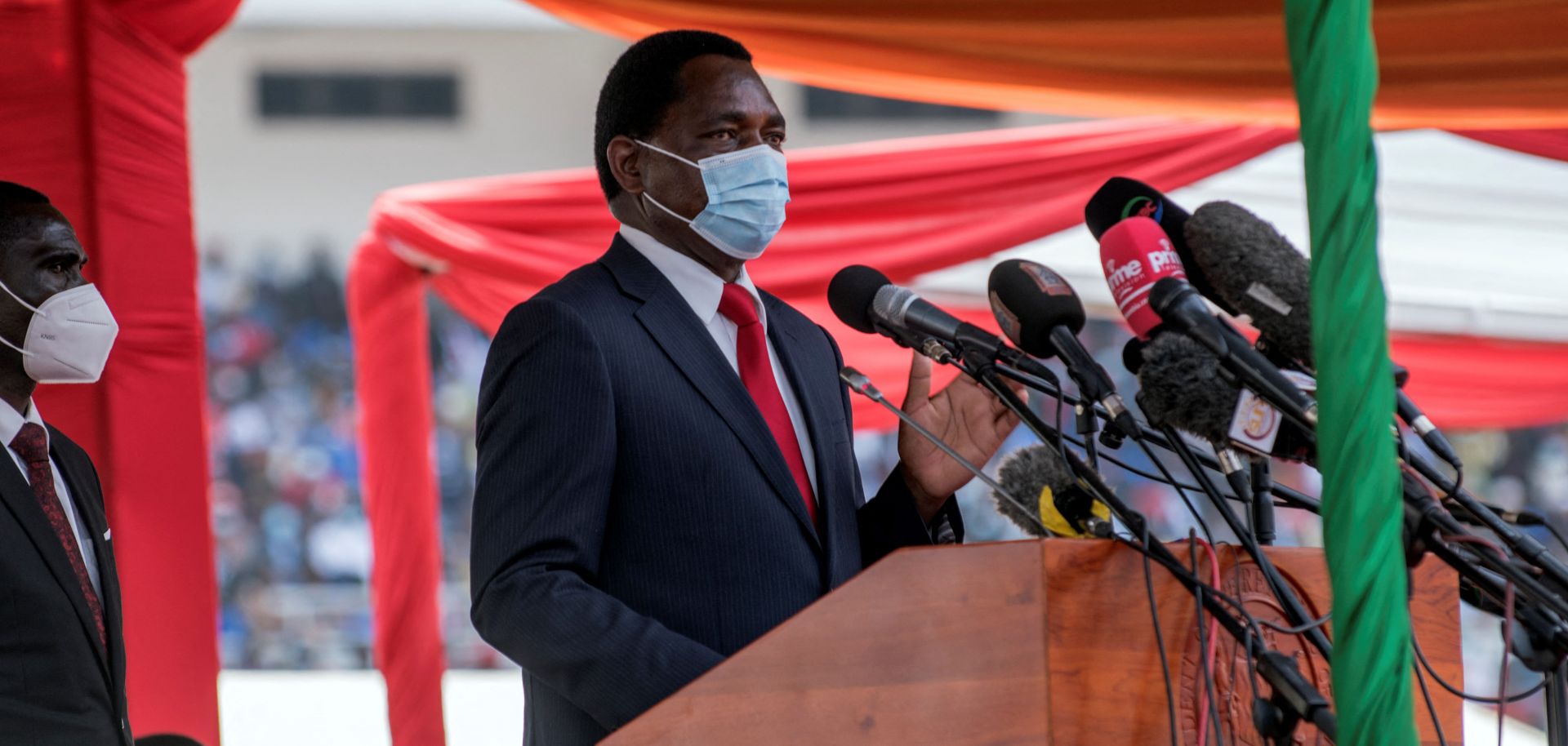
Newly elected Zambian President Hakainde Hichilema delivers a speech during his inauguration at the Heroes Stadium in Lusaka on Aug. 24, 2021.
Ongoing negotiations to restructure Zambia's debt are most likely to end in a compromise that will offer insight into China's potential position in other countries' creditor talks, especially if Beijing decides to grant debt forgiveness to Lusaka. On July 30, Zambia's bilateral creditor committee co-chaired by China and France released a statement committing to negotiating with the Zambian government under the terms of the Group of 20 (G-20) Common Framework. Zambia's finance ministry also announced on July 29 that it will cancel $2 billion in undisbursed loans from Exim Bank of China, Jiangxi Bank, Intesa Sanpaolo Bank and Israel Discount Bank, marking the first update on Zambia's multilateral debt negotiations in months. The cancellation of undisbursed funds is tangential to the ongoing restructuring talks over Zambia's estimated $32 billion in debt (money that has already been spent by the Zambian government). But China's participation under the G-20 Framework and willingness to engage — even if only over undisbursed loans — could bode well for future talks. Given that Zambia was the first African country to default on its debt in the COVID-19 pandemic era, and is also the first country to have China co-chair its debt committee, the outcome of debt negotiations will provide a case study for understanding how China could treat restructuring in other African contexts.
- The International Monetary Fund (IMF) awarded the Zambian government a $1.4 billion support package in December 2021, but the IMF review board will not give final approval for disbursement to occur until Zambia's creditors agree to a restructuring package.
- A consortium of approximately 18 different Chinese creditors holds a total of $6.6 billion in Zambian debt, accounting for about a third of Zambia's external debt sources. China's commitment comes after months of delays in attempting to restructure Zambia's $32 billion debt (120% of GDP, $17 billion of which is external), during which China was widely perceived to be the lone holdout.
- In April, China agreed to Zambian debt negotiations under the Common Framework debt restructuring process, which the G-20 launched in response to the COVID-19 pandemic. The Common Framework seeks to restructure low-income countries' unsustainable debt on a case-by-case basis, bringing together bilateral creditors in a coordinated process.
- An estimated 45% of Zambia's total external debt is owed to external private lenders (excluding China), 37% to Chinese lenders (public and private), 8% to other governments, and 10% to multilateral lenders. Zambia's external debt service in 2021 was 45.9% of government revenue.
- In November 2020, Zambia formally defaulted on about $3 billion in eurobonds after a 30-day grace period to pay a $42.5 million coupon due in October ran out, becoming the first African country to default since the onset of the Continent's COVID-19 crisis.
The Zambian government is pursuing domestic reforms to service its debt and achieve growth, but cooperation with Western and Chinese creditors is essential for long-term debt sustainability. Since Zambian President Hakainde Hichilema took office in 2021, he has embarked on a domestic reform agenda to accompany external debt restructuring. As part of the reform package, Zambia will cancel more than $2 billion in projects financed by commercial loans to reduce the risk of racking up more non-concessional debt. The Zambian parliament is also debating a Public Debt Management bill that caps total borrowing at 65% of GDP. On July 9, the country's finance ministry also announced plans to fund social programs with tax increases in an effort to keep the Zambian economy on track to meet its targeted growth rate of 4.4% by 2025. While such measures have had a positive impact on Zambia's growth outlook, the country's ability to service its debt in the long term hinges on inking deals with external creditors.
- The Public Debt Management bill mandates that total government borrowing cannot exceed 65% of the previous year's GDP, and that the cost of serving external debt cannot exceed 20% of average annual recurrent revenues of the prior three years. Under the bill, all government agencies would also be required to receive written approval from the Treasury Secretary before taking on new debt or face up to five years in prison.
The slow progress in negotiations appears to be due to coordination problems, lack of transparency, and likely disagreement between Chinese and Western governments on debt relief measures. Opaque loan terms, private contracts and hidden debt are common challenges in negotiating Chinese loans, and the same is true in Zambia. Lack of transparency in Chinese contracts has made Western bilateral creditors weary of Chinese commitments to debt restructuring, although it is also likely that Chinese negotiators themselves are experiencing difficulty coordinating the disparate creditors belonging to Chinese state institutions and private companies as they navigate negotiations for the first time. As Zambia is China's first foray into debt restructuring under the G-20 framework, previous debt negotiations have limited applicability to China's position on Zambian talks. However, Sri Lanka and Pakistan's recent attempts to pursue debt forgiveness with China have illustrated Beijing's tendency to restructure loans rather than to forgive them, in contrast to most Western creditors. Chinese restructuring often means extended time horizons, so that while the immediate debt servicing costs are postponed for the borrower — thereby averting default — the debtor country ends up paying more interest in the long term. In other cases, such as Pakistan, China addressed debt sustainability by granting new loans to cover old ones without dipping into foreign currency reserves. China's finance ministry is the biggest shareholder of policy lenders like China Development Bank and Exim Bank, which means that it will suffer the losses of write-offs and restructuring interest-free loans, which could explain the reported hesitancy.
- The following Chinese creditors have given loans to the Zambian government from 2001 to 2019: China International Development Cooperation Agency; Eximbank of China ($5 billion); Eximbank/ICBC ($1.5 billion); China Development Bank ($.5 billion); Industrial and Commercial Bank of China (1.5 billion); and the Bank of China ($.4 billion). Zambia also received $1.3 billion from various other, smaller Chinese creditors during this time period.
- In 2020, China agreed to defer payments on an undisclosed amount of loans to Zambia in bilateral negotiations.
- On June 24, Pakistani Finance Minister Miftah Ismail announced that a consortium of Chinese state banks had agreed to give Pakistan's central bank $2.3 billion in new loans as a way of rolling over $2 billion in previous loans coming due in June and July.
- In 2018, China forgave some existing interest on a 10-year $4 billion loan for an Ethiopian railway, but also extended the loan's repayment term by 20 years.
While the Zambian finance ministry's recent cancellation of undisbursed loans shows Chinese willingness to make concessions, China's economic slowdown and concerns over setting costly precedents may curtail the extent to which China is willing to extend debt forgiveness, thereby making some form of compromise the most likely outcome. In February, local activist organizations and the Jubilee Debt Campaign U.K. estimated that Zambia had the capacity to repay between $2.8 billion and $3.5 billion of debt over the next 14 years, leaving the remainder for external and/or domestic creditors to write off. This would mean that some private and bilateral lenders would have to forgive the majority of their loans, which appears unlikely given Chinense lenders' histories. China's recent economic downturn likely further reduces the possibility of ''haircuts,'' as alleviating foreign debt could come with domestic political costs and additional economic constraints. Additionally, Reuters reported on May 31 that a source involved in negotiations said that China's central bank is willing to move ahead. But China's finance ministry has been wary of setting a costly precedent — in particular for Chinese development banks — if it grants large concessions by way of a debt write-off, or ''haircuts'' to Zambia. On the other hand, Beijing has spent billions on its political and economic influence campaign in sub-Saharan Africa in recent decades, which means that — despite the myriad factors constraining debt forgiveness — it is unlikely to abandon negotiations in Zambia due to the negative message it would send to its African partners. As negotiations stretch on and the disbursement of the $1.4 billion IMF package becomes more urgent, it is possible that Western creditors will be more willing to accept Chinese concessions falling short of write-offs, making some combination of relief the most likely outcome.
- Zambian Finance Minister Situmbeko Musokotwane told reporters in May that the relief program could require a ''haircut,'' stretching the payment period, adjusting interest rates, or some combination of these measures.
The Zambian negotiations will provide other borrowers with a sense of how China could handle debt talks in the future, particularly in Africa. Over the next seven years, 35% of African governments' external debt service is due to non-Chinese private lenders, compared with 19% due to Chinese lenders. Even so, China's role in debt restructuring will become increasingly relevant for particular cases in which China owns a large proportion of debt, especially as the list of African countries at high risk of debt distress grows. Angola, Ethiopia and the Republic of Congo are three cases that meet both criteria, as each country has a high percentage of external Chinese debt and faces a high risk of default. Of these three, Ethiopia is the only country pursuing debt restructuring under the G-20 Common Framework and therefore likely has the most to glean from China's position on Zambia. Given the differences in debt composition, Zambian negotiations do not represent a ''one-size-fits-all'' approach. However, the results of the Zambian creditor committee's negotiations could provide insights into how willing China may be to forgive (rather than restructure) debt if and when defaults occur.
- Ethiopia's $44 billion of public debt is increasingly difficult for the government to service, given rising inflation and its depreciating currency. China accounts for an estimated $13.7 billion (almost a third) of Ethiopia's total public debt, and Addis Ababa spends almost twice as much to service Chinese debt than private debt. China has a key role to play as Ethiopia also attempts to secure debt restructuring under the G-20 Common Framework.
