
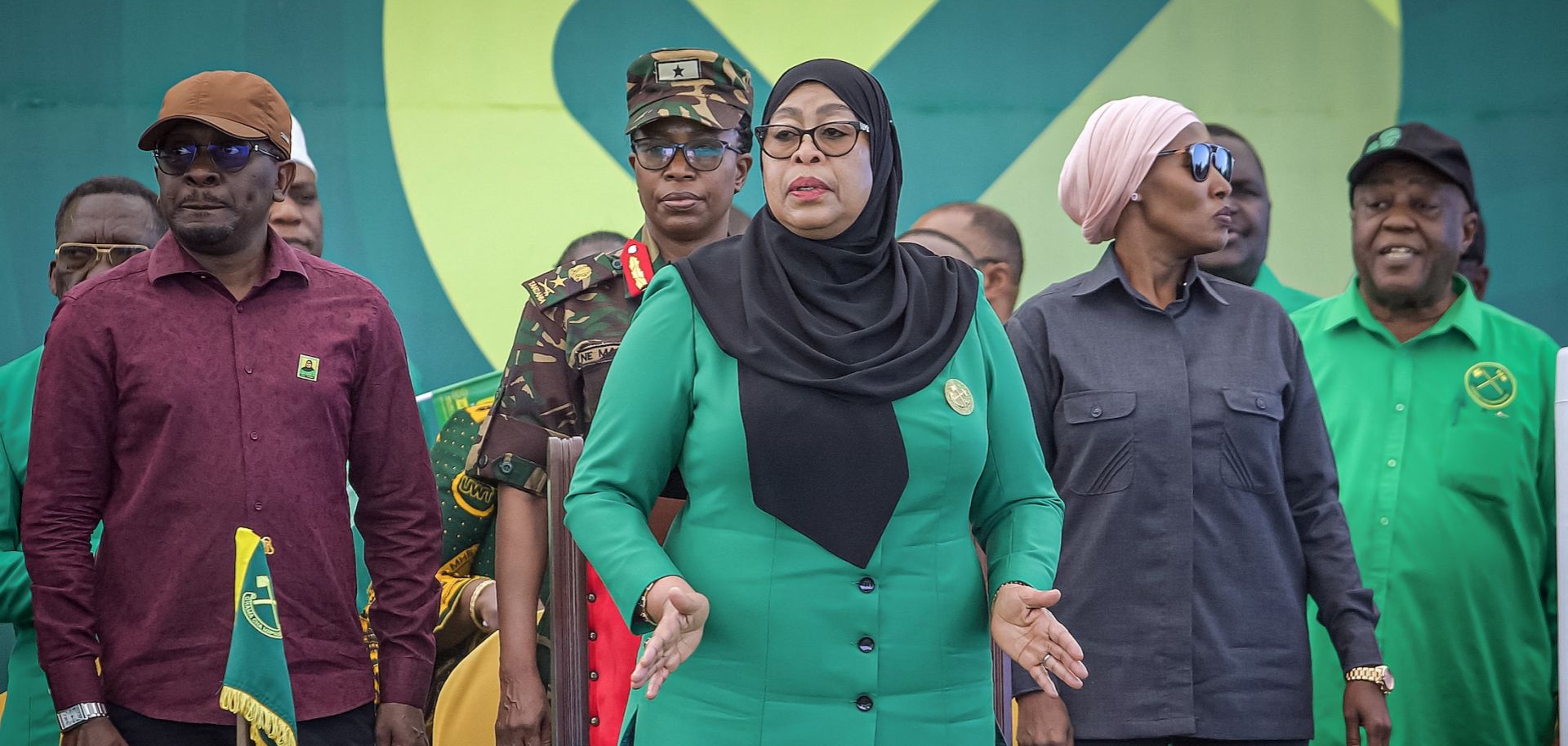
Tanzanian President Samia Suluhu Hassan is highly likely to be reelected in Tanzania's Oct. 29 general elections, and while her sidelining of opposition forces threatens to trigger potentially violent demonstrations, these are unlikely to pose a threat to her second term, set to focus on advancing constitutional reforms and infrastructure projects. On Oct. 10, Hassan stated at a campaign rally for her Chama Cha Mapinduzi party, or CCM, in the northern Mara region that she would press ahead with constitutional amendments should she be elected for a second term. Hassan's comments built on previous pledges made since taking office in 2021, when she accepted opposition demands for a constitutional review, though precise details have yet to be laid out. But while Hassan's recent comments were likely aimed at shoring up her reformist credentials, authorities have barred the country's two largest opposition parties — Chadema and the ACT-Wazalendo — from challenging Hassan in the race for the presidency. Abductions of Hassan's critics have continued at pace, with over a dozen Chadema members reportedly kidnapped in early October ahead of the start of the trial of Chadema leader Tundu Lissu on treason charges. Notably, abductions have also targeted members of the CCM itself, with former Tanzanian ambassador to Cuba and Hassan critic Humphrey Polepole reportedly abducted in early October.
- Tanzania's general elections will see Tanzanians vote to elect a new president, often referred to as the union president, members of the country's unicameral National Assembly and councilors. The president is elected with a first-past-the-post voting system.
- In May, Tanzania's Electoral Commission announced that elections for the National Assembly would take place in 272 constituencies — 222 on the Tanzanian mainland and 50 in the semi-autonomous archipelago of Zanzibar. Lawmakers representing constituencies are elected with a first-past-the-post voting system. In addition to constituency seats, special seats are reserved to ensure that at least 30% of National Assembly lawmakers are women, allocated based on each party's number of constituency seats.
- In Zanzibar, the general elections will also involve the election of a new President of Zanzibar, as well as lawmakers for the territory's House of Representatives. The president of Zanzibar and lawmakers of the House of Representatives are elected using first past the post.
Hassan has reversed much of the political liberalization she initiated after taking office in a bid to consolidate power amid backlash from the CCM's old guard, effectively resulting in an uncompetitive presidential race. After taking office in 2021 following the death of her predecessor, President John Magufuli, Hassan advanced a number of political liberalization measures, including lifting bans on certain media outlets, enabling the return of exiled opposition leaders such as Lissu and entering into political dialogue with opposition parties, including Chadema. However, these moves drew the ire of the CCM's old guard — which has effectively ruled Tanzania since independence in 1961 — over concerns that they would threaten the party's hold on power. This prompted Hassan to gradually depart from her political liberalization agenda, a process which was accelerated following Chadema's organization of protests in early 2024. While Hassan's authoritarian turn sought to appease CCM grandees, she also asserted her own leadership by sidelining rivals. Hassan's escalating crackdown on critics within and outside the ruling party enabled her to secure a landslide victory for the CCM in the November 2024 local elections as well as the party's presidential nomination in January. Against this backdrop, Chadema vowed to boycott the general elections and launch demonstrations in the absence of electoral reforms ensuring a level playing field. This ultimately resulted in Lissu's arrest in April, with Chadema barred from running in the general elections shortly after. Meanwhile, ACT-Wazalendo's candidate for the union presidency, Luhanga Mpina, was also barred from running in September, though the party has been able to file candidates in a significant number of constituencies as well as for Zanzibar's presidential race. While Hassan will be facing 16 contenders in her bid for a second term, the latter are running on behalf of small parties and lack nationwide prominence, which, together with the CCM's leveraging of state resources effectively, makes the race for the union presidency uncompetitive.
- The CCM was formed in 1977 as a merger between the Tanganyika African National Union, or TANU, and the Afro-Shirazi Party. Prior to that, TANU had governed the Tanzanian mainland since independence in 1961, while the Afro-Shirazi Party governed Zanzibar from 1964 onwards in coordination with TANU and Tanzania's first president, Julius Nyerere.
- In February 2024, the Tanzanian government adopted three electoral reform bills that Hassan pitched as being part of her political liberalization agenda. However, the reforms were deemed insufficient by Chadema and several other opposition forces on the basis that the president retained the power to appoint members of the electoral commission.
- Lissu's treason charges are non-bailable and carry the death penalty, but the opposition leader also faces accusations of incitement of violence and publishing false information. In June, a Tanzanian court issued an order restricting Chadema's day-to-day activities.
Despite persistent pushback against her leadership from within the CCM, Hassan is highly likely to be reelected for a second term and secure a large parliamentary majority for the ruling party, while ACT-Wazalendo will likely gain some parliamentary representation in Zanzibar. Although Hassan's authoritarian turn has quelled backlash from CCM hardliners, her efforts to consolidate control over the party have only been partly successful, with elements within the CCM disapproving of her policies and management of party affairs. These internal tensions came to the fore during the CCM's parliamentary and councilor primaries, finalized on Aug. 23, during which violence broke out on several occasions, a highly unusual turn of events. While local rivalries between different CCM candidates and their supporters were an important driver, discontent with Hassan's leadership from elements within the party is likely to have compounded tensions. Despite dissatisfaction with Hassan likely extending to parts of the security apparatus, the exclusion of Chadema and ACT-Wazalendo from the race for the union presidency means that she is highly likely to be reelected in a landslide. Meanwhile, the CCM is likely to secure a large parliamentary majority owing to its access to state resources, strong party structures and control over much of the media landscape. Despite the deployment of election observers from the European Union, East African Community (EAC) and Southern African Development Community (SADC), electoral manipulation from CCM and local election officials remains likely in many localities, given logistical constraints facing election observers and likely curbs on their mobility. Nonetheless, ACT-Wazalendo is likely to secure parliamentary representation in Zanzibar, given its strong local support and the territory's semi-autonomous institutions. Hassan will likely be open to ACT-Wazalendo gaining some parliamentary representation, given that the party has adopted a less confrontational stance to her rule than Chadema. ACT-Wazalendo's ability to gain some parliamentary representation would also enable the CCM to portray some semblance of competitive politics, thereby helping it mitigate criticism from Western countries.
- Reports indicate that there is significant discontent from parts of the CCM with Hassan's nomination as the party's presidential candidate in January, which several have claimed did not follow the CCM's normal nomination procedure. CCM lawmaker Josephat Gwajima, who is also a bishop, continues to voice criticism of Hassan's leadership and growing abductions in the country. This prompted the government to order the closure of Gwajima's church in June, after which security forces broke up gatherings of congregants who were protesting the church's closure.
- Hassan's rule has seen four heads of intelligence services, an unprecedentedly high turnover that suggests that Hassan is struggling to assert her authority over Tanzania's intelligence community. Gwajima has claimed that this turnover is linked to appointees resisting demands by Hassan to press ahead with abduction campaigns.
- Zanzibar's institutions ensure power-sharing between the territory's two largest parties, which in the 2020 general elections were the CCM and ACT-Wazalendo. These power-sharing provisions guarantee that the second party secures the position of first vice-president as well as positions in cabinet. The Zanzibar Election Commission is distinct from the Tanzanian mainland's electoral commission.
- In May, Tanzanian authorities blocked access to X in the country. Many traditional media outlets have resorted to self-censorship and promotion of the government's agenda to continue their activity.
Discontent with the organization and outcome of the general elections will threaten to trigger anti-government demonstrations, but they are unlikely to pose a credible threat to Hassan's rule as crackdowns on potential protesters and apathy from many Tanzanians will likely curb turnout at demonstrations. During and after polling day, tensions are likely to rise in several localities amid expected allegations of electoral manipulation from opposition supporters. This will threaten to trigger scuffles at polling centers, which would increase the risk of demonstrations, especially if allegations of voter fraud are widespread. Moreover, the electoral commission's expected announcement of Hassan's reelection could trigger sporadic gatherings from disgruntled youths, which would risk turning violent. The likelihood of protests will be higher in Zanzibar, as ACT-Wazalendo's strong local support raises the prospect of narrower margins of victory for the CCM in the territory's parliamentary and local elections and by extension the possibility of contested election outcomes auspicious for opposition demonstrations. Given these risks, the CCM is likely to continue its abduction of opposition figures in the immediate aftermath of polling day, with the goal of hindering opposition groups' ability to mobilize supporters. Moreover, security forces are likely to retain a highly visible public presence in the weeks following the election, prohibit any gatherings perceived as threatening to undermine the CCM's legitimacy and swiftly break up any such demonstration. The EAC and SADC are likely to endorse the election results as regional governments seek to retain cordial relations with Tanzania's ruling party, could further discourage demonstrators. Together with widespread apathy about the inevitability of the CCM's victory and Hassan's successes in driving economic growth, this suggests that turnout at opposition anti-government demonstrations after polling day is likely to be limited. While this does not preclude the risk of gatherings from more fervent opposition supporters turning violent and resulting in fatalities, it suggests that post-election protests are unlikely to pose a credible threat to Hassan's rule, which would ensure a relatively smooth start to her second term in office.
- The electoral commission has not unveiled a clear timetable regarding the publication of election results, but Tanzania's recent electoral cycles suggest that results will likely be announced within less than a week of polling day.
- While reports from July and August claimed that Tanzanian authorities had excluded EAC and SADC observers from the general election, the Tanzanian government ultimately invited both regional organizations to send election observers.
In a lower-likelihood, higher-impact scenario, CCM overreach in curbing the opposition could escalate post-election demonstrations into nationwide unrest, which would undermine investor confidence in Tanzania, heighten intra-CCM tensions and likely prompt Hassan to launch dialogue with parts of the opposition to defuse political tensions. While post-election demonstrations are unlikely to pose a major threat to Hassan's rule, a number of triggers could prompt protests to escalate. For example, a particularly brutal crackdown from security forces against demonstrators could drive social outrage and push more people to the streets, especially if incidents are captured on camera and come on the back of widespread allegations of voter fraud. A harsh court ruling against Lissu — due to be issued on Nov. 12 — could also act as a catalyst for demonstrations to escalate. Even though much of Chadema's leadership is detained and ACT-Wazalendo is unlikely to pivot towards frontal opposition to the CCM, the recent international momentum of Gen Z protests, including in neighboring Kenya and elsewhere in Africa, could inspire protesters to take to the streets using decentralized leadership structures. In this scenario, the Tanzanian government's initial reaction would likely be to double down on its crackdown on protesters, portending rising fatalities and a potential shutdown of the country's communication network. However, such a turn of events would undermine investor confidence in Tanzania and prompt criticism from Tanzania's Western partners. Some European countries could suspend some development aid to the country. Moreover, widespread anti-government protests would — if left to linger — likely deepen pushback within the CCM at Hassan's rule from reformist and hardliner factions alike. This suggests that nationwide protests would, if they persist for more than several weeks, likely prompt Hassan to open dialogue with parts of the opposition and civil society. In turn, Hassan could eventually pledge electoral reforms and a review of security forces' policing tactics. While the implementation of these pledges would be highly questionable, proposals to give more space to CCM critics could cause fresh damage to Hassan's relations with the CCM's old guard, which would complicate her running of government affairs through her second term.
Following her expected reelection, Hassan will focus on advancing transport infrastructure and energy projects as well as forwarding constitutional revisions, but her authority over the CCM is likely to gradually decline as different factions within the party strive for influence ahead of her expected exit from power in 2030. Absent an unexpected crisis, Hassan is likely to sustain many of her investor-friendly policies during her second term aimed at encouraging private sector growth, including by streamlining and updating regulations and supporting public-private partnerships. These efforts are set to involve the continued upgrade of Tanzania's transport network, including by extending the country's Standard Gauge Railway system from Dodoma to northern and western Tanzania as well as the refurbishment of the Tazara rail line — which connects Dar es Salaam to Zambia's copper-rich regions. Hassan's efforts to bolster the country's economy will also see her government renew its push to finalize an agreement with Western energy companies to kick-start the $42 billion Tanzania LNG project. Separately, Hassan is also likely to initiate her promised constitutional revisions, which could notably involve provisions to limit presidential powers and increase the independence of Tanzania's electoral commission — especially in the event of significant post-election protests. While it cannot be entirely ruled out that these constitutional changes will pave the way for Hassan to run for a third term, this currently appears unlikely given the major stumbling blocks — both institutional and political — that such changes would require. Although this will ensure relative institutional stability, Hassan's expected departure from power in 2030 will likely see her authority over the party gradually erode as time passes, as different factions within the CCM jockey to take over the party leadership. Resurging factionalism within the party could undermine policy certainty — and potentially see CCM hardliners hijack Hassan's constitutional revision process, which could ultimately be stalled or rendered meaningless.
- Tanzania LNG aims to tap into an estimated 47 trillion cubic feet of natural gas located off the coast of the country's southern region of Lindi and would be developed by Norwegian energy company Equinor, Anglo-Dutch oil major Shell and U.S. multinational energy company ExxonMobil. While these major natural gas discoveries were made as early as 2010, the project faced years-long delays during her predecessor's term. Hassan rebooted the project in 2022. Although pledges by Energy Minister Doto Biteko to finalize the project by October have not materialized, the end of the 2025 electoral campaign will create more conducive conditions for all parties to finalize an agreement.
- Tanzania's two-term limit for the presidency is an entrenched provision of the Tanzanian constitution, which means that amending it would require the approval of a two-thirds majority of the National Assembly and Zanzibar's House of Representatives and a nationwide referendum. The CCM's old guard has consistently rejected moves aimed at personalizing power, instead favoring party dominance through regular succession, which, together with major domestic and international backlash, would make running for a third term highly challenging for Hassan.
Avoiding major outbreaks of violence and continuing Hassan's pro-business agenda would likely sustain investor confidence in Tanzania and rapid economic growth for the next few years, but the CCM will continue to face long-term challenges to its rule that leave the door open for future unrest. While most African countries face insurgencies and/or political instability, Tanzania is relatively safe and stable compared to the continent's other heavyweights. Tanzania's perception as a relatively safe country would be reinforced in the likely scenario that Hassan is reelected without major and sustained outbursts of post-election violence, which, together with her government's pro-business agenda and advancement of transport infrastructure projects, would shore up the country's credentials in the eyes of international investors. Barring a major external shock like a steep surge in oil prices or a large decline in the prices for key non-oil commodity exports like gold and agricultural goods, this will likely enable Tanzania to sustain rapid economic growth in the first few years of Hassan's second term. While this will provide the Tanzanian government with additional revenue, the country's investment needs will remain immense over the coming decade in the face of its surging population, which will increase pressure on key services, including water and electricity, education and healthcare. Tanzania's rapidly rising population will also pressure the CCM to ensure that economic growth creates sufficient employment opportunities for the country's expanding cohort of young adults. While the CCM's power appears secured for the foreseeable future, the party faces a number of structural challenges to its rule in the medium- to long-term, which together with discontent at its authoritarianism and corruption could eventually pave the way for widespread anti-government protests if left unaddressed.
- There are no active insurgencies in Tanzania. Major security risks are largely contained to the southern Mtwara province due to the presence of Islamic State Mozambique Province cells and sporadic cross-border attacks from Mozambique.
- Tanzania's population rose from 44.7 million in 2010 to an estimated 70.5 million people in 2025. The United Nations Population Department estimated in the medium variant of its 2024 World Population Prospects that the country's population would increase to 80.9 million by 2030 and close to 104 million by 2040.
- While official statistics show that Tanzania's unemployment rate is 2.6%, local reports indicate that the real figure is closer to 9%. Informal employment and underemployment are also widespread.
