
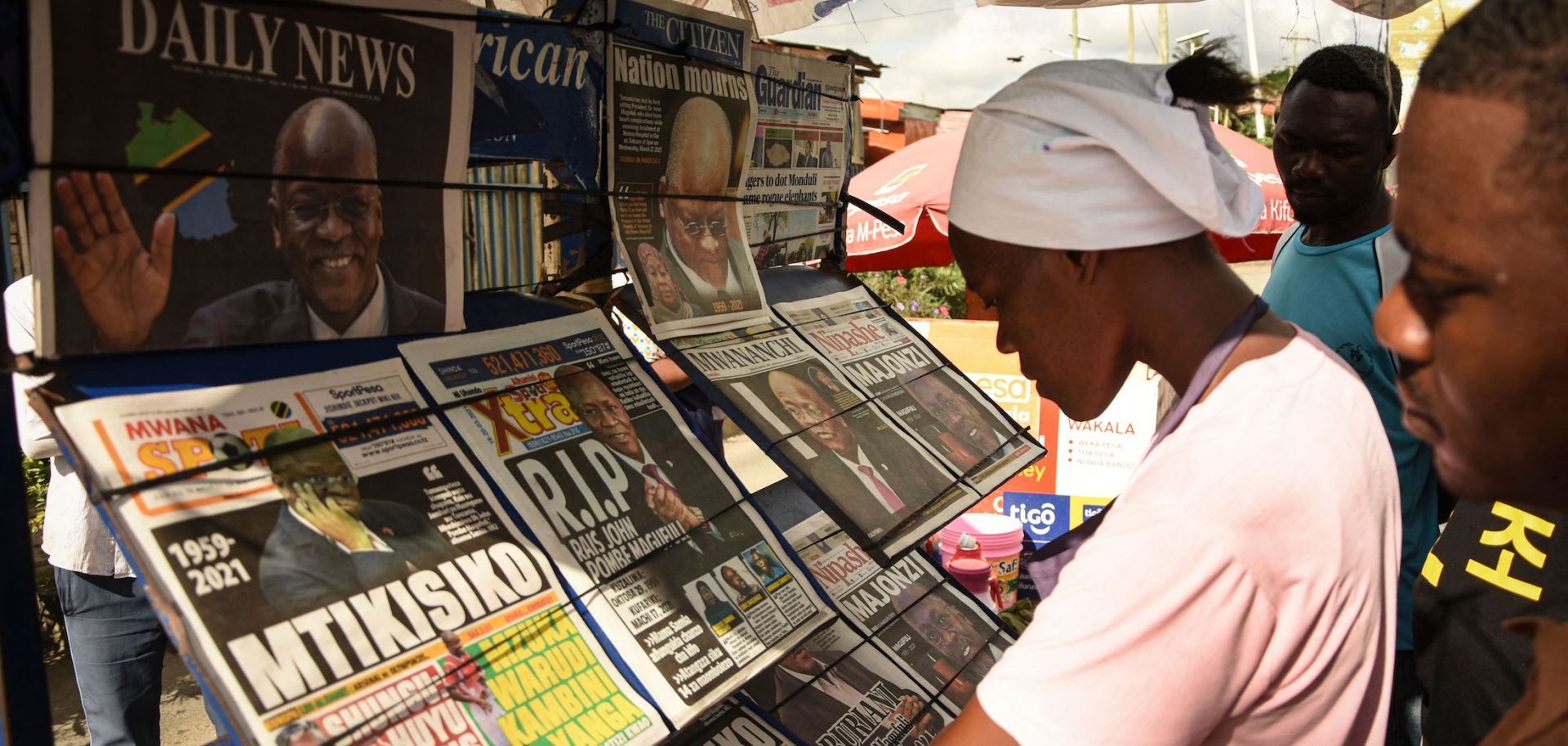
People read newspapers announcing the death of Tanzanian President John Magufuli in Dar es Salaam on March 18, 2021.
The death of Tanzanian President John Magufuli will slow but not reverse the country’s drift towards authoritarianism and China over the next few years. His passing, however, upends Tanzania’s traditional 10-year political cycle where an anointed successor is usually hand-picked by the preceding leader and the ruling Chama Cha Mapinduzi (CCM) party, which will increase continuity risks for foreign investors in the medium term. On March 17, Tanzanian Vice President Samia Suluhu Hassan announced that the 61-year-old president, who was nicknamed “The Bulldozer” for his aggressive leadership style, had died due to heart complications. Under Tanzania’s constitution, there should be a relatively straightforward handover of power to the vice president. But even having Hassan finish out Magufuli’s current term may prove contentious, as she would not only be Tanzania’s first female president but the first one born in Zanzibar.
- Magufuli had just been elected for his second (and final) five-year term last October and the next political transition was not planned to occur until 2024.
- Tanzania has yet to set a date for Hassan’s swearing-in, with the CCM calling for a special meeting of its central committee on March 21 to discuss next steps.
- Because Magufuli died with more than three years remaining in his five-year term, Hassan would be eligible for re-election only once if she finishes the remainder of Magufuli’s term.
- Magufuli’s death also creates a vacuum at the head of CCM, as Tanzania’s president is also usually the party’s chairman.
The CCM will maintain its stronghold on Tanzania's political system, but if Hassan assumes the presidency, she will likely be a relatively weak leader compared with Magufuli and his predecessors. Tanzania is technically a union of mainland Tanzania (the former British colony of Tanganyika) and Zanzibar (the former British protectorate), with each still having autonomous control over local issues. Typically, Tanzania’s president has been someone from mainland Tanzania (as Magufuli was) due to the fact that they also oversee mainland Tanzania as president. The vice president, meanwhile, is generally someone from Zanzibar (as Hassan is). It’s currently unclear whether the various ambitious CCM figures who had been gunning to succeed Magufuli will now back Hassan or if they’ll instead seek to marginalize her by potentially weaponizing Hassan’s relative lack of influence and time in office. The latter could play out by either preventing Hassan from taking office or limiting her political strength as president (which is more likely). Unorderly political transitions are unprecedented in Tanzania’s history, increasing some uncertainty moving forward as each previous transition has been highly choreographed since independence.
- Former Tanzanian President Ali Hassan Mwinyi (1985-1995) was also from Zanzibar. But unlike Hassan, he was born in mainland Tanzania and was also handpicked by longtime President Julius Nyerere, raising his status significantly.
Beyond the CCM’s March 21 meeting on immediate next steps, there will be several key indicators that could inform the strength of a potential Hassan presidency, including who is nominated as her vice prescient and how that process unfolds, as well as whether she or someone else is appointed CCM chairman. Under Tanzania’s constitution, the president must consult with the ruling party on appointing a vice president who would then be approved by the National Assembly. In practice, the assembly’s approval is a rubber-stamp process, but the selection of Hassan’s vice president will be key in testing her strength vis-a-vis other CCM figures. In an extreme scenario, it is possible that Hassan is asked to resign as president if there is a clear successor after November 2022, as there will be less than three years left in the term and her replacement would be eligible to run for two more terms starting in 2025.
The CCM’s turn toward authoritarianism under Magufuli was reflective of the conditions facing the ruling party, which will likely continue given that those conditions still exist. Magufuli’s presidency came in the wake of several high-profile corruption scandals in the CCM under his predecessor, which had tarnished the ruling party’s image and allowed opposition parties to make gains. Magufuli rose to power on the back of a relentless “Bulldozer” commitment to purging high corruption from the CCM, along with a strong nationalist domestic policy and promised crackdown on media and human rights groups.
- The results of Zanzibar’s election in 2015 were annulled after the opposition likely won the presidential election for the first time since the CCM’s formation in 1977, highlighting the party’s slow decline in the wake of high-profile corruption cases.
But once it becomes clear who Tanzania’s leader will be for the next decade, the CCM will reorient itself around that figure, which could open the door for more moderate policies. Tanzania’s return to a more Western- and investor-friendly environment, however, would likely take more than just a few years.
- For the immediate future, Tanzania’s improving relationship with China is likely to continue as Tanzania’s ongoing human rights violations and fading democracy further complicate Western relations with the country.
- Magufuli also largely rejected the existence of COVID-19 in Tanzania, declaring the outbreak over in Tanzania in June 2020 while dismissing the need for vaccines. Magufuli started to weaken that position in February 2021 amid criticism from Christian leaders and several high-profile deaths that were likely linked to COVID-19 complications. Without Mulgulfi, we could see Tanzania continue that path toward accepting and better managing COVID-19, which would positively impact the country’s economic and social recovery from the pandemic.
