

Tanzanian President Samia Suluhu Hassan attends the U.N. climate conference in Glasgow, Scotland, on Nov. 2, 2021.
Tanzanian President Samia Suluhu Hassan is opening up the country's political and media environment in a bid to improve her country's international image, as well as its relations with foreign investors and governments. On March 4, Tanzanian prosecutors dropped terrorism charges against Freeman Mbowe, the chairman of the opposition Party for Democracy and Progress (commonly known as Chadema for its Swahili portmanteau), and ordered his release from prison along with three other defendants. The move is the latest in a series of actions that Tanzania's first female president has taken to restore political freedoms in the country and reverse the iron-fisted policies of her late predecessor, John Magufuli. In a highly publicized event on Feb. 16, Hassan also met with Tundu Lissu — Tanzania's most prominent opposition leader and Chadema's presidential candidate in 2020 elections — in Brussels, where Lissu has been in exile since a 2017 assassination attempt. And on Feb. 10, Hassan's government lifted bans on four newspapers that were forced to shutter their operations between 2016-2017 after publishing stories exposing corruption and human rights violations conducted by the Magufuli administration.
- Hassan took office in March 2021 after 61-year-old Magufuli unexpectedly died due to heart complications. During his six-year presidency, Magufuli conducted widespread crackdowns on dissent and limited foreign investment. His aggressive leadership style and attempts to centralize power earned him the nickname “the Bulldozer,” and fueled concerns about Tanzania’s slide to authoritarianism.
- Opposition leader Freeman Mbowe was arrested in June hours before he was set to hold a public forum demanding constitutional changes over drummed up terrorism and conspiracy charges.
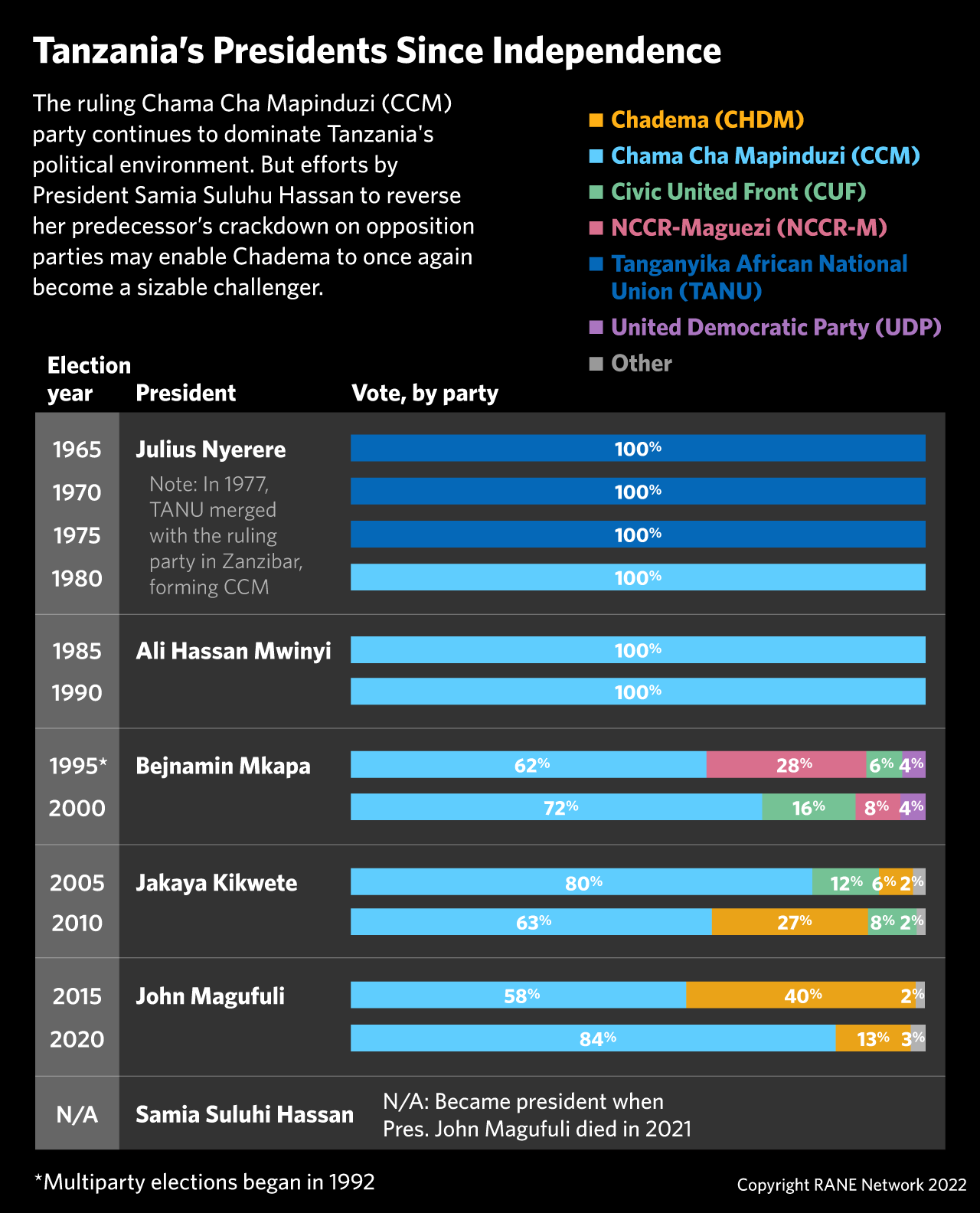
As she consolidates her power, Hassan will have a stronger hand to continue reversing Magufuli's “Bulldozer” policies. When Hassan took office a year ago, she did not have a strong political base within the ruling Chama Cha Mapinduzi (CCM). But over the past year, she has made several moves to sideline party hard-liners and Magufuli's allies in the CCM who have been jockeying to challenge her as the party's presidential candidate in 2025 elections. Hassan started her presidency by focusing on repealing Magufuli's economic and health policies. She reversed the government's position rejecting COVID-19's existence, which enabled Tanzania to finally join the World Health Organization's COVAX vaccine program in June and begin distributing shots across the country a month later. Hassan also ordered the government to quickly resolve disputes with foreign investors and resume negotiations with international oil companies on liquified natural gas (LNG) export terminals that had been stalled. In addition, Hassan's government has revived talks on the $10 billion Bagamoyo Port project, which is designed to alleviate congestion at the Port of Dar es Salaam. Progress on increasing political freedoms, however, has been slower. Mbowe was arrested on her watch, but Hassan almost certainly faces more resistance from within the party in liberalizing the country's political environment due to how aggressive Magufuli made the CCM in curbing dissent. In the 20 years before Magufuli took office in 2015, the CCM had largely tolerated Chadema's activities, recognizing the opposition party was no true threat to its power at the national level.
- In January, Hassan reshuffled her cabinet to install more loyalists in key positions and empower the political base of former President Jakaya Kikwete, including by appointing Kikwete's son to Deputy Minister of Lands and Human Settlement Development. Like Hassan, Kikwete sought to strengthen Tanzania's image abroad to boost foreign investment in Tanzania.
- Also in January, Tanzania’s parliamentary speaker Job Ndugai — a possible challenger to Hassan in 2025 — was forced to resign and was replaced by a Hassan ally after making statements critical of Tanzania's debt levels and Hassan's willingness to use external financing (the International Monetary Fund says that Tanzania currently has a moderate risk of external debt distress).
Hassan's efforts to liberalize the Tanzanian political environment will help remove roadblocks for interested investors, but the global economic environment may still constrain the financial windfall the country is able to reap from these changes. In the past, most foreign investor interest in Tanzania has focused on infrastructure and mining projects as Tanzania has ample gold, natural gas and other natural resources. The country's size and location on the Indian Ocean have also historically made it a favorable destination for investment with strong growth prospects. But Tanzania faces an uphill battle in getting international oil companies to develop its offshore gas resources, despite current sky-high LNG prices. Tanzania's offshore reserves are remote and emissions-intensive, making them more financially and reputationally risky to develop — especially for Western-based oil companies facing pressure to reduce their carbon footprint. Western investors will look for opportunities in places like Dar es Salaam, but competition among investment destinations in Africa is fierce. Prior to Magufuli's term, Tanzania had a reputation of being investor-friendly and stable. But Hassan may struggle to fully convince investors that her country will return to — and retain — that status, whereas other African countries like Rwanda and Ghana may still be able to position themselves as more attractive. Hassan's government could seek increased economic cooperation with China, though even this may prove difficult as Beijing is becoming increasingly conscientious in making overseas investments to ensure they pay off.
