
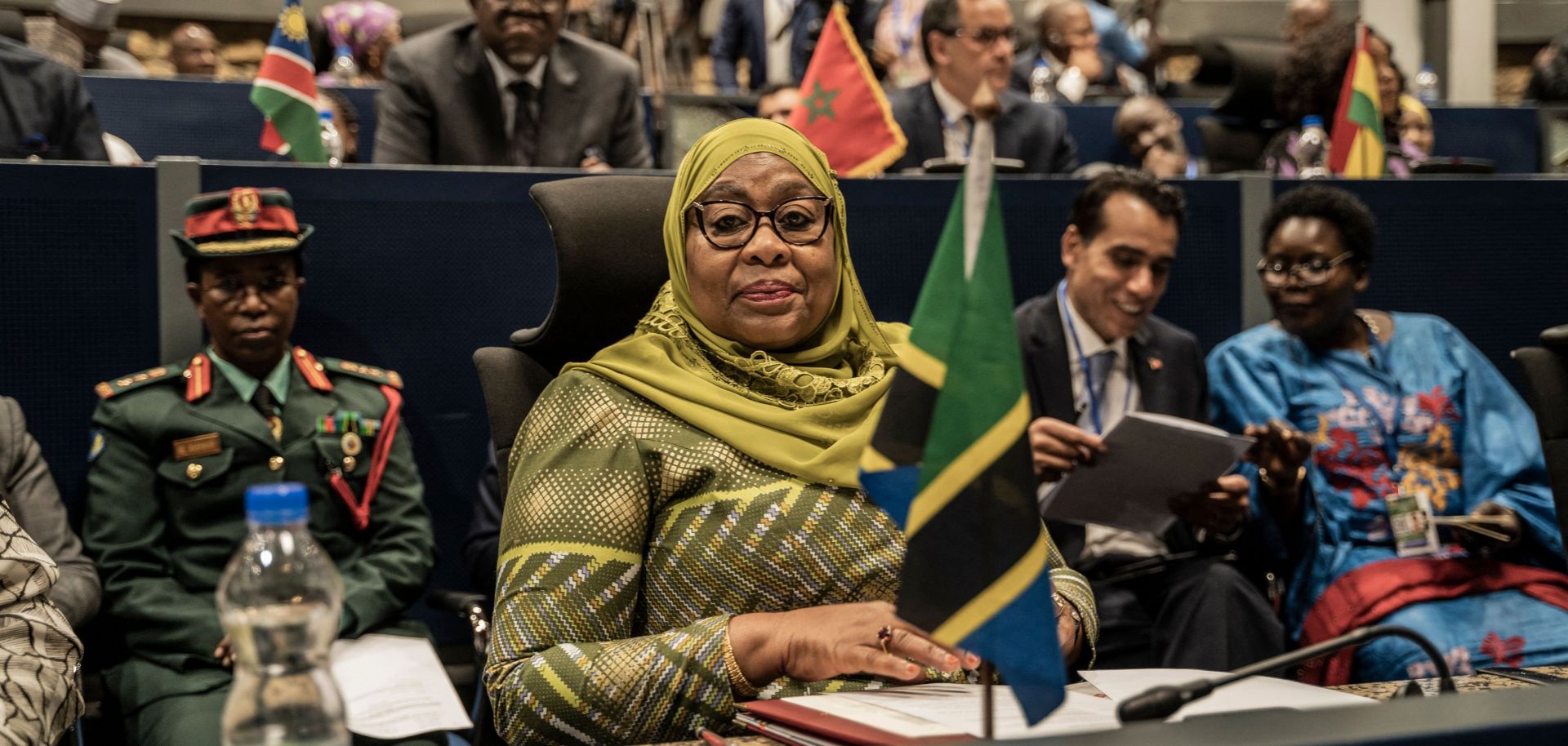
In Tanzania, opposition demands for greater political liberalization will likely grow ahead of 2025 elections, risking a security crackdown that would undermine the East African country's reformed international image and thus harm investor confidence, but not to the extent that financing for major projects is harmed. On Jan. 24, Tanzania's primary opposition Chama cha Demokrasia na Maendeleo (Chadema) party held protests in Dar es Salaam over proposed electoral legislation, the high cost of living and delays to constitutional reforms. The protests, attended by an estimated 800-1,500 Tanzanians (reports on the number of participants are conflicting), were the first major demonstrations since President Samia Suluhu Hassan took office in 2021. According to opposition party leadership, the protests were intended to pressure the government to reject three proposed electoral bills and implement a constitutional review process before general elections in 2025. Chadema secured permission from the police to hold the demonstrations in compliance with Tanzanian law, which kept the demonstrations largely peaceful.
- The ruling Chama cha Mapinduzi (CCM) presented the electoral bills in question to parliament in November, which Chadema condemned on the grounds that stakeholders' opinions were not sufficiently considered. The three bills are the National Electoral Commission (NEC) Bill 2023; the Presidential, Parliamentary and Local Government Elections Bill 2023; and the Political Parties Affairs Laws (Amendment) Bill 2023. Among Chadema's chief complaints is that the NEC bill would grant the president final say over appointing election commissioners, including the NEC chairperson and vice-chairperson, which the party argues would give the executive too much influence in the electoral process. The ruling party says that the reforms are a result of the constitutional dialogue process and take into account the feedback of the country's opposition.
Hassan has reopened dialogue with the opposition and passed several liberalizing reforms since taking office, but the stalled constitutional review process and proposed electoral bills have triggered a resurgence of political opposition. Former President John Magufuli, who ruled from 2015 until he died in office in 2021, oversaw a highly repressive political environment through strict media censorship, bans on opposition gatherings and the widespread arrest of political and civil society actors critical of his administration. Since taking office, Hassan has reversed several Magufuli-era policies, including bans on opposition demonstrations and certain media outlets, enabled exiled opposition leaders to return home, accepted opposition demands for a constitutional review, and reopened political dialogue with Chadema and other parties. These political reforms coincided with an economic reopening, as Hassan sought to increase foreign investment in hydrocarbon and infrastructure projects to spur economic growth. Although Chadema initially welcomed these reforms, dialogue between the two parties broke down in November 2023 as Chadema leadership condemned an alleged lack of sincerity and commitment by CCM officials and the government's October 2023 decision to postpone the constitutional review for three years until after 2025 general elections. Chadema alleges that CCM is using the proposed electoral bills to enhance the ruling party's advantage, and delaying the constitutional referendum in order to maintain political dominance through 2025. The CCM, for its part, argues that gradual liberalization is necessary but that too much too soon would endanger Tanzania's political stability.
- The constitutional review process started in 2012 and has since been delayed by successive presidents. Chadema and other opposition groups advocate for reforms to reduce presidential powers, establish an independent electoral commission, improve checks on executive power, enhance protections for opposition politicians, and increase representation for the island of Zanzibar.
- Hassan has pursued more and expanded trade deals with global partners as she attempts to boost international confidence in greater regulatory certainty and investment opportunities in agriculture, tourism, fishing, real estate and transportation. Hassan also restarted development on the Lindi port and progress on a $42 billion onshore liquid natural gas project, both of which stalled under the Magufuli administration due to regulatory delays, an opaque business environment and disputes between the government and the private companies involved.
Opposition protests will challenge Hassan's balancing act between liberal reforms and maintaining the CCM's political dominance, while potential security crackdowns on escalating demonstrations would tarnish Tanzania's reformed international image, although not to the extent that major investments are harmed. Hassan will seek re-election in 2025, which means she will remain reliant on the CCM — including its hard-line members — for support. This will constrain her ability to introduce the types of liberal reforms the opposition is demanding ahead of elections; and she herself has little incentive to introduce such reforms, which would dim her re-election prospects, if only marginally. As such, the opposition appears poised to continue protests ahead of local elections at the end of 2024 and general elections in 2025 to keep pressure on the government. Chadema leader Freeman Mbowe said on Jan. 24 that the nationwide protests would continue until the government responded to the party's concerns, and further opposition protests in coming months would offer a glimpse of the president's commitment to political liberalization. CCM hard-liners will likely advocate for bans on demonstrations and even using force to suppress the protests, congruent with the country's history of violent repression, which is at odds with Hassan's carefully curated portrayal of a new, more open Tanzania. As authorities continue to exert significant control over demonstrations, the unrest is very unlikely to escalate to the extent of disrupting transportation and business activity for more than a few hours at a time, and is also unlikely to hamper progress on major infrastructure projects like the Lindi port development, the East African Crude Oil Pipeline construction or the onshore liquified natural gas plant development. That said, the arrest and/or criminal prosecution of opposition leaders would make widespread demonstrations and a violent security response more likely, which would undermine perceptions of Tanzania as a safe and stable investment destination. This risk will remain elevated through elections in 2025 and the presumed constitutional review process set to begin in 2026; while greater political openness would likely unlock more economic development opportunities with Western partners in the long term, it would also likely facilitate risks to Western investor confidence in the medium term. Sunk costs and the expectation of major financial gains mean this is unlikely to harm financing for major infrastructure and hydrocarbon projects already underway, and even less so for Chinese investment projects that are likely to continue to grow in number. However, Western democracies would likely be more hesitant to provide new financing to a more repressive Tanzania in the future.
- CCM hard-liners were initially resistant to Hassan's political and social reforms, but in the last three years, she has largely consolidated support across the party. Hard-line members of the ruling party have expressed support for Hassan's 2025 presidential run.
- Hassan's approval ratings are generally high within the CCM and across the country, which bodes well for her re-election in 2025. The CCM holds 364 of the 393 seats in Tanzania's parliament, while Chadema holds just 20 (with several additional parties holding the remaining seats). This means that the proposed electoral reform bills will very likely pass, further supporting the CCM's decades-long monopoly of control over electoral institutions.
- China is a key trade, development and investment partner for Tanzania. Chinese firms won the contract to build the $1.9 billion Standard Gauge Railway line connecting the Port of Mwanza on Lake Victoria to the southern town of Isaka, and talks over resuming construction of the Bagamoyo port project are reportedly underway. If the port project proceeds, Bagamoyo will be the largest port in East Africa, with 40 times the capacity of the port at Dar es Salaam by 2045.
