
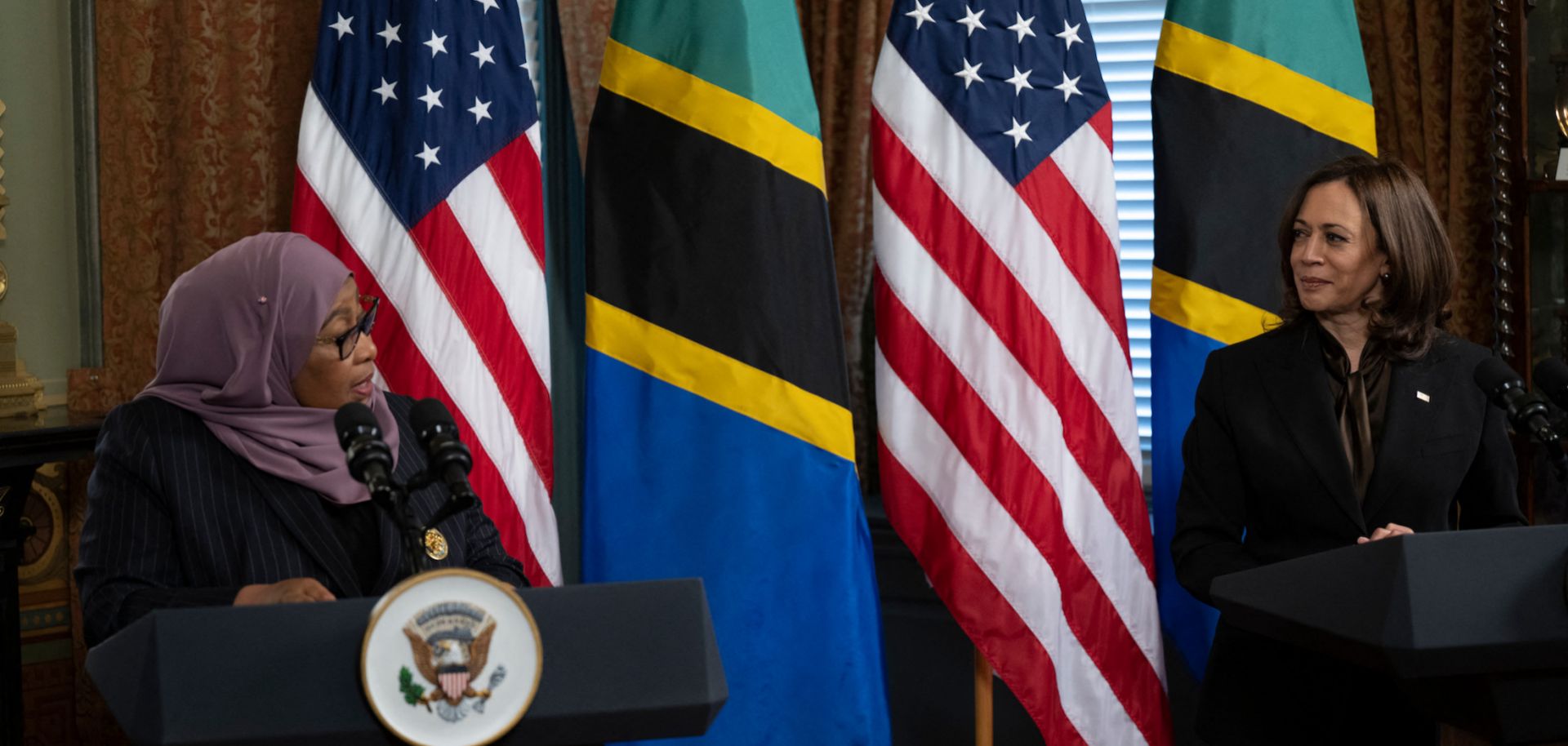
U.S. Vice President Kamala Harris listens to Tanzania's President Samia Suluhu Hassan make a statement to the press before a meeting in the Eisenhower Executive Office Building on April 15, in Washington, D.C.
China is better positioned to benefit from Tanzanian President Samia Suluhu Hassan's liberalizing reforms than the United States, which will increase Beijing's diplomatic influence over Dodoma. Since taking office in March 2021, Hassan has streamlined regulatory compliance laws, resolved disputes with foreign investors, and reopened negotiations with international oil and construction companies over stalled projects, and these measures have increased investor confidence and improved relations with external partners. As part of these diplomatic efforts, Hassan has improved Tanzania's human rights conditions, which has, in turn, led to increased economic cooperation with the United States. Hassan has had equal — if not greater — diplomatic contact with Chinese counterparts, driven not by alignment on human rights but by investment in key projects.
- Hassan has lifted some restrictions on press freedoms, met with key opposition leaders and reversed a ban on adolescent mothers attending school.
- At the 76th session of the U.N. General Assembly in September 2021, Hassan marketed her country as an international trading partner about to embark on business-friendly policy changes. This was the first time a Tanzanian leader had addressed the body since 2015.
- Hassan also reversed the previous Tanzanian president's position of denying COVID-19's existence, which spurred the introduction of the World Health Organization's COVAX vaccine distribution program in July 2021.
President Hassan's tenure marks a shift from Tanzania's previously icy external relationships that deterred foreign investment. Under former Tanzanian President John Magufuli, who served from November 2015 until his death in March 2021, Tanzania pursued populist economic policies and an oppressive political environment, which led to the degradation of relations with international partners. Countless bureaucratic and regulatory delays resulted in stalled projects, while alleged human rights violations decreased Western foreign investors' interest in the country. Tanzania's lack of access to financial support from the West prompted Magufuli to turn to other countries that do not attach grants, aid and loans to human rights and democracy concerns, like China. Even so, Tanzania's relations with China also worsened under Magufuli, as the president heavily criticized Chinese investors for reportedly attempting to swindle the country out of millions of dollars, pulled the country out of negotiations over the Bagamoyo port (a strategic investment for the Chinese), and arrested several Chinese nationals over alleged investment fraud.
- Commonly referred to as the "bulldozer president," Magufuli frequently instituted unpopular policies by stamping out dissent and allegedly perpetrating human rights abuses.
- In 2018, the World Bank paused a $300 million loan for an education project partially in response to Magufuli's ban on pregnant girls and adolescent mothers attending school. According to the World Bank, Magufuli's policies reduced foreign direct investment in Tanzania by a third between 2015 and 2018.
- Former Tanzanian President Jakaya Kikwete, Magafuli's predecessor, signed the Bagamoyo port deal with China Merchants Port Holdings Company Ltd. The terms of the deal would have granted the company a guaranteed term of 33 years, a lease of 99 years, tax holidays and the right to develop other ports between Tanga and Mtwara.
Hassan's reforms offer the United States both a friendly business environment and an opportunity to gain influence in East Africa, but limitations remain. Hassan concluded a week-long visit to the United States on April 22, during which she took meetings with U.S. officials, including Vice President Kamala Harris. During this visit, Tanzanian representatives signed deals worth a total of $1 billion, as well as new private sector investments and public-private partnerships that are worth at least $540 million. These deals include a memorandum of understanding (MoU) between the U.S. Chamber of Commerce and the Tanzania Trade Development Authority to build business ties, cohost trade policy dialogues, and work together on trade and investment forums. While increased U.S. private sector investment could spur Tanzanian growth and development in key sectors like mining, telecommunications, aviation and infrastructure, MoUs are not guaranteed investments, as they still require commitments from private investors. To that end, some Western investors may hesitate to commit due to worries that Tanzania will revert to its old ways should Hassan be defeated in the 2025 presidential election. Moreover, while the April 22 MoU signals a break from years past, $540 million is only 1.3% of the $4.144 billion Tanzania received in foreign direct investment in 2021, and the U.S. investment will likely be spread out over a number of years.
- The U.S. under secretary of commerce for international trade commented at an April 22 event with the Tanzanian delegation that Hassan's first year in office has been "transformational" and that her leadership has set a "new and exciting tone for [U.S.-Tanzania] partnership."
- The White House said on April 22 that Tanzania also recently signed an Open Skies Air Transport Agreement establishing a "modern civil aviation relationship between the United States and Tanzania" that "promotes increased travel and trade and helps spur economic growth."
- While the United States is not a direct investor in any major Tanzanian infrastructure projects, Western oil companies (including ExxonMobil) are in talks with the Tanzanian government over the $30 billion liquified natural gas project in the country's Lindi region. The project stalled under Magufuli, but the Tanzanian acting director general of the Petroleum Upstream Regulatory Authority said on April 29 that the parties will enter into the initial Host Government Agreements by May 31, which will pave the way for more comprehensive negotiations.
Meanwhile, China is poised to continue its substantial involvement in Tanzanian infrastructure development through its Belt and Road Initiative, further deepening its influence in East African markets. In January 2021, Tanzania awarded the China Civil Engineering Construction Corp. and China Railway Construction Corp. the contract to build the $1.9 billion Standard Gauge Railway line connecting Tanzania's port of Mwanza on Lake Victoria to the southern town of Isaka. Additionally, the Chinese ambassador to Tanzania said on April 29 that she expects relevant Tanzanian authorities and potential Chinese investors to make substantial progress on restarting the Bagamoyo port project. If implemented, the Bagamoyo port would be the largest in East Africa, with 40 times the capacity of the port at Dar es Salaam by 2045.
- President Hassan laid the foundation stone for phase III of the Standard Gauge Railway from Makutupora to Tabora on April 12, and the project is expected to be completed in December.
- In late February, Chinese ambassador to Tanzania Chen Mingjian and Hassan opened a new political training academy in Dar es Salaam, Tanzania. Such academies are vital components of the ruling Chinese Communist Party's party-to-party diplomacy in Africa.
China is likely in a better position to take advantage of Tanzania's improving business environment than the United States, which could lead to increased trade, economic privileges and diplomatic influence. While Hassan's progress toward Western human rights standards indicates Tanzania's increased desire for improved relations, it by no means indicates a preference for Western partnerships. For China's part, its role as a key partner in major infrastructure projects with Tanzania could position it to benefit from increased trade. Annually, China's exports to Tanzania have increased by an average of 25% since 1995, and in November 2021, an increase in product exports in delivery trucks, building stone and vehicle parts largely accounted for the year-on-year rise. As Tanzania gradually increases its industrialization, China is likely to benefit from increased trade in these areas. Additionally, if the Bagamoyo port construction proceeds as planned, China is likely to gain special rights, access and tax exemptions. As China and Tanzania become more economically involved, China is likely to gain increased diplomatic influence in arenas like the United Nations, which will assist China in opposing Western efforts to sanction or impose restrictions on non-democratic regimes. While U.S. policymakers appear to recognize the opportunity provided by Tanzania's opening economy, other foreign policy priorities (like the Russia-Ukraine war, counterterrorism and opposing Chinese advances in other parts of Africa) will likely prevent a significant deepening of the partnership.
- According to the Observatory of Economic Complexity, from 1995 to 2020, Chinese exports to Tanzania increased from $92.2 million to $4.17 billion, mainly through China's top three exported goods: rubber footwear, synthetic filament yarn-woven fabric and rubber tires. In the same period, Tanzanian exports to China increased at an annualized rate of 16.4%, from $8.79 million to $388 million. Tanzania's top three exported goods are oily seeds (sesame seeds, cotton seeds, etc.) raw copper and refined copper. In 2020, 6.5% of Tanzanian exports went to China, and 0.16% of Chinese exports went to Tanzania.
- From 1995 to 2020, U.S. exports to Tanzania increased from $88.9 million to $200 million, primarily through exports of petroleum gas, acyclic hydrocarbons and gas turbines. In the same period, Tanzanian exports to the United States increased at an annualized rate of 6.8%, mainly through the export of precious stones, gas turbines and knit T-shirts. In 2020, 2% of Tanzania's total exports went to the United States, and 0.15% of the United States' total exports went to Tanzania.
- Tanzania was one of 17 African countries that abstained from the March 2 United Nations resolution condemning the Russian invasion of Ukraine, a position shared by China as part of its non-interventionist foreign policy.
