
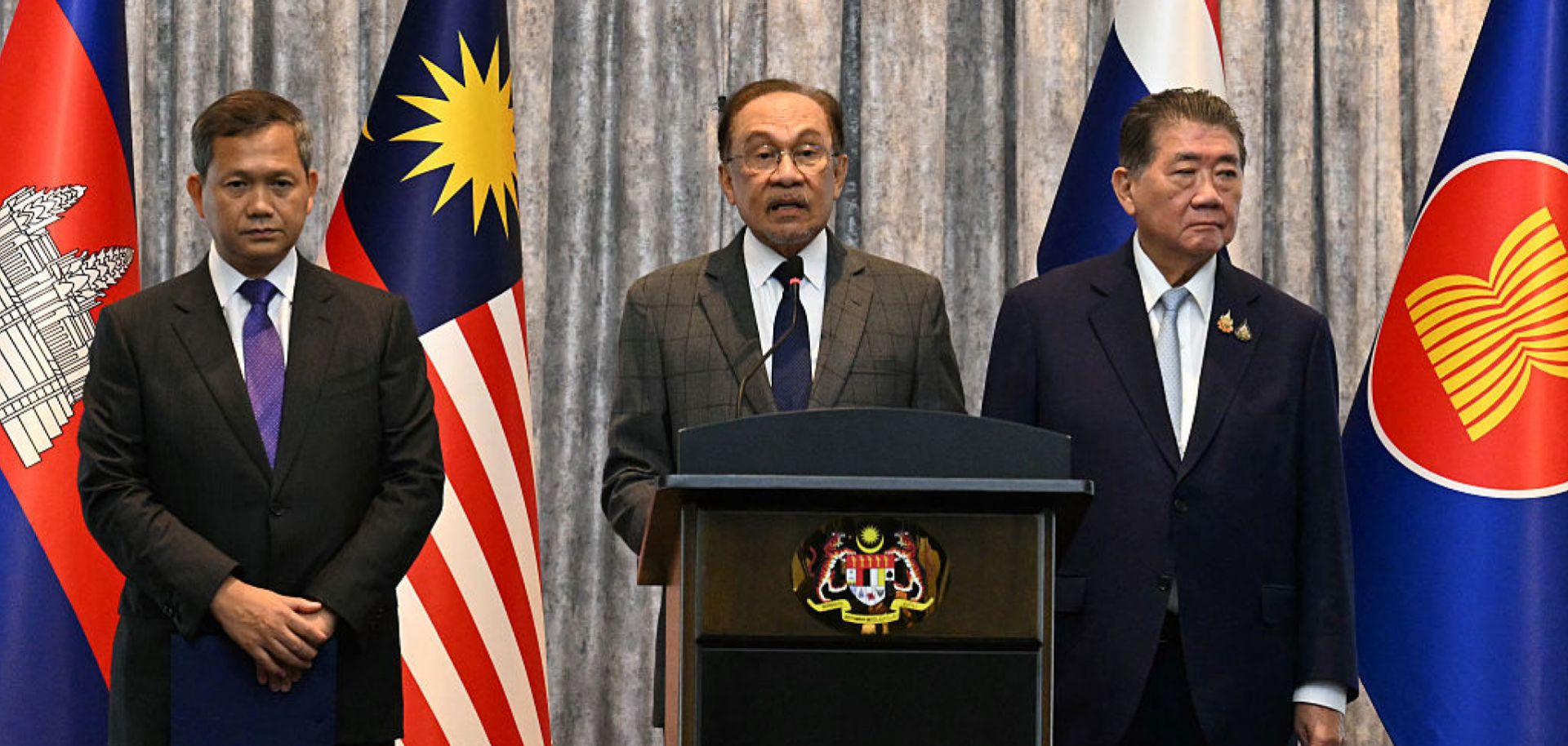
A ceasefire has paused the deadliest Thailand-Cambodia clashes in over a decade, but unresolved disputes and political pressures make renewed fighting a moderate to high risk in the short to medium term, and probable in the long term, with the next exchanges likely to be deadlier. An unconditional ceasefire between Thailand and Cambodia took effect at midnight local time on July 29, ending five days of fighting that began on July 24. The agreement was brokered on July 28 through the mediation of the Association of Southeast Asian Nations (ASEAN) and amid diplomatic pressure from both the United States and China. Although both sides have so far accused each other of minor violations, the truce is holding, and Thailand and Cambodia have each broadcast their intent to abide by it. The agreement stipulates the creation of a joint monitoring mechanism involving foreign and military officials from Thailand, Cambodia and Malaysia. However, no third-party peacekeeping forces have been deployed to the areas where clashes broke out. Thailand and Cambodia also have not formally disengaged their troops, with both armies still forward-deployed across at least six contested zones and adjoining border districts. Thailand's military maintains aerial and artillery readiness, while Cambodia's ground units remain stationed near disputed markers with continued rocket artillery emplacements.
- The ceasefire was mediated by Malaysia, this year's ASEAN chair, during an in-person meeting between acting Thai Prime Minister Phumtham Wechayachai and Cambodian Prime Minister Hun Manet. Malaysia's mediation mirrors Indonesia's mediation efforts as ASEAN chair in 2011 during the last round of Thai-Cambodian hostilities.
- The five-day conflict resulted in about 40 fatalities on both sides, and displaced over 200,000 civilians. Multiple cross-border roads, schools and hospitals were also damaged or destroyed. Initial humanitarian efforts, including the return of some displaced civilians, are beginning cautiously. But commercial border crossings remain largely closed, and infrastructure repairs have so far been minimal.
Prompt intervention from regional and international actors quickly de-escalated the clashes between Cambodia and Thailand amid concerns over mounting casualties and economic disruption. There are conflicting reports as to what started the clashes on July 24. The Thai military said the fighting began after Cambodian troops flew drones in the vicinity of the Ta Moan Thom temple complex and tried to establish forward logistics positions near contested territory, though Cambodia claimed its forces were provoked. But regardless of the initial trigger, the conflict rapidly escalated, with Cambodian forces launching sustained artillery and rocket attacks into Thailand, which Thailand then responded to with airstrikes, heavy artillery and naval strikes to push back Cambodian positions. Casualties and infrastructure damage quickly began to mount, with both sides reporting fatalities and hundreds of thousands of civilians displaced from their homes. The rising human toll, disruption of cross-border trade and reputational risks from perceived escalation prompted urgent diplomatic outreach by regional actors, particularly the ASEAN chair. But while Malaysia hosted and mediated the ceasefire talks, U.S. President Donald Trump's intervention was widely credited by Thailand and Cambodia for unlocking those talks, with both countries' leaders later publicly thanking him for his role. Indeed, Thailand initially resisted mediation calls, given it held the upper hand militarily. But U.S. pressure ultimately pushed Bangkok to the negotiating table, as Trump threatened to withhold trade concessions from both Thailand and Cambodia unless the conflict ended — increasing the risk each country would be hit with high tariffs on Aug. 1. China, for its part, also applied behind-the-scenes pressure, urging Cambodia to de-escalate to preserve regional stability and safeguard Beijing's Belt and Road Initiative infrastructure.
- Trump has threatened to impose 36% tariffs on both Thailand and Cambodia. Both countries are actively negotiating with the White House to lower those tariffs before they take effect on Aug. 1. U.S. Commerce Secretary Howard Lutnick announced reaching trade deals with both countries on July 31, but neither Bangkok nor Phnom Penh has confirmed this. Cambodia and Thailand are likely seeking a reduction in tariffs to the 19-20% levels that fellow ASEAN members Indonesia, the Philippines and Vietnam secured in their recent trade deals with the White House.
- China's diplomatic pressure on Cambodia to de-escalate stemmed from a desire to project Beijing's international leadership as a peacemaker, as well as concerns that prolonged conflict could threaten Belt and Road Initiative infrastructure in the region, including planned links in the Pan-Asia Railway and Mekong logistics corridors.
The ceasefire remains fragile due to unresolved territorial disputes, entrenched mistrust, continued military deployments and weak enforcement mechanisms, increasing the risk of isolated clashes in the short to medium term and of a bigger confrontation in the long term. There are thus four key risks with respect to ceasefire collapse. First, the underlying drivers of the conflict — which are deeply politicized and rooted in colonial-era border demarcations and national claims over religious heritage sites — have not been resolved and have no immediate viable path toward resolution. Second, both militaries remain fully deployed along contested zones with no agreed demobilization, only an agreement not to send additional forces. Third, mutual trust is low, with each side accusing the other of ceasefire violations. And fourth, the monitoring mechanism, though now active, is limited in scope; while Malaysian-led civilian observer teams have been deployed along the border, they lack formal enforcement authority or independent third-party verification. As such, in the short to medium term, the risk of renewed clashes or skirmishes is moderate to high. In the long term, the absence of a formal peace process, demilitarization framework or legal arbitration pathway will leave the ceasefire highly susceptible to collapse. However, the truce could hold for a decade or longer, evidenced by 14 years passing between this round of clashes and that of the last round, which occurred in 2008-2011.
- Disruptions to regional trade and investment, especially in areas near the Thai-Cambodian border, will likely persist, with commercial crossings closed, infrastructure damaged and investor confidence shaken. Tourism, particularly to northeastern Thailand and Cambodian temple zones, will likely take a prolonged hit as a result.
Domestic political pressures in both countries further contribute to a high risk of renewed clashes in the future. Through the brief escalation with Thailand, Cambodia's leadership appears to have achieved its domestic objective of strengthening the prime minister's legitimacy. This will reinforce the power of nationalist and military elements that are likely to dominate policymaking and prioritize defense expansion in the coming years. It also means Cambodia retains domestic incentives to stoke nationalist tensions, particularly as Prime Minister Hun seeks to bolster support within the military and consolidate authority. Thailand's caretaker civilian government, by contrast, is facing internal criticism from two contradicting camps. The political opposition has criticized the government for ceding political power to the Thai military during the crisis, while nationalist elements are unhappy that the government agreed to a ceasefire with Cambodia when Thailand had the battlefield advantage. Amid Prime Minister Paetongtarn Shinawatra's ongoing suspension, the Thai government will lack the political strength to push for a formal settlement with Cambodia, particularly amid disapproval by the military, which has a strong sway over Thai politics.
- In Thailand, persistent political instability and entrenched military influence ensure that civilian leaders remain constrained by a security establishment that both retains authority and has the political leverage to expand it, with the capacity to escalate quickly in future crises. Though unlikely, another military coup cannot be ruled out amid already intense scrutiny of the Shinawatra government.
The relatively high death toll of the recent clashes signals that future border clashes will likely stem from lighter triggers and escalate more quickly. The conflict killed 38-43 people in just five days, whereas the previous round of kinetic exchanges between Thailand and Cambodia killed 19 people over three years. This relatively high human cost reflects a shift toward higher operational intensity and greater strategic risk tolerance by both militaries, evident in their use of heavier weapons, expanded target sets and diminished regard for civilian casualties. Thailand deployed air and naval assets, capabilities it refrained from using during the 2008-2011 clashes. And Cambodia targeted civilian-populated areas in Thailand with Chinese-made PCL and PHL long-range rocket launchers, which it did not possess during the last round of hostilities. This signals a recalibration toward more intense, higher-risk military engagements driven by domestic political incentives and reduced thresholds for escalation. Thailand's military (if not its embattled civilian government) and Cambodia's government appear more willing to absorb civilian costs, which suggests that in the event of another flareup, domestic incentives increasingly favor escalation over restraint. Meanwhile, ASEAN's failure to de-escalate tensions between two of its members before the conflict erupted underscores the bloc's structural limitations in deterrence and crisis prevention, even as ASEAN proved effective in conflict mediation. This indicates that ASEAN would again only be able to facilitate post-hoc mediation in the future, rather than prevent renewed hostilities. The next round of clashes between Cambodia and Thailand is thus likely to be faster, deadlier and harder to contain, underscoring the erosion of traditional deterrents (such as the U.S.-Thai alliance) and the limitations of ASEAN's crisis management capacity. However, this will also heavily depend on the interests of the United States and China in the context of potential future hostilities, both of which possess meaningful powers of compulsion over Thailand and Cambodia that ASEAN lacks.
- While ASEAN earned a rare diplomatic win for brokering the Thai-Cambodian truce, its capacity to enforce peace remains highly constrained. The bloc's success in mediating the conflict hinges more on U.S. and Chinese pressure than institutional leverage, of which ASEAN has little.
