
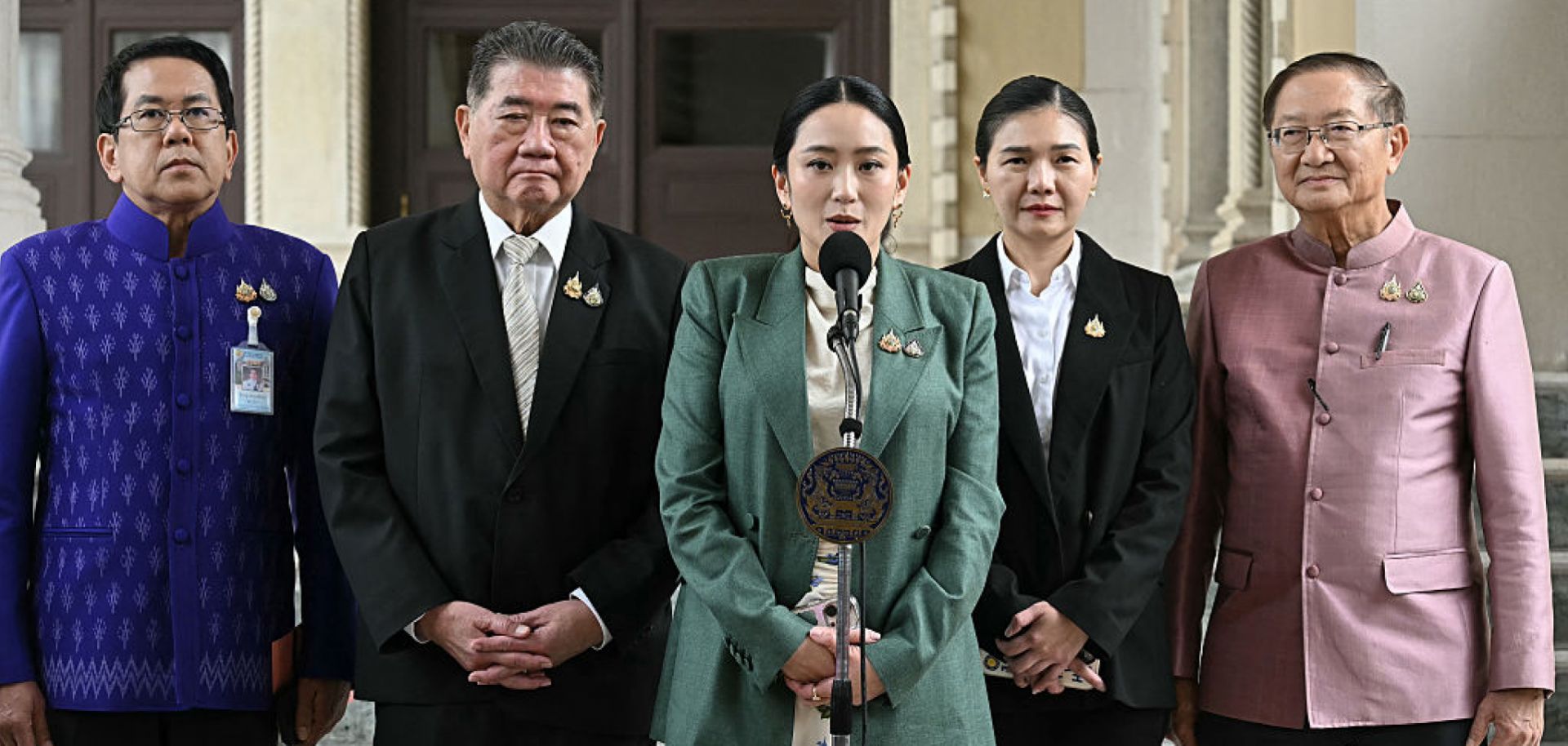
In Thailand, the prime minister's suspension creates a new political crisis that raises the risk of government collapse and economic disruption amid U.S. trade tensions. On July 1, Thailand's Constitutional Court suspended Prime Minister Paetongtarn Shinawatra from office while it reviews a petition alleging she violated the constitution by conducting foreign policy in an unethical and unauthorized manner. The complaint, which was submitted by 36 senators, centers on the prime minister's June 15 phone call with Hun Sen, Cambodia's former prime minister and current Senate president, during which she discussed ongoing border demarcation tensions and referred to the Thai military as an "opponent." Hun leaked an audio recording of the call, which triggered an uproar in Thailand, with critics arguing that Paetongtarn's tone was overly deferential and that she undermined Thailand's negotiating position in its long-running territorial dispute with Cambodia around un-demarcated border temple regions. On June 18, the Bhumjaithai Party, until then a key coalition partner holding 69 seats, defected from Paetongtarn's government in protest over the leak. That decision left her center-left Pheu Thai Party-led coalition with a slim eight-seat parliamentary majority and forced a cabinet reshuffle. The Constitutional Court has not provided a deadline for its ruling, but such deliberations can take weeks or months. In the meantime, Deputy Prime Minister Suriya Juangroongruangkit of Paetongtarn's Pheu Thai party will serve as caretaker prime minister, though his role is constitutionally limited as he cannot make major political appointments, initiate legislation or authorize significant fiscal decisions.
- The senators claimed that Paetongtarn had bypassed official diplomatic procedures by not coordinating the call with Thailand's foreign ministry, and that her statements amounted to a breach of ethical standards under the country's 2017 constitution.
- Paetongtarn has denied any wrongdoing, stating that the call was a goodwill gesture meant to de-escalate tensions with Cambodia, which have grown since March when Cambodian Prime Minister Hun Manet warned that his country was prepared to use military force if Thai troops reentered the disputed Ta Moan Thom temple complex, a flashpoint near which both sides maintain a military presence. A May 28 clash that killed a Cambodian soldier further escalated military deployments, checkpoint closures on both sides of the Thai-Cambodian border, trade bans and diverging views on dispute resolution.
The suspension comes at a precarious moment for Paetongtarn, as her government, built on a fragile coalition with limited support, is facing political pressure from both elite and opposition factions in Thailand, while it simultaneously grapples with U.S. tariff threats amid declining economic growth forecasts. Though Paetongtarn's Pheu Thai Party returned to power in 2023, it did so through a controversial coalition deal with military-aligned and royalist parties — many of which previously ousted Pheu Thai governments led by her father, Thaksin Shinawatra. The agreement alienated the top vote-getting progressive Move Forward Party, with which Pheu Thai had abandoned during coalition talks, thus making a new enemy on its political left even as Pheu Thai was simultaneously beholden to influence from the royalist right-wing. That uneasy power-sharing agreement has never enjoyed strong public support, and Paetongtarn's own ascent to the premiership has drawn criticism from both pro-military elites and alienated progressive opposition forces. On the economic front, Thailand currently faces unresolved trade tensions with the United States, which imposed its 10% baseline tariff on Thai exports and is threatening to implement a 36% reciprocal tariff if no deal is reached before a July 9 moratorium expires. At the same time, Thailand's once-dominant tourism sector remains sluggish, especially from the key Chinese market, helping to drive down economic growth forecasts.
- The petition's timing also comes as Thaksin himself faces criminal proceedings for alleged lese-majeste violations and separate proceedings related to corruption and abuse of power dating back to his premiership before his 2006 ouster.
- The Constitutional Court has previously intervened in Thai politics to remove sitting prime ministers and dissolve opposition parties, reinforcing perceptions among critics that the judiciary functions as a gatekeeper of the conservative establishment. Since 2006, successive governments led by the Shinwatra-centric Pheu Thai Party (or its predecessor party) have been removed from office by judicial or military interventions, rather than electoral defeat. These include Thaksin Shinawatra (ousted in a military coup, 2006), Samak Sundaravej (removed by the Constitutional Court, 2008), Somchai Wongsawat (removed by the Constitutional Court, 2008), Yingluck Shinawatra (ousted by the Constitutional Court in 2014, shortly before the May 2014 military coup) and Srettha Thavisin (dismissed by the Constitutional Court, 2024).
- Thailand's GDP growth slowed to 3.1% in the first quarter of 2025, down from 3.3% in the previous quarter. Meanwhile, the Bank of Thailand downgraded its full-year growth forecast to 2.0% in April. This projection does not include the impacts of U.S. tariffs, meaning growth estimates will only worsen if the full 36% U.S. tariff rate or even if a compromise lower rate is implemented. Meanwhile, foreign tourist arrivals in Thailand declined 4.6% in the first half of the year, and plunged over 30% year-on-year in the same period. A high-profile case in January involving the kidnapping of a Chinese actor — who was trafficked across the border into Myanmar — has alarmed prospective Chinese tourists and heightened safety fears about travel to Thailand.
- While Finance Minister Pichai Naripthaphan has traveled to Washington for trade talks, there are so far few signs of serious progress, sustaining the possibility of a U.S. tariff hike that threatens Thailand's major export sectors, including electronics, rubber and automotive parts. Thailand exported approximately $55 billion worth of goods to the United States in 2024 (approximately 18.3% of its total exports), which resulted in an approximately $45.6 billion trade surplus. In light of the July 2 U.S.-Vietnam trade deal, the Thai Chamber of Commerce has predicted that Thailand will reach a deal with the United States before the July 9 deadline with more favorable terms than Vietnam's 20% tariff rate because Thailand's trade surplus with the United States is much lower than Vietnam's, but that remains to be seen.
Regardless of whether Paetongtarn is removed or cleared, Thailand faces mounting political instability, protest risks from both sides of the spectrum, and economic uncertainty exacerbated by stalled governance. If the court finds Paetongtarn guilty, she would be permanently removed, likely collapsing the coalition and forcing Pheu Thai to renegotiate a new alliance or face early elections. That scenario would invite a power struggle among ruling party factions, creating a particular opening for the center-right Bhumjaithai Party, the third-largest party in Thailand. This is because the Bhumjaithai Party is better positioned than Pheu Thai and the People's Party, the current progressive party after the Move Forward Party was banned in 2024, to swing support from conservative and military-aligned lawmakers following its coalition withdrawal. Such a scenario would also risk renewed political protests, particularly from pro-Shinawatra rural bases, which have previously mobilized at scale (as seen during the Red Shirt demonstrations in 2010 that drew tens of thousands and led to violent clashes with the police and military). But even if Paetongtarn is cleared, she would be politically weakened. The opposition could still pursue censure (which, if passed, would bring about the expectation of a voluntary resignation) or a no-confidence vote (which, if passed, would force her to resign), especially if elite backlash continues or coalition allies drift. Clearing her could also provoke fresh street protests from nationalist and royalist factions. Either way, the Thai government's effectiveness will be limited in the coming months, raising the risk of legislative gridlock and stalled reform efforts, particularly on digital economy regulation and long-delayed police and military accountability reforms. Economically, prolonged political uncertainty threatens to worsen Thailand's already shaky investment environment. The tariff standoff with the United States is particularly urgent, as if no deal is reached before the July 9 deadline, and the Trump administration does not grant another delay, the 36% reciprocal tariff would take effect, severely impacting Thailand's export competitiveness. The tourism slump has also undermined one of the country's most important revenue streams. With limited fiscal headroom, constrained central bank maneuverability and no clear political mandate, Thailand risks facing a widening gap between economic needs and policy capacity in the second half of 2025. Finally, the political crisis creates a low likelihood, high-impact possibility of another military coup (which would be Thailand's first since 2014 but add to its extensive history of military takeovers).
- On June 28, thousands of protesters rallied in Bangkok demanding Paetongtarn's resignation over the leaked Hun Sen phone call, marking the largest anti-government demonstration since Pheu Thai returned to power.
- With public debt near the legal ceiling and limited room for new stimulus, and with interest rates already cut in April to support growth, Thailand has little fiscal or monetary space left to respond to further economic shocks.
- If the Bhumjaithai Party takes control of the government, it will more than likely form a coalition with military-aligned parties. Thailand's foreign policy would likely adopt a more assertive and nationalist tone, particularly toward Cambodia, where the party has already framed the border dispute as a matter of national dignity and sovereignty. Rather than continuing Paetongtarn's conciliatory approach, a Bhumjaithai-led government would likely further bolster military presence along the border.
