
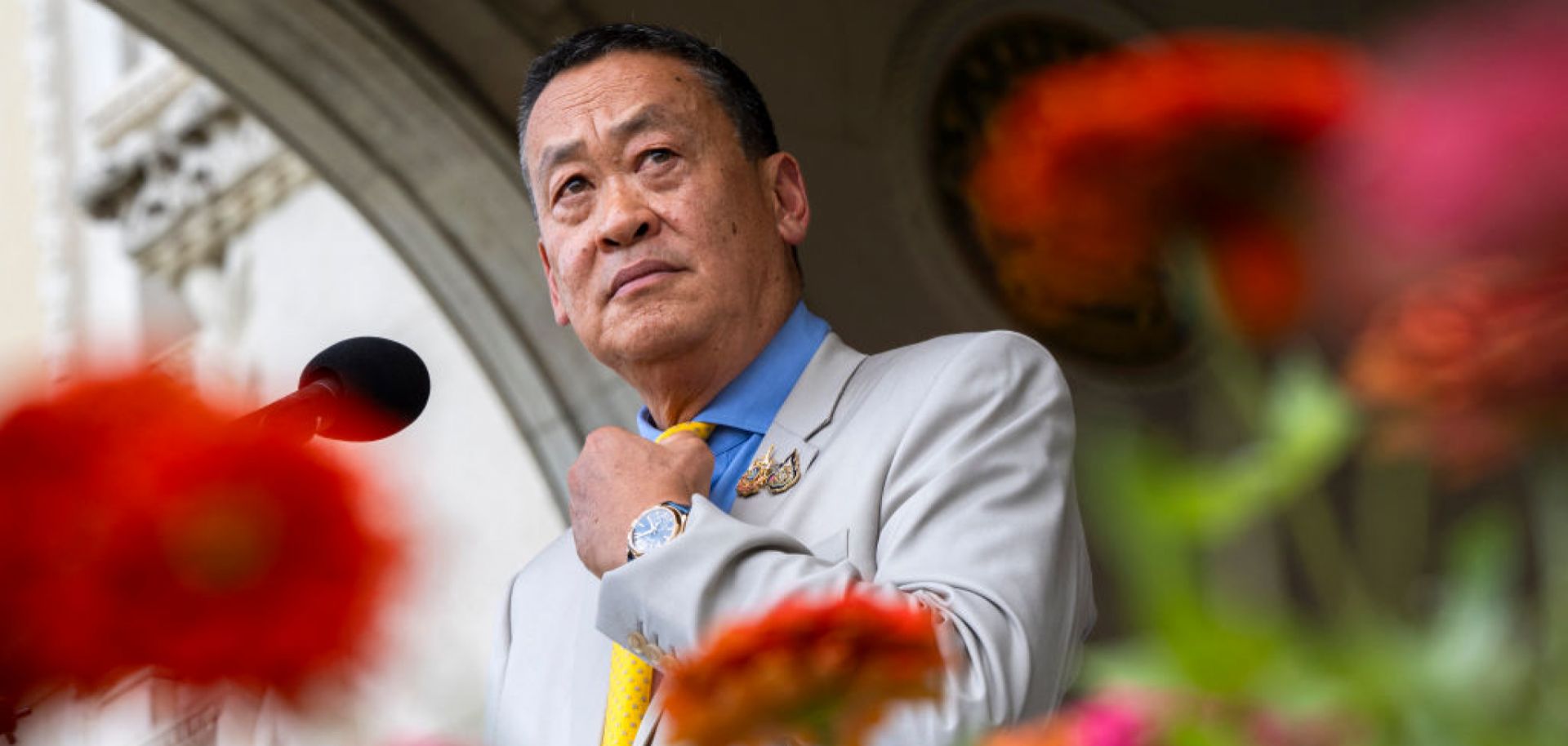
The removal of the Thai prime minister represents the military establishment's latest attempt to impose its influence on the government, which in the coming months and years will continue to constrain Thailand's economic growth while stoking social unrest. In a 5-4 decision, Thailand's Constitutional Court on Aug. 14 removed Prime Minister Srettha Thavisin of the Pheu Thai Party and his Cabinet from office after finding him guilty of an ethics violation. Srettha's removal was effective immediately; the Thai House of Representatives subsequently elected Paetongtarn Shinawatra (also from the PTP) as the new prime minister Aug. 16 with 319 of 491 votes. The ethics violation stemmed from Srettha's appointment of ex-convict Pichit Chuenban to the prime minister's office in April. Upon his appointment, 40 military-appointed senators issued a formal complaint calling for Srettha's removal in response. Given the presumably unexpected controversy, Pichit quickly resigned in May, having served in the position for less than a month. The resignation did not satisfy the complaining senators, however, and the Constitutional Court took the case.
- Pichit, a family lawyer for the Shinawatra clan that runs Srettha's PTP, was convicted of contempt of court and sentenced to six months in prison for attempting to bribe court officials in 2008 in an infamous incident known as the "lunch box case" (because Pichit carried bribe money to court in a lunch pail).
- Paetongtarn ran as the PTP candidate in the 2023 general elections, but ultimately declined the nomination for prime minister, paving the way for Srettha. She is the daughter of PTP founder, de facto boss and former Prime Minister Thaksin Shinawatra and niece of former Prime Minister Yingluck Shinawatra.
The case is the latest in a broader institutional effort by the military establishment to curb power bases not under its control. The ruling follows another controversial Constitutional Court decision to dissolve Thailand's most popular party, the main opposition Move Forward Party on Aug. 7. Meanwhile, Thaksin was indicted in June and is likewise facing charges of insulting the monarchy stemming from comments he made in a 2015 interview. These three cases all represent checks on the power bases of political movements outside the control of the military establishment, which held direct control over the government from its 2014 coup until the 2023 general election, and were pursued on questionable legal grounds. The two main military-aligned parties — United Thai Nation and Palang Pracharath — performed dismally in the 2023 election, combining for less than 14% of the total vote. For the military parties, this likely drove home that a return path to political power would not come from the ballot box, and the two parties formed an alliance of convenience with their longtime rival the PTP — which won the second-most votes — to form a government with eight additional parties, excluding out election winner Move Forward Party, which then led the opposition until its Aug. 7 court-ordered dissolution. The institutions responsible for these processes, namely the Senate and Constitutional Court, were staffed by the military in the wake of its 2014 coup and the rewriting of the Thai Constitution in 2017. This sends a message to the PTP that the military establishment will allow it to govern as long as it accepts limitations on its power.
- Rivalry between the PTP and the military establishment has existed for some time, evidenced by two military coups against the party (and its predecessor) in 2006 and 2014.
- The MFP immediately reconstituted into the People's Party the day after its court-ordered dissolution Aug. 8, though without 11 leaders banned from politics for 10 years. The People's Party denounced Srettha's ouster.
Srettha's removal will likely result in the scrapping of the PTP's flagship digital wallet policy, forestalling digitization of the economy and a consumer spending recovery. The government's plan to implement an approximately $16 billion initiative for one-time $275 cash handouts to Thai citizens, called the digital wallet — a stimulus measure intended to boost domestic consumption that has lagged since the COVID-19 pandemic — will be scrapped, according to PTP insiders speaking to the press. Though the plan came under heavy criticism from economists and ran into consistent budgetary and financing shortfalls, its scrapping would suggest that policy uncertainty will increase in the coming months. According to the same PTP insiders, a Paengtorn-led government will pursue "simpler" stimulus measures. Scrapping the digital wallet plan would stall Thailand's broader push to digitize its economy, weighing on consumer spending as consumer preferences shift to e-commerce. Enduring factors such as high levels of household debt compounded by political and policy uncertainty continue to impact consumer spending negatively. Though Paetongtarn's swift ascent following Srettha's ouster limits the risk of political gridlock in the immediate term, additional interventions by the military establishment (such as a conviction of Thaksin) that disrupt the top echelons of the PTP would risk further disruptions that would create gridlock in the future. This is particularly true because under Thai election rules, the only other eligible PTP prime ministerial candidate is 75-year-old Chaikasem Nitisiri, who is in poor health. This would aggravate existing economic risk, such as slowing Thailand's push to attract foreign investment in its electric vehicle sector. Even so, the slow pace of reforms in Thailand — the region's No. 2 economy — means it will continue to underperform relative to its Southeast Asian neighbors like Indonesia, Malaysia, the Philippines and Vietnam, both in terms of economic growth and attracting foreign investment.
- In July, Thailand's consumer confidence index dropped to 57.7, its lowest since September 2023, the month following the latest government’s formation.
- The digital wallet was the populist PTP's flagship policy proposal in the 2023 general election.
- The World Bank projects Thailand will see 2.4% growth in 2024, far below Srethha's promised 5% and below growth rates in neighboring countries pursuing similar economic goals.
The ruling demonstrates enduring de facto military control in the short to medium term in Thai politics, perpetuating the risk of future similar politically destabilizing episodes. Paengtorn's appointment to the premiership will come with several challenges, including the perception that she will be her father's proxy as was the case with Srettha. Should this perception reach the same heights, her government will come under the same scrutiny from military-aligned institutions like the courts Srettha experienced, and could similarly be removed on technical or flimsy legal grounds by such institutions given the Thai system is designed to accommodate such removals. Still, given that she is backed by all 11 coalition parties, the military parties' willingness to elevate not just another PTP leader but another Shinawatra (she is the third prime minister from that family) indicates a desire to minimize political upheaval and create a sense of continuity despite the military's ongoing rivalry with both the party and the family. As with the initial government formation in August 2023, another goal of the alliance between the military establishment and PTP is to marginalize the more progressive and monarchy-skeptic opposition Move Forward Party, now rebranded as the People's Party, ahead of the 2025 municipal elections, the 2026 Bangkok gubernatorial election and the next national elections due by 2027. Moreover, these interventions by military-aligned interests perpetuate the risk of social unrest that has simmered in Thailand since the 2014 coup and exploded in at times violent mass protests in 2020 and 2021, though the risk of widespread protests is currently low considering the divisions between the PTP and the Move Forward Party and thorough crackdowns on activist groups in subsequent years.
- Given the military has staged two coups historically against the PTP and the Shinwatra family in particular, its willingness to check their power is well-established. Srettha's status as a novice politician and longtime confidant of the Shinawatra family — plus staffing his Cabinet with other close Shinawatra associates — created the widespread perception that he was Thaksin's proxy. The same dynamic could haunt Paetongtarn's stay atop the government.
