
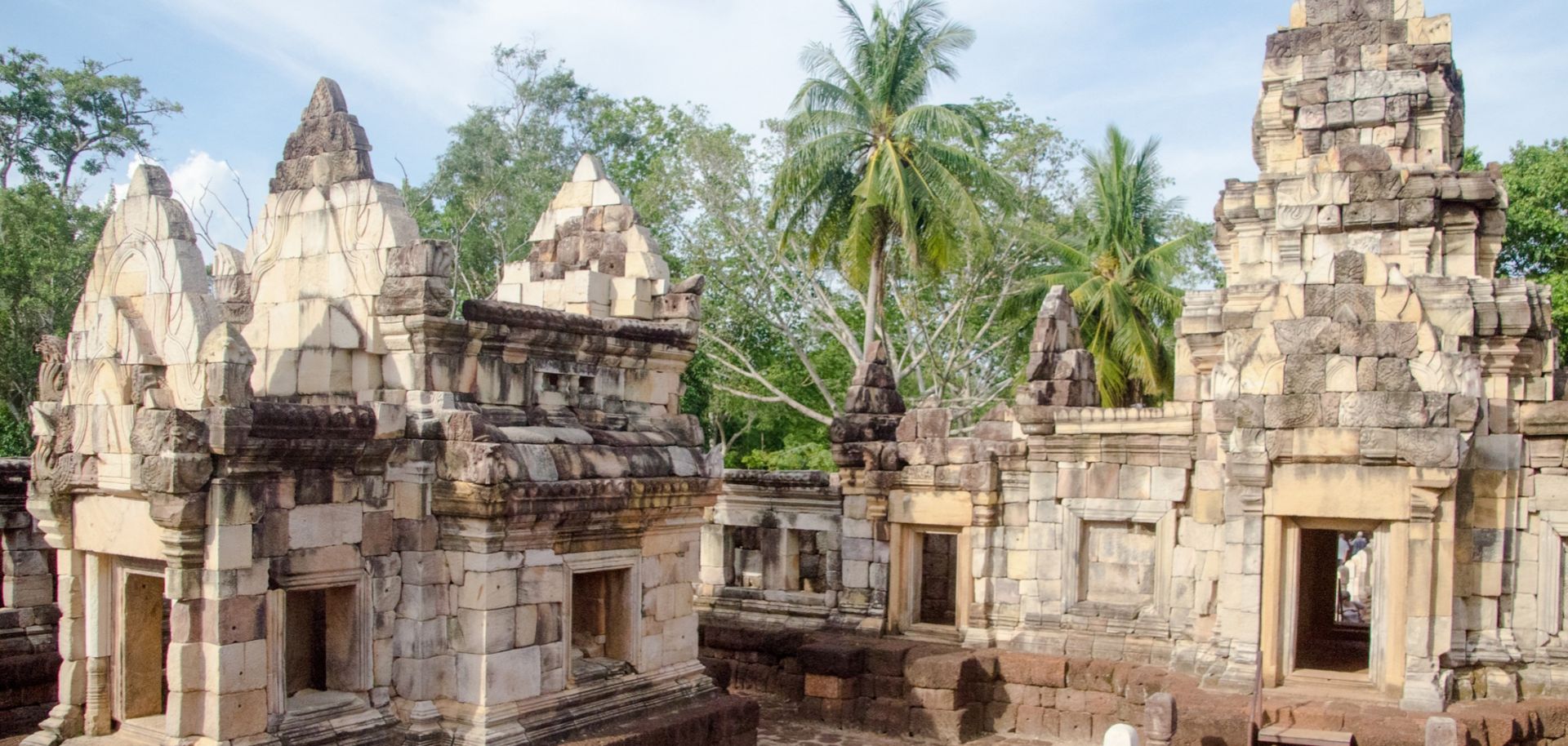
Rising tensions between Thailand and Cambodia over a disputed ancient temple create risks of localized clashes and modest economic disruption, though a full-scale armed conflict remains unlikely. Tensions between Thailand and Cambodia have recently escalated over the disputed Ta Moan Thom temple complex, near which both countries station troops. On March 18, Cambodian Prime Minister Hun Manet warned that his country was prepared to use military force if Thai troops reentered the site. His statement follows a February confrontation between Thai and Cambodian soldiers at the complex, which led Thailand's defense ministry to issue a formal protest. Cambodia claims that Thai forces are illegally stationed near the temple complex, while Thailand maintains that the complex falls within its jurisdiction.
- Ta Moan Thom was built in the 11th century during the Khmer Empire that ruled over wide swathes of mainland Southeast Asia, including modern-day Thailand and Cambodia, until the 15th century. The temple complex is located in a highlands border region between Cambodia's Oddar Meanchey province and Thailand's Surin province, where official boundary demarcation remains incomplete. The temple's status extends into broader questions of territorial sovereignty, making it both a strategic military position and a symbol of national heritage for both countries.
- On Feb. 13, a group of Cambodian soldiers crossed into the disputed Ta Moan Thom temple complex and sang the Cambodian national anthem. This prompted Thai troops stationed nearby to enter the site, where a verbal confrontation ensued.
Risks of clashes are heightened amid Thailand and Cambodia's longstanding territorial disputes, and the latter's increasing military assertiveness under Prime Minister Hun Manet. The dispute over To Moan Thom is particularly sensitive given the historical precedence of conflict over the nearby Preah Vihear temple, another Khmer Empire-era temple along the Thai-Cambodian border. From 2008-2011, tensions over Preah Vihear escalated into deadly armed clashes, including full-scale artillery exchanges and cross-border skirmishes, that displaced over 100,000 people. After the Association of Southeast Asian Nations (ASEAN) failed to conclusively mediate the dispute in 2011, the conflict ultimately led to an International Court of Justice (ICJ) ruling in 2013 that reaffirmed Cambodia's sovereignty over Preah Vihear. However, territorial disputes persist in other areas along the Thai-Cambodian border, including around the Ta Moan Thom temple. The recent spike in tensions over Ta Moan Thom has thus fueled fears of a potential return to armed clashes. Adding to these fears is Cambodia's increasing military assertiveness under Prime Minister Hun Manet, who took office in 2023, succeeding his father Hun Sen after 38 years of rule. The elder Hun relied on pragmatism to build his authority, using patronage networks in the military, while exploiting Cambodia's longstanding territorial disputes with Thailand and Vietnam as negotiating leverage. The younger Hun, however, only inherited — rather than earned — his authority, creating an impetus to project strength and consolidate power among the country's elite. This has seen the West Point graduate and former general adopt a more structured, militarized approach that emphasizes border security, military modernization and sovereignty enforcement to solidify his legitimacy — signaling a potential generational shift in Cambodia's national security posture that could make the country more willing to use force to defend its claims to the Ta Moan Thom temple.
- The three-year Preah Vihear conflict killed at least 28 people, including 22 military personnel and six civilians. It also included a single clash at Ta Moan Thom in 2011.
- The 2013 ICJ ruling did not resolve any territorial issues beyond Preah Vihear. Other territorial disputes include the 12th-century Ta Krabey temple complex, which is also situated along the Thai-Cambodian border and saw fighting in 2011. Thailand and Cambodia have broader border village and agricultural land disputes as well, which have periodically resulted in encroachments, arrests and shootings. Additionally, the Gulf of Thailand maritime boundary remains unresolved due to competing exclusive economic zone claims and disputes over offshore oil and gas reserves.
- The Jan. 7 assassination of a former opposition Cambodian lawmaker in Bangkok has also escalated tensions between the two countries, as the alleged shooter, a former Thai marine already taken into custody, reportedly has ties to top Cambodian officials, including former Prime Minister Hun Sen. On Jan. 15, Thailand issued an arrest warrant for Somwang Bamrungkit, a politician in the ruling Cambodia People's Party and alleged mastermind of the assassination. Cambodia is refusing to cooperate, however, with the elder Hun, denigrating the warrant as “useless.”
- In September 2024, Hun Manet withdrew Cambodia from the 1999 Cambodia-Laos-Vietnam Development Triangle Agreement over territorial disputes with Vietnam, further highlighting his more bellicose and nationalistic posture.
While full-scale military conflict is unlikely, localized clashes and consequent cross-border economic disruptions remain possible, as both sides maintain entrenched military positions with no clear legal resolution. Unlike the dispute over Preah Vihear, where Cambodia successfully leveraged a 1962 ICJ ruling on the temple to reaffirm its sovereignty in 2013, the Ta Moan Thom dispute lacks legal precedent, making resolution more difficult. The two countries are thus unlikely to seek another ICJ ruling because the court requires both parties to consent, which Thailand is not incentivized nor legally obliged to give. Additionally, compared with Preah Vihear, the ICJ's jurisdiction over Ta Moan Thom is less clear, meaning the court could decline to hear the case even if petitioned. This absence of a definitive legal framework favors Thailand, which has maintained de facto military control at the temple complex since 1998, while Cambodian troops have only been stationed near Ta Moan Thom since 2008. With no clear legal resolution, Bangkok is thus unlikely to withdraw its troops from the area without securing concessions from Phnom Penh, such as a land swap or favorable trade agreement. This is particularly the case amid Thailand's domestic political instability, which could push an otherwise cautious government to adopt a more assertive stance against Cambodia as it tries to appease and stave off scrutiny from the powerful and interventionist Thai military establishment. However, in doing so, Thailand will run up against the more antagonistic leadership of Han Sen, raising the risk of escalation, including clashes akin to those seen during the 2008-2011 conflict over Preah Vihear. Such an escalation would pose economic risks to both sides, including border closures, investor uncertainty, trade restrictions and tourism declines — all of which occurred during the 2008-2011 standoff over Preah Vihear. Businesses reliant on cross-border trade, labor mobility and tourism could see losses, making economic pressure a potential negotiating tool for both governments. However, the dispute remains unlikely to escalate to full-scale armed conflict, given Thailand and Cambodia's strong economic ties ($9 billion in annual trade), limited strategic incentives, and history of containing disputes via diplomatic and legal channels.
- In 2013, Thailand was compelled to accept ICJ jurisdiction because it was a party to the original 1962 ICJ ruling, and Cambodia only sought clarification of that ruling rather than a new case, making Thailand legally bound to participate.
- ASEAN would likely attempt to mediate in the event of an escalation between two of its member states, though the bloc's credibility in this regard is low. Another failure akin to 2011 would further undermine this credibility — especially if China leverages its close ties with both Cambodia and Thailand to successfully mediate the dispute instead, which likely represents the best chance for a relatively quick resolution. It would also further undermine ASEAN's aspiration to become a geopolitical pole driving its own destiny under the doctrine of “ASEAN centrality,” which its member states view as increasingly essential in the emerging multipolar world order.
