
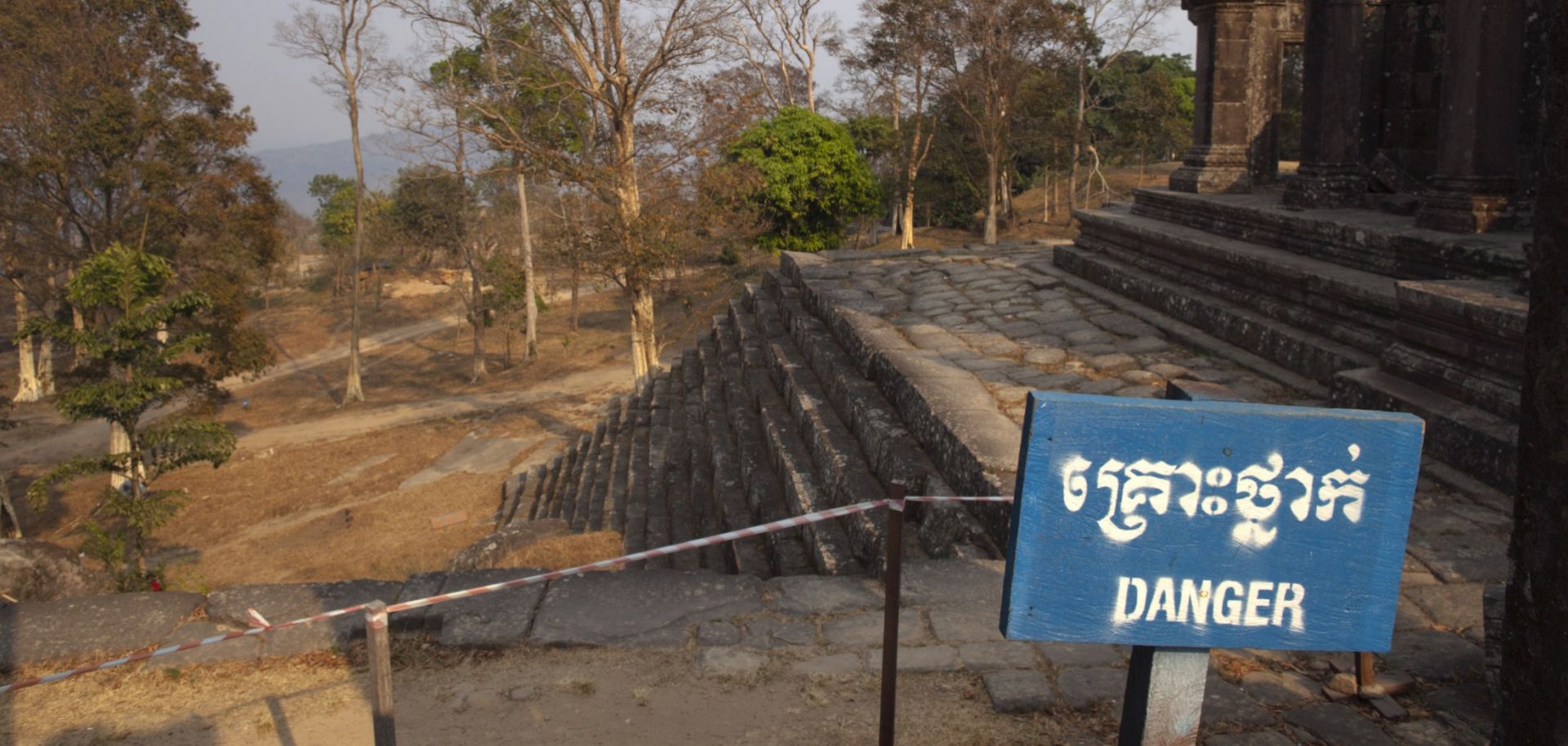
Border clashes between Thailand and Cambodia will likely continue as localized skirmishes in the near term, but in the medium to long term, Cambodia may pursue a military campaign to seize disputed territory if Thai political instability persists, Chinese support remains permissive and Phnom Penh succeeds in modernizing and expanding its military capabilities. On July 24, Thailand-Cambodia border tensions escalated significantly in the disputed area of the Ta Moan Thom temple complex. According to Thai officials, the Thai army detected a Cambodian surveillance drone, followed by an approach of Cambodian soldiers to their position to establish logistics positions. After verbal warnings, Cambodian soldiers then opened fire on Thai soldiers. Cambodian forces subsequently launched rockets and artillery shells into Thailand's Surin and Sisaket provinces, reportedly hitting a gas station and a hospital, as well as civilian homes and public roads. According to the Thai government, the bombardment killed at least 11 Thai civilians, including a child, and one Thai soldier, with over 30 others wounded. In response, the Royal Thai Air Force launched airstrikes using F-16 fighter jets. Thai officials said that the airstrikes targeted two Cambodian military positions responsible for the rocket fire, claiming precision and proportionality in the operation. However, Cambodian officials reject this account, accusing Thailand of bombing a public road near a Buddhist pagoda. In the initial confrontation at the Ta Moan Thom temple complex, Cambodian officials also assert that their troops responded defensively to Thai provocation, and claim the Thai army had deployed a drone in the area. No casualty figures from Thailand's airstrikes have been reported. At the time of writing, sporadic shelling and gunfire had continued into the evening of July 24. China and Malaysia, the current chair of the Association of Southeast Asian Nations (ASEAN), have urged calm and offered to mediate.
- Thailand recalled its ambassador and expelled Cambodia's envoy on July 23 after a landmine incident, while Cambodia reciprocated the next day following the kinetic exchange.
- Thailand has one of Southeast Asia's most powerful militaries, with a $5.73 billion budget, over 360,000 active personnel, 112 combat aircraft (including 28 F-16s), an aircraft carrier, and thousands of armored vehicles and artillery systems. In contrast, Cambodia's military has a $1.3 billion budget, 124,300 personnel, a smaller ground force with around 200 tanks, no fighter jets, and a modest naval and air fleet focused on transport and patrol capabilities.
Tensions between Cambodia and Thailand have been escalating since February, driven by various border disputes and Cambodia's efforts to strengthen its prime minister's political standing via the military. For decades, unresolved border demarcation and enduring nationalist claims by both Thailand and Cambodia have fueled disputes over several hotspots, including around historic Khmer temples and strategic hilltops such as Preah Vihear (a dispute resolved by the International Court of Justice in 2013). Over the years, tensions between the two countries have periodically flared, most recently between 2008 and 2011. Tensions have again risen since a February altercation between Thai and Cambodian troops at the Ta Moan Thom temple complex, leading to diplomatic protests and forward deployments by both militaries. On May 28, an exchange of gunfire killed one Cambodian soldier, and on July 20, a Thai soldier lost a leg to a Cambodian landmine, which also injured three others. Additionally, the two sides have engaged in tit-for-tat media and trade bans and border checkpoint closings. But despite being significantly outgunned, Cambodia is the one stoking tensions. In February, Cambodia sent forces into Thai-controlled Ta Moan Thom, and in June, Cambodia leaked a phone call with the Thai prime minister in an apparent attempt to destabilize the Thai government. Cambodia has also increasingly used bombastic rhetoric surrounding disputes with Thailand, aiming to inflame Cambodian nationalist sentiment. Thailand, by contrast, has merely reacted to these provocations. Considering Thailand's military superiority, Cambodia is likely not expecting to take the disputed border positions by force, especially as Thailand has effective control over all disputed sites. The military escalation that led to the July 24 events is thus likely a political gambit by Cambodian Prime Minister Hun Manet (who took office in 2023) and his father and predecessor, Hun Sen (who served as Cambodia's prime minister from 1985 to 2023 and currently holds the positions of President of the ruling Cambodia People's Party and Senate President). Hun Manet is a former general and West Point graduate who draws his influence from the military and has to contend with powerful rival Cambodian families that are strong in other sectors. Through the recent military confrontations with Thailand, the prime minister and his father are likely seeking to consolidate the younger Hun's political power base and legitimacy by riding Cambodian nationalist sentiments — a critical element of which is the reclamation of lost territories, particularly those containing Khmer Empire-era temples and inhabited by Khmer ethnic people. Meanwhile, the Thai government is in chaos owing to the suspension of Prime Minister Paetongtarn Shinawatra on July 1.
- De-escalation talks occurred before the July 24 kinetic exchange, but no progress was made. Cambodia has forwarded the issue to the International Court of Justice for arbitration, but Thailand must consent to this process, and it is unlikely to do so.
- In September 2024, Prime Minister Hun Manet pulled Cambodia out of the 1999 Cambodia-Laos-Vietnam Development Triangle Agreement amid rising national sentiments with respect to lost territory with Vietnam, underscoring his government's increasingly assertive and nationalist stance. Cambodian nationalists also decry the loss of the Mekong Delta to Vietnam, completed in the 19th century, a region which they call ''Lower Cambodia.'' The Khmer Rouge invaded this area in 1978, driven by the same nationalist sentiments, but this led to its overthrow by Vietnamese forces and a subsequent decade-long occupation of Cambodia by Vietnam. A longer-term Cambodian war footing could also spell renewed troubles in this area, particularly if it completes a key Chinese-backed canal project.
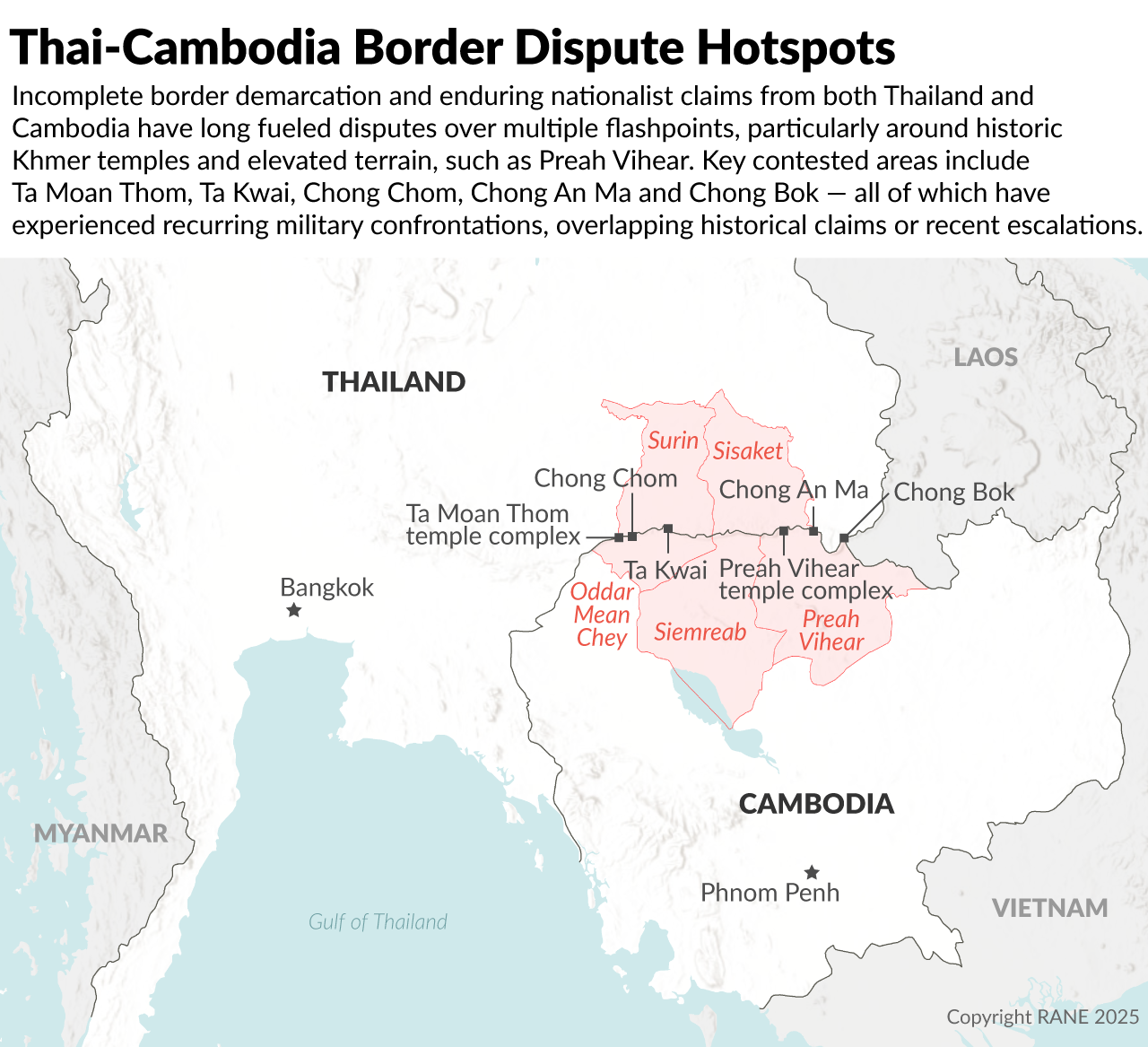
While border clashes will probably continue, the conflict remains unlikely to turn into full-scale war in the short to medium term. Localized artillery strikes and/or skirmishes between the two armies will likely persist along the several border points under dispute. However, a full-scale war is unlikely due to Cambodia's weaker military and Thailand's desire to maintain the status quo in which it holds effective control over all the disputed zones, as well as both countries' desire to limit disruptions to tourism (a critical pillar of their economies). Bilateral diplomatic channels are currently frozen, but Chinese or ASEAN mediation or backchannel efforts could manifest. ASEAN will likely pursue quiet diplomacy rather than formal mediation, but its track record in this regard makes such mediation unlikely to be impactful. Compared with ASEAN, China holds far greater leverage — particularly over Cambodia, which depends heavily on Chinese political, military and financial support. Beijing could use this leverage to pressure Phnom Penh to avoid deeper escalation if the crisis begins to threaten regional stability or Chinese strategic investments. Thailand is less likely to accept Chinese mediation due to China's close alignment with and perceived bias toward Cambodia. Bangkok is also concerned about Chinese domination of its economy and wants to preserve strategic autonomy and its long-standing alliance with the United States. Both sides could ultimately tolerate discreet third-party backchannels that allow for limited de-escalation without either government appearing to back down on sovereignty, such as mutually agreed troop disengagements, informal ceasefire understandings without written commitments or the establishment of neutral observation zones facilitated by ASEAN under the guise of confidence-building rather than dispute resolution. Still, rapid escalation could occur in the short term if there is another mass-casualty event.
- The U.S.-Thai alliance is weakening — particularly under tariff pressures, with the United States threatening 36% duties on its imports of Thai goods. But it remains structurally intact.
- China maintains deep strategic and economic stakes in Cambodia, including control over key infrastructure like the Dara Sakor project, military access at Ream Naval Base and dominant roles in arms sales, foreign direct investment and political backing. In Thailand, Chinese interests focus on economic integration through Belt and Road Initiative rail projects, expanding defense cooperation as a top arms supplier and leveraging cultural ties via Thailand's large Sino-Thai population, though its influence is more limited due to Bangkok's alliance with the United States.
- The escalation threatens to severely disrupt already largely interrupted cross-border trade and logistics, with the Thai-Cambodian border now completely sealed and commercial flights likely to be disrupted as Thailand prioritizes military airspace. Meanwhile, tourism — which generates around 12% of Thailand's GDP and 9.4% of Cambodia's — will likely decline in both countries, particularly at heritage temples and border sites. This will hinder Cambodia and Thailand's efforts to revitalize the sector, which has not yet recovered to pre-COVID-19 levels in either country. Indeed, Thailand has already seen a severe dip in key Chinese tourism owing to a February kidnapping and trafficking incident of a Chinese actor into Myanmar.
In the medium to long term, Cambodia could try to take the disputed areas by force, but its ability to do so will largely depend on strengthening its military capacity, as well as China's tolerance for regional conflict and the evolution of Thailand's internal political instability. Cambodia currently lacks the conventional military capability to dislodge entrenched Thai forces from the disputed areas, which are well-defended and under effective Thai control. While Phnom Penh has announced plans to implement mandatory military conscription in 2026 and continues to modernize its forces with Chinese assistance, including surveillance systems and artillery, any serious offensive would require a significant leap in coordination, logistics and air defense. China's support would be critical in terms of arms and training, as well as in determining whether a prolonged or escalatory campaign would jeopardize Beijing's broader regional interests, infrastructure investments or diplomatic posture within ASEAN. If China signals restraint, Cambodia is more likely to pursue a longer-term strategy of militarized pressure, symbolic confrontations and domestic mobilization, rather than an outright assault on Thai-held territory. However, should the Thai military remain strained — whether due to internal political instability, prolonged deployments to Thailand's west, south and east or eroding public support — Cambodia could view the medium to long term as a window of opportunity to initiate a military campaign aimed at capturing the disputed areas, particularly if the U.S.-Thai alliance remains strained and its deterrence value minimized. This could take the form of a sudden, high-intensity strike designed to overwhelm lightly defended positions, backed by intensified nationalist rhetoric and domestic mobilization. While such a move would carry high risks, especially given Thailand's superior air power and artillery, it may be seen in Phnom Penh as a calculated gamble if China tacitly approves and Thai political paralysis persists in the coming years.
- Though superior, Thailand's military is currently stretched thin. It is contending with a long-standing separatist movement in the country's deep south, which has recently seen several bombing incidents. Thailand has also deployed security forces to its western border with Myanmar to address spillover from that country's ongoing civil war.
- Cambodia sources approximately 82% of its arms imports from China, highlighting its heavy reliance on Beijing for defense equipment, infrastructure development and military training. However, Phnom Penh has begun gradually diversifying its suppliers by reviving limited ties with Russia, including acquisitions of Mi-17 helicopters, ongoing technical maintenance cooperation and renewed dialogue on defense training and equipment upgrades. At the same time, Cambodia has expanded its relationship with Turkey through a 2019 security cooperation agreement focused on counterterrorism and law enforcement, which has since evolved into broader military engagement, including Turkish offers of technology transfers and bilateral talks on defense industrial collaboration. Cambodia is also exploring potential procurement channels with UAE-based firms under its economic partnership with Abu Dhabi. Successful arms diversification would increase the likelihood that Cambodia attempts to take the border areas by force.
