
Editor's Note: This article is part of an ongoing RANE series on the geopolitical impacts of water stress. The first installment of this series provided a broad overview of how the unequal distribution of freshwater shapes geopolitical patterns. Other installments have examined the impacts of water stress on the global economy, Europe, China, the Sahel region of sub-Saharan Africa, Israel, Central Asia, Chile, the Middle East, the Mekong River region, climate investment, India, North Africa, cyberattacks, Egypt, Brazil, and South Asia.
Underinvestment in water distribution systems has resulted in South Africa facing surging water rates and recurring water outages. While government reforms will help catalyze much-needed investments in water infrastructure, these are unlikely to rapidly resolve the country's water supply challenges, which threaten to undermine South Africa's economic growth amid more frequent droughts. South Africa's Gauteng province, the country's commercial hub, has faced a worsening water crisis in recent years. First limited to townships and informal settlements, cuts to water supplies have now extended to the entire region, sometimes lasting for days and causing severe disruptions to public services in spite of restrictions on water usage imposed by municipalities. The growing frequency of water outages has stifled business activity, with estimates suggesting that each day without water in Gauteng could cost up to 3 billion rand (about $160 million) to the South African economy. Cuts to water supplies frequently trigger protests, sometimes resulting in vandalism against water infrastructure such as pumping stations. Much of the current crisis stems from insufficient investment by the province's municipalities in maintaining water infrastructure, which has resulted in more than 40% of the water supplied by state-owned bulk water supplier Rand Water being lost due to leaks and theft. Municipalities' financial woes have also led to mounting nonpayments to Rand Water for its bulk water supply, with the company warning in December 2024 that it could be forced to shut down if municipalities did not settle 7.7 billion rand in municipal debt. These challenges bode ill for Gauteng, but they are not limited to the province, as South Africa's overall water supply-demand gap is at risk of rising to 17% by 2030 in the absence of rapid intervention from authorities and sweeping changes to household and businesses' water usage.
- Rand Water is one of South Africa's seven water boards. These boards operate bulk water supply infrastructure and sell bulk water to municipalities, which then supply water to households and businesses under their jurisdiction.
- Reasons behind South Africa's water outages include poor maintenance of water infrastructure, bursting water pipes, vandalism against water infrastructure and power outages affecting water pumps. A six-month shutdown of the Lesotho Highland Water Tunnel for maintenance has exacerbated Gauteng's water crisis, as South Africa purchases about 25% of its total water supply from Lesotho.
- South Africa's National State of Water Report found that as of 2023, 98% of the country's available water resources were already allocated. Localized bouts of water scarcity have occurred in South Africa, such as in Cape Town between 2015 and 2020.
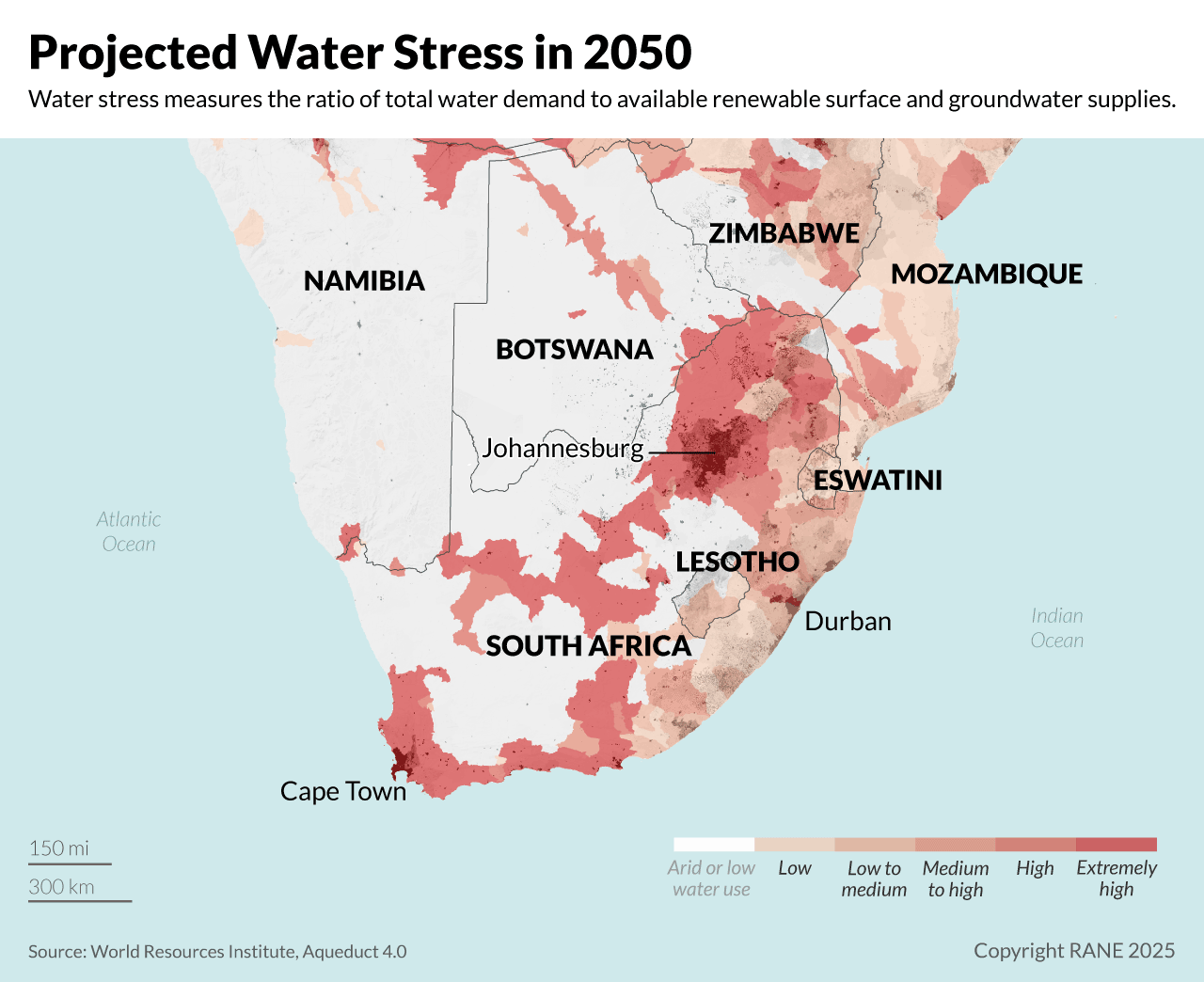
Municipalities' financial difficulties and mismanagement are the driving factors behind the lack of maintenance to South Africa's aging water distribution systems, which together with growing pressure on water infrastructure from surging demand has resulted in increasingly frequent water outages and surging water tariffs. Challenges in securing a reliable water supply are inherent to South Africa's geography, as the country lacks large rivers and has an arid or semiarid climate throughout much of its territory. Limited freshwater resources only partly explain South Africa's current water sector challenges. Following the end of apartheid in the early 1990s, the ruling African National Congress inherited a structurally imbalanced water infrastructure network, with poor Black neighborhoods severely underserved. The ANC expanded access to water services nationwide, but this caused water demand to surge, a problem compounded by rapid population growth and urbanization. In parallel, weak metering, billing and revenue collection systems have curbed municipalities' revenue to press ahead with necessary repairs to water distribution networks. Moreover, poor management by municipal officials and staff has often resulted in water infrastructure maintenance being deprioritized, which has led to rising levels of so-called nonrevenue water nationwide. As aging infrastructure breaks down at an increasingly frequent rate, South Africa has faced worsening water outages, causing repeated disruptions to households and business activity. Meanwhile, water prices have surged as authorities have sought to make them reflect the costs faced by the water provider, causing a growing strain on businesses and households alike. Moreover, South Africa's heavy reliance on water-dependent coal-fired power plants to generate electricity means that disruptions to water supply also threaten to undermine the country's power supply.
- South Africa's population grew from 44 million in 1994 to 64 million in 2024, while the share of the population living in urban areas increased from 54% in 1994 to 68.8% in 2023. Access to basic water services has risen from around 55% in 1994 to approximately 90% as of 2024.
- Nonrevenue water is water that is not accounted for financially through billing and payments, either due to theft or leaks. South Africa's Department of Water and Sanitation found in 2023 that the country's average nonrevenue water rate stood at 47.4%, with nonrevenue water levels standing above the national average in all of South Africa's provinces with the exception of the Western Cape, where it was significantly lower at 27.6%.
- Research from energy company PowerOptimal found that, from 1996 to 2024, South Africa's water and sanitation tariffs on average had risen 5.6 times faster than inflation.
South Africa's government will look to address the country's water supply challenges by increasing access to private sector and developmental financing for water infrastructure projects and improving the management of the country's water resources. Following the formation of a coalition government between the ANC and the center-right Democratic Alliance, President Cyril Ramaphosa confirmed in July 2024 that increasing investment in South Africa's water infrastructure would be a priority for the new government. Amid fiscal constraints, the government is seeking to increase private sector investments in water infrastructure, for example by streamlining the regulation of public-private partnerships and launching a credit guarantee vehicle. Efforts to increase funding have also involved reforming South Africa's water management institutions, notably through the upcoming establishment of the National Water Resources Infrastructure Agency. The agency will operate the country's national water infrastructure and use revenue from these assets to raise commercial and development finance, notably by issuing debt. Its establishment will also help optimize the operation of South Africa's national water assets by unifying their management under a single body, part of a broader push by the government to improve the governance of South Africa's water sector. To that end, the government is likely to pass legislation that de facto compels municipalities to increase funding for the maintenance of water infrastructure, for example by ring-fencing the revenue from water sales for water services. Institutional reforms may also enable the Department of Water and Sanitation to directly intervene in the maintenance of water infrastructure of failing municipalities. Moreover, the government is likely to expand measures aimed at ensuring municipalities resume payments to water boards, whether by withholding funding from municipalities with substantial arrears or enabling the write-off of water debt for those that resume the payment of their invoices.
- Ramaphosa gave his assent to the bill establishing the National Water Resources Infrastructure Agency in August 2024. Until the formal establishment of the South African National Water Resources Infrastructure Agency, scheduled for May 2025, the management of South Africa's bulk water assets will remain divided between a variety of bodies, including the Department of Water and Sanitation, the Trans-Caledon Tunnel Authority and the Water Trading Entity.
- The Water Services Amendment Bill, currently undergoing deliberation in South Africa's National Assembly, will enable the Department of Water and Sanitation to issue directives to municipalities that fail to provide clean drinking water to residents. Should municipalities fail to meet a deadline, the bill would enable the government to direct "any water service institution" to take over all of the municipalities' responsibilities regarding water provision.
- In November 2024, South Africa's National Treasury announced that it would withhold up to 845 million rand in funding from the municipalities of Kopanong, Matjhabeng, Merafong City, Thabazimbi and Victor Khanye due to their failure to pay water boards for their supplies of bulk water.
Municipalities' financial distress will hinder national government efforts to increase investments in the maintenance of water infrastructure, portending sustained disruptions to water supplies and high nonrevenue water levels that raise the risk of so-called day-zero droughts and will likely result in more stringent restrictions on water use. Despite proposed reforms, municipalities' liquidity and solvency challenges will likely deter many companies from pressing ahead with repairs to municipal water infrastructure given the risk of nonpayment. These financial difficulties, together with weak water revenue collection systems, could also result in many municipalities halting their compliance with debt write-off programs, causing water boards to face sustained default risks. This suggests that while the government's proposed reforms will help mitigate further degradation in the reliability of South Africa's water supply and could reduce the duration and frequency of water outages in certain municipalities, they are unlikely to result in the investment needed fully to address the country's water supply challenges over the next few years. Persistently high levels of nonrevenue water will increase South Africa's vulnerability to droughts, as they result in water losses that could be used to mitigate water stress and require water boards to press ahead with larger water withdrawals, stressing freshwater sources. These vulnerabilities significantly increase the likelihood of localized day-zero droughts — which are when taps run dry due to depleted water reserves — over the next two decades, which will likely prompt municipalities to impose more stringent restrictions on water usage to mitigate these risks.
- In October 2023, Minister to the Presidency Maropene Ramokgopa said that 163 of South Africa's 257 municipalities were in financial distress. The driving factors behind municipalities' financial challenges include weak revenue collection systems, poor management, and local officials' misappropriation of funds.
- If water boards go bankrupt, this will threaten to deny bulk water supplies to all municipalities falling under the water board's remit, likely resulting in costly government interventions to ensure the continuity of water services and denying the National Water Resources Infrastructure Agency revenue to raise financing.
Climate change and rising water demand will compound South Africa's water supply challenges, likely undermining the country's economic growth. But worsening water stress is unlikely to cause a protracted return of rolling blackouts in the next few years, as the government will likely prioritize water supplies to power generation. Southern Africa is expected to witness declining rainfall and warm by more than 3°C through 2100 compared to 1901-2016 averages in a baseline scenario developed by the Intergovernmental Panel on Climate Change. In addition to more frequent droughts and heatwaves, South Africa is set to face further increases in water demand as the population grows and urbanization progresses. Amid already high levels of nonrevenue water, the growing stress on the country's water resources in the years ahead will likely result in stringent restrictions on water consumption becoming more frequent and in further increases in water tariffs, which will likely weaken economic growth. To mitigate damage to the economy, the government will likely prioritize water supplies to power generation, as a failure to do so would threaten to trigger a return of nationwide blackouts given the country's reliance on water-intensive coal-fired power plants. While this could trigger a backlash from the public, the power sector's small water footprint suggests that trade-offs for households and other businesses will likely be limited. This suggests that South Africa's water challenges are unlikely to cause a return to monthslong rolling blackouts in the next few years. The government is unlikely to fully shield these sectors from higher water tariffs or periodic water outages, however, which will threaten to further deteriorate state-owned energy company Eskom's balance sheet and could lead to temporary shutdowns of power generation at certain coal-fired power plants.
- In Q3 2024, South Africa's economy contracted by 0.3% after the agricultural sector suffered a 28.8% year-on-year decline due to a drought. Excluding agriculture's sharp decline, gross domestic product would have expanded by 0.4% during the quarter.
- As of 2022, 58% of South Africa's water use was directed toward the agricultural sector, against 30% for municipalities, which cover residential, commercial and industrial water users, with 6% for the mining sector and 2% for power generation.
- Under the baseline SSP2 climate model developed by the Intergovernmental Panel on Climate Change, South Africa's yearly average temperature will rise from 18.56°C in 2014 to 19.5°C in 2050, before reaching 20.7°C in 2100. South Africa's average annual temperature stood at 17.5°C for the 1901-2016 period.
- The impact of climate change is set to significantly vary between South Africa's different provinces. For example, inland regions are expected to warm faster than coastal regions, with the western parts of the country set to face the steepest decline in rainfall, while the eastern provinces will face stagnant or rising rainfall. For example, rainfall in the Western Cape is expected to decline by 25 mm (about 1 inch) on average by 2040-2059 under the SSP2 scenario, while KwaZulu-Natal's average rainfall is forecast to increase by 22 mm.
Worsening water stress levels will likely undermine South Africa's food sovereignty and erode the international competitiveness of the country's mining and manufacturing sectors, while also straining social cohesion and threatening to result in violent demonstrations and mass looting. The agricultural sector's large water footprint and limited contribution to the economy mean that it is set to be first in line when curbs on water consumption are imposed. The sector will likely face steeper requirements to cut its water usage compared to households and other businesses. This bodes ill for irrigation-reliant crops such as fruits, vegetables and vineyards, but also means that rain-fed agriculture will be unable to rely on irrigation to mitigate declining rainfall, portending steep drops in the output of staple crops during droughts. Worsening water supply challenges thus portend bouts of surging food inflation, but South Africa will likely retain the means to prevent surging food insecurity through greater food imports over the next five to 10 years, even though this will worsen the country's balance of payments and undermine its self-sufficiency regarding food production. South Africa's mining and manufacturing sectors are also set to face challenges from worsening water stress levels, and it will be more politically challenging for governments to prioritize water supplies to these sectors at the expense of households when compared to power generation given their larger water footprint. In practice, this means that companies operating in these sectors may be compelled to reduce output during droughts, or that their acquisition of water licenses may involve more stringent requirements regarding water usage or the adoption of water-saving technologies. In addition to sectoral economic impacts, South Africa's worsening water supply challenges are set to fuel public discontent, with localized demonstrations to denounce water outages poised to continue for the years to come. High levels of inequality and racial disparities also mean that the imposition of stringent water restrictions on households in times of drought will likely become politicized, threatening to result in escalating unrest, including violent protests and mass-looting incidents. In addition to causing economic disruptions, water supply challenges thus threaten to erode South Africa's already fragile social fabric, potentially becoming a fresh source of political instability in the decades ahead.
- As of 2022, the agricultural sector only represented 2.7% of South Africa's GDP but employed around 19% of the workforce.
- Water restrictions by the Department of Water and Sanitation at the height of the Cape Town drought in 2017 resulted in the Western Cape's agricultural sector being forced to cut its water consumption by 60% on average, which resulted in around 30,000 job losses and in a 13%-20% drop in agricultural exports.
