
The formation of a coalition government between the African National Congress and the Democratic Alliance in South Africa has the potential to raise the country's macroeconomic outlook, but the government's reform drive will likely face severe challenges linked to intra-coalition ideological and political disagreements and strong pushback from unions. On July 18, South African President Cyril Ramaphosa delivered his Opening of Parliament Address to lay out his new government's priorities. The address included pledges to reform local government, expand the use of public-private partnerships and continue reforming South Africa's state-owned enterprises. Ramaphosa's announcement came after the center-right Democratic Alliance party, or DA, agreed to join a Government of National Unity (GNU) with the ruling African National Congress party, or ANC, and eight other parties on June 14. While controversy marred the formation of the new Cabinet, Ramaphosa ultimately unveiled its composition on June 30, and the Cabinet held its first meeting, or lekgotla, on July 13-14.
- In his July 18 speech, Ramaphosa also outlined the GNU's ambitions to press ahead with ''massive'' investments in infrastructure projects, professionalize public services, implement ''institutional reforms'' to the water sector and stabilize the country's debt. In addition, Ramaphosa signaled his willingness to strike a compromise over the controversial National Health Insurance (NHI) Act, which the DA has criticized as unaffordable. The NHI Act was signed into law soon before South Africa's May 29 general election.
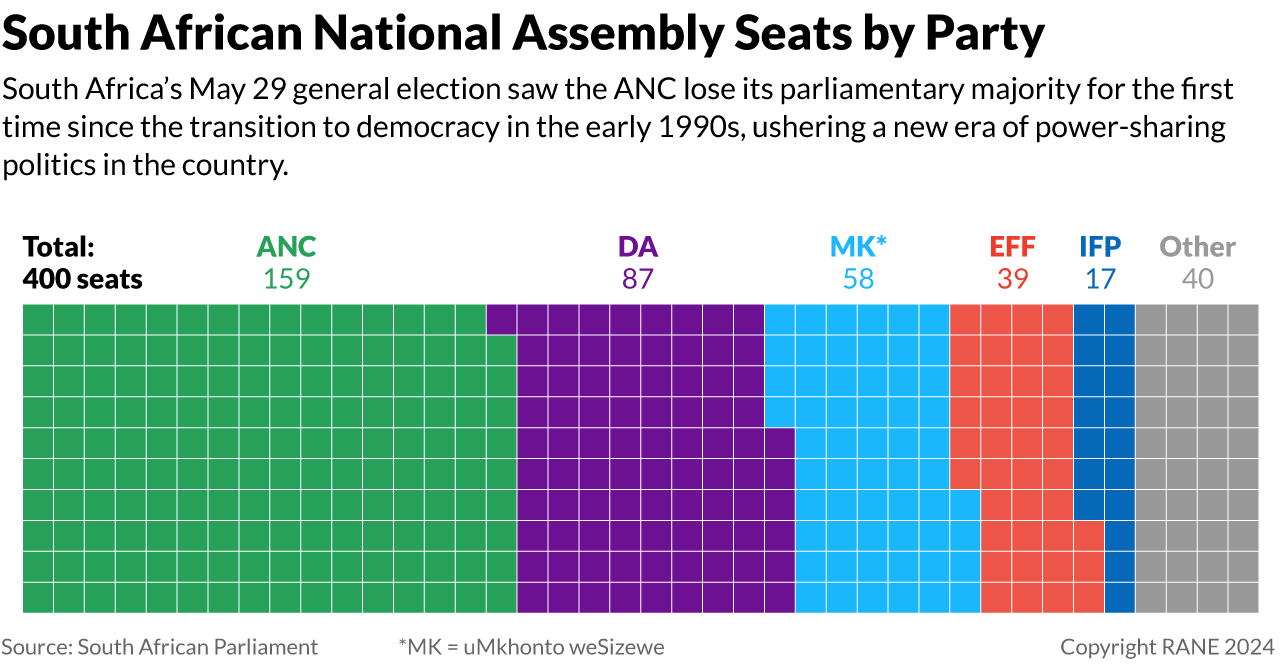
- The formation of GNU followed the ANC's loss of its parliamentary majority in the May 29 election, a first since the country's transition to democracy in 1994. In the election, the ANC gained only 40.2% of the vote, down from 57.5% in 2019, with the decline primarily linked to former President Jacob Zuma's decision to run separately through his uMkhonto weSizwe party, or MK, which gathered 14.5% of votes.
- In addition to the ANC and the DA, the unity government includes eight other parties, including the conservative Inkatha Freedom Party and the right-wing Patriotic Alliance. However, the GNU does not include MK or the far-left Economic Freedom Fighters party, or EFF.
Although Ramaphosa emphasized government unity, ideological differences between the ANC and the DA will likely hinder the development of detailed policy proposals, potentially delaying the reform process on several policy issues. The GNU is now due to craft a Medium-Term Development Plan that includes detailed policy proposals, as well as a roadmap to implement reforms. While the DA's endorsement of Ramaphosa's July 18 speech showcases that the unity government's two main parties have reached a consensus on the GNU's priorities, developing detailed policy proposals will likely prove more challenging given the two parties' ideological differences. For example, the ANC and the DA will likely disagree on the extent to which the private sector should be involved in infrastructure projects, as Ramaphosa will face pressure from the ANC's left-wing Radical Economic Transformation faction, or RET, to limit the expansion of the private sector's role in the economy. Policy disagreements could hold up much-needed structural economic reforms, such as reforms intended to facilitate investments in water infrastructure, which would delay the start of the reform process. Nonetheless, Ramaphosa's openness to compromise on the NHI Act — together with the DA easing its criticism of the act — suggests that the two parties are likely to overcome their ideological differences on a number of policy proposals.
- The government is set to convene a national dialogue with opposition parties, trade unions and business groups as part of efforts to develop its Medium-Term Development Plan.
- Broad-based Black Economic Empowerment policy, or B-BBEE — which is designed to address economic inequalities caused by apartheid by facilitating Black South Africans' participation in the economy — will likely be a contentious issue between the ANC and the DA. The DA opposes B-BBEE, arguing that it has failed to address economic inequalities and hinders South Africa's economic growth. While Ramaphosa reiterated the unity government's commitment to B-BBEE on July 18, the DA could demand the review of certain provisions in specific sectors, such as oil and gas, which would likely trigger a strong backlash from ANC lawmakers.
In addition to ideological differences between the ANC and the DA, disagreements between the two parties over the unity government's decision-making process and the management of corruption scandals could trigger intra-coalition infighting that ultimately prompts the DA to exit the government. The GNU's statement of intent consecrates the need for ''sufficient consensus'' before the government can move forward with a decision, requiring agreement from parties within the unity government that represent 60% of the seats in the National Assembly (240 seats). With the government currently controlling 283 of the 400 seats in South Africa's National Assembly, this de facto grants the DA veto power over government decisions, as the ANC cannot meet this threshold if all other coalition partners besides the DA support a specific decision. However, the need for sufficient consent has stirred controversy between the ANC and the DA, with high-profile ANC figures attempting to walk back from this provision. While these controversies have now eased, Ramaphosa could look to override the provision should he feel pressured to appease the ANC's RET faction by advancing left-leaning legislation. Corruption scandals — particularly those involving ANC lawmakers and ministers — will likely be another source of tension between the GNU's two main parties, as the DA will want to avoid any association with state capture. Over time, fresh corruption scandals and repeated breaches of the statement of intent could prompt the DA to withdraw from the unity government. Although the DA would still likely be willing to provide ad-hoc support to the ANC to discourage it from pivoting toward the EFF, the center-right party's exit from the GNU would likely significantly delay the reform process, dimming South Africa's macroeconomic outlook.
- Of the GNU's 283 seats, the ANC controls 159 seats, while the DA controls 87. With the remaining 37 seats held by other parties participating in the unity government, the ANC would only be able to secure 49% of the seats within the National Assembly without the DA — significantly below the 60% threshold of sufficient consensus.
- On June 18, ANC General-Secretary Fikile Mbalula argued the DA could not veto government decisions, claiming that the 60% threshold was based on parties' share of seats within the GNU rather than the National Assembly at large. This prompted strong criticism from DA Federal Council Chairperson Helen Zille, thereafter causing heightened ANC-DA tensions that delayed the formation of Ramaphosa's Cabinet.
Even if the ANC and DA leaderships develop a functional working relation, the government's reform agenda will likely face strong pushback from trade unions and left-wing parties, which could compel Ramaphosa to water down or shelve some of his key pledges. The ANC has historically held close ties with South Africa's trade union movement, especially the Congress of South African Trade Unions, or Cosatu, which is part of the Tripartite Alliance with the ANC and the South African Communist Party, or SACP. However, relations between the ANC and unions have frayed in recent years as Ramaphosa's first administration attempted to reduce public sector wages to curb the country's fiscal deficit. With the DA's inclusion in the unity government, this approach is likely to persist, which will set the stage for tense relations between the government and trade unions and threaten to trigger strike action — with the public and mining sectors most at risk of facing disruptions. Moreover, disagreements over wage increases will make unions reluctant to adopt a cooperative approach with the government regarding the reform process. In the absence of consensus, the passing of structural economic reforms would likely prompt unions and left-wing parties such as the EFF and MK to call for nationwide demonstrations. Should this happen, Ramaphosa would face strong pressure from RET lawmakers to water down reforms to appease unions, especially if Cosatu and the SACP threaten to exit the Tripartite Alliance. This pressure would risk destabilizing the GNU, as yielding to unions' demands would undermine ANC-DA relations while overriding RET's warnings could pave the way for a parliamentary rebellion by RET lawmakers and a fractured Tripartite Alliance. Even though the RET faction likely lacks the numbers in the National Assembly to defeat the government by itself, Ramaphosa would likely seek to meet some of the faction's demands to avoid splitting the ANC.
- The National Union of Metalworkers of South Africa, or NUMSA, has already engaged in strike action since the May 29 election, including in the automotive and aviation sectors.
- Around 25% of workers in South Africa's formal economy are unionized, with the majority hailing from the country's mining and public service sectors. Competition between unions for membership will make them even more reluctant to cooperate with the government.
- On July 15, SACP secretary general Solly Mapaila criticized the ANC's decision to form a coalition government with the DA, saying that the party would have favored the inclusion of the EFF in government rather than that of ''neoliberal forces.''
Should the government overcome these challenges, it will likely be able to press ahead with several key economic reforms that would raise South Africa's economic outlook, even though deeply entrenched corruption will likely remain an important constraint for foreign investors, whose confidence in South Africa could be undermined by a potential Donald Trump presidency in the United States. While the unity government's reform agenda will face significant challenges, the formation of a coalition government will reduce left-wing ANC lawmakers' influence over policymaking compared with Ramaphosa's first administration, raising the prospect of several market-friendly reforms passing in the coming years. Topping the government's reform agenda will be reforming South Africa's state-owned enterprises, or SOEs, especially state-owned utility company Eskom and state-owned transport company Transnet. The GNU will likely press ahead with unbundling Eskom — a process initiated during Ramaphosa's first term — which will help create a more competitive market structure in South Africa's power sector by ensuring market competition over electricity prices. Moreover, the government will also likely seek to improve SOEs' governance, which together with an expansion of public-private partnerships, could unlock private sector investments in South Africa's troubled power and transport sectors. Combined with a pledged reduction in red tape and fiscal consolidation measures, the successful implementation of the government's reform agenda would thus likely help raise South Africa's medium- and long-term economic outlook, which will be key in addressing the country's unemployment crisis. However, deeply entrenched corruption and state capture will likely continue to curb foreign investors' interest in the country for the foreseeable future. In addition, a Trump victory in the U.S. presidential election in November would risk undermining investor confidence in South Africa, as the Trump administration would likely review the United States' commitment to the $9.3 billion Joint Energy Transition Partnership, as well as pressure Congress to suspend South Africa's eligibility for the African Growth and Opportunity Act — which enables South African goods duty-free access to the U.S. market – due to Pretoria's genocide case against Israel before the International Court of Justice.
- The National State Enterprise Bill, which was first published in January, will look to place South African SOEs under a single asset management company overseen by an eight-person board. However, much of the reform's success will depend on who is appointed to the board, with the process potentially subject to political machinations within the unity government or ANC.
