
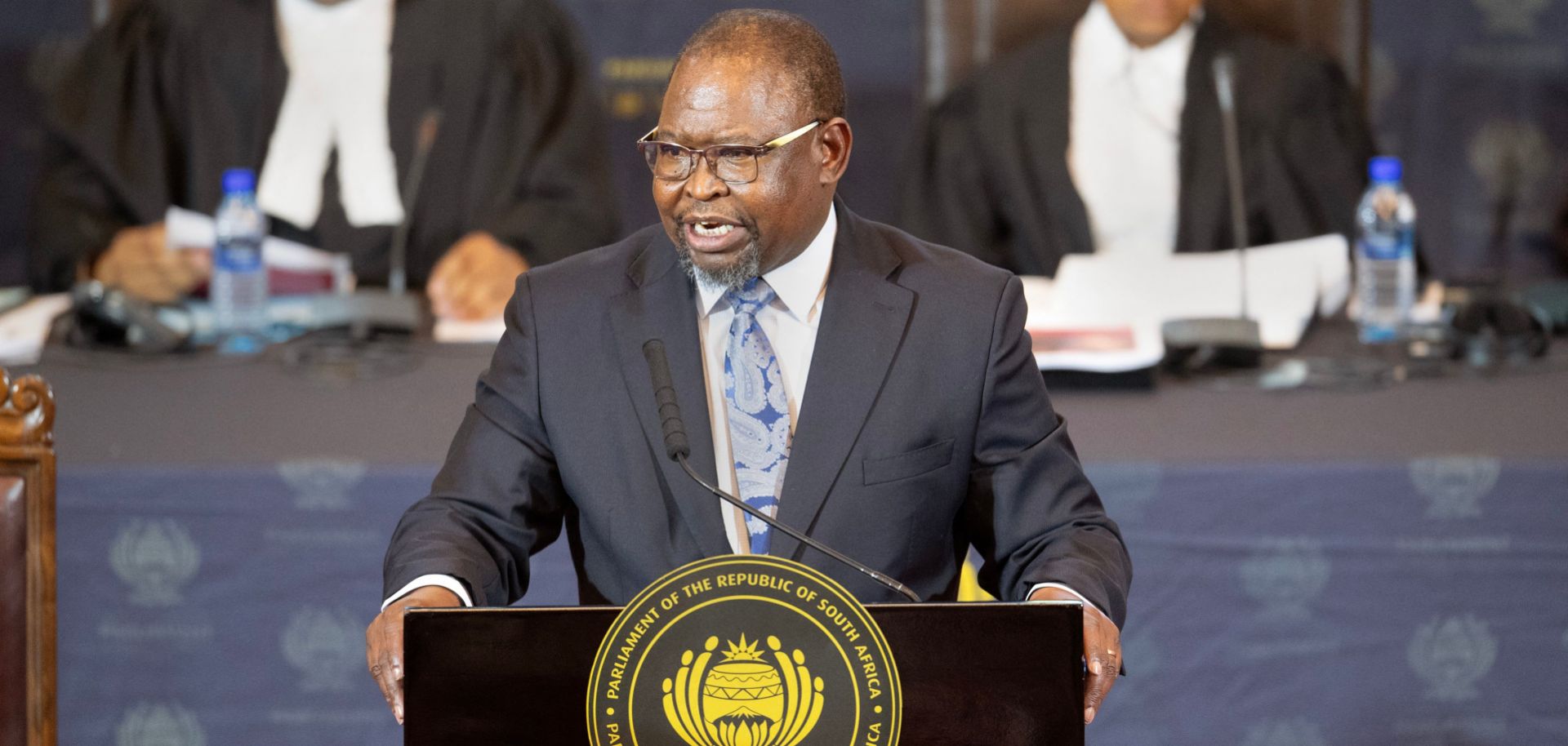
Adjustments to South Africa's budget will likely stave off public anger in the short term, but will not address South Africa's fundamental macroeconomic challenges and worsening socioeconomic problems, portending waning support for the ruling party beyond next year's election. On Nov. 1, South African Finance Minister Enoch Godongwana delivered his midterm budget speech to parliament, providing projections through 2026, during which time he said that the government would cut spending to cope with lower than expected state revenue. The national 2023-24 fiscal year budget has been revised down by 56.8 billion rand (about $3 billion) due to poor economic performance, made worse by blackouts, state-owned rail company Transnet's inefficiencies and other logistical problems that hamper growth. Godongwana announced cuts totaling 21 billion rand even though overall spending increased by 10.3 billion rand. The government will cut budget allocations to government departments by 85 billion rand over the next two years, while it will also immediately cut conditional grants to municipalities in the 2023-24 fiscal year — which are used to fund infrastructure projects, among other things — by 3.4 billion rand. Godongwana also signaled tax increases totaling 15 billion rand (about $807 million) to be announced when the 2024-25 budget is unveiled in February. Even so, Godongwana allocated 23 billion rand to "labor intensive departments" like health, security services and education to enable them to implement the 2023 public wage sector agreement, which will increase the salaries of civil servants by 7.5% in 2023-24 fiscal year. He also announced that 34 billion rand has been allocated to extend the COVID-era Social Relief of Distress Grant that provides low-income South Africans with a cash transfer of 350 rand per month for another year, now ending in March 2025.
- South Africa's gross debt is expected to rise to 6.52 trillion rand in 2026-27 from 5.24 trillion rand in 2023-24, reaching 77% of gross domestic product in 2025-26 compared with 73.6% of GDP in 2023-24.
- Godongwana also announced that the bailout packages for state-owned enterprises are changing. The government loan to Eskom will switch from no-interest to interest-bearing, and will offer Transnet no bailout or assistance until progress has been made toward improving efficiency, facilitating competition and leveraging financial and technical support for the private sector.
These adjustments come amid lower than expected economic growth and state revenue. Economic growth is projected to fall from 1.9% in 2022 to 0.8% in 2023, with a GDP growth rate from 2024-2026 projected to average 1.4% — far short of the rates that most South African economists say are needed to spur job creation and poverty reduction. Low growth rates accompany state revenue shortfalls; Godongwana noted that the "windfall tax" that South Africa had enjoyed due to the 2020 commodity boom has come to an end. In particular, provisional figures of corporate tax collections from the mining industry fell by 24.6 billion rand (or by about 55%) relative to the same period in 2022-23, driven by lower commodity prices, weaker global growth, increased electricity cuts and logistical constraints. Tax revenue has also dwindled as the country's tax authority raised less corporate tax and had to pay higher value-added tax refunds, including those related to businesses and households investing in alternative energy sources. Mining companies claimed the largest share of VAT refunds at 5.7 billion rand, followed by the manufacturing sector's 5 billion rand and electricity sector's 3.5 billion rand.
In attempting to balance spending cuts compensating for low economic growth with politically expedient social spending, the adjustments will likely forestall public backlash ahead of next year's election, but will not address South Africa's economic decline and will risk eroding the ruling party's electoral dominance. The adjustments announced during the midterm budget speech are temporary patches measures rather than real solutions to fundamental macroeconomic problems. In the short term, cuts to specific government department allocations and municipalities will only slightly alleviate the budget deficit, but not to the extent that they prevent the government from having to borrow to finance next year's budget. While a more detailed plan to address South Africa's revenue shortfalls will likely be unveiled during the presentation of the 2024-25 budget in February, the budget priorities do not bode well for South Africa's medium-term economic growth. Given the increases to public sector wages and the extension of the social relief grant, it appears as though the government is prioritizing avoiding political blowback ahead of the 2024 election — during which the ruling African National Congress is expected to face its lowest levels of support since ascending to power in 1994 — rather than using limited revenue to address the deterioration of the country's electricity and logistics infrastructure. This will likely hamper economic growth beyond 2026. Although this strategy may prove successful enough to support the ANC's bid to retain its majority through the 2024 election, South Africa's economic decline will likely undermine the party's support in years to come. Without sweeping reforms, debt-ridden state-owned companies like electricity utility Eskom and rail and port operator Transnet will continue to provide worsening services amid rampant corruption and inefficiencies, making the country less hospitable for foreign investment and business activity. Amid low growth, unemployment, poverty and inequality — all three already among the highest in the world — are poised to worsen, exacerbating grievances against the ANC. Thus, while the government may be able to stave off economic collapse in the medium term with increased borrowing, greater tax collection and some spending cuts, these will only get the ANC so far in staving off voter backlash in next year's poll and may ultimately undermine its long-term political future.
- The International Monetary Fund projects that South Africa's unemployment rate will reach 34.7% by the end of 2023, while the poverty rate will hover around 40%.
- The South African central bank estimated in March that load shedding will account for 2 percentage points of economic growth in 2023. Electricity outages hamper nearly all aspects of development, from school operating hours to supply chain reliability to food production. Load shedding also impairs business confidence, leading to reduced spending, lower recruitment and backlogs of work due to diminished efficiency.
