
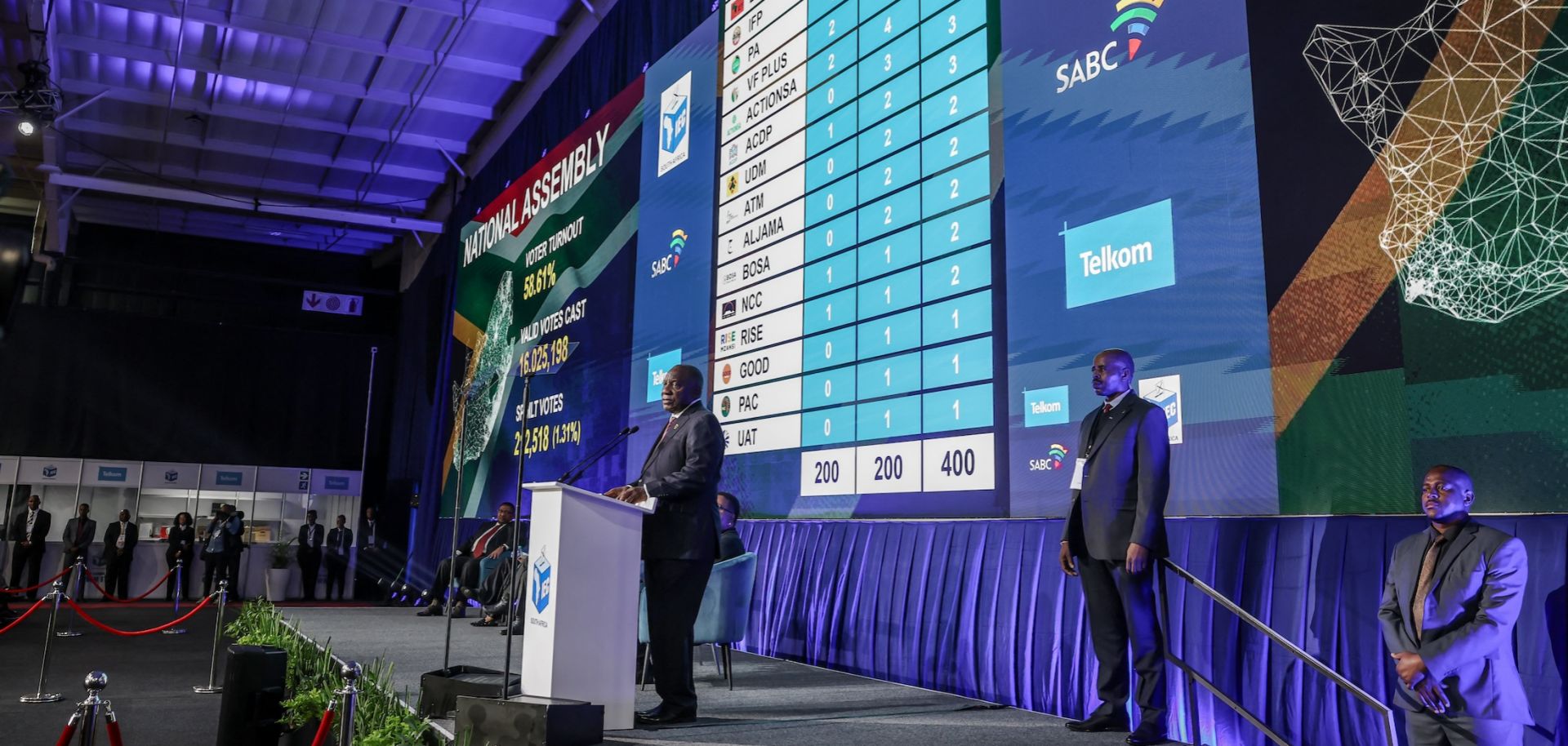
The African National Congress (ANC) party's historic defeat in South Africa's general election will test the party's internal cohesion as its leadership looks likely to seek a deal with the center-right Democratic Alliance party, which would raise investor confidence in the country, but also increase the risk of politically-motivated violence in the short term. On June 2, South Africa's Independent Electoral Commission (IEC) announced that President Cyril Ramaphosa's ruling ANC had gathered 40.18% of votes in the country's May 29 general election, stripping the party of a parliamentary majority for the first time since democratic elections were held following the end of apartheid. The ANC will now only hold 159 out of 400 seats in the National Assembly, a sharp decline from the 230 seats the party secured in the 2019 general election. This electoral defeat was accompanied by a surge in support for former President Jacob Zuma's uMkhonto We Sizwe (MK) party, which secured 14.58% of the vote nationwide, earning it 58 seats in the legislature following its recent formation in September 2023. This will make the MK the third-largest party in the National Assembly after the ANC and the center-right Democratic Alliance (DA), which slightly increased its parliamentary presence to 87 seats after securing 21.81% of the vote. The far-left Economic Freedom Fighters (EFF) came in fourth place with 9.52% of the vote — leaving it with 39 seats compared with the 44 seats the EFF previously held — with smaller parties securing the 57 remaining seats in the National Assembly.
- Some of the more consequential smaller parties that secured parliamentary representation in the May 29 ballot include the Inkatha Freedom Party (IFP) with 17 seats, the Patriotic Alliance with 9 seats, the Freedom Front Plus with six seats, and ActionSA with six seats.
President Ramaphosa appears likely to seek a governing agreement with the DA to secure a parliamentary majority, but this will prove controversial among the ANC's left-wing members — potentially paving the way for their exodus from the party or Ramaphosa's departure as president. As it became increasingly clear that the ANC would not be able to solely rely on smaller parties to govern, Ramaphosa's allies in the ANC began hinting in private that the party should strike an agreement with the DA, whose 87 seats would on paper grant the ANC a 246-seat majority in the National Assembly. However, the ANC's left-wing Radical Economic Transformation (RET) faction is set to strongly oppose this push, as it views the center-right DA party as defending the economic interests of South Africa's White minority. Should Ramaphosa decide to override these concerns and formally back an agreement with the DA, it would risk triggering calls from within the party for his replacement as ANC leader — and by extension, president of South Africa. ANC members opposed to a deal with the DA will likely prefer that the ANC instead reach an agreement with the EFF. However, the far-left party's 39 seats mean that the ANC would also need to gain the support of an additional party to secure a governing majority, such as Zuma's MK or the IFP. However, an ANC coalition with the EFF and MK would badly damage investor confidence in South Africa and compound the country's economic challenges due to both parties' left-wing and populist economic agendas. Together with the MK's demands for the presidential amnesty of Zuma, Ramaphosa thus still appears more likely to pursue a governing agreement with the DA, which would likely raise investor confidence in South Africa amid hopes that the center-right party will seek to accelerate the pace of economic reforms, such as expanding the role of the private sector in the power, transport and water sectors. However, an ANC-DA deal would also likely prompt an exodus of RET lawmakers from the ANC, which could compel Rampaphosa to include other parties, such as the IFP and the Patriotic Alliance, in a prospective agreement with the DA.
- While the ANC was widely expected to lose its majority amid rising public discontent, the ruling party still hoped to come away with enough seats that it would have only had to secure support from smaller parties to secure a parliamentary majority. However, support for the ANC slipped in the last 10 days of campaigning, as the party forwarded a controversial healthcare reform bill. The Constitutional Court's decision to bar Zuma from running on the MK's list also likely reinforced support for the MK by strengthening narratives that Zuma is being persecuted by South Africa's political establishment.
- The powerful Congress of the South African Trade Union (COSATU), as well as the South African Communist Party (SACP), are likely to be skeptical of an ANC-DA deal due to the DA's support for market-friendly economic reforms. While not represented in parliament, COSATU and the SACP play an important role within the ANC's governing structure and have held Cabinet positions, as the three groupings formed a tripartite alliance following Nelson Mandela's release from prison in 1990.
- According to MK spokesperson Nhlamulo Ndhela, the party's conditions to enter a coalition with the ANC include Ramaphosa's departure as ANC leader, changes to South Africa's constitution regarding the country's financial and water sectors, and a presidential amnesty for Zuma that would pave the way for his return as president.
- During a June 1 press conference, EFF leader Julius Malema said that while his party would not seek to remove Ramaphosa as president, its participation in a coalition with the ANC would be contingent on the ANC agreeing to let the EFF control South Africa's National Treasury, as well as fast-track land redistribution without compensation from White landowners.
Reports that the ANC is seeking to reach an agreement with the DA — combined with Zuma's allegations of electoral fraud — will raise the risk of violent unrest in the coming days and weeks. Allegations of voter fraud emerged in the Western Cape on May 31, with local supporters of the EFF, MK and other smaller party members accusing the IEC of rigging the vote in favor of the DA and ANC. While the party leadership of the ANC, DA and EFF rejected these claims, Zuma warned the IEC not to declare the results the following day, adding that doing so would ''start trouble'' as ''people [would] be provoked'' — a warning that the electoral commission disregarded. Zuma's comments were in clear echo to South Africa's July 2021 unrest, during which his supporters rioted following the former president's condemnation for contempt of court. Given this recent historical precedent, the IEC's decision to overstep Zuma's warning markedly raises the risk of some MK supporters taking to the streets in the immediate term, despite certain MK officials calling on party supporters to remain calm. Demonstrations will most likely occur in Zuma's home state of KwaZulu-Natal, as well as in Gauteng province, and will face a high risk of turning violent, threatening to cause potentially significant disruptions to transport and supply chains. An announcement that the ANC is looking to strike a governing agreement with the DA would only exacerbate these risks, as this would most likely trigger outrage from MK and EFF supporters that the ANC leadership is selling off South Africa to White economic interests to the detriment of the Black majority.
- On June 2, the Crime Intelligence Division of the South African Police Service confirmed that it was on high alert for potential unrest in Durban, where South Africa's largest commercial port is located.
Further compounding the threat of violence will be the possibility of Russian-backed misinformation, as the Kremlin may look to discourage a DA-ANC agreement that could see Pretoria tilt closer to the West. During his time as president, Zuma developed strong ties with Russia, which he has kept to this day. These ties have materialized through pro-Russian accounts on social media platform X (formerly Twitter) being used to rally support for the MK during the electoral campaign, as well as allegations by Zuma opponents that he is being financed by Moscow. In any case, a coalition government involving the MK and EFF would likely see Pretoria tilt further toward Russia, which would help the Kremlin further expand its influence across Sub-Saharan Africa. Conversely, an ANC-DA coalition that sidelines Zuma would risk weakening bilateral relations with Russia, as the center-right DA party has vocally condemned Moscow's invasion of Ukraine. As such, Russia could look to tilt the scales toward an ANC-EFF-MK coalition by spreading disinformation aimed at making an ANC-DA agreement even more politically challenging, for example by proliferating narratives playing into Zuma's claims of voter fraud.
