
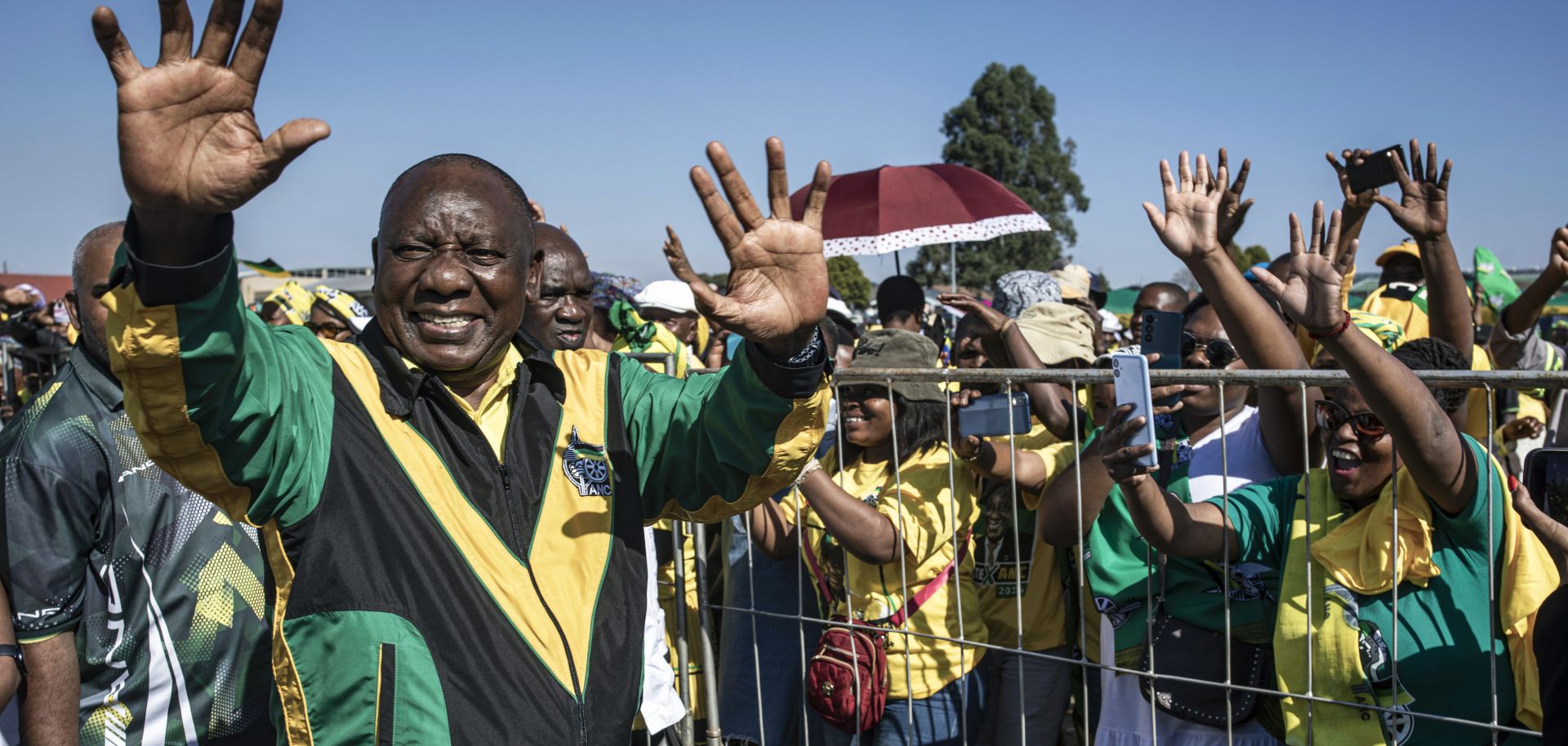
South Africa's May 29 general election will likely usher in a new era of coalition governments, with President Cyril Ramaphosa likely to govern with the support of smaller, mostly centrist parties. South Africa will hold general elections on May 29, during which voters will elect the National Assembly's 400 lawmakers, as well as the country's nine provincial legislatures. The election is set to be South Africa's most competitive since the end of apartheid in 1994, with polling showing that the ruling African National Congress (ANC) party is likely to lose its parliamentary majority. Other leading parties in the contest include the center-right Democratic Alliance (DA), the far-left Economic Freedom Fighters (EFF) and former president Jacob Zuma's new uMkhonto we Sizwe, or MK, party.
- The election for South Africa's provincial legislature will determine the composition of the country's upper house, known as the National Council of Provinces. The Council comprises 90 members, with each of South Africa's nine provinces sending a delegation of 10 members that must proportionally represent the party representation in provincial assemblies.
- The ANC currently controls eight of South Africa's nine provinces, with the DA controlling the Western Cape, where Cape Town is located.
The general election comes amid rising public discontent with the ruling ANC, fuelled by low economic growth, record-setting power outages, high unemployment and pervasive government corruption. South Africa's economic performance has markedly deteriorated over the past decade, with GDP growth averaging 0.9% between 2013 and 2023. Key among the reasons for low economic growth has been the country's yearslong power crisis, which stems from the long-standing mismanagement of state-owned power utility company Eskom. While the crisis first emerged in 2007, it sharply worsened in 2022 and 2023, during which households and businesses faced power outages of up to 14 hours per day. Rolling blackouts have starved the country's economic growth by forcing businesses to rely on expensive power generators to keep the lights on, raising energy costs while leading to major disruptions to business continuity, which, in turn, have further degraded the country's competitiveness and deterred foreign investments. Adding to South Africa's economic woes have been the difficulties facing state-owned rail and port company Transnet, which has struggled to provide adequate freight and port services amid rising vandalism and years of under-investment, resulting in maintenance backlogs and causing traffic chaos. Taken together, the crises facing Transnet and Eskom have compounded the ANC's challenges in creating enough jobs for South Africa's growing population. In addition to widespread perceptions that the ANC has failed to effectively manage the economy, several corruption scandals have further marred the party's image by reinforcing perceptions that the ANC leadership has favored self-enrichment and state capture over addressing South Africa's economic challenges.
- According to Statistics South Africa, unemployment stood at 32.9% in the first quarter of 2024, remaining at steady levels on a year-on-year basis, even though it rose from 31.9% in the third quarter of 2023. Simultaneously, unemployment levels for South Africans aged 15-34 rose from 40.7% to 45.4% between the first quarter of 2023 and 2024.
Compounding the ANC's challenges ahead of the general election has been former President Zuma's decision to run a separate campaign through the MK party. In the face of South Africa's severe economic challenges and power crisis, President Ramaphosa has undertaken limited reforms in an attempt to shore up the country's macroeconomic outlook. This has included pressing ahead with fiscal consolidation measures and removing limits on how much power private generators can produce. However, these reforms have been a source of tension with the ANC's left-wing Radical Economic Transformation (RET) faction, as well as among many ANC voters who view Ramaphosa's policies as a sell-out of the party's socialist roots. Capitalizing on this growing discontent, former President Zuma announced in December 2023 that he would not be campaigning for the ANC under Ramaphosa's leadership, later announcing that he would instead be backing — and leading — the MK party in the upcoming general election. Despite being mired in corruption scandals himself, Zuma has been able to successfully appeal to disgruntled ANC voters — especially in his native KwaZulu-Natal region — by leveraging his legacy as a decades-long anti-apartheid activist and portraying himself as the main opponent to an allegedly aloof ANC leadership. Together with South Africa's economic challenges, Zuma's decision to run independently has further dentend support for the ANC, with support for the party dropping below 40% by mid-April, compared to between 69 and 57% in general elections since the end of apartheid.
Amid South Africa's ongoing economic difficulties and the rise of Zuma's MK party, the ANC is expected to lose its parliamentary majority in the 2024 election, but the party will likely retain control of the presidency owing to the country's presidential appointment procedure. Given that South Africa's election system is one of proportional representation, the ANC appears likely to lose its parliamentary majority. However, the fact that South Africa's president only needs to secure a majority of ballots cast by National Assembly lawmakers, rather than being directly elected by voters, means that the ANC will probably retain control of the presidency. Barring a major electoral defeat, Ramaphosa is highly likely to be the party's presidential candidate, and he will likely be able to secure the support of smaller parties in exchange for concessions. This should enable the ANC to secure more votes than other presidential candidates to secure reelection, such as from the DA-led Multi-Party Charter for South Africa, which regroups 11 opposition parties. However, current polls show that the ANC will likely secure more parliamentary seats than these 11 parties combined in the upcoming election. Even in an unlikely scenario where the ANC secures fewer seats than the opposition coalition, the ANC would likely still be able to gain support from smaller parties in exchange for policy concessions or greater influence in parliamentary committees to retain control of the presidency, thus enabling Ramaphosa to remain in office.
The ANC's loss of its parliamentary majority is set to usher in a difficult era of coalition politics in South Africa that will threaten legislative gridlock, but Ramaphosa will likely be able to capitalize on broader trends of political fragmentation within the country to find junior coalition partners. If it loses its parliamentary majority, as is currently expected, the ANC could seek to govern as a minority government, though this would threaten policy gridlock by forcing Ramaphosa to enter into lengthy, case-by-case talks with opposition parties on key pieces of legislation. Alternatively, the ANC may attempt to reach a coalition agreement with opposition parties like the center-right DA or the far-left EFF by offering them influence over policymaking in exchange for their partnership. Governing in a coalition with the DA or EFF, however, would also prove challenging, as the former alliance would likely stoke tensions within the ANC due to the DA’s perception as defending the interests of the White minority, while the latter alliance would cause a massive shock to investor confidence in South Africa. In the likely case that it loses its outright majority in the National Assembly, the ANC is instead more likely to favor forming a coalition with smaller parties projected to enter the legislature as a result of the ongoing fragmentation of South African politics. Given South Africa's proportional representation system and absence of an electoral threshold, these smaller parties will be able to enter parliament if they secure more than around 0.2% of votes in the general election, making them the ANC's preferred partners with which to form a coalition government. While this political fragmentation has chipped away at the ANC's support through the formation of Zuma's MK party, it has also undermined the DA and the EFF, with rival splinter parties threatening to prevent both opposition parties from being able to fully capitalize on the ANC's growing unpopularity. Even Zuma's MK party is facing its own internal divisions, which the ANC will likely seek to leverage to secure the backing of individual lawmakers elected on the MK party's list.
- Ahead of the May 29 election, the DA has become increasingly concerned that it may lose its majority in the Western Cape's provincial legislature, which it has held since 2009. According to polling from the Social Research Foundation, support for the DA in the province has slipped to 52% as of May 14, compared with 64% in July 2023, amid mounting challenges from the Patriotic Alliance party.
- In by-elections held on April 25 in the North West Province's Bojanala Platinum district, a splinter party of the EFF known as the Economic Liberators Forum came in second place behind the ANC.
While the election's most likely outcome will see the ANC form a coalition with smaller, mostly centrist parties, Ramaphosa's need to balance support from coalition partners and left-wing ANC lawmakers will risk leading to a government collapse in the medium term. In the final weeks of the campaign, support for the ANC has risen from below 40% to around 45%, which stems from the party successfully deploying its large membership to drum up public support, as well as Eskom's recent success in pausing its rolling blackouts for over 50 consecutive days. Should these numbers materialize on polling day, the ANC would likely form a coalition with smaller, mostly centrist parties. This new government would probably oversee Eskom's unbundling into three separate units managing electricity generation, transmission and distribution, while also keeping to Ramaphosa's February 2024 fiscal consolidation targets. Together with a decline in political uncertainty following the ANC's loss of its parliamentary majority, the formation of this new government could raise short-term investor confidence in South Africa. However, Ramaphosa would continue to face political challenges in the medium term, due in part to the unreliability of smaller parties. Ramaphosa would also need to assuage demands for a policy shift to the left from the ANC's RET faction as he passes economic reforms, forcing him to jockey between coalition partners and RET lawmakers. Pressure from either side could prompt repeated spikes in political uncertainty as coalition partners or RET lawmakers threaten to oppose key pieces of legislation amid policy disagreements, which could ultimately lead to the coalition government's collapse. In the event of such a collapse, Ramaphosa would likely seek to form a new coalition with different parties. But while he may succeed in cobbling together a new governing bloc, this could set the stage for South Africa to enter an era of unstable and short-lived coalition governments, dimming the prospect of much-needed structural economic reforms.
- The ANC's current political momentum could see its support rise to close to 50% on polling day, which would reduce Ramaphosa's need to make major policy concessions and increase the likelihood of the ANC governing as a minority government.
If, however, the ANC only secures around 40% of the vote, South Africa will face a major spike in political uncertainty as the ANC will likely be compelled to rely on the far-left EFF or center-right DA to govern. The ANC's inability to secure more than around 40% of votes would represent a major political defeat for Ramaphosa, shaking the party's leadership to its core while causing a steep surge in political uncertainty. While Ramaphosa would still likely secure reelection as president should he be the ANC's candidate, he would face significantly steeper challenges in forming a coalition than if the ANC had won around 45% of the vote, as support from smaller parties would likely be insufficient to secure a parliamentary majority. In the wake of such a painful electoral defeat, members of the ANC's left-wing RET faction would demand the party increase its focus on advancing Black economic empowerment, such as land redistribution without compensation, and call for a coalition agreement with the EFF and/or MK party. But the formation of such a government would likely trigger a steep slump in investor confidence given the EFF's far-left economic agenda. Ramaphosa may instead call for a government of national unity that would include the DA, but this will prove highly challenging from a political standpoint, as left-wing and center-right parties may demand contradictory policy concessions. Therefore, such an election outcome may result in Ramaphosa governing as a minority government with ad-hoc support from the DA, which could involve the center-right party supporting the government's budget and certain redistributive policies in exchange for greater influence in parliamentary committees and an expansion of the private sector's role in the power, water and transport sectors. But given that RET lawmakers would strongly push back against such concessions, this Ramaphosa-led minority government could collapse within a matter of months, which could either result in the ANC pivoting toward the EFF or in protracted legislative deadlock.
