
Editor's Note: This article is part of an ongoing RANE series on the geopolitical impacts of water stress. The first installment of this series provided a broad overview of how the unequal distribution of freshwater shapes geopolitical patterns. Other installments have examined the impacts of water stress on the global economy, Europe, China, the Sahel region of sub-Saharan Africa, Israel, Central Asia, Chile, the Middle East, the Mekong River region, climate investment, India, North Africa, the impact of cyberattacks on water stress and Egypt.
Changes in rainfall patterns and extreme weather events exacerbated by climate change will increasingly challenge Brazil's crop production over the next five to 10 years, causing unrest. Brazil is famously home to the Amazon, the world's largest river by water volume, and the Guarani Aquifer, the second-largest aquifer worldwide. Most of the country lies in the tropics, meaning that although precipitation levels vary throughout the territory, most areas have moderate rainfall ranging between 1,000 millimeters and 1,500 millimeters (39 inches and 59 inches) yearly, mostly concentrated between December and April. Steady rainfall, coupled with technology-induced productivity gains, have allowed the country's agribusiness to expand across the center-west region over the past five decades and, more recently, to fringes of the country`s north and northeast. The agricultural sector directly accounts for 6.6% of Brazil's gross domestic product while, indirectly, its contribution to the Brazilian economy rises to 22%, according to some estimates. Growing deforestation coupled with broader climate changes have in recent years resulted in changes to rainfall patterns and increasingly frequent severe droughts, wildfires, floods and rime icing. Since crops such as soybeans, coffee and sugarcane rely on predictable rainfall, erratic weather and extreme weather events have disrupted seeding and harvesting schedules, reducing yields and raising production costs. Ongoing changes to rainfall regimes will likely be exacerbated by weather phenomena like El Nino, connected to warm water in the western Pacific Ocean. In Brazil, El Nino intensifies droughts in the north and northeast, increases temperatures in the center-west and southeast while boosting precipitation levels in the south. La Nina has the opposite effects on these regions, meaning that the same areas face different extremes of weather conditions, depending on how climate change interferes with Pacific water temperatures.
- In 2024, Brazil recorded its most severe drought in nine years on the back of El Nino, which impacted the country's north and center-west region, while severe floods hit its southernmost state of Rio Grande do Sul.
- Also in 2024, the southeast region was affected by four heat waves, with temperatures in some parts of Minas Gerais being 3°C to 4°C above average while rainfall was down 10% over during the rainy season.
- Limited rainfall has delayed sowing of soybeans, corn and wheat and impacts productivity.
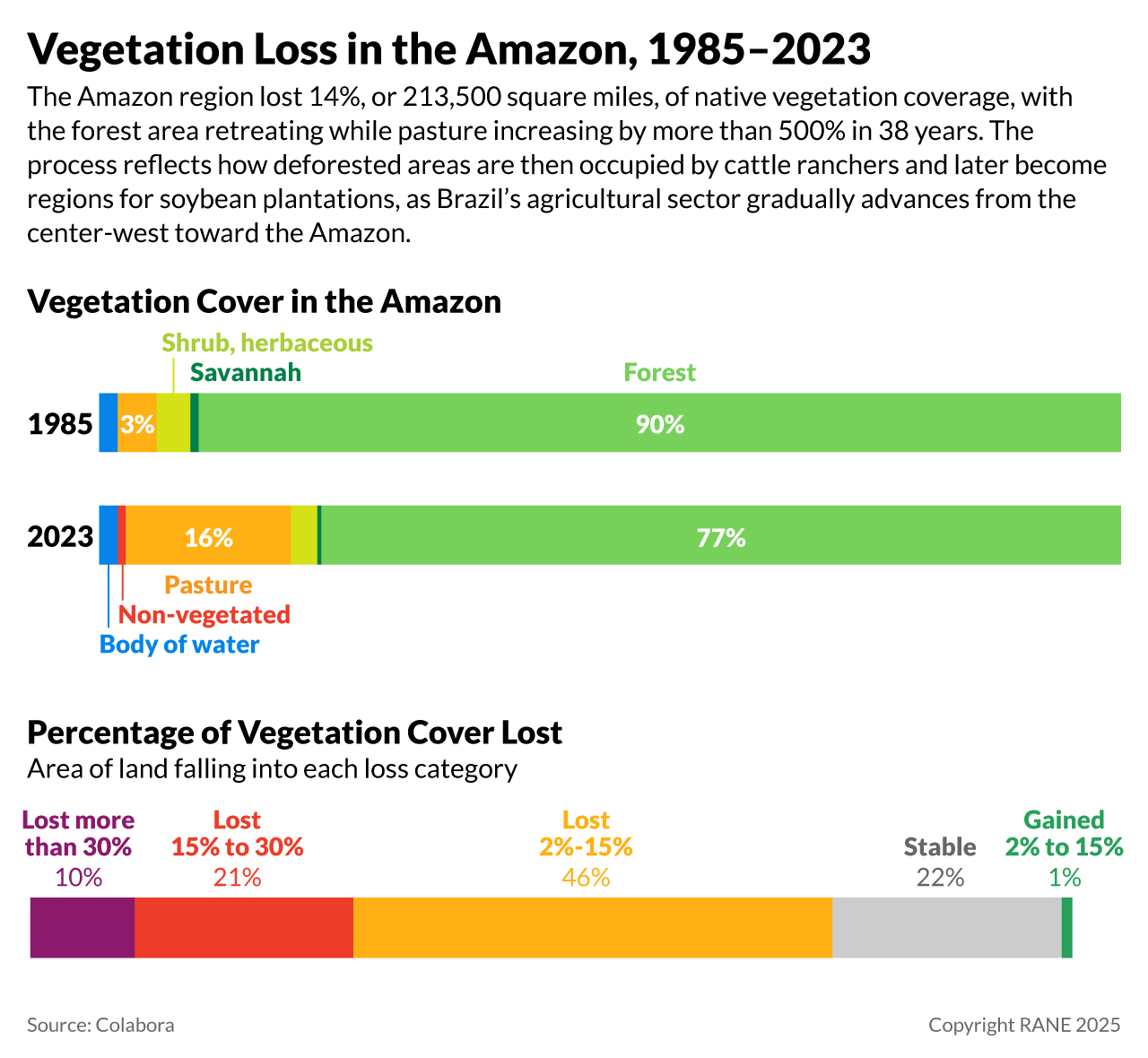
Despite government efforts to fight deforestation, large areas of vegetation lost over the past decades will further disrupt rainfall regimes while water scarcity will challenge agribusinesses and future governments, threatening to cause food shortages or inflation in the coming years. Deforestation in the Amazon fell 19% year over year in 2024 to the lowest level in seven years as President Luiz Inacio Lula da Silva seeks to boost environmental protection and benefit from funding from developed countries to preserve the biome. Still, the Brazilian Amazon lost more than 800,000 square kilometers (about 497,000 square miles), or an area equivalent to the states of California, Florida and Texas combined, between 2008 and 2022, the latest period for which data is available. At the same time, 60% of the areas in regeneration were again targets of deforestation over the same period, preventing vegetation from fully recovering. According to the Intergovernmental Panel on Climate Change, the Amazon is undergoing a process of savannization — or transformation from forest to grassland — with more than 2 million square kilometers of rainforest very close to a point of no return, a point it could hit by 2029. These dynamics have profound implications for the country's hydrological cycle, as the Amazon rainforest generates much of the atmospheric moisture that drives rainfall across the country, including the center-west, southeast and south regions, all key to agricultural production. Such consequences will require many agribusinesses to adopt preventive measures to anticipate climate change disruption and resiliency plans to handle extreme weather events better as they unfold. Developing genetically modified crops will help the sector face the challenges climate change imposes. Investment in irrigation systems — currently present at only 13% of agricultural lands in Brazil, mostly in projects run by large exporters — will also become more important. Future governments will meanwhile likely face growing calls to support small farmers facing water shortages. Failure by public and private sector players to adapt to changes in water provision could harm Brazil's agricultural productivity and undermine grain exports, and directly impact households' living standards amid food shortages and inflation. Water scarcity is also likely to have broader implications on the Brazilian economy, from higher energy costs to disruption to waterways, further undermining agribusinesses operations.
- Changes in rainfall patterns and atmospheric temperatures will reduce the area suitable for Arabica coffee production without irrigation systems by more than 50% by 2060, according to a Sao Paulo State University study based on the Intergovernmental Panel on Climate Change's least adverse forecast. Brazil currently produces approximately 49.3 million bags of coffee across 2.1 million hectares of land and accounts for one-third of global production. The industry generates more than 8 million jobs, including about 287,000 coffee growers, most of them doing so on a small scale.
- A similar study assessed the impact of a 2º C increase in temperature and a decline in rain volumes between 4.5% and 7.9% on soybeans and found growing risks of crop failures, although the study found that soy is likely to adapt to dryer conditions and maintain productivity levels.
- Family farming accounts for 77% of all agricultural establishments in Brazil and covers 23% of the country's land, equivalent to approximately 80.8 million hectares.
- Brazil relies on hydroelectric power for nearly two-thirds of its electricity generation, while approximately 20% of its grains are exported via waterways. During severe droughts, governments have prioritized using river water for energy generation to prevent blackouts at the expense of transportation or irrigation, which could pose further challenges to agribusinesses should droughts become more frequent.
In the coming years, severe storms, excessive rains and flooding will disrupt agricultural production and damage transport infrastructure, fueling operational and financial risks to public and private sector players. In recent years, different regions across Brazil have experienced severe storms or prolonged rains that resulted in massive floods and landslides in both rural and urban areas, especially during the typically wet summer season. Overflowing rivers, poor drainage systems and often precarious infrastructure exacerbate damages, leading to significant economic losses, from impaired dams, collapsed bridges and blocked roads, which can take weeks to months to repair. Heavy rains or floods can also wash away fertile soil and reduce agricultural productivity. For instance, Rio Grande do Sul state in two weeks in May 2024 received three times its average year-to-date rainfall, reaching more than 635 millimeters (about 25 inches) of precipitation that month. The unprecedented meteorological event occurred due to a combination of warm water in the Pacific, which boosted El Nino's effects, and unusually high temperatures in the South Atlantic, which resulted in increased humidity and rainfall. The widespread floods left some crops underwater for over a month. As the state is the country's largest producer of rice and wheat and the second main soybean producer, federal and state governments quickly coordinated economic relief for farmers while monitoring the need to import rice given its prominence in Brazilians' diet. Even if only somewhat less severe weather events become more frequent over coming decades, they will pose significant medium and long operational and financial challenges to agribusinesses, as deteriorated soil conditions, machinery losses and damaged infrastructure will likely impact sector activities and finances for several years. The magnitude of the required financial effort to provide assistance, rebuild and support businesses will add pressure to federal, state and municipal governments, as their need to spend public funds to prevent or remediate the impacts of extreme weather events will further pressure their budgets.
- Rio Grande do Sul Agriculture Federation destimated that the May floods caused losses of $3 billion reais (about $600 million) in the state, and that it will likely take at least a decade for farmers to recover their harvest, machinery, infrastructure and soil health.
- More broadly, the event will cause losses of up to $58 billion reais in Rio Grande do Sul and indirect losses of $38.9 billion reais elsewhere in the country, having a negative impact of up to 1% on Brazil's gross domestic product and resulting in the loss of 305,000 jobs countrywide, according to a National Confederation of Commerce study.
- The federal government made available $100 billion reais to fund recovery and reconstruction efforts, anticipate and increase cash handouts to climate refugees, and provide subsidized credit to small- and medium-sized farmers in Rio Grande do Sul.
Water scarcity will also likely fuel occasional clashes between local communities and water-intensive industries, while increasingly frequent drought and floods will undermine government popularity and fuel unrest. Agribusinesses account for 25% of water usage grants across the country and also represented one-fourth of the conflicts over water usage in the first six months of 2024, the latest data available. Disputes usually involve local communities aiming to preserve the resource against contamination and private appropriation by often resorting to demonstrations and legal action backed by local prosecutors. In the coming years, prolonged droughts or a large contamination of rivers, water tables or aquifers could spark harsher reaction from inhabitants, environmentalists and local political or judicial authorities, posing reputational, operational and security risks for companies in the sector. Recurring droughts that result in rationing, floods that devastate entire neighborhoods, or more frequent disputes over water will likely to stress social and economic inequalities and increase discontent in the long term. Unrest risks are likely to increase and pose challenges to governments nationwide. Given historical fiscal constraints and Brazil's historic struggles to deliver public services and benefits, issues around access to water are likely to play a more prominent role than they have so far over the coming years. Against that backdrop, agribusiness countries are likely to become targets of disgruntled communities, which may resort to roadblocks, protests or attacks against private sector assets to voice their concerns, posing growing operational and security threats in the long term.
- Brazil recorded 125 disputes over water usage in the first six months of 2024, 31 of which were related to the use of pesticides. The number represents a 37% increase over the same period of 2023 but a 49% reduction from the peak of 244 clashes recorded between January and June 2019.
