
Editor's Note: This article is part of an ongoing RANE series on the geopolitical impacts of water stress. The first installment of this series provided a broad overview of how the unequal distribution of freshwater shapes geopolitical patterns. Other installments have examined the impacts of water stress on the global economy, Europe, China, the Sahel region of sub-Saharan Africa, Israel, Central Asia, Chile and the Middle East.
In the lower Mekong River region, upstream dam construction and insufficient regional cooperation are creating cyclical water shortages, which threaten the food security and livelihoods of the millions who live in the region, but the continued prioritization of national interests will likely worsen this and other environmental risks. Since around the turn of the century, the lower Mekong River region, which includes Cambodia, southern Laos, northeastern Thailand and Vietnam's Mekong Delta, has been facing increasingly acute risks of water shortages. Extreme weather patterns marked by prolonged periods of drought and high temperatures have exacerbated the situation, particularly in recent years, and the region's environmental trajectory is set to worsen. In addition, upstream dam construction, particularly by China and Laos (in the upper Mekong region), has disrupted natural flow patterns, reducing water levels and altering seasonal flooding critical to seasonal agriculture and fisheries harvests. Noncommittal regional cooperation and the lack of a unified water management strategy among lower Mekong countries have further aggravated the crisis as states prioritize national interests over collective regional water security. These environmental and political factors undermine local food and economic security, destabilizing an already fragile socioeconomic landscape, while causing regional political disputes.
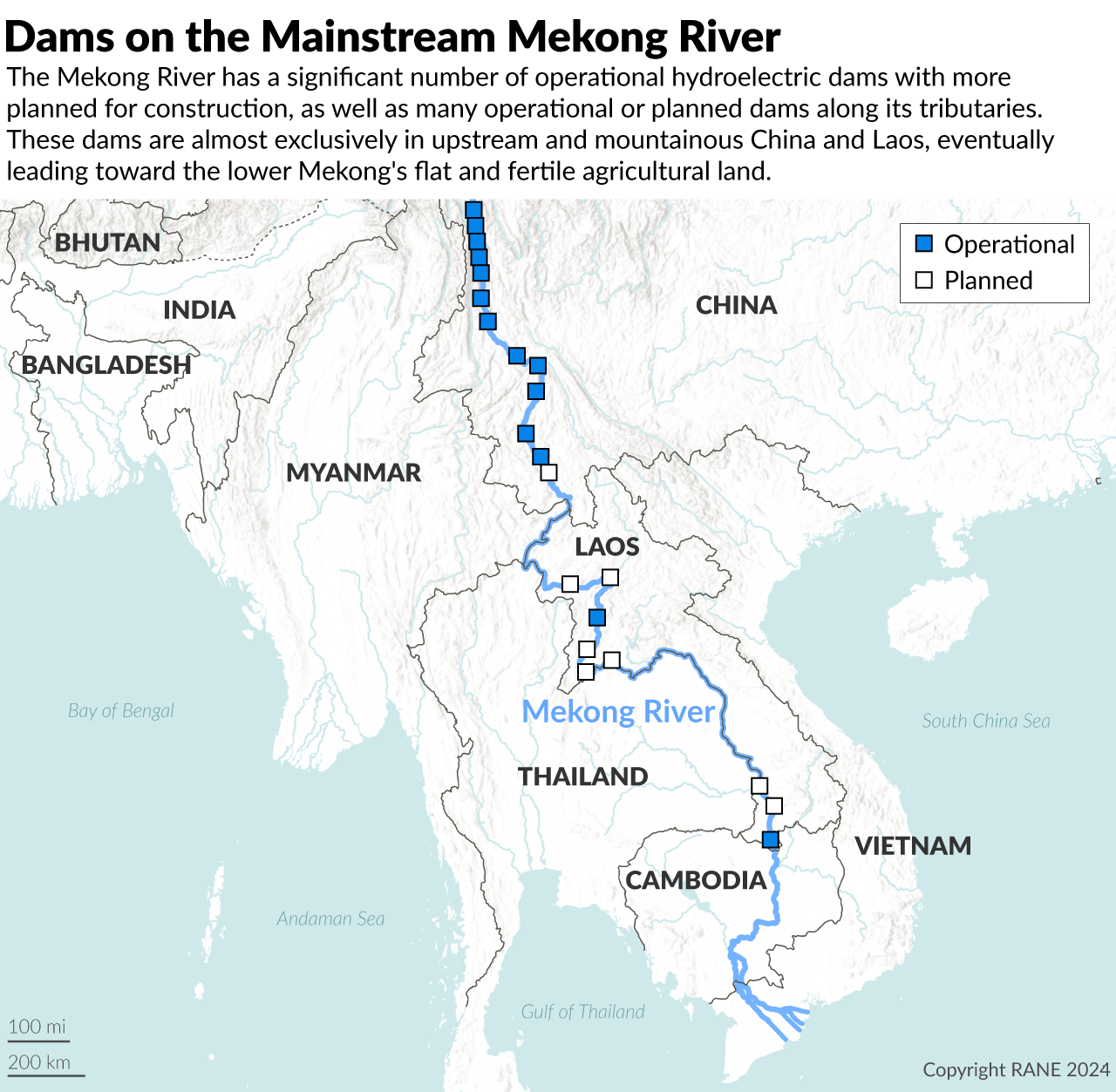
- The Mekong River, Southeast Asia's primary internal waterway, spans 2,700 miles (about 4,345 kilometers) from China's Tibetan plateau through Myanmar, Laos, Thailand, Cambodia and Vietnam. Its basin houses 190 operational hydropower dams along its main channel and tributaries with hundreds more being constructed or planned for construction.
- The Mekong River accounts for around 20% of the world's freshwater fish catches annually, which — in addition to being a vital source of food and biodiversity — represents the livelihoods of tens of millions of people. Globally, the Mekong River's ecosystem is second only to that of the Amazon River in terms of the diverse biodiversity of plant and animal life.
- The upper Mekong’s terrain is mountainous, and its fast-flowing waters are ideal for hydroelectric dams while limiting impacts on local agriculture that are not concentrated in such terrain. However, the river flows gradually into the flat, fertile floodplains of the lower Mekong region, ideal for agriculture and fisheries under normal circumstances.
- Historically, downstream countries began to feel the impact of large-scale dam construction in the early 2000s as China completed its first major hydroelectric dam, the Manwan Dam, in 1993, followed by several others, including the Xiaowan Dam in 2010. These dams disrupted the natural flow of the Mekong River, especially during the dry season, measurably reducing water levels downstream. During this period, water shortages started to affect agriculture and fisheries in the lower Mekong, particularly in Cambodia and Vietnam, leading to acute water shortages in 2010, 2016, 2020, 2023 and 2024.
- In the first half of 2024, the region experienced high temperatures reaching 104-109 degrees Fahrenheit (about 40-43 degrees Celsius) for extended durations, far exceeding seasonal norms that typically top out at 95 degrees Fahrenheit, according to the Mekong River Commission. These conditions produced extreme dryness while severe salinity intrusion affected coastal provinces, producing a shortage of fresh water. At the same time, a prolonged lack of rainfall has meant the Mekong's large upstream dams are less able to fill their reservoirs, such as China's Nuozhadu Dam, which at the start of 2024 had reached only 50% of its storage capacity. These lower-than-normal dam releases reduced China's contributions to the Mekong's dry season flow, already diminished by abnormal natural flow conditions, leading forests to dry out in 2024.
Upstream hydroelectric dams in China and Laos that alter seasonal water flows are combining with climate change to heighten water scarcity risks in the lower Mekong River basin. Climate change is leading to more frequent droughts in China and Southeast Asia, and hydropower production and water flow compound these worsening drought conditions along the Mekong River, with seasonal variations. In the 2024 dry season, hydropower releases were the lowest since 2021, primarily due to the 2023 drought in China and the country's attendant decision to keep its Tuoba Dam reservoir full in 2024, thus withholding normal water releases. The dam began filling in February, restricting 1.22 billion cubic meters of Mekong flow to reach its normal service level in under six months. Additional downstream restrictions occurred when China refilled the Nuozhadu Reservoir early in late April. This led to significant drops in river levels along the Thailand-Laos border, disrupting local ecosystems. While this strategy benefits China by conserving water for the 2025 dry season, it has harmful effects downstream. Moreover, the manipulation of water flow creates sharp fluctuations in the river's ecology, severely impacting fish habitats and migration. These developments also speak to a larger and broader trend wherein increased water storage has gradually — though severely — shifted water flow trends, with water flow now artificially more abundant in the dry season than the wet season, highlighting that the Mekong's various dependents such as downstream fishers are largely at the whims of upstream dam and reservoir operators, increasingly more so than those of nature itself.
- Unseasonal releases also alter normal climate patterns, which can disrupt natural flows and thus disrupt the Mekong's abundant natural fisheries cycles while also degrading wetlands with out-of-season flooding, which further disrupts planting and harvesting cycles and soil fertility, increasing the risk of crop failures. For example, in January (during the dry season), China unseasonably released over 1 billion cubic meters of stored water from its Xiaowan Dam located upstream in a bid to raise water levels of dwindling downstream channels, which disrupted fish migratory patterns as the river normally recedes during that time.
The rapid erosion of arable land and viable fisheries along the Mekong presents first-order environmental, economic and social risks to the region and second-order risks to affected countries' economies and public health. Environmental degradation along the Mekong River negatively impacts water quality, with increased salinity and sediment disruption harming aquatic life and the health of people who rely on the river for drinking water and agriculture. For example, low water levels and sediment loss cause riverweeds to bloom, obstructing fishing and reducing oxygen levels in the water. At the same time, agricultural productivity is reduced because the loss of forests increases erosion and reduces soil quality, lessening crop yields, while vegetation loss disrupts habitats for wildlife species, reducing the Mekong's rich biodiversity. Moreover, altered river flow patterns — both from climate change and water release manipulations upstream — lead to unpredictable flooding and drought cycles, making local communities in the region more vulnerable to each extreme while reducing the viability of their livelihoods. Therefore, regional water scarcity is leading to reduced agricultural productivity as a first-order risk, but more broadly this can lead to food scarcity, unemployment and poverty for the tens of millions who rely on the Mekong River.
- The Mekong Delta is Vietnam's most productive region in terms of agriculture and fisheries. It produces half of the country's rice and is home to a thriving fishing industry, which for many locals represents their primary source of income. The region is also home to about 21.5 million people.
- Tonle Sap Lake in Cambodia is vital for its agricultural production and climate regulation. The lake expands and contracts with annual water flow. However, the alteration of seasonal flooding is changing the lake's unique flood-pulse system, endangering both the ecosystem and the livelihoods of those who reside there.
- Reduced water availability negatively impacts northeastern Thailand's Chiang Rai, Nong Khai and Ubon Ratchathani provinces in terms of agricultural productivity.
Multilateral institutions and domestic government initiatives to responsibly manage the Mekong's ecosystem have largely proven ineffective. The Mekong River Commission, or MRC, is an intergovernmental organization between Cambodia, Laos, Thailand and Vietnam that holds a formal mandate of environmental protection along the river and its tributaries. However, the commission has proven woefully inadequate in preventing environmental degradation and mitigating the damage from existing projects. The first issue with the MRC is that its decisions are not legally binding. For example, a 2020 MRC study concluded that the negative impacts of upstream hydroelectric damming mean that project developers should pay a levy on their profits, a proposal the member states rejected and the MRC has no means of enforcing. Moreover, China, the main contributor to damming the Mekong, only has observer status, as it refuses membership in the MRC. This not only puts Beijing outside the deliberations of the commission, but it also means China is under no obligation to share data or provide notice of dam construction per MRC rules. Even among its member states, the MRC's consultative process, which is supposed to consider concerns of neighboring or downstream countries regarding industrial activity in the Mekong, does not function properly. The mechanism has limited stakeholder engagement, does not have institutional transparency and is prone to the unilateral influence or lobbying of member states seeking approval for new projects. Moreover, despite almost every member state passing policies that prioritize maintenance of the Mekong ecosystem, energy needs — particularly from renewable sources like hydropower — take priority, as economic development is the most pressing concern of every country in the Mekong region.
- A March report from Vietnam's Water Resources Science Institute suggested that Vietnam's Mekong Delta region is taking on increasingly high levels of saltwater, damaging arable land and causing crop losses worth $3 billion per year. The report states that saltwater levels are escalating due to rising sea levels, droughts, tidal fluctuations and a dearth of upstream freshwater.
- The MRC was established in 1995 pursuant to the multilateral Agreement on the Cooperation for Sustainable Development of the Mekong River Basin.
Various national, economic and geopolitical interests among Mekong countries will severely constrain action to curb environmental degradation on the river. Energy-needy upstream China and Laos will continue to build out hydroelectric dams on the Mekong River, with mounting environmental concerns likely to only slightly temper their activities. For China, hydro dams on the Mekong increase its renewable energy capacity and decrease its dependence on coal, leading it to construct over a hundred dams on the river and its tributaries since 1993, including five so-called mega-dams that exceed 100 meters (about 109 yards) in height. For Laos, a landlocked country saddled with debt and few natural resources, its ability to harness hydropower on the Mekong River has led to an institutionalized aspiration to become the "battery of Asia," given that hydropower has become Laos’ primary export — accounting for around 30% of all its exports — and an indispensable pillar of its struggling economy. Despite being on the receiving end of the environmental impacts downstream, Thailand and Vietnam, which together import around 80% of Laos' hydropower exports, will continue importing Lao hydropower at scale. Thailand and Vietnam need these imports to satisfy growing domestic energy demand, including for energy- and water-intensive high-end manufacturing, while attempting to achieve carbon neutrality in the coming decades. These factors imply a continued need for Lao hydropower to mitigate reliance on coal, at least while other renewable energy sources like wind and solar remain insufficient to meet these countries' expanding energy needs. Moreover, demand is growing as countries outside the Mekong region like Malaysia and Singapore increase their imports of Lao hydropower for similar economic reasons. These trends point to unilateral, bilateral and even multilateral drivers for a continued prioritization to enhance energy capacity at the expense of environmental protection.
- Though none of downstream Cambodia, Thailand or Vietnam have hydroelectric dams on the Mekong's mainstream, all three have several dams on the river's tributaries.
- In 2022, Singapore began importing up to 100 megawatts of hydropower from Laos pursuant to the Lao PDR-Thailand-Malaysia-Singapore Power Integration Project, signed in 2021. This marked the first multilateral cross-border electricity trade among members of the Association of Southeast Asian Nations and is part of a broader initiative to establish a regional ASEAN Power Grid given the region's universality of energy needs.
Lower Mekong countries will experience growing strains in agriculture, food security, local economic growth and public health, leading to periodic crises that exacerbate poverty, internal migration and attendant social tensions, though only a severe crisis could trigger meaningful action. Structural drivers for continued environmental degradation and water shortages are strong, whereas motivation to mitigate their causes is weak. In the short-to-medium term, lower Mekong countries will likely continue prioritizing national economic interests, such as energy production and industrial development, even at the expense of long-term environmental sustainability. While the impacts of water shortages, crop failures and declining fisheries will continue to escalate in the coming years, it would probably take an extreme event for countries to take joint action to address these issues. An extreme event could include a prolonged and severe shortage of food or fresh water leading to sustained social unrest and political pressure, the economic collapse of key local agriculture or fisheries sectors, a globally publicized humanitarian crisis, or cross-border political or even military tensions. Subsequent attempts at solutions might include emergency measures, more intense regional negotiations via strengthening the MRC or even international assistance. However, without significant policy changes and greater regional cooperation in the long term, continued environmental degradation will lead to more frequent economic shocks, internal migration, social unrest and tension between regional countries.
- Cambodia's construction of the Funan Techo canal along Mekong tributaries exemplifies how environmental concerns come second to geopolitical ones. The canal will enable Cambodia to escape a large proportion of its trade dependence on Vietnam while limiting Vietnam's ability to project military power into the country, priorities that Cambodia places above the environmental protection of the Mekong.
