
Editor's Note: This article is part of an ongoing RANE series on the geopolitical impacts of water stress. The first installment of this series provided a broad overview of how the unequal distribution of freshwater shapes geopolitical patterns. Other installments have examined the impacts of water stress on the global economy, Europe, China, the Sahel region of sub-Saharan Africa, Israel, Central Asia and Chile.
In the Middle East and North Africa, worsening water stress due to years of bad governance, security vacuums and population growth will increasingly make water a highly contested resource, raising the risk of social unrest, violence from non-state armed groups, and interstate conflict. In recent years, water stress in the Middle East and North Africa has become a more acute threat to the stability of both individual states and the broader region amid a constant struggle for control and management of this increasingly scarce vital resource. Countries' mismanagement of their water supplies over the decades has worsened the situation in the region, where the predominantly hot and dry climate already exacerbates water shortages. The rapid population growth many countries are experiencing has also heightened the demand for limited fresh water. Against this backdrop, access to water supplies has become an increasing driver of conflict between both states and non-state actors in the Middle East and North Africa, as well as a catalyst for social unrest.
- Water stress refers to the disparity between a country's water supply and its demand. In highly water-stressed nations such as those in the Middle East and North Africa, nearly all available water resources are being used, making these countries vulnerable to water shortages if there are any changes in supply or demand.
- Despite water scarcity in the Middle East and North Africa, water vulnerabilities differ from country to country. For instance, some states have access to rivers, considered surface water systems, giving them an advantage over states without access to such surface-level systems.
- According to an August 2023 report by the World Resources Institute, the most water stressed countries in the world include Bahrain, Kuwait, Qatar, Oman and Lebanon, mostly driven by the lack of supply for domestic, agricultural and industrial use. The report also details that the world's most water-stressed region is the Middle East and North Africa, with extremely high water stress affecting 83% of the population.
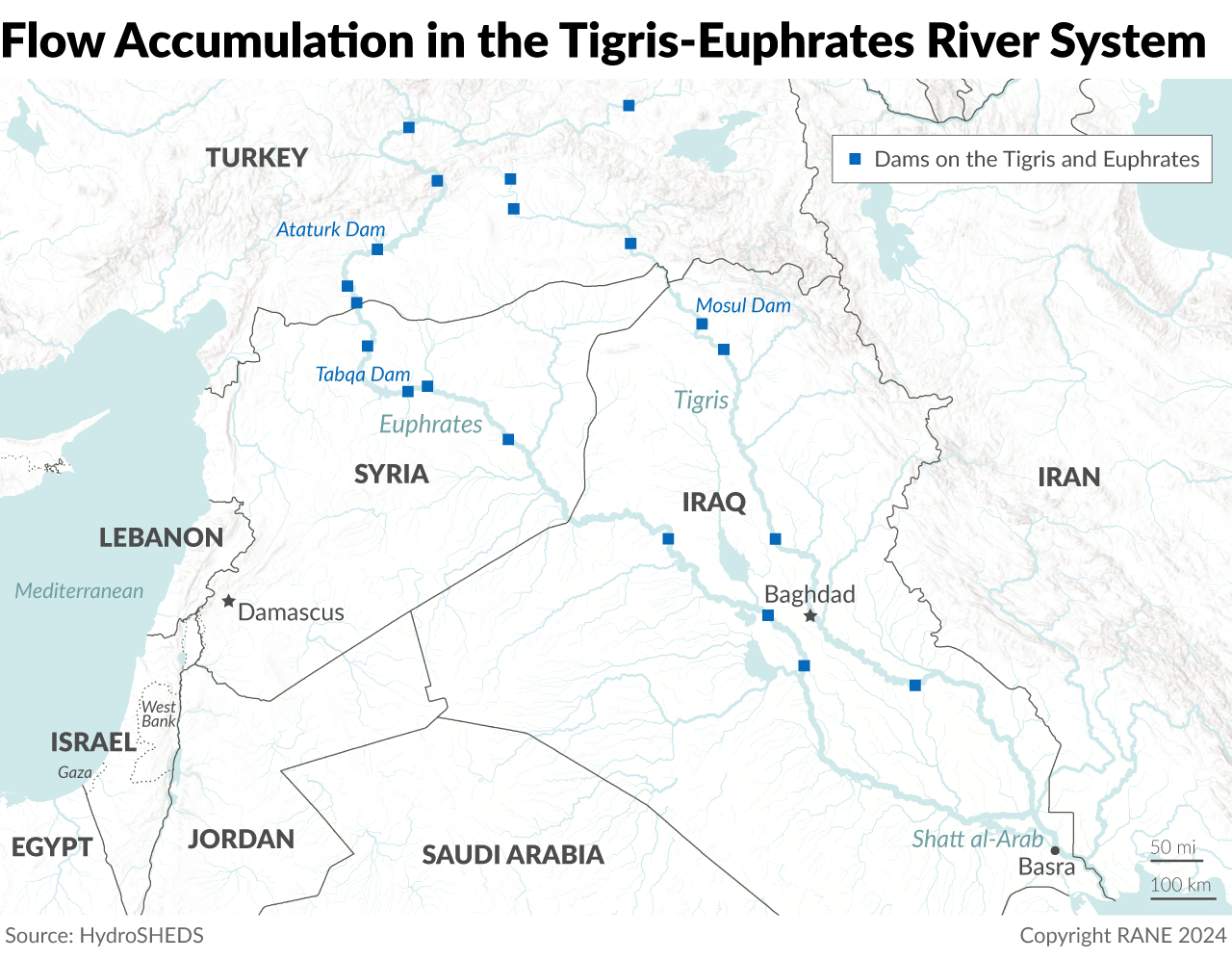
States with water resources will increasingly use them as a coercive tool to deter potential hostile actions in the event of disagreements or conflict, threatening the stability of water-stressed countries. Given the growing unavailability of water and its need for various agricultural and industrial processes, as well as domestic consumption, water-scarce states will at least initially likely look to sign agreements with states with more water supplies. However, geographic, infrastructure and financial constraints will limit many states' abilities to do so. Moreover, given that states in the Middle East and North Africa are often diplomatically at odds or in outright conflict — and most countries outside the Gulf are already highly strapped for cash — water coercion will increasingly become a strategic tool to exert power and influence other water-stressed states. For naturally water-rich countries like Turkey, or those like Israel that have the technological capacity (in its case, via desalination) to be comparatively water-rich, this strategy will involve controlling water flow and access, often exacerbating tensions and conflicts in a region already plagued by instability. For instance, the 2021 water-for-energy deal between Jordan and Israel sees Jordan providing 600 megawatts of solar generating capacity to Israel, with the latter providing water-scarce Jordan with 200 million cubic meters of desalinated water. While the treaty facilitates cooperation, it also highlights the power imbalances, as Israel controls upstream resources, often leaving Jordan vulnerable during periods of drought. In January 2024, the Israelis reportedly mulled over the potential of not renewing the treaty with Jordan, due to the latter's harsh comments and diplomatic initiatives against Israel following its invasion of Gaza, demonstrating how water-related agreements could be used to coerce in the event of disagreements or upheaval. The Israelis eventually renewed the treaty in May 2024, following Jordan's toning down of rhetoric, but the potential for further unrest in the West Bank — which Jordan's government sees as directly threatening its own stability — means Israel's water leverage over Jordanian policy could again reemerge. Meanwhile, Turkey's control over the Tigris and Euphrates rivers, which impacts downstream countries like Iraq and Syria, is another example of the recent use of water as a coercive tool. Turkey's construction of dams, such as the Ataturk Dam, allows it to manipulate water flow, thereby gaining leverage over its neighbors that rely on these rivers for agriculture and drinking water. In June 2021, Turkey reportedly stopped water flow toward Syria and Iraq to pressure its Kurdish foes in Syria and Iraq, exacerbating food insecurity and triggering displacement. As climate change intensifies drought conditions and water stress in the next few years, the coercive use of water in the Middle East and North Africa will likely become more pronounced.
- The Tigris and Euphrates rivers originate from the mountains of eastern Turkey, traveling through Syria and a large portion of Iraq, eventually forming the Shatt al-Arab river, which ends at the Arabian Gulf. This overlap has made the river basin a source of interstate disagreement, causing water-sharing challenges for decades.
- Turkey's historic dam construction projects, aiming to maximize water security for itself, have reduced water supply to Iraq by 80% since 1975, according to a 2023 report by the Arab Center Washington DC. Projections for the future estimate that by next year, the flows of the Tigris and Euphrates rivers will decrease by 25% and 50% respectively, further limiting the supply of potable water to cities like Basra in Iraq.
- Jordan initially claimed in November that it would not sign the water-for-energy deal with Israel. However, Amman backtracked in March and asked Israel to extend the deal.
Water stress and weak water governance will drive protests and regime instability, threatening the region's fragile and most water-scarce states in the coming years. In countries like Iran, Iraq, Algeria and Bahrain, inadequate water management has already sparked bouts of public unrest, highlighting the potential severity of the issue in the coming years. Protesters are increasingly accusing authorities of corruption and mismanagement, reflecting broader dissatisfaction with Middle Eastern and North African governments' handling of their countries' water crises, especially as demand grows while supply diminishes over time. For instance, in Iraq, protests are becoming more frequent and disruptive, especially in the southern region of Basra, where contaminated water and inadequate public services have fueled mass demonstrations. Given that these trends are likely to persist in the foreseeable future, there is a higher likelihood that these protests in Iraq, as well as in other countries, may expand in geographic scope, as well as grow larger and possibly become violent — especially as water becomes more scarce for day-to-day activities and needs. Furthermore, weak governance structures across the region amplify these problems, as corruption, inefficiency and a lack of investment in water infrastructure hinder effective management. For example, in Iran, excessive dam construction and unsustainable agricultural practices have drained water sources like Lake Urmia and exacerbated drought conditions. Similarly, in Egypt, government policies that prioritize water-intensive crops like rice have strained limited water supplies from the Nile River, despite growing concerns about the impact of Ethiopia's filling of the Grand Ethiopian Renaissance Dam (GERD). Iran and Egypt's governments are unlikely to efficiently address these problems in the coming years, making the risks of nationwide protests higher as their populations continue to grow and become more dissatisfied with the unavailability of water and their country's mishandling of the situation.
- In Algeria, protests erupted in July 2021 as residents in the country's capital of Algiers and second-largest city of Oran faced chronic water shortages during a heatwave. Additionally, during the summer of 2024, people in several other Algerian cities, including Tiaret, have taken to the streets demanding better water distribution and accusing the government of neglect and mismanagement.
- Similarly, in Iran, water shortages have led to widespread protests in provinces like Khuzestan and Isfahan. In Khuzestan, demonstrations in 2021 — which expanded to many other Iranian provinces and cities, including Tehran — were driven by the drying up of rivers essential for both drinking water and agriculture, exacerbated by government water diversions to other provinces.
- The Nile River dispute between Egypt, Sudan and Ethiopia revolves around Ethiopia's construction of the GERD. Egypt, which relies on the Nile for over 90% of its freshwater, views the dam as an existential threat, fearing it will significantly reduce the river's flow.
Growing water scarcity in the region will likely create an environment where non-state armed group will probably seize control of critical water resources to gain influence. As state institutions weaken due to ongoing conflicts and economic challenges, the risk of non-state actors monopolizing water supplies will likely increase, potentially leading to the establishment of parallel governance structures in the absence of a central government or the presence of an efficient one. This scenario not only threatens regional stability but also complicates humanitarian efforts, as access to water becomes a tool of coercion. Should extremist and terrorist groups like the Islamic State be able to gain more territory in the future, they will likely try to seize strategic footholds where water is available for their survival and use it as a strategic weapon, such as to tax local populations for its use and thus generate more revenue or, conversely, to provide free water as a form of propaganda to burnish their image. As water becomes more scarce, especially in states with weak central governance and existing parallel institutions, such as in Iraq and Syria, these non-state militias and terrorist groups will likely seize water-rich towns and villages to exert control and influence over the region, exacerbating conflict as they try to defend their gains and expand into new areas by worsening access to water for civilians in other areas.
- In conflict zones like Syria, Yemen and Iraq, non-state actors like the Islamic State, and Iran-backed militias — including the Houthis in Yemen and Kataib Hezbollah in Iraq — have already demonstrated their ability to take over strategic water assets. In Yemen, Houthi militants have taken control of key water facilities to exert leverage over local populations in Houthi-controlled areas of the country. Iranian-backed militias in Iraq and Syria have also manipulated water access for political and military gains in those countries.
- After seizing control of the Tabqa Dam in Syria in 2014, the Islamic State leveraged the dam for both military and political purposes. The dam was critical because it controlled water and electricity supplies to large parts of northern Syria. By threatening to flood areas downstream or cut off water and electricity, the group could coerce local populations and demand concessions from both the Syrian government and opposing forces. This allowed the group to maintain control over territories and negotiate cease-fires or safe passage in some instances. The control of Tabqa Dam remained vital until the Islamic State lost it to U.S.-backed Syrian Democratic Forces in 2017.
Although it remains a comparatively less likely scenario, the risk of interstate conflict in the region will rise in the coming years as water stress intensifies, driven by competition for control of shrinking water resources. As countries like Egypt, Sudan and Ethiopia struggle over the control and usage of the Nile River, tensions will likely escalate, highlighting the potential for interstate conflict over shared water resources in the Middle East and North Africa and neighboring regions. Similarly, disputes between Turkey, Syria and Iraq over the Euphrates and Tigris rivers will likely persist, especially as the impacts of climate change accelerate and population growth increases demand. Water (and the lack thereof) is still more likely to be used as a tool of coercion and spur unrest within individual states, rather than trigger an interstate war. However, should states face an existential threat as water scarcity worsens in the coming years, water will then become a more significant factor that could push states into direct conflict. Moreover, even if a proverbial ''water war'' is less likely in the coming years, the risk of water playing a role in worsening interstate disputes (like territorial disputes) will also likely rise. Without effective water-sharing agreements and diplomatic interventions, these disputes could devolve into broader regional conflicts, destabilizing the entire region. As climate change continues to bring increasingly erratic rainfall patterns, prolonged droughts and even hotter temperatures, the pressure on the Middle East and North Africa's already limited water resources will grow, further heightening the risk of conflict. This problem of water availability will also increase the urgency for states to secure their water supplies, potentially leading to more aggressive postures and less willingness to compromise as water becomes less available.
