
Despite short-term measures to increase LNG imports, Egypt's energy crisis will deepen in the coming years as it struggles to meet rising domestic demand due to a lack of long-term investment in renewable energy sources, tight global LNG markets and falling natural gas production. State-owned Egyptian Natural Gas Holding Company signed a 20-month agreement with Norway's Hoegh LNG and Australian Industrial Energy to deploy a floating storage and regasification unit (FSRU) in Ain Sokhna, Egypt, to reconvert LNG into gas, Hoegh LNG announced on May 2. The agreement comes after Egypt began ramping up its imports of LNG, with at least two cargoes in April and additional purchases likely throughout the summer, to maintain energy supplies as its own domestic natural gas production declines and electricity demand increases during the hot summer months. Meanwhile, Egypt stopped all LNG exports beginning in May to ensure that it has enough supplies to meet its domestic demand.
- Named ''Hoegh Galleon,'' the FSRU in Ain Sokhna will be able to regasify 4 billion cubic meters of LNG per year. Hoegh LNG's president and CEO said the FSRU deal would ''provide Egypt with flexible infrastructure in support of energy security.''
- Egypt is reportedly planning to purchase three LNG shipments per month between July and October, forecasted to cost around $500 million.
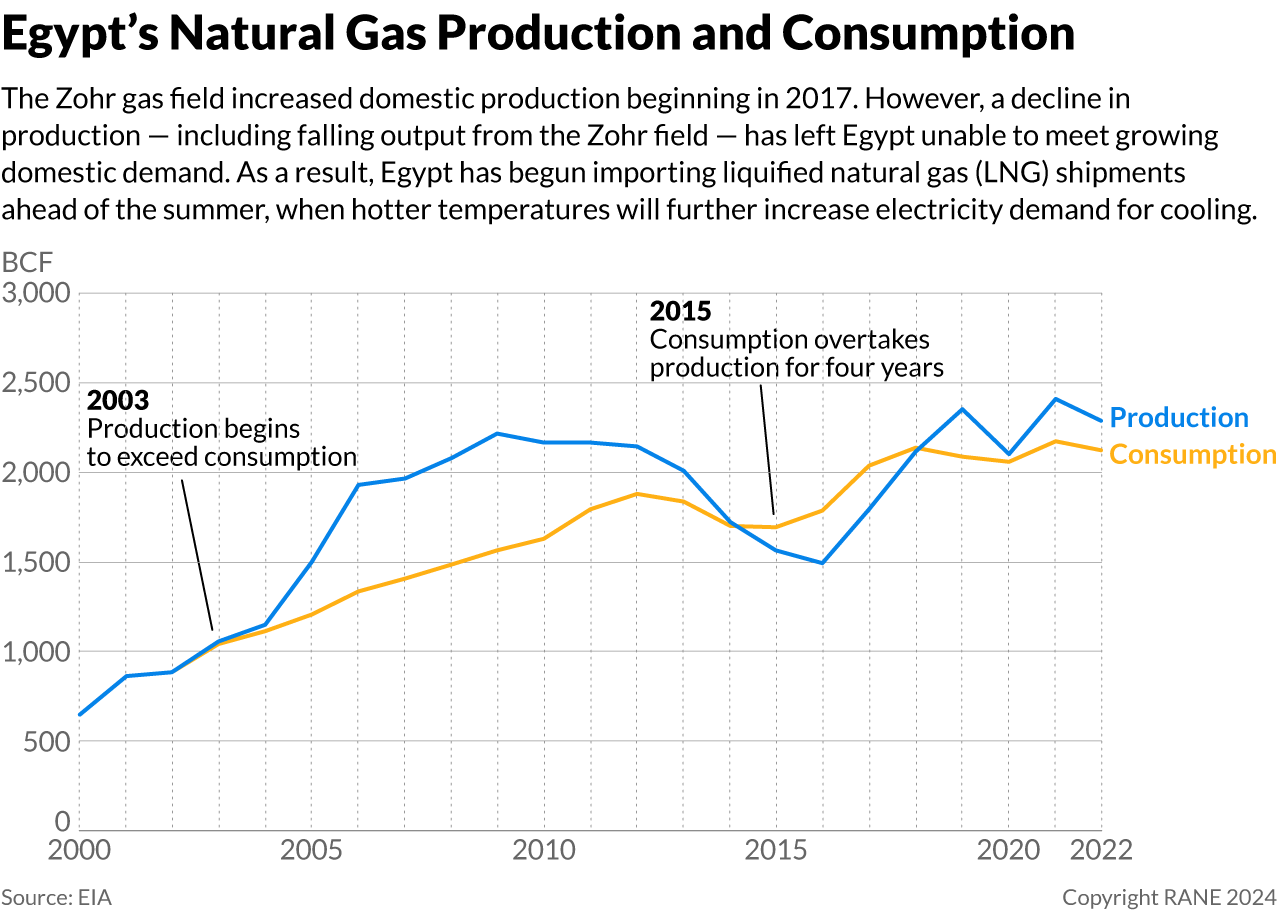
Falling domestic natural gas production — coupled with limited financial resources, regasification infrastructure and supply options to significantly increase LNG imports — means Egypt is unlikely to secure adequate amounts of natural gas to meet domestic demand over the coming years. Egypt significantly reduced LNG imports in 2018 after the Zohr gas field, located off Egypt's Mediterranean coast, began production in late 2017. However, declining production from the gas field has caused Egypt's total domestic output to decline, reaching its lowest level in late 2023 in six years. Meanwhile, Egypt's gas demand has continued to increase, causing Egypt to import growing quantities of LNG to supplement its gas supply. Although a lucrative investment deal with the United Arab Emirates and agreements with lenders (including the International Monetary Fund, the World Bank and the European Union) in recent months have provided Cairo with a boost in foreign reserves and some economic flexibility to increase imports of LNG, a significant portion of the money has been used to pay off Egypt's debts, with Cairo required to pay $29.23 billion in the 2024 fiscal year alone, limiting what is available for energy imports. Moreover, limited infrastructure for importing LNG and a tight global LNG market also constrain the amount that Egypt will be able to import over the summer to ease its energy crisis. To import more LNG, Egypt's only option is to secure more FSRUs, and while the lease of the Hoegh Galleon FSRU will expand Egypt's short-term LNG import capacity, this will only provide for a temporary and costly solution that will be difficult to scale up. Finally, Egypt has no long-term LNG contracts, and purchases on the spot market will remain expensive until new LNG supply comes online from Qatar and the United States in 2026/27, limiting the amount Cairo will be able to import. Against this backdrop, Egypt is unlikely to secure adequate amounts of natural gas to meet domestic demand in the coming years.
- Egypt inked a $35 billion agreement with the United Arab Emirates in February to give an Emirati sovereign investment fund development rights over the Ras el-Hekma peninsula. After a series of economic measures, including a devaluation of the Egyptian pound and hiked interest rates, the government also finalized an expansion of its IMF agreement in March from $3 billion to $8 billion. Additional agreements (including those with the World Bank and the European Union in March), combined with the UAE deal, together brought $50 billion to the Egyptian economy.
- On April 21, a spokesperson for Egypt's Ministry of Petroleum and Mineral Resources said that the Zohr gas field's production output has decreased by 15% on average annually. The gas field's production peaked in 2021, when it had a daily production rate of 2.74 billion cubic feet (bcf), but that daily rate declined to 2.1 bcf in December. Egyptian state media sources reported an average total daily natural gas production in FY 2022-2023 of around 6.2 bcf, while the local natural gas consumption rate was 5.9 bcf daily.
Egypt will likely continue to experience a domestic energy crisis amid inadequate natural gas supply and growing electricity demand, likely resulting in expanded power cuts for businesses and households, but not in significant social unrest. Scheduled blackouts, which have already resumed in April after the end of Ramadan, will likely persist throughout the summer and extend in length, disrupting business activities. Previous blackouts have disproportionately impacted rural areas, degraded health care services due to the lack of power — although hospitals were supposed to be exempted — and incurred financial losses to the food industry after extended power outages caused refrigerated and frozen foods to spoil. Impacts to these sectors will likely persist as blackouts increase in length and frequency over the coming months. By contrast, tourist areas will likely be spared from the power cuts as Egypt seeks to maintain growth in its tourism sector and hard currency flows. While power cuts will likely fuel anti-government sentiment among Egyptians, they are unlikely to spur large protests or domestic unrest due to Cairo's crackdown on demonstrations, as evidenced by the fact that the power cuts imposed in the summer of 2023 and again in early November did not trigger significant unrest.
- Temperatures for summer 2024 are expected to be higher than those in 2023, with temperatures in mid-April reaching hotter-than-usual 35 Celsius (95 Fahrenheit) in Cairo. In the summer, average temperatures are forecasted to reach over 40 Celsius (104 Fahrenheit). Should these forecasts prove accurate, power demand for cooling will likely increase further in Egypt.
- Last summer, Cairo imposed daily power cuts for hours at a time, though some of the upscale neighborhoods outside the New Administrative Capital area on the outskirts of Cairo and coastal areas — which are frequented by tourists — were spared power cuts amid concerns that it would deter tourism and reduce the inflow of hard currency. At the time, Egypt was in the midst of a balance of payments crisis and needed hard currency to pay off some of its debts.
Rising temperatures and population growth will further increase Egypt's energy demands and worsen the crisis, making power shortages a chronic issue for years to come. Cairo will likely seek to secure long-term LNG contracts, but with the global LNG market set to remain tight until at least 2026/27, such agreements would not likely come to fruition for years. Egypt's lack of infrastructure, meanwhile, will also continue to limit its import capacity. As a result, Egypt will likely continue to invest in gas exploration to expand its domestic gas production and discover new gas fields to offset the impact of the Zohr gas field's declining production. Furthermore, despite Cairo's long-term goal of achieving 42% of power generation from renewable energy by 2035 and its high potential to generate electricity from solar and wind power, it has not invested in renewable energy projects to the same extent that other North African countries have. In addition, Egypt's economic crisis has made it riskier for prospective renewable energy investors compared with, for example, nearby Morocco. Egypt's previous struggles to repay international oil companies will likely further dissuade such investors from seeking out opportunities in the country. As a result, Egypt will likely miss its 2035 renewable energy targets and continue to rely on LNG imports to supplement domestic natural gas production, but the country will still incur power shortages in the long term, likely resulting in its domestic energy crisis remaining a chronic problem.
- In August 2023, Egypt's Minister of Petroleum and Mineral Resources announced that 35 exploratory wells would be drilled with $1.5 billion in investments through 2025. However, even if additional discoveries were made, it would take several more years for newly discovered fields to reach peak production.
- As other North African countries have expanded their renewable energy projects, Egypt has only marginally expanded its own. According to the International Renewable Energy Agency, planned power generation projects between 2021 and 2025 using wind and solar accounted for 62% of projects for Morocco, 39% for Tunisia, and 36% for Algeria, but only 15% of Egypt's planned projects.
- According to Egypt's National Population Council, an estimated 142-157 million people are expected to be living in Egypt by 2050, up from the country's current population of 114 million.
