
Climate change is emerging as a major obstacle to Saudi Arabia's already challenged model for economic transformation, Vision 2030. The costs of this challenge are becoming overt: during the 2024 Hajj season, over 1,300 pilgrims reportedly died of heat exhaustion in Mecca as a heat wave reaching 125 degrees Fahrenheit, or 50 degrees Celsius, baked the region. This deadly incident is part of a wider trend, one that goes beyond the Hajj to every corner of the country, which must be watered, cooled and hardened against increasingly erratic weather patterns. These measures do not come cheap, and it is the economic costs of climate change, even more than the deaths, that challenge Saudi Arabia and its economic transformation. So who is to pay? The short answer is the Saudi state — for now. But eventually, the government will push the cost of climate change onto the country's political have-nots, widening inequality, sowing division and reinforcing the fault lines that could erupt in violence and instability during future periods of geopolitical crisis.
Saudi Arabia's climate, and the impact of climate change upon it, is more complex than its stereotype. While most of the country is a hot desert, this does not mean it has scorching temperatures year-round. From fall through spring, much of the country is comfortable and attractive for tourists escaping colder climates in Europe or Asia. Occasionally, the kingdom even experiences deluges of rain that can cripple major cities like Jeddah. But under current climate change projections, Saudi Arabia's already long summers will only grow longer and hotter, encroaching on the more temperate part of the year, while its currently rare flooding events will become more destructive when they hit major cities.
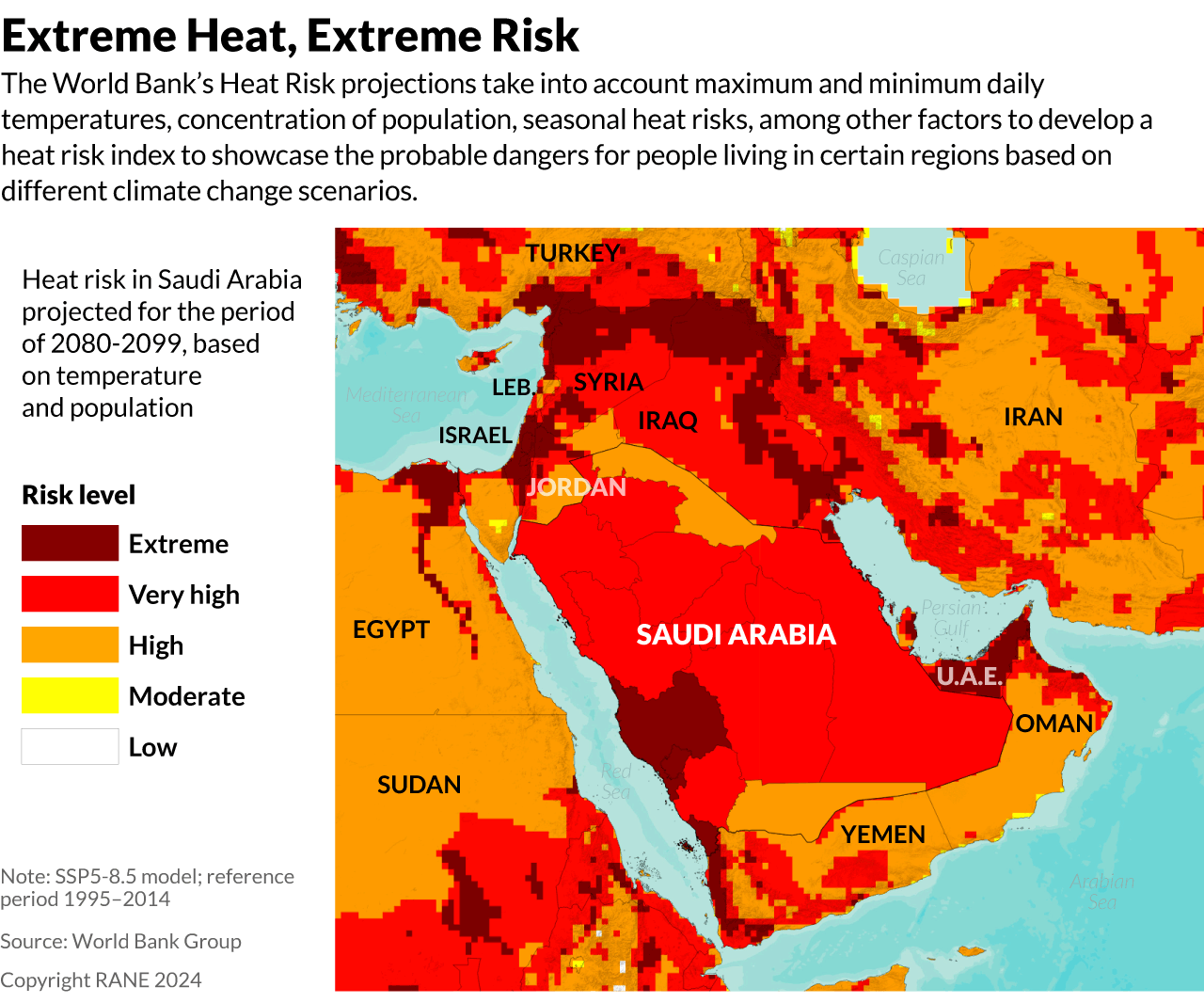
These challenges demand technological and infrastructure solutions, which are relatively obtainable for a wealthy country like Saudi Arabia. The question is not about survival, as it might be in neighboring Yemen, but about the cost of adaptation and, perhaps most importantly, who is going to pay for it.
Saudi Arabia has a unique climate change challenge not just because its hot geography is only growing hotter, but because up until a decade ago, the government's answer to the question of payment was always the state itself. Saudi Arabia's social contract involves the government monopolizing politics and policies while citizens enjoy relatively comfortable economic and social lives. But Riyadh recognizes that this contract is economically unsustainable in a world where its primary export, oil, may become less desirable while the cost of maintaining its citizens' standard of living increases. Hence, Vision 2030 aims to transform Saudi Arabia into an economy where market forces, rather than the state, ensure the standard of living.
However, market forces are not always affordable or socially stabilizing. Currently, the government subsidizes electricity and water for Saudi citizens and businesses, enabling them to escape the true economic cost of heat waves and increasingly hot summers. This was and still is a regional norm. Such subsidies help preserve citizens' and residents' spending power and their sense of economic comfort, and they help businesses provide similar comfort for their employees to attract and retain talent and perform knowledge economy functions. Despite these advantages, Vision 2030 suggests that Saudi Arabia will follow the United Arab Emirates' and Qatar's lead by easing away from utility subsidies, bringing residents and citizens closer to experiencing the true cost of summer in the country. However, Saudi Arabia has a notable disadvantage compared with its neighbors in pursuing this path.
While the United Arab Emirates and Qatar are dominated by foreign workers who can be readily deported if they become politically active, in this case in response to rising utility costs, Saudi Arabia's economic transformation relies on citizens who are not going anywhere. Therefore, Riyadh must find a way to increase prices for citizens without inciting anger that could lead to political demands on the monarchy. This is a tricky path for Riyadh and has already led to abrupt policy reversals in response to public disapproval of other reforms, like those seen as too socially liberal. The United Arab Emirates and Qatar can force foreign residents to bear the economic cost of climate change because these residents have no political rights and do not expect them. In contrast, Saudi citizens may demand more political power if their standard of living declines or stagnates.
In addition, Vision 2030 aims to grow Saudi Arabia's economy, and a bigger economy will almost certainly require more energy and water. Saudi Arabia has the wealth to experiment with new technologies that could offset the costs of such growth, from more speculative technologies like those that pull drinking water from the air to established systems like solar energy. However, Saudi Arabia must import these technologies, given the country's limited manufacturing and technological base, so someone must pay for them. Currently, the Saudi state pays for many of these technologies, directly or indirectly, either through its national budget or its sovereign wealth fund. Although Saudi Arabia intends for the free market to take over eventually, there is no clear timeline for when the government's central role in securing these technologies will diminish.
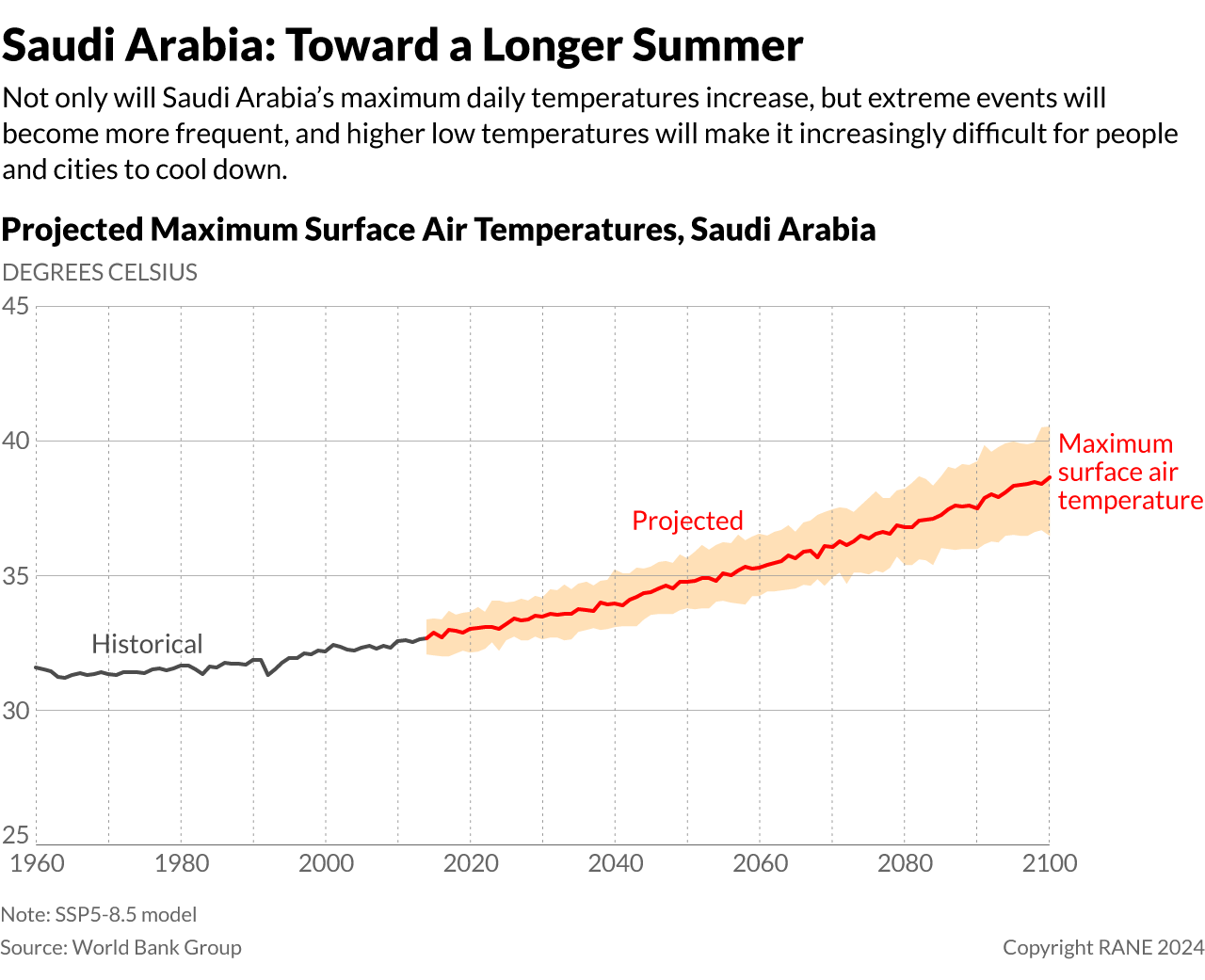
Additionally, climate change will become more expensive. As summers grow longer and hotter and floods more impactful, the country must increasingly invest in infrastructure to push back. Necessary infrastructure includes not just power plants to provide electricity or desalination plants to provide water, but also new homes, commercial buildings and factories resistant to a different climate. The latter need alone is a monumental task, as builders constructed many of Saudi Arabia's buildings without considering the cost of air conditioning or insulation, suggesting urban renewal at scale will need to occur. Moreover, as rain storms bring spectacular, if rare, floods, cities will have to invest in canals, sewers and channels that tear up neighborhoods, redirect transport routes and upend established commercial centers if they are to avoid their own versions of Dubai's crippling 2024 floods.
As the years go on, Saudi Arabia will increasingly seek non-state ways to pay for these expenses and strengthen the economy. Namely, the state will strive to push the cost of climate change onto the population and market, but it must take care to do so without creating new political centers to oppose the monarchy. For instance, Saudi Arabia cannot rapidly remove subsidies for electricity and water for the whole population without risking backlash that might turn to violence and sustained opposition. Instead, Riyadh will likely carry out targeted subsidization to keep certain parts of the population insulated from the costs of climate change.
This strategy will likely result in targeted subsidies for upper and middle-class citizens and for politically sensitive tribes, which will either enjoy a continuation of the old, expensive subsidy system or live under a new scheme designed to offset the impact of subsidy reform. A new subsidy scheme could also have sectarian dimensions that leave out politically disenfranchised Shiites. Some businesses considered either economically sustainable or politically unimportant will also see their bills rise, while others, particularly those with political connections, will continue to have access to state subsidies. Most of all, it's a near-guarantee that foreigners will be asked to pay up for climate change more often than any other group, given their guest worker status in the kingdom, though the specifics remain to be seen.
Overall, the subsidy pattern will be one of inequality, which will deepen divides in Saudi society between sects, regions, economic classes, and residents and citizens. Riyadh will prioritize protecting those most connected to the monarchy's political legitimacy from the price of climate change while neglecting or imposing costs on those considered less important. This will feed into existing inequalities that already produce occasional violence, radicalism and unrest, which come to the fore during times of geopolitical stress, like the Arab Spring, when old divisions resulted in a sustained Shiite uprising in the Eastern Province. As climate change's economic costs fall unequally on Saudi Arabia's population over the years, these divisions risk becoming fault lines that burst open in future geopolitical shocks — portending more rounds of violence and instability for a kingdom trying to sell itself as a haven from both.
