
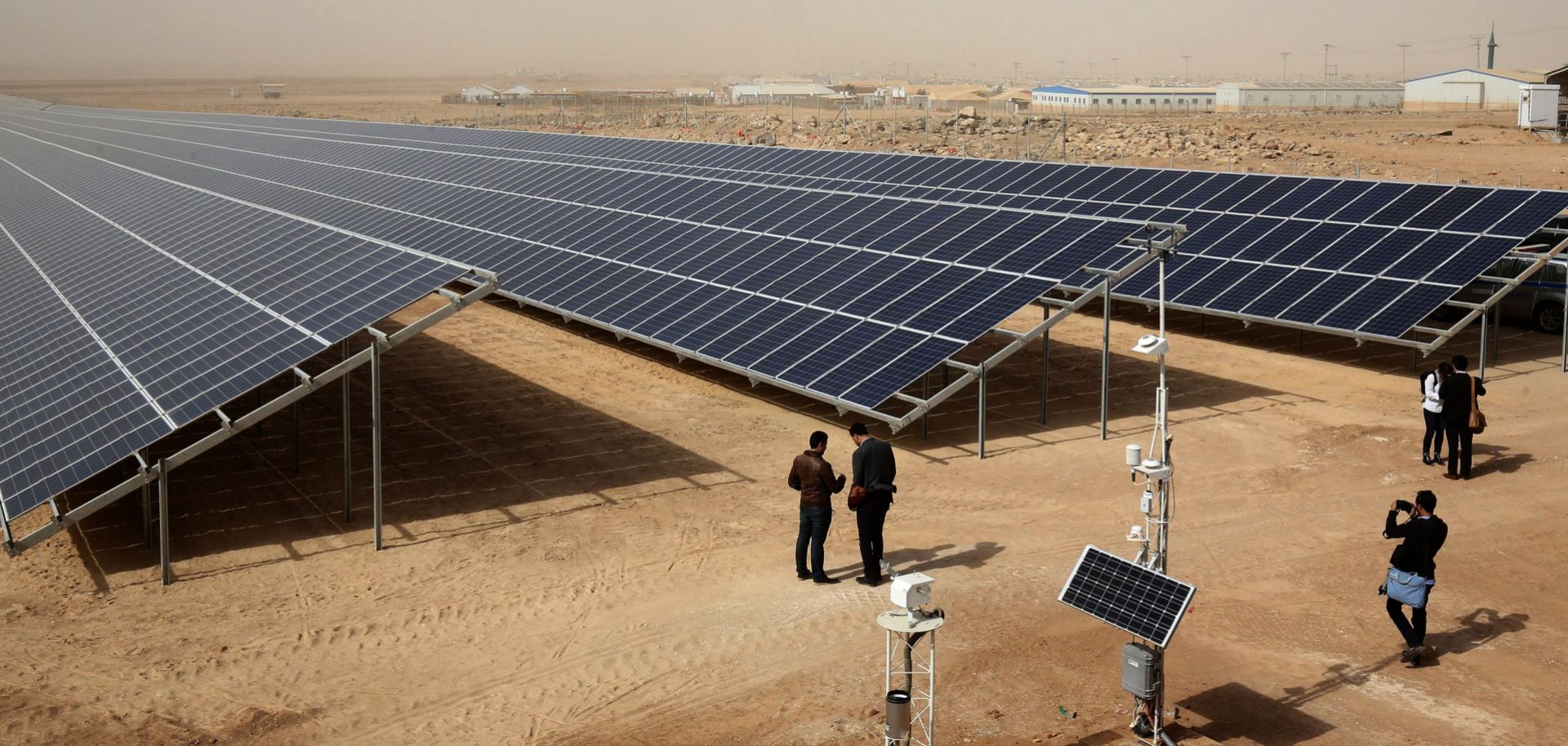
Part of a new solar plant is seen at the Zaatari refugee camp in Jordan on Nov. 13, 2017.
A new power-for-water trade deal between Israel, the United Arab Emirates and Jordan show how climate-related cooperation could offer alternative paths for future Israeli-Arab normalization. On Nov. 22, the United Arab Emirates, Jordan and Israel signed a cooperation deal that will see the United Arab Emirates help construct a solar power facility in Jordan, which in turn will trade power to Israel in exchange for desalinated water. The United States also took part in the signing, which environmental observers cited in news coverage have hailed as a major breakthrough in Jordan and Israel’s efforts to prepare for climate change.
- The United Arab Emirates’ state-backed Masdar, an alternative energy company, will build the solar plant, which is set to be operational by 2026.
- Israel has agreed to pay $180 million per year to Jordan and Masdar to receive the power of the new solar plant, which is meant to supply 2% of Israel’s energy supply by 2030. In exchange, Jordan will purchase 200 million cubic meters of desalinated water from Israel each year.
By helping ease cash-strapped Jordan’s water woes, Israel and the United Arab Emirates are seeking to help defuse the threat climate change poses to regional stability. Israel and Jordan are both at risk of being hit hard by the impacts of warming global temperatures, with scarce water supplies and arable land vulnerable to desertification. But Jordan is particularly exposed because it lacks the wealth to offset these changes itself. Indeed, a combination of poor domestic infrastructure and a record regional drought is already creating acute water shortages in Jordan, which bodes ill for the country’s long-term stability as the effects of climate change grow increasingly severe. This has raised concerns in Israel and Jordan’s nearby allies like the United Arab Emirates, which do not want to see another Arab monarchy collapse.
- Jordan has limited options for useable water, with its small coast making it difficult to construct large-scale desalination facilities. The country’s politically important agricultural sector uses up 60% of the country’s water supplies.
- The water levels in the Dead Sea — which borders Israel and Jordan — have declined an average of 40 inches per year since 1990. Environmental scientists expect the salt lake to continue to deplete in the coming years as Jordan’s water use rises and rainfall becomes less reliable.
- The Middle East has seen a record-low rainfall over the past 14 years, which has caused water reservoirs in Syria, Iraq and Turkey to hit dangerously low levels in addition to Jordan. Such severe droughts are expected to become a “new normal” in the desert region as a result of climate change.
New political and economic ties with the United Arab Emirates will give Israel more opportunities to export its environmental technological know-how to the Arab world. The United Arab Emirates’s large sovereign wealth funds and state-backed environmental companies, like Masdar, position it to fund and build climate-change-related infrastructure, like solar power plants, throughout the Arab world. Additionally, the United Arab Emirates can now infuse Israeli technology and infrastructure into this strategy, thanks to the normalization deal it signed with Israel in 2020, which allows the two countries to engage in overt technological and economic cooperation. A joint Israeli-Emirati effort may also develop in Bahrain, Morocco and Sudan (the three other countries that normalized ties with Israel last year), along with Egypt — all of which are highly exposed to climate change but have limited financial and technological abilities to counter the impacts.
These joint ventures could entice other climate-exposed states like Oman, Saudi Arabia and Turkey) to seek out similar Emirati-Israeli support, which would strengthen Israel’s regional acceptance. Some Arab and Muslim citizens will protest any cooperation with Israel, regardless of how pragmatic, without a full resolution of the Israeli-Palestinian conflict, But for their governments, the existential threat posed by climate change may ultimately outweigh the political risk of pursuing Israeli environmental technologies, investments and expertise. Oman, which already has covert relations with Israel, increasingly needs investment and technology to prepare itself for a future with less rainfall and potentially more damaging cyclones (like the one that rocked the coastal country last month) as water temperatures rise in the Arabian Sea. Turkey, which is in the midst of battling both a growing economic crisis and drought-induced water shortages, also desperately needs investment to build the environmental infrastructure needed to offset the worst effects of climate change. And Saudi Arabia, for its part, might be tempted to lure Israeli-Emirati investment into the kingdom’s already up-and-running solar and desalination plants.
- On Nov. 26, thousands of Jordanians protested against the new deal with Israel out of solidarity with Palestinians, who were left out of its benefits.
