
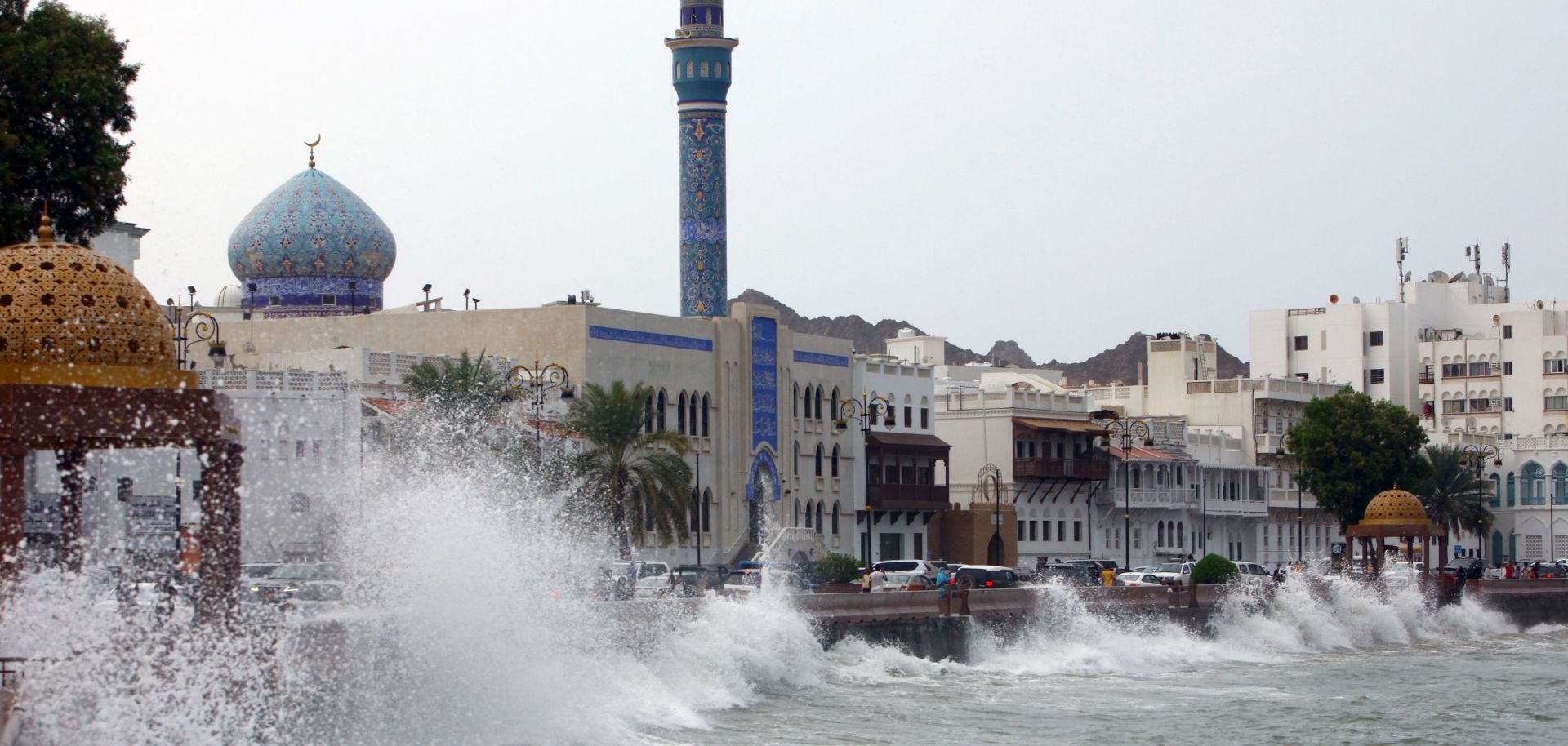
High waves break on the seaside promenade in Muscat on Oct. 2, 2021, the day before Cyclone Shaheen officially made landfall in Oman.
To harden its infrastructure against increasingly frequent cyclones, Oman will need external funding from its wealthier Arab Gulf neighbors, which could ultimately undermine Muscat’s autonomy on regional matters by increasing its economic dependence on powerful players like Saudi Arabia and the United Arab Emirates. Damage from torrential rains and high winds have so far killed 13 people in Oman after tropical cyclone Shaheen made landfall along the country’s coast on Oct. 3, bringing unprecedented storm activity to the deserts of southwestern Arabia. Shaheen is only the second tropical storm on record to strike through the Gulf of Oman since 1890. But as climate change increases sea temperatures in the region, such extreme weather events are likely to become less isolated in the coming years.
- Shaheen formed out of Cyclone Gulab, which traversed the southern tip of India in late September. The cyclone was then renamed once it entered the warm waters of the Arabian Sea and the Gulf of Oman, which — according to projections by the Intergovernmental Panel on Climate Change — are set to only become warmer over the next several decades alongside global temperatures.
- In addition to bringing more Shaheen-like storms to Oman, increasing sea temperatures also create the potential for cyclones to enter the Persian Gulf along other paths and strike Qatar, Bahrain and eastern Saudi Arabia.
The potential for more frequent tropical cyclones like Shaheen poses a major threat to all Arab Gulf states, though Oman’s long coastline makes it particularly vulnerable. Major cities across the region, which are almost exclusively located near the sea, all have flooding infrastructure designed to withstand occasional monsoons rather than major cyclones, given the latter’s historic rarity. Many of these cities have also prioritized developing buildings with unobstructed views of the ocean to generate tourism and high property values, increasing their exposure to strong storm activity. Compared with its Arab Gulf neighbors, however, Oman risks bearing the brunt of more frequent cyclones due to its geographic exposure to the warming waters in the Gulf of Oman.
- Cyclones will likely increase flood and wind damage risks in Gulf of Oman coastal cities like the Omani cities of Muscat, Sohar, Sur and the Emirati city of Fujairah, where beachfront properties are already facing the slower-moving threat of rising sea levels.
- In addition, Oman’s interior is filled with fragile historical sites that are part of the sultanate’s tourism strategy, which may also need to be protected from the higher probability of storm damage. These include dozens of castles, some of which are more than 1,000 years old and built out of materials better suited to the dry conditions of pre-industrial Arabia.
To limit the infrastructural damage and death toll of future tropical storms, Oman will likely seek to construct new sea walls and drainage systems, as well as establish early warning systems and update building codes. But its limited resources and expertise will force Muscat to turn to external investment to generate the capital for these projects. After witnessing the damage caused by Shaheen, the United Arab Emirates, Qatar and Saudi Arabia will likely also seek to harden their infrastructure against severe storms, which they’ll largely be able to self-finance. Cash-strapped Oman, however — with a debt-to-GDP ratio that hit 80% last year amid the fallout from COVID-19 — will likely have to rely on external financing from these wealthier Arab Gulf states to fund such improvements.
The United Arab Emirates and Saudi Arabia will likely leverage Oman’s need for infrastructural funding to undermine Muscat's traditional neutrality in regional affairs. Oman has prized a neutral foreign policy, including during the 2017-21 blockade against Qatar. But such stances have run up against Emirati and Saudi opposition and even economic harassment of Omani interests. Greater economic inroads into Oman could place both Riyadh and Abu Dhabi in a better position to coerce Muscat into more overtly supporting their foreign policies — whether that’s in a future confrontation with Qatar or in an attempt to cut off Iranian aid to Houthi rebels in Yemen. Saudi Arabia, in particular, could also use its new economic leverage to undermine Omani influence in eastern Yemen, where Muscat and Riyadh’s proxies have previously been in competition.
- In October 2020, Oman was reportedly attempting to secure Arab Gulf support for its bonds as the COVID-19 pandemic damaged its economy. Oman had previously shied away from aid that looked like bailouts for fear they might be used as leverage against Oman, which has kept warmer ties with Iran and Qatar.
