
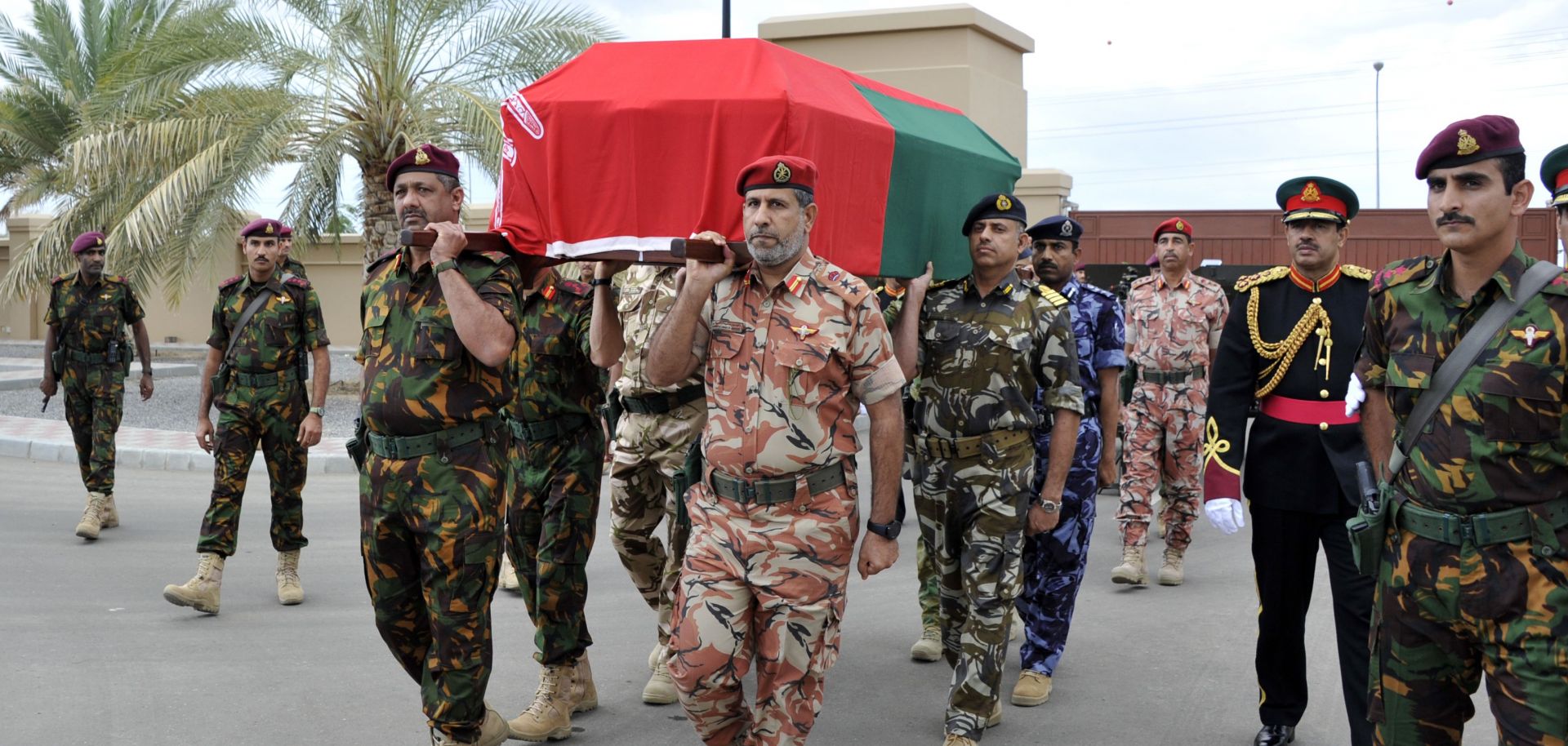
High-ranking Omani army officials carry the coffin of the late Omani leader Sultan Qaboos bin Said al Said toward his burial place on Jan. 11. Qaboos, who was not married and had no heirs, named his cousin Haitham bin Tariq al Said as his successor.
Everything about the ascension of Oman's new ruler, Sultan Haitham bin Tariq al Said, has screamed continuity — including the sultan himself. "We will continue to follow in the same course the late sultan adopted," he said in his inaugural speech Jan. 11, a day after the death of his predecessor, Sultan Qaboos bin Said al Said, had been announced. So far, so stable. Regardless, Haitham will have trouble filling Qaboos' large shoes. During his nearly 50-year reign, Qaboos wrote a playbook of Omani geopolitics that toward the end of his life was running thin on tactics for the 21st century. But what a playbook it proved to be for his time. Few of the region's Gulf rulers had faced as many challenges, and fewer still lasted as long. Qaboos took a backward, crumbling empire and shoved it into the 20th century. For Haitham, however, the strategies of the past will need an update — and will present him with the first of his royal challenges.
Qaboos, Father of the National Strategy
Qaboos was the last of a special Gulf Arab breed, a leader whose rule bridged the poverty of the pre-oil era and the wealth of the post-petroleum boom. After taking power from his father in a palace coup in 1970, the 29-year-old Qaboos took the helm of a state, but not a nation. At that point, Oman was undeveloped and divided, barely emerging from Britain's imperial dusk. Its neighbor in Communist South Yemen sought to export revolution through an active rebellion in Dhofar province; its Gulf Arab brethren in the budding United Arab Emirates and Saudi Arabia coveted Omani territory and gaining influence in its royal palace. In the mudbrick towns around Nizwa in the interior, the followers of Oman's ousted Imam Ghalib Alhinai, a formerly independent religious-political authority, grumbled against Muscat after enduring the government's British-backed conquest of the interior regions in the 1950s. But the once-mighty British Empire was in fatal decline, and it was not clear who might replace it as guarantors in those unstable Cold War days.
Despite all this, Qaboos found a formula that worked. To fend off competitors and keep Oman's foreign policy largely independent, he made Oman useful to powers big and small, from the United States and the United Kingdom to Iran and Israel. He spread out Oman's limited energy wealth to key tribes, villages and business figures, building a wide network of supporters loyal to his direct handouts, relying on them and his security forces to keep Omani politics in stasis.
An Incomplete Inheritance
Qaboos' strategies were not perfect: Being closer to Iran often meant angering his Gulf Arab compatriots in Abu Dhabi and Riyadh. His all-important alliance (and subsequent troop basing agreements) with the United States kept Oman in the crosshairs of Iranian missiles, should the dreaded all-out regional war ever begin. By doling out Oman's state wealth, he bought loyalty at the price of birthing deep and lasting corruption, a rot that must be addressed should Muscat's post-hydrocarbon future ever be realized. And while his monopolization of Omani politics may have minimized dissent, it did not eliminate it: in the Arab Spring, young Omanis risked their reputations and their personal freedom to demand a better economic deal from the sultan. The legacies of these imperfect strategies are now what he bequeaths to Haitham.
Oman's new leader faces plenty of challenges abroad — starting with the Saudis and the Emiratis. Qaboos kept them at arm's length, pivoting to the United States to fend off their policies while relying on his own personal mystique to prevent the influence of his powerful Gulf neighbors from building inside his borders. Haitham can, of course, stay close to the United States and may yet strengthen his predecessor's work by drawing closer to Israel as a means to gain support from Washington, in addition to being a useful partner to regional U.S. goals. But he has none of Qaboos' mystique, and as an inheritor of a wobbly Omani economy, a desperate need for investment. As Saudi and Emirati money flows into Oman, Haitham will need to find a way to ensure that Omanis continue to see him as the center of the nation — and not begin to feel split loyalties to foreign investments.
He will also need to help manage the U.S.-Iran confrontation, mediating between both sides without being seen as favoring either, considering the danger of Oman's being dragged into a war between them. Several Omani bases host a number of U.S. troops, who would be considered targets should Iran's regional retaliation grow large enough, and already oil tankers not far from Oman's waters have been sabotaged by Iranian forces. Can Haitham repeat Qaboos' deft balance and keep Oman useful to all and a threat to none? Or will he decide that he must change tack, hew closer to either America or to Iran, and change the country's diplomatic strategy to prevent Oman from being pulled into war?
At home, how will Haitham proceed to step into the shoes of the father of the nation? He will have no great military campaign, as Qaboos did in the Dhofar rebellion, to endow himself with the gravitas of a general. He will have less cash to hand out to loyalists and tribes to tie them to his own person — and what cash he might have will increasingly come with strings attached, whether that's from international investors who want to see returns or from fellow Gulf Arabs who will demand influence in exchange. To offset social pressure, perhaps he will consider a liberalization of domestic politics, a great taboo under Qaboos. Or perhaps he will follow in the footsteps of his Saudi and Emirati neighbors and embark upon a crackdown against dissenters.
Such long-term costs are now Qaboos' legacy. The late sultan guided Oman out of empire; his successor now finds he must find a path toward geopolitical sustainability. Much of what Qaboos did worked to bring Oman to the present. But those strategies now need an updating — and choosing how to update them will be one of Haitham's first great tasks.
