
Editor's Note: This article is part of an ongoing RANE series on the geopolitical impacts of water stress. The first installment of this series provided a broad overview of how the unequal distribution of freshwater shapes geopolitical patterns. Other installments have examined the impacts of water stress on the global economy, Europe, China, the Sahel region of sub-Saharan Africa, Israel, Central Asia, Chile, the Middle East, the Mekong River region, climate investment and India.
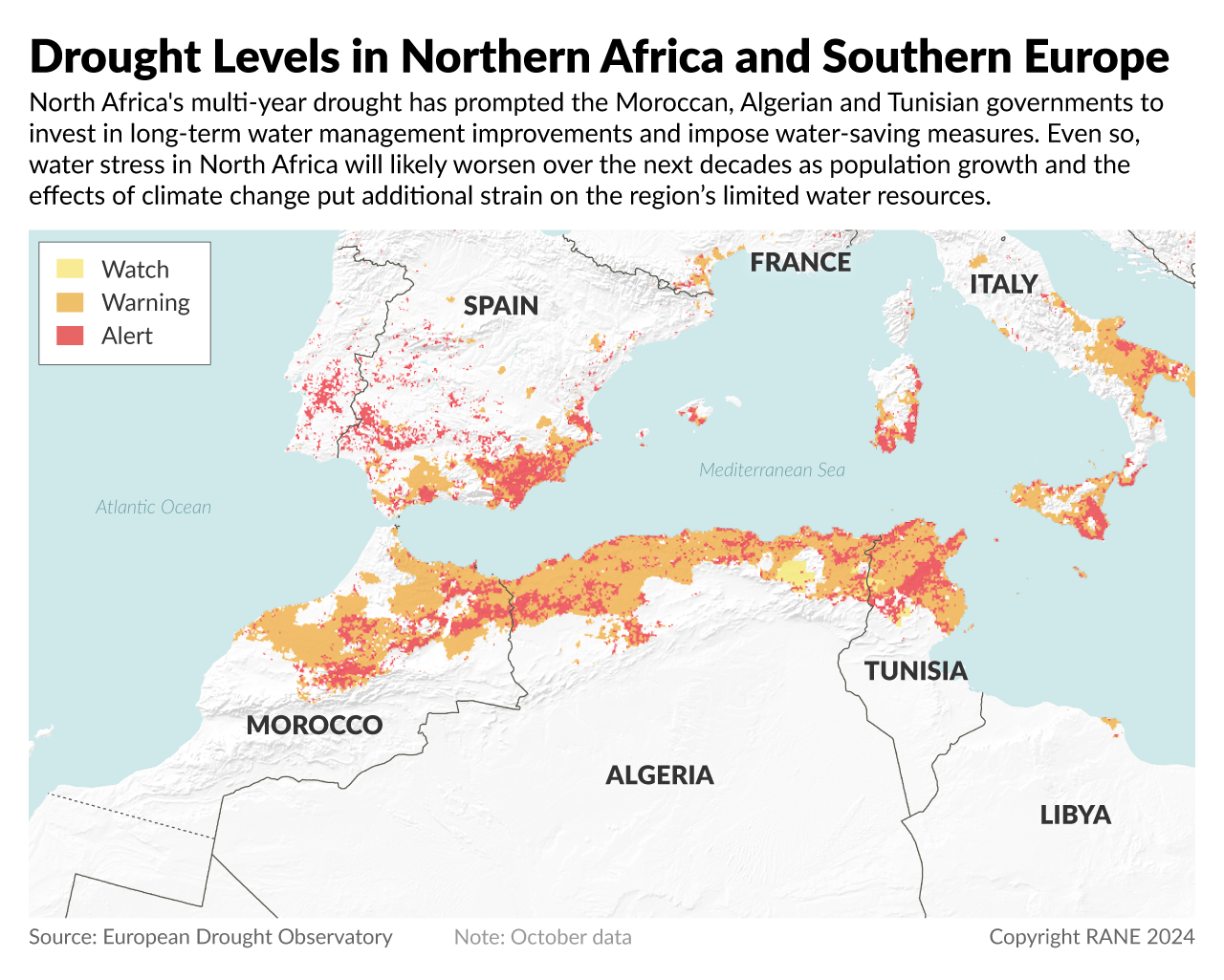
Facing an ongoing drought, North African governments are promoting water-saving technologies and infrastructure improvements, but prolonged overconsumption in the agricultural sector, mismanagement and technological constraints will worsen water stress and heighten the risk of unrest over time. North Africa is in its sixth year of drought, most directly impacting Morocco, Algeria and Tunisia, and regional rainfall has decreased more broadly over the past several decades due to the effects of climate change, which are anticipated to worsen in the coming years. As a result of the drought, North Africa has less arable land, emptier regional dams, a loss of agricultural jobs and higher food prices. Water scarcity is projected to continue rising alongside North Africa's population, which the Institute for Security Studies, an African human security organization, projects will grow from 121.4 million in 1990 to 270.5 million by 2043. Already, growing populations have pushed North African countries to overexploit finite groundwater resources, many of which replenish slowly, making these countries even more vulnerable to droughts. According to the World Resources Institute, Morocco and Algeria both experience high water stress, defined as using 40%-80% of their renewable water resources, while Tunisia experiences extreme water stress, defined as using more than 80% of its renewable water resources. The institute forecasts all North African countries will experience extreme water stress by 2050.
- While North Africa has faced droughts in the past, this is the worst Morocco has experienced in 40 years. The country’s dam filling rates increased slightly to nearly 29% by Oct. 15 due to increased rainfall, an increase from 25% year on year. However, while most dams in the northern, central and eastern regions of Morocco are at moderate-to-high levels of 33%-48%, others, such as the Oum Er-Rbia basin, are at critically low levels of less than 5%.
- Despite also experiencing increased rainfall, Tunisian dams did not benefit in the same way as Moroccan dams since most rain fell in central Tunisia, away from the north and northwest areas of the country where dams are concentrated. In early October, Tunisia's dam fill rate was at a 30-year record low of 21.6%.
- The agricultural sector consumes the vast majority of water in North Africa, despite only accounting for a comparatively much smaller percentage of the countries' gross domestic products. For example, the Moroccan agricultural sector accounts for about 85% of the country's total annual water consumption but only contributes about 15% of Morocco's GDP.
- The management of transnational groundwater resources varies based on the diplomatic relations of the countries in which groundwater basins are found. For example, Algeria, Libya and Tunisia have a consultation mechanism for the North-Western Sahara Aquifer System to monitor extraction rates and prevent overexploitation. On the other hand, Morocco and Algeria, whose diplomatic relations are severed, have very limited coordination over the transboundary Bounaim-Tafna basin, causing an inflated risk of overexploitation and pollution.
After years of mismanaging water resources, North African governments have made efforts to conserve water, expand water management technologies and access potable water through desalination technologies, but these initiatives will take several years to bear fruit and, in the meantime, some will generate popular criticism. Years of mismanagement, lack of maintenance of water management systems and centralized approaches that at times neglect region-specific needs have exacerbated North Africa's water stress problems. However, the multi-year drought has galvanized momentum for large-scale water improvement projects that include more desalination plants and efforts to increase the amount of recycled wastewater. For example, in January 2024, the Moroccan government expedited some of its mid-term water management projects that were slated to be completed by 2027, including new dams and connections between existing ones. Similarly, the Algerian government has fast-tracked the Cap Blanc water desalination plant to expand Algeria's desalinated water supplies. However, these projects are long-term investments to improve North Africa's water security that will take years to complete. In the interim, governments have implemented unpopular water-saving measures that heavily restrict personal water consumption but generally shy away from restricting farmers' access to water. As household use comprises only a small portion of North African water consumption, this strategy has led to public criticism of North African governments' drought management while also largely failing to achieve significant water savings.
- Funding sources have supported improved water management projects throughout North Africa. In 2020, the European Investment Bank signed a 38 million euro ($40 million) agreement with Tunisia to finance a critical drinking water supply program to address water shortages. In February 2024, the African Development Bank and OCP Group, Morocco's state-owned phosphate and mining company that has a Green Investment Program, approved three loans worth $188 million for new modular seawater desalination plants in Morocco that will provide potable water resources for 1.5 million people.
- Earlier this year, both Morocco and Tunisia implemented water rationing measures mostly targeting urban populations. In such cases, Moroccan bath houses, called hammams, closed three days a week; water was also restricted for car washing, landscaping and irrigation. Business owners affected by the restrictions, as well as politicians, have criticized the targeted rationing measures since they impede business operations and result in profit loss while minimally reducing the country's total water usage. In addition, Tunisia increased the price of drinking water by up to 16% in March, exacerbating the cost of living.
- Aging infrastructure and unmaintained water management systems in North Africa lose significant quantities of water due to leakages, which leads to ineffective management of water resources. For instance, the World Wide Fund for Nature estimates that leakages in water management systems account for 30% of water loss in Tunisia. Therefore, many of North Africa's initiatives require major infrastructure overhauls to replace aging pipes, requiring costly multi-year endeavors to improve the infrastructure's efficiency.
Despite calls to conserve water, North African governments are unlikely to reduce water subsidies, as doing so would likely constrain the growth of the agricultural sector due to higher input costs. Several North African governments, like Morocco's, have encouraged farmers to conserve water but simultaneously promoted initiatives to increase domestic food production to improve food security and reduce reliance on food imports, which have driven up the cost of living alongside inflation. While governments could decrease water subsidies to meet the first goal, as higher input costs would likely decrease water usage, farmers' crop yields would likely shrink, resulting in job losses and curtailing efforts to expand the countries' agricultural sectors and domestic food cultivation. Furthermore, the removal of subsidies would likely result in significant backlash from the agricultural sector, potentially mobilizing labor unions like the powerful Tunisian General Labour Union to protest. Due to these conflicting priorities, North African governments are unlikely to decrease water subsidies, meaning farmers will have little financial incentive to reduce their water usage. As a result, the agricultural sector will likely remain the primary consumer of water in North African countries.
- According to the Morocco Economic Competitiveness Project, a program funded by the U.S. Agency for International Development, the true value of water based on agricultural revenue is 70 cents per cubic meter; for comparison, Moroccan farmers pay 4 cents. Additionally, as part of Morocco's Green Morocco Plan, the government has heavily subsidized the adoption of 80%-100% of the country's drip irrigation systems, though this disproportionately benefits large commercial farmers and largely excludes smaller farming operations. As a result, smaller family-run operations will remain vulnerable to dwindling water resources, especially compared with large agricultural operations.
- The 2022 Russian invasion of Ukraine caused a spike in global food prices, driving up the cost of living and inflation for many North African countries. Since then, Morocco and Tunisia have had Cabinet reshuffles, and while no reason was directly cited, local media sources speculated that popular discontent with economic conditions — especially high food prices — contributed to the personnel changes.
North African governments will likely promote water-saving technologies, improve the efficiency of irrigation and reduce water wastage, but these efforts face near-term constraints and tradeoffs that weaken their impacts. In particular, authorities will likely prioritize the implementation of drip irrigation systems, which deliver water directly to plant roots and more effectively irrigate land by reducing water loss and minimizing evaporation. Furthermore, North African governments will likely lead initiatives to reduce crops' vulnerabilities to climate change and water stress, such as Tunisia's efforts to use indigenous drought-resistant crops. However, some farmers from long agricultural traditions may resist adopting new technologies, especially drip irrigation systems, due to their divergence from historical techniques and high upfront costs. Therefore, North African governments — such as Morocco's — will likely heavily subsidize the equipment in the hopes of fostering more sustainable agricultural practices. However, the adoption of drip irrigation systems may inadvertently promote an increase in the cultivation of more profitable water-demanding crops, thereby increasing overall water consumption. While in the long term, these initiatives will likely make the agricultural sector more resilient, in the short term, drought and water stress will shrink North Africa's annual crop yields, decrease agricultural sector revenue and maintain the region's increased reliance on food imports.
- The International Center for Agricultural Research in the Dry Areas established a gene bank in Morocco in May 2022 to identify and preserve drought-resistant variants of crops to make future harvests more resilient.
- In April 2024, the Moroccan minister of agriculture, fisheries, rural development and water and forests said Morocco would experience a 20% decrease in its crop yield due to the drought. Similarly, Algeria's cereal production, while expected to be comparable to the 2023 harvest, was predicted to be 22% below the five-year average due to drought conditions.
Even as North African countries complete infrastructure improvements that increase access to potable water, dwindling water resources will still disproportionately affect citizens in rural areas, likely driving increased urbanization and heightening the risk of protests. With most of North Africa's population concentrated in urban areas, many upcoming and in-progress water infrastructure projects will concentrate on cities and surrounding areas, leaving smaller rural communities more vulnerable to limited water resources. Although some technologies such as mobile desalination units will improve access to water in more remote areas, these technologies have limitations. For instance, mobile desalination units cannot process as much water as their larger permanent counterparts, and limited units will leave some more remote areas exposed. As a result, water scarcity will likely worsen existing inequalities in rural areas, which are frequently populated by underserved, Indigenous communities. Most immediately, limited water resources — and government measures to ration them — will likely drive protests in these areas and eventually, along with other factors, likely motivate more people to move to cities, where water resources are concentrated. However, as urbanization increases, the strain on North Africa's water resources in these areas will worsen, forcing governments to implement more urban water rationing that will heighten protest risks in cities as well.
- In August, protesters in Algeria's central city of Tiaret protested water rationing measures implemented by the government. Demonstrators obstructed roads and demanded the restoration of access to potable water. Tunisia has faced similar protests.
- According to a September 2023 report by the International Organization for Migration, frequent droughts fuel rural-urban migration. Furthermore, intense weather patterns associated with climate change such as flash floods (which drought-stricken areas are prone to in times of rainfall) will likely fuel the migration of disaster-displaced individuals.
