
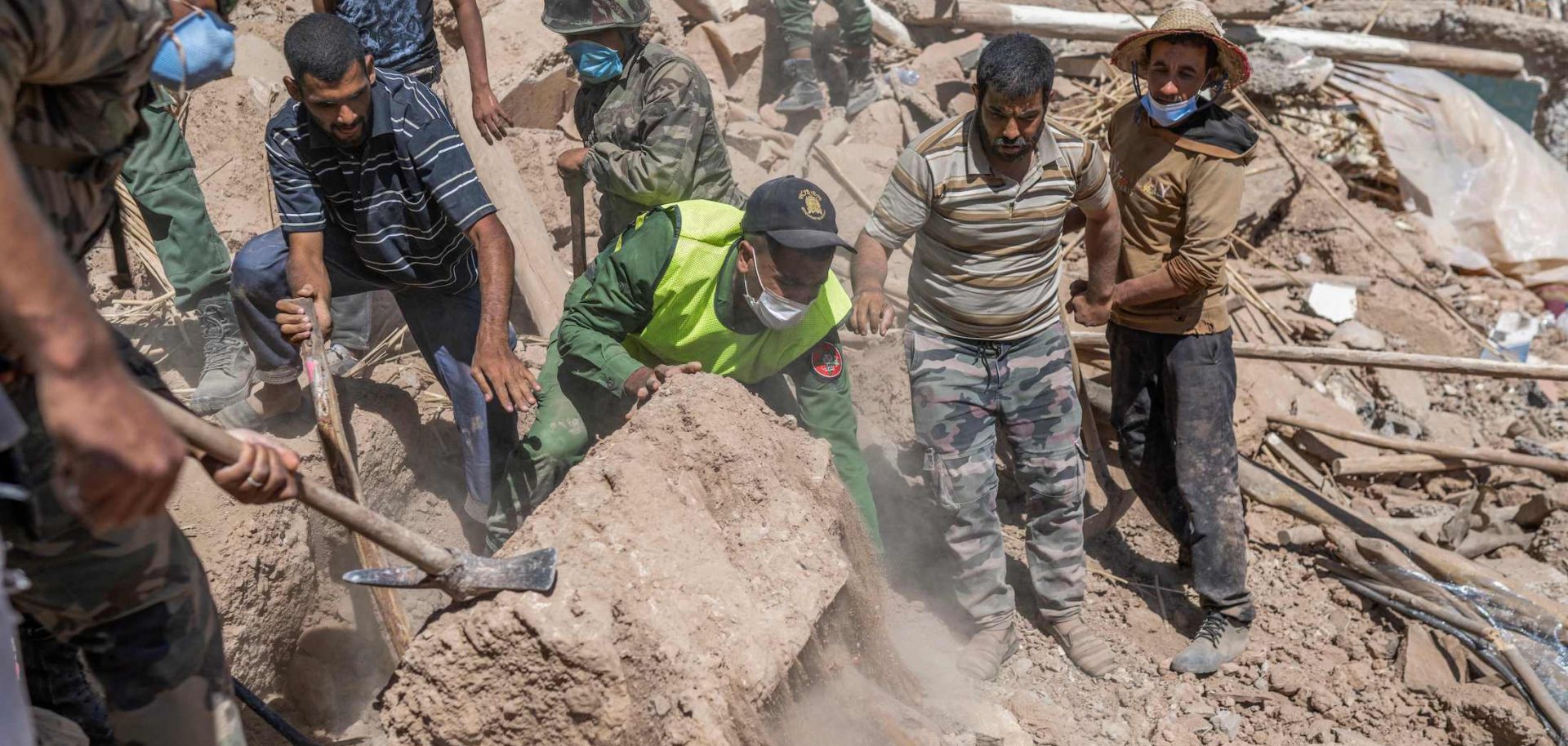
The economic impact of Morocco's earthquakes will harm growth into 2024, potentially forcing the elected government out and slowing the country's fiscal consolidation. On Sept. 8, a magnitude 6.8 earthquake struck Morocco's Marrakesh-Safi province just south of the city of Marrakech. Combined with at least one major aftershock, the disaster left at least 2,500 people dead and thousands more injured and disrupted transportation, tourism and businesses across the region. One of the largest to hit Morocco in decades, the earthquake comes as Morocco is dealing with ongoing drought and economic challenges from the Russian war in Ukraine and the aftermath of the COVID-19 pandemic. While Morocco experienced an economic rebound after the downturn of 2020, it has also experienced higher than average inflation projected at around 4.6% in 2023, according to the International Monetary Fund, against a projected real GDP growth rate of 3%. Its agricultural sector is also experiencing a downturn as drought reduced overall agricultural yields, harming exports, driving up local food prices and making Morocco more reliant on international food sources. The earthquake also brought a new challenge to this economic picture: Marrakech was a major hub for the tourism industry, a bright spot in the Moroccan economy and a vital source of hard currency. Meanwhile, some public criticism of the government's response has emerged, with citizen complaints circulating on social media, prompting the Moroccan government to issue a statement Sept. 10 defending its response.
- Drought has afflicted Morocco's agricultural sector, causing it to shrink 14% in 2022. The IMF had previously projected that much of Morocco's economic growth in 2023 would derive from an improvement over 2022.
- Morocco has enacted a program of fiscal consolidation that included increased taxes, liberalization of the electricity sector, better targeting of social subsidies, educational and health sector reforms and reforms to stimulate more international investment. These reforms helped stabilize the country's fiscal position after its steep economic decline in 2020.
- Morocco's constitutional monarchy, headed by King Mohammed IV, includes an elected legislature headed by Prime Minister Aziz Akhannouch. The civilian government typically bears the brunt of any public criticism, with the king subsequently dismissing Cabinet members and/or prime ministers in response.
On top of disruptions to the agriculture and tourism sectors, reconstruction from earthquake damage will be costly, impacting economic growth into 2024. The U.S. Geological Survey estimates that the impacts of the quake could reduce Moroccan GDP by up to 1-9%, as thousands of homes and buildings will need to be rebuilt, thousands of civilians will be displaced and require emergency housing, and roads and other key infrastructure will need repairs. Especially in light of the government's current handling of the earthquake, doubts persist regarding how well Rabat will oversee reconstruction and distribute aid, which could mean that the negative economic effects last longer and further drag growth. Tourism in Marrakech may not rebound quickly, especially if buildings like hotels are found to be unsafe in the wake of the earthquakes and if additional aftershocks cause more damage. Moreover, while Marrakesh-Safi is not the heart of Morocco's agricultural sector, it nevertheless has some wheat and barley farms reliant on damaged infrastructure and displaced labor. Morocco is a net wheat and barley importer, with its domestic production going toward meeting internal demand, meaning the loss of harvest at home will force Moroccans to purchase wheat and barley from potentially more expensive sources abroad.
- Many of the initially affected buildings were of older, more traditional construction, and their reconstruction to modern quake-resistant standards could prove substantially more expensive.
- Agriculture, which is largely centered north of Marrakesh and therefore mostly escaped the immediate earthquake zone, contributed 13% of the country's GDP in 2022, and, when combined with forestry and fisheries, employed 31% of Morocco's labor force. Even if larger agricultural areas in the north were largely spared, many Moroccans work on small farms, particularly in remote and rural areas. Lost harvests could prove economically catastrophic for such individuals, requiring extensive government aid.
If there is both an economic slowdown and a strengthened public perception of a slow government response to the earthquake, the civilian government could come under pressure and even fall, while Morocco's key Arab allies, like Saudi Arabia and the United Arab Emirates, may have to step in with substantial economic aid to stabilize the country. Some media coverage has focused on the government's slow response in reaching already marginalized communities in Marrakesh-Sefi, which is dominated by minority Berbers; this could generate localized unrest in the region, particularly among the Berbers, who make up around 40% of the population. Additionally, reconstruction costs and the economic impacts will add to popular anger over the cost of living, something that as recently as spring 2023 sparked public protests against government policies, including its fiscal consolidation programs like the end of food subsidies. To deflect this anger, the king may dismiss some or all of the government of Prime Minister Akhannouch and/or demand the prime minister reshuffle his Cabinet. Akhannouch, who leads a pro-monarchy and pro-business party, the National Rally of Independents, has already come under public criticism for corruption during his time as minister of agriculture and for the government's overall turn towards suppressing dissent. Should these moves fail to quell unrest, Morocco's major allies, like Saudi Arabia and the United Arab Emirates, will be pressured to provide increased financial support to stabilize the country's economy. While such support could allow Rabat to slow the pace of its fiscal consolidation program to avoid further public backlash, slowing fiscal consolidation would hamper the future growth and development of the country's economy, especially in the event of a global economic slowdown.
- Morocco has a long history of public protest, including during the Arab Spring, which has resulted in changes in the civilian government and empowered new political parties to take over the legislature. While the king reserves wide powers under the 2011 Moroccan Constitution, the legislature decides who is the prime minister and is an important barometer of public opinion regarding economic, social and foreign policy issues.
- Morocco has a special status for the main Gulf Arab monarchies because it is also an Arab monarchy. Both Riyadh and Abu Dhabi are concerned that the overthrow of one Arab monarch could result in political contagion that spreads to other monarchies, like Jordan and the Gulf states.
