
Editor's Note: This article is part of an ongoing RANE series on the geopolitical impacts of water stress. The first installment of this series provided a broad overview of how the unequal distribution of freshwater shapes geopolitical patterns. Other installments have examined the impacts of water stress on the global economy, Europe, China, the Sahel region of sub-Saharan Africa, Israel, Central Asia, Chile, the Middle East, the Mekong River region, climate investment, India, North Africa and the impact of cyberattacks on water stress.
In the coming decade, water scarcity will likely contribute to the erosion of Egypt's economic and political independence, including its ability to act unilaterally against other countries vying for water along the Nile basin, as Cairo is forced to look abroad for aid and investment to offset the impact of dwindling water supplies. Egypt is facing an increasingly urgent water shortage, estimated to reach around 7 billion cubic meters per year by 2025, or around 12% of its allotted volume from the Nile River, bringing its per capita water use below 500 cubic meters, something that hydrologists classify as "water scarce." According to the United Nations, this could mean that Egypt might face a future in which it is unable to meet the everyday needs of its population with current water resources. This water scarcity threatens the country's all-important agricultural sector, which employs 25% of Egypt's workforce and indirectly contributes to the jobs of another 25% of the population, according to the Atlantic Council.
- Egypt's population rapidly grew in the 20th century, from 22 million in 1952 to over 111 million in 2022. Most Egyptians live in cities crowded along the Nile River.
- Egypt sources 90% of its water supplies from the Nile River, though it also pulls from ground resources that are considered non-renewable due to the low level of rain the country gets. Egypt averages less than 80 millimeters of rain a year, most of which falls near the coastline.
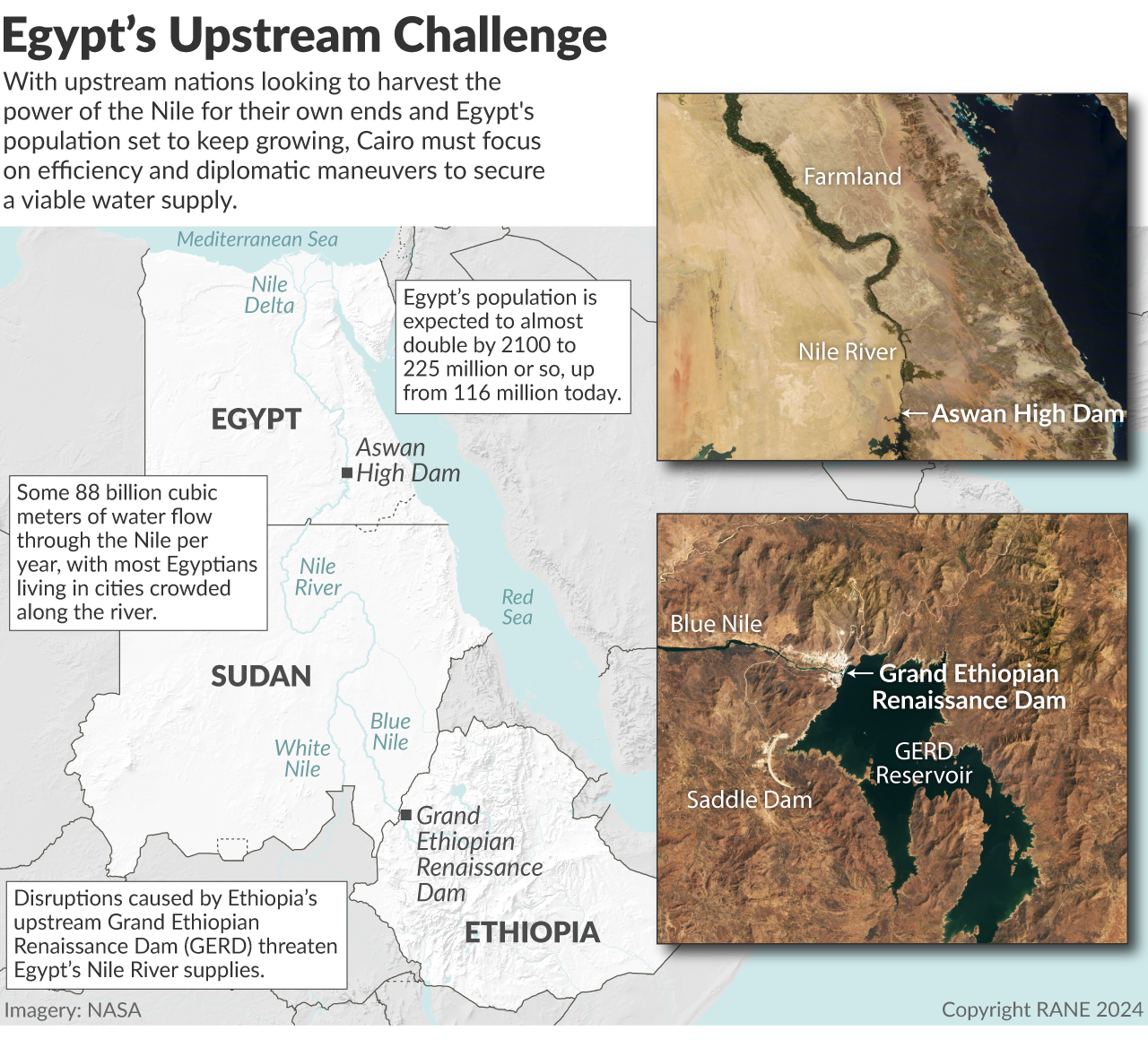
Egypt has few water resources besides the Nile, making the ebb and flow of the river critical to the country's water supply. Egypt is heavily reliant on the Nile River's downstream flows for its available water supply, as its groundwater resources are limited and considered non-renewable, while its annual rainfall needs to be higher to meet the needs of its 111 million people. According to the United Nations, Egypt has received 55 billion cubic meters of water per year from the Nile since 1959, a figure that is increasingly stretched thin by the country's wasteful distribution system and ever-growing population. Disruptions caused by Ethiopia's upstream Grand Ethiopian Renaissance Dam, or GERD, also threaten Egypt's Nile River supplies, which has become a source of diplomatic tension between the two countries. To offset the impact of climate change, Egypt is increasingly trying to attract investment into desalination plants, improve its water distribution systems, promote more efficient agricultural use, and increase the use of treated water and groundwater. As a result of these government initiatives, the country has increased the proportion of its population with access to clean drinking water from 90% in 2015 to 96.9% in 2019. It has also increased its percentage of total wastewater being reused from 50% in 2015 to 68.7% in 2018. Finally, as a last resort, the country's 58 desalination plants can produce up to 440,000 cubic meters of water per day, with another 39 plants under construction.
- Some 88 billion cubic meters of water flow through the Nile per year, with Egypt enjoying the lion's share of its allocation in part because of colonial-era treaties and agreements that were set up by the British Empire.
- Per water per capita for Egypt has dropped dramatically from 1990, from 1,123 cubic meters of water per capita to 492 estimated in 2025, largely as a result of population increases; this figure classifies Egypt as water impoverished.
Though upstream dam projects on the Nile, like Ethiopia's GERD, could threaten Egypt's long-term water supply, Cairo is unlikely to resort to military or covert force as it seeks both a diplomatic solution to the GERD challenge and increased international support for its overall water diversification efforts. GERD and other upstream dams pose potential constraints and water supplies for Egypt, especially if such projects eventually support agriculture instead of hydroelectric generation or if droughts or heat waves force more water to be diverted into their reservoirs to maintain levels needed for electricity generation. But Egypt already faces notable military and diplomatic constraints on a potential campaign to use force to offset this challenge, particularly because much of its equipment is U.S.-made, and the United States is unlikely to support airstrikes or other military actions against Ethiopia; Ethiopia's geographic distance and air defenses also complicate such a mission for the Egyptian Air Force. Meanwhile, in the near term, the GERD is not a direct threat to Egypt's water supplies, as the dam is primarily for electricity generation rather than agriculture, with the already-filled reservoir minimally impacted downstream. Additionally, Egypt can leverage the threat of the GERD to rally Arab, and in particular Gulf Arab, support for Cairo's diplomatic position, a means by which Egypt can also convince these countries to invest in its overall economy and water diversification efforts and to support Egypt as it negotiates new agreements for water usage in the Nile Basin.
- The Ethiopian government said the GERD was reportedly filled in late October 2023, with excess then flowing back into the Nile. As a result, Egypt did not report a marked drop in Nile flows in the summer of 2024 as a result of the GERD's filling. Annual replenishments, like the one that began in July 2024, of the GERD's reservoirs are also unlikely to significantly affect downstream flows, barring historic heat waves or droughts.
- Egypt is pushing for adjustments to the 1959 Nile agreement that might improve its access to water supplies with Sudan, a country in which Gulf Arab countries have substantial influence.
As Egypt seeks new supplies from the Nile River negotiation, it is also likely to focus on further reducing water subsidies and potentially reallocating water supplies from wasteful agricultural practices. Part of Egypt's economic diversification efforts involves modernizing its agricultural practices, including upgrading canals, switching to dripline irrigation and finding other water-efficient methods to improve or maintain yields and reduce the water burden on farmers. In addition, Egypt is already focused on reducing subsidies as part of its International Monetary Fund-recommended economic restructuring — a program that is likely to continue reducing water subsidies for industries and farmers, which will lower the country's overall water use per capita. Nevertheless, these steps may not be enough to address the estimated shortage of 7 billion cubic meters of water. Meanwhile, Ethiopia could decide to build more dams on the Blue Nile as part of its own electrification strategy, which would further constrain Egypt's water supplies. The reduction of water subsidies will also likely spark protests and backlash from the population, forcing the government to either use crackdowns to maintain order or impose more targeted subsidies for affected citizens to offset the standard of living impact.
- Egypt still utilizes premodern flood irrigation techniques, especially along the Nile River. These techniques lose water to evaporation but are accessible to the country's impoverished farmers. An estimated only 6% of total irrigated areas in Egypt use improved modern irrigation techniques.
- Rising sea levels pose another notable threat to Egypt's water supplies by increasing the salination of water in the Nile Delta and harming farming there. The full impact of this dilution will depend on how high sea levels continue to rise and if Egypt can protect the Delta from inundation through infrastructure improvements.
In the case of continued shortages, Egypt's government will likely resort to direct payments to farmers to reduce or halt farming to ensure adequate water supplies for the remaining farmers and urban dwellers. However, this will be an expensive program that will likely require foreign aid, particularly from Western and Gulf Arab partners, in order to sustain itself. In exchange, Western and Gulf Arab partners will likely continue pressing Egypt to further privatize its economy and weaken state influence, particularly that of the military. While this overall trend will likely boost Egypt's economic competitiveness in the long run and increase water efficiency, it will also weaken Egypt's government patronage networks, which are key to maintaining power without resorting to political liberalization. As a result, Egypt's ability to maintain economic and political independence will diminish, increasingly tying Cairo's interests to those of its Western aid donors and Gulf Arab states. This process will likely also reduce Egypt's ability to conduct military operations to destroy Ethiopia's GERD, as both Western and Gulf Arab countries are unlikely to support a military campaign against Ethiopia that could destabilize the Horn of Africa.
Water shortages will likely further erode living standards in Egypt that are overall part of a drag on the country's independence. With no clear way for Egypt to develop water solutions on its own, Cairo will remain reliant on foreign aid and investment to both establish and maintain technologies and investment to improve its water efficiency and meet the demands of its still-growing population. As a result, Egypt will be reliant on these partners abroad to offset the impact of scarcer water, making Cairo less likely to make decisions, both at home and abroad, that go against those partners' interests. Though water scarcity will not be the sole driver towards greater Egyptian dependence on its partners, it will be one ongoing factor and will act as a constraint on Egyptian foreign and domestic policy independence — particularly from Saudi Arabia, the United Arab Emirates and Qatar, all of whom have a history of using investment and aid as a tool to influence their neighbors' policies.
- Though Egypt's fertility rate is declining, the country is expected to almost double in population by 2100 to 225 million or so, up from 116 million today.
- Over the next few decades, rising seas will also further damage the Nile delta and its water supplies, further hampering Egyptian water supplies and making Egypt more dependent on foreign investment to build infrastructure to offset the impact of such sea level change.
