
Editor's Note: This article is part of an ongoing RANE series on the geopolitical impacts of water stress. The first installment of this series provided a broad overview of how the unequal distribution of freshwater shapes geopolitical patterns. Other installments have examined the impacts of water stress on the global economy, Europe, China, the Sahel region of sub-Saharan Africa, Israel, Central Asia, Chile, the Middle East, the Mekong River region, climate investment, India, North Africa, cyberattacks, Egypt and Brazil.
South Asia will increasingly prize the Brahmaputra and Indus rivers as demographic and economic growth heighten regional water demand and intensify geopolitical rivalries, portending more severe diplomatic tensions and instability in the region over the coming years. Water insecurity remains a distinct challenge in Asia; despite the continent being home to 60% of the global population and projected to see some two-thirds of the world's population growth over the coming decade, it only has around 3,920 cubic meters of freshwater per person per year, less than any other continent besides Antarctica. This issue is particularly keen in South Asia, with the World Resources Institute categorizing 74% of the region as exposed to "extremely high water stress," which the institute defines as countries regularly using up almost their entire available water supply. Population growth and economic development have only intensified regional competition over the usage of major waterways, especially with India experiencing years of strong economic growth and overtaking China as the world's most populous country in 2023 — a distinction India is expected to maintain for another quarter century. These pressures, in combination with simmering rivalries between China and India as well as India and Pakistan, are raising risks of water-related conflict in South Asia and the broader region.
The Brahmaputra River is a major transboundary river in South Asia, and India and China increasingly value it as an untapped source of hydroelectric power and strategic advantage. Given the Brahmaputra flows through parts of northeast India that receive some of the highest amounts of rainfall in the world, it is only modestly important as a source of irrigation to local communities. For India, the river's greater value lies as a major transportation route to and from the country's northeast and its potential as a source of hydroelectric power for northeastern states, whose development has lagged compared with the rest of the country. In recent years, this has driven tensions with neighboring China, which has also increasingly valued the river's potential hydroelectric capacity, prompting Beijing to announce in 2021 that it intended to build the world's first "super dam" upstream at the river's Great Bend in Tibet. China has justified such major damming projects as necessary for the country to achieve its climate goals as a global leader in manufacturing and energy consumption. However, China's announcement of the project came amid a major flare-up in its long-standing territorial dispute with India, which only deepened in subsequent years as both sides doubled down on developing military and civilian infrastructure along their border. Thus, alongside China's capacity to harness hydroelectric power from the Brahmaputra to support its economic growth, India has become increasingly concerned about China's use of the planned super dam to bolster its territorial claims in the disputed region — especially since such projects typically require establishing or bolstering territorial control in nearby areas to support construction.
- Though India-China relations have ebbed and flowed amid their decades-long territorial dispute, bilateral relations severely worsened in 2020-21 following a series of deadly border clashes between the two countries' troops. The most severe clash took place in June 2020 in the Galwan River Valley, where China reportedly had set up tents and observation posts that it claimed aligned with its agreements with India, but which India argued were illegally built on its side of the de-facto border. Indian soldiers on patrol later discovered the tents and set them on fire, which triggered a melee involving fistfights, iron rods, and nail- and barbed wire-laden clubs, ultimately killing at least 20 Indian and four Chinese soldiers while wounding dozens of others.
- China's planned super dam will reportedly produce up to 60 gigawatts of power, far overshadowing China's Three Gorges dam, which is currently the largest hydroelectric project in the world with an installed capacity of 22.5 gigawatts.
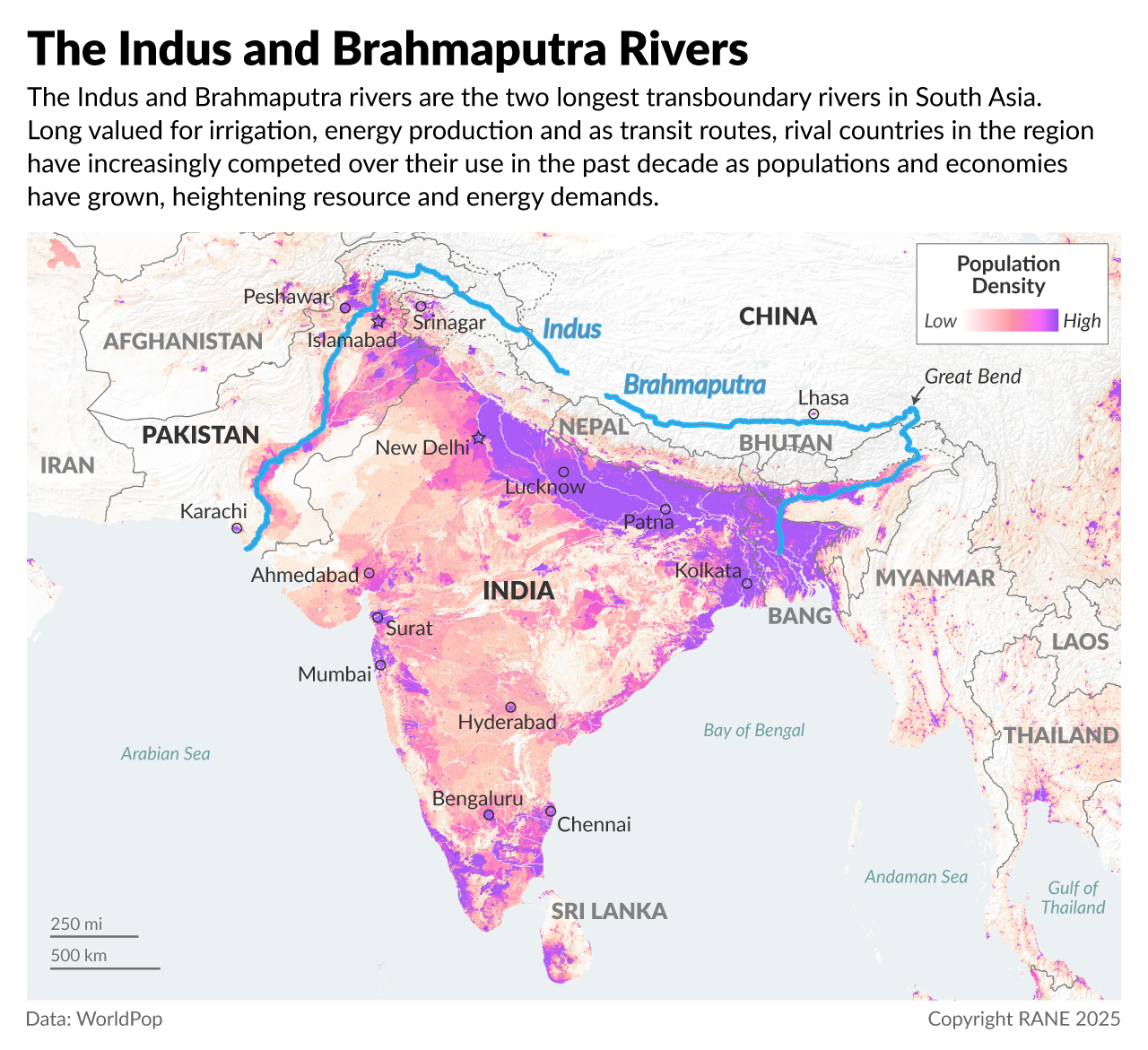
Over the coming years, India and China's continuing rivalry will bolster the Brahmaputra's importance as a source of power, while the two sides' unresolved border dispute will increasingly situate the river as an arena through which to legitimize and even defend territorial claims, particularly during high bilateral tensions. The Brahmaputra's value as an irrigation source probably will remain limited, as climate projections suggest much of northeast India will continue to see significant rainfall, with precipitation in parts of the region likely even intensifying. As a result, the river will continue to grow in importance as a source of power to support India's and China's economic development and as a place where the two countries will strengthen their respective territorial claims. Though tensions along the border have eased modestly since India and China signed a breakthrough border patrolling agreement in October 2024, their mistrust for each other remains deep, and they appear far from resolving their decades-long territorial dispute. Beyond legitimizing territorial claims, China's advantageous position upstream will enable it to influence the timing of water flows, which the country may use to defend its claims by threatening or unleashing floods on downstream northeast Indian communities during periods of high tension or even conflict with India. China has already triggered flood events along the Mekong River in East Asia through unexpected releases at its Dachaoshan and Nuozhadu dams, which caused river levels to surge and inflicted widespread damage on downstream communities. China's planned super dam upstream of the Brahmaputra would enable it to present a similar threat to Indian military positions along parts of the disputed border in addition to downstream communities. The long-standing absence of any formal transboundary water agreements and accompanying dispute resolution mechanisms between India and China will exacerbate the likelihood that the Brahmaputra becomes another flashpoint for diplomatic tension and potential conflict between the two rivals.
- China's planned super dam has already driven India to plan its own hydroelectric projects along the Brahmaputra in its claimed territories. In July 2024, Reuters reported the country intends to spend some $1 billion to accelerate the construction of 12 hydropower projects in the northeastern state of Arunachal Pradesh. Months later, in November 2024, the government formally approved the construction of two such projects worth around $435,000.
- Though China and India shared water data related to the Brahmaputra from 2002-23, China occasionally has withheld critical hydrological information from India during periods of high bilateral tensions, including during the 2017 and 2020 flood seasons. Though the two sides are reportedly in the process of renewing the agreement, reports on the progress of these efforts have been scant.
The Indus River is another major transboundary waterway in the region, and while the Indus Waters Treaty has facilitated decades of relatively peaceful water-sharing between India and Pakistan, intensifying demands for water use are threatening this stability. India and Pakistan signed the Indus Waters Treaty in September 1960, giving India unrestricted use of the "eastern rivers" of Sutlej, Beas and Ravi, while granting Pakistan use of the "western rivers" of Indus, Jhelum and Chenab; India is also allowed to use the western rivers, but for strictly limited purposes that must not significantly disrupt or alter water flow to Pakistan. Though the Indus Waters Treaty has successfully mitigated the threat of India-Pakistan water conflict for decades, disagreements have arisen since the turn of the century as both countries' populations and demand for energy and water have grown. India has argued that the eastern rivers it controls make up only around 20% of the total water of the Indus River system, which alongside significant environmental, demographic and economic changes that have transpired since the treaty's signing in 1960, warrants a renegotiation of the treaty's terms to grant New Delhi greater flexibility in using the western rivers. Meanwhile, Pakistan's location downstream has made it sensitive to India's growing use of the western rivers, particularly for hydroelectric projects. Pakistan claims some of these projects violate India's treaty obligations to allow the western rivers to flow unimpeded, and Islamabad has used these arguments and the treaty's dispute mechanisms to help stall India's hydropower projects. Tensions linked to the dispute have risen in recent years, during which India has sent Pakistan four formal requests to reassess the treaty's obligations, marking the greatest challenge to the agreement since its inception.
- India's efforts to modify the Indus Waters Treaty have included making its demands through the Permanent Indus Commission, the formal entity tasked with implementing the treaty, in addition to threatening to disregard rulings by arbiters disfavorable to its interests. However, these efforts have thus far failed to secure New Delhi the more flexible water usage it is pursuing.
Mistrust and the challenges of renegotiating the treaty suggest neither side will agree to modify it in the near term, and rising demand for water will heighten bilateral tensions and fuel greater instability between India and Pakistan over the coming years. Though India and Pakistan have become increasingly dissatisfied with certain parts of the treaty, the two countries' contentious history and persisting rivalry continue to incentivize both to prioritize domestic political interests and remain uncompromising. This suggests both sides are unlikely to agree to renegotiate their water treaty in the near term, especially since a new bilateral agreement would probably be less satisfactory than the current one, which for all its alleged faults has proven to be a surprisingly resilient and stabilizing force. That India has yet to detail the specific changes it seeks to make and that Pakistan has not formally put forth its own request to renegotiate the treaty's terms may also indicate some level of begrudging acceptance that suggests the treaty will remain intact in the near term. However, demographic growth and economic interests will continue to heighten water demand over the coming years for such things as power generation and irrigation, particularly for India. Eventually, the severity of these demands probably will prompt India to undertake more assertive efforts to secure more flexible use of the western rivers using all available dispute and mediation mechanisms linked to the Indus Waters Treaty. Should these efforts fail or otherwise fall short of realizing India's demands, India may consider abrogating the agreement to secure its needs. Such an escalation would worsen bilateral relations, threatening diplomatic spats involving punitive measures or, more severely, the weakening of agreements like the tenuous 2021 bilateral ceasefire that for years has limited skirmishes along the two countries' border. And though both sides would remain incentivized to avoid outright conflict and the costs thereof, India and Pakistan could intensify covert activity and other efforts to destabilize each other. Such a scenario would mark a new era of Indian and Pakistani relations in which the Indus Waters Treaty is no longer a stabilizing force but rather another flashpoint for confrontation.
- In September 2016, after Pakistan-based militants attacked an Indian army base in Kashmir, India considered using its upstream advantage to retaliate against Pakistan. Reportedly, Prime Minister Narendra Modi told other Indian officials that "Blood and water cannot flow simultaneously," and officials discussed various options for India to use as much water as it could under the terms of the treaty at Pakistan's expense. India ultimately opted to suspend the meetings of the Permanent Indus Commission, which is responsible for implementing the provisions of the Indus Waters Treaty.
