
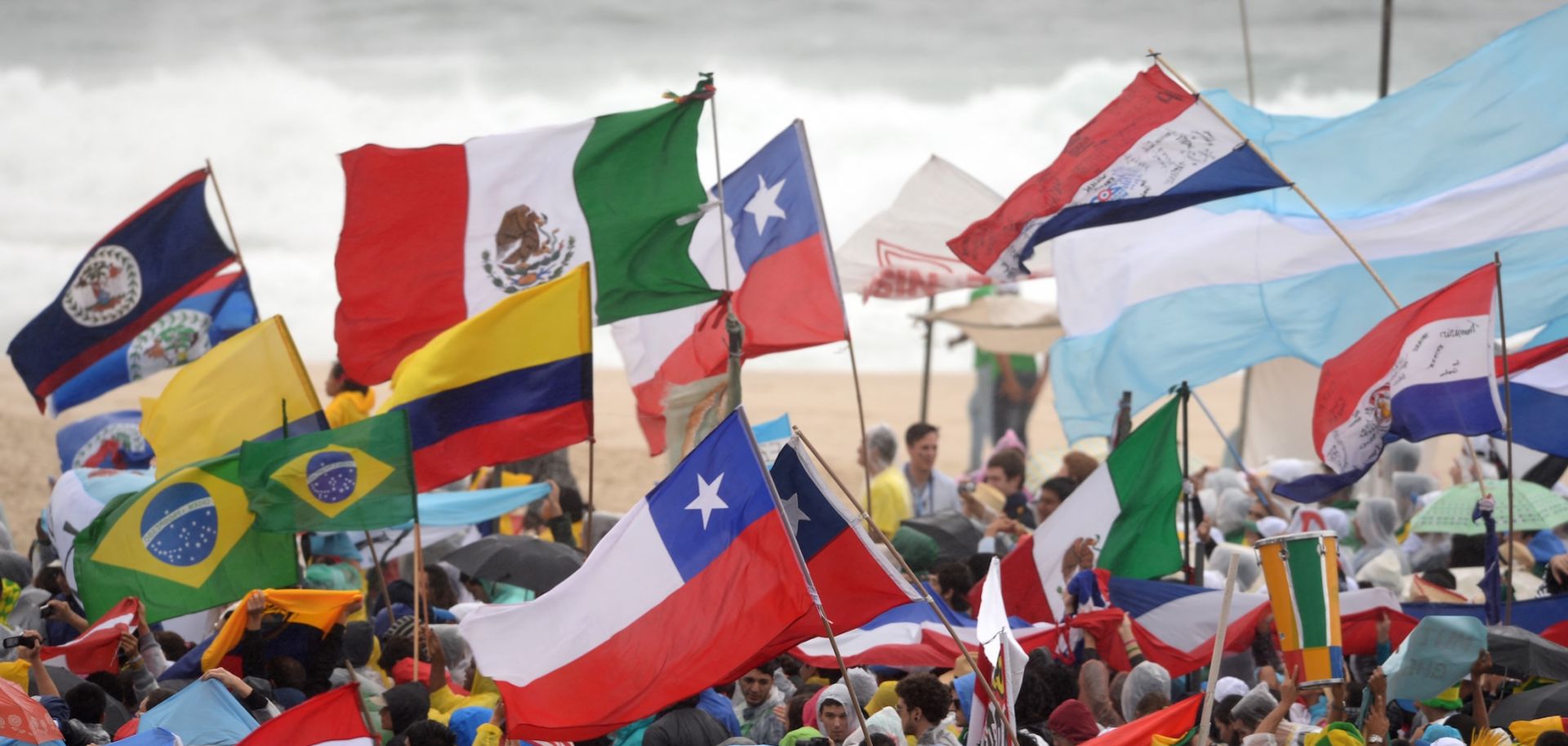
Pilgrims with flags from different countries gather at Copacabana beach in Rio de Janeiro, Brazil, on July 23, 2013, as they wait for the official opening of the Catholic Church's World Youth Day, which will be celebrated with a holy Mass.
(TASSO MARCELO/AFP via Getty Images)
Pilgrims with flags from different countries gather at Copacabana beach in Rio de Janeiro, Brazil, on July 23, 2013, as they wait for the official opening of the Catholic Church's World Youth Day, which will be celebrated with a holy Mass.

South America's rightward political shift will deepen countries' security cooperation with the United States and attract selective U.S. private investment to strategic sectors, but it will not result in a larger supply chain realignment. Since late 2023, pro-business governments have taken office in Argentina, Bolivia, Chile and Ecuador, and still others will take office in the coming weeks in Peru and Colombia. Although commonly referred to as part of a single right-wing shift, these administrations do not share a single ideology, nor are they part of a unified regional movement, as they differ on economic doctrine, the pace of reform and social policy. Still, these governments have similar pro-business agendas, back stricter security policies and are in broad alignment with U.S. President Donald Trump's administration. In addition to ideological affinity with Washington, these governments all came to power in part due to voters' demands for stricter security measures, which align with the White House's prioritization of a militarized fight against drug trafficking in the region. That convergence has so far resulted in the U.S.-led Shield of the Americas coalition and increased security cooperation. To further consolidate U.S. predominance in the Western Hemisphere, the White House also aims to secure strategic supply chains and reduce Chinese influence in the region

  • Popular discontent over organized crime, weak economic growth, poor public services and widespread corruption in South American countries has generated anti-incumbent sentiment and favored right-wing candidates who prioritize heavy-handed security policies, deregulation, private investment and pledges to tackle graft.
  • In line with its 2025 National Security Strategy, the U.S. government launched the Shield of the Americas initiative on March 7. This regional coalition intends to take a more militarized stance against drug trafficking, cooperate on developing critical supply chains and deter Chinese influence.
  • Alongside its ongoing maritime strike campaign against alleged narcotrafficking vessels in the Caribbean Sea and the eastern Pacific Ocean, the U.S. military has increased cooperation with Mexican security forces and carried out joint kinetic strikes targeting cartel leaders in Ecuador and Venezuela. It is also boosting security cooperation with other regional governments.

South American security cooperation with the United States will likely expand from anti-drug trafficking measures into a framework encompassing financial intelligence and other steps that introduce new compliance risks for companies, although other global priorities could shift the U.S. focus away from the region. A militarized campaign against drug trafficking will be the most visible aspect of regional security cooperation, including joint operations and an escalation to occasional coordinated strikes against cartels. This will be the starting point of a broader regional framework to tackle growing insecurity and safety threats to businesses. As transnational criminal organizations become more sophisticated and infiltrate legal economies, governments across the region will likely deepen intelligence sharing, military cooperation and law enforcement coordination. These efforts would be even more impactful if they were concentrated within U.S.-led initiatives, such as the Shield of the Americas, which would facilitate operational coordination, rather than being left to regional governments to carry out on an ad hoc or more bilateral basis. As part of security forces' efforts to weaken criminal groups' revenue streams, government initiatives will likely increasingly scrutinize industries with growing criminal infiltration, such as logistics, mining and the financial sector. As a result, counter-crime efforts will progressively incorporate financial intelligence to effectively map and curb money flows and sophisticated schemes involving shell companies and crypto currencies for money laundering purposes. Such a focus will likely increase sanctions and other compliance risks for companies linked to criminal organizations, even if unwittingly. These risks will be especially high in sectors with strong cartel infiltration, from fuel distribution and construction to logistics and financial services. That said, regional security cooperation and U.S. focus on the Western Hemisphere will depend in part on broader global security dynamics, particularly the conflict with Iran, as prolonged U.S. military focus elsewhere would likely divert resources and attention away from South American security concerns.

  • In November 2025, the United States announced Operation Southern Spear, a military and counter-narcoterrorism campaign. The operation encompasses U.S. strikes on alleged drug trafficking vessels in the Caribbean and eastern Pacific, killing 221 people since September 2025.
  • The Trump administration has designated several regional cartels as Foreign Terrorist Organizations and Specially Designated Global Terrorists since February 2025.
  • Washington's militarized approach will likely lead to unilateral U.S. operations in countries where a lack of ideological affinity prevents joint military action and/or sufficient local government concessions to meet U.S. demands. These operations are most likely in Cuba and Mexico amid Washington's efforts to weaken regional leftist autocracies and cartel activities, respectively. Such operations, especially if recurrent (such as repeated airstrikes against cartel targets in Mexico) or large-scale (such as a significant intervention in Cuba) could introduce significant friction with regional governments, especially leftist ones, though they likely would offer only light rhetorical pushback. More ideologically aligned administrations would likely endorse these operations.

Washington will increasingly engage with ideologically aligned South American governments on geopolitical goals, which could create a positive environment for U.S. companies on strategic projects but will not result in a structural realignment of regional supply chains. The Trump administration's rhetoric around strengthening regional supply chains to secure critical raw materials and de-risk its reliance on China will likely increase U.S. engagement with ideologically aligned South American countries on strategic projects, ranging from physical and digital infrastructure development to raw materials sourcing. In turn, those governments will likely pursue investor-friendly reforms to improve the broader business environment, reducing obstacles for private sector players and ultimately creating a more favorable environment for U.S. companies while also increasing scrutiny of Chinese counterparts. That said, the region will likely remain primarily a supplier of regular commodities, as it offers only a few critical inputs for U.S. strategic sectors that the United States cannot access elsewhere, with niobium being the main exception. Moreover, as opposed to other places such as Mexico, Central America or Southeast Asia, South America is not embedded in manufacturing supply chains connected to the U.S. market and has limited potential to be quickly incorporated into U.S. supply chains and replace existing suppliers, given structural bottlenecks.

  • South America's exports to the United States are concentrated in crude oil, raw or lightly processed commodities (such as copper and semi-finished iron and steel), and agricultural goods.
  • Ideologically aligned governments will likely step up screening of investments and strategic projects tied to China, likely prioritizing U.S. or Western companies in new concessions and procurement amid U.S. pressure to deter Beijing's influence in sensitive projects, especially in the defense, critical minerals, telecoms and logistics sectors.
  • The main critical inputs the United States sources from South America are niobium (as Brazil holds more than 90% of world reserves and production), some high-grade copper (mostly from Chile and Peru) and lithium (concentrated in Argentina, Bolivia and Chile). 

While the region's rightward political shift creates favorable conditions for U.S. investment, domestic constraints in South American countries and the prospect of future political changes will temper investor appetite, as market fundamentals are likely to outweigh geopolitical alignment in business decisions. Political convergence is unlikely to result in large-scale industrial or investment shifts, as business decisions will likely continue to be primarily driven by project economics, long-term regulatory predictability and country-specific risks, rather than geopolitical alignment alone. Moreover, alignment or cooperation with the United States will not address structural bottlenecks in South American countries, such as governments' limited policy implementation capacity, institutional weaknesses, infrastructure deficiencies, permitting delays and corruption, which will continue to curb the region's attractiveness as an investment destination. The political shift is also unlikely to produce a uniform regulatory framework across the region, given significant differences in implementation across geographies. Governments that combine political alignment with regulatory stability, institutional credibility and implementation capacity will likely capture a larger share of U.S. capital. By contrast, administrations constrained by legislative fragmentation, political and regulatory uncertainty or weak state capacity will struggle to convert geopolitical alignment into sustained investment. Long-term political uncertainty will also be a constraint, as many of the reforms underpinning South America's current pro-investment shift rely on executive decisions rather than on constitutional changes supported by broad political consensus, increasing the risk that future administrations will partially reverse them. This dynamic is especially important because large investments required to reshape supply chain dynamics would take decades and certainly outlast the current right-wing political shift. 

  • While market-friendly measures may improve the business environment over the coming years, companies' investment decisions will remain primarily driven by commercial fundamentals and market conditions, including commodity prices, exchange rates, interest rates, inflation, demand growth, access to financing, operating costs, logistics and infrastructure constraints, labor availability, tax systems and regulatory predictability.

Domestic political, regulatory and security conditions will shape how investment opportunities in the oil and gas and mining sectors unfold across different South American countries, with reliance on China leaving agriculture as an exception to the broader trend. While countries currently under or transitioning to right-wing rule will seek to facilitate U.S. private sector investment in strategic sectors, opportunities are also likely to emerge in countries under leftist governments that implement market-oriented reforms and improve their investment climates. That is especially the case in Brazil, given the size of its economy and vast natural resources, which will keep the country a key investment destination. In the oil and gas sector, Argentina and Guyana will likely remain top destinations for investment due to their large oil reserves, as well as Buenos Aires' pro-business shifts and Georgetown's stable political outlook. Colombia's new government will draw private sector interest by lifting extraction bans, despite regulatory uncertainty driven by limited legislative support. By contrast, sanctions risks, degraded infrastructure and political instability will keep investment in Venezuela gradual despite the sector's reopening under U.S. tutelage. Meanwhile, Brazil will either further open the sector to private players or continue to use state-owned Petrobras as a policymaking tool, depending on the results of its October 2026 election. Regarding mining, Argentina and Chile will consolidate their roles among the region's most attractive mining investment destinations, while Peru will remain a key copper provider regardless of political instability, social unrest risks and illegal mining. Criminal control of mining areas will also be a constraint in Venezuela, while legal uncertainty and community opposition will remain major hurdles in Bolivia and Ecuador. In Brazil, a right-wing government would push for bilateral deals with Washington, while a leftist administration would prioritize technology transfers or investment in processing capacity. The agriculture sector is an outlier, as the United States competes with South America for market share, rather than functioning as a primary buyer, a role that China plays for most countries. This dynamic will weaken U.S. investment opportunities in the sector, highlighting the limits of geopolitical alignment in reshaping regional trade patterns.

  • Guyana produces roughly 926,550 barrels of oil per day and targets 1.7 million barrels per day by 2030. Argentine crude hit a record high of almost 881,809 barrels per day in April 2026, with Vaca Muerta supplying more than 70%.
  • Chile and Peru are the world's largest and third-largest copper producers, respectively, together accounting for roughly a third of global output. Meanwhile, the "lithium triangle," comprising Argentina, Bolivia and Chile, holds roughly 60% of the world's identified lithium resources, making it the world's largest concentration of the metal.
  • Argentina's Incentive Regime for Large Investments, enacted in 2024, offers 30-year fiscal, customs and foreign exchange stability to projects above $200 million, along with reduced corporate income tax, export duty exemptions and access to international arbitration.
  • Brazil will hold a general election in October, with leftist President Luiz Inacio Lula da Silva running for a fourth nonconsecutive term against right-wing Sen. Flavio Bolsonaro, the eldest son of former President Jair Bolsonaro. As of mid-July, polls put Lula with a multi-point lead over Flavio Bolsonaro in an expected runoff election, assuming neither candidate secures more than 50% of the vote in the first round.
RANE
SUBSCRIBERS ONLY

Expert analysis when it matters most.

Get access to RANE's decision-grade geopolitical intelligence.