
The United States will boost defense and economic cooperation, leverage development finance and make military and economic threats to pressure Latin American governments to favor U.S. interests and counter China, but outcomes will vary depending on their economic reliance and ideological affinity with Washington. On March 7, U.S. President Donald Trump hosted 12 ideologically aligned Latin American leaders at the "Shield of the Americas" summit in Florida. The event created a coalition to fight drug trafficking with military means and counter "hostile foreign influence" in the Western Hemisphere. It marked a new step in Washington's efforts to formally establish U.S. primacy in the region by limiting rivals' influence (especially from China, Russia and Iran), rewarding aligned governments, expanding security partnerships and securing U.S. firms' access to critical material supply chains. The summit was the latest example of the White House's enforcement of a "Trump Corollary" to the Monroe Doctrine (dubbed the "Donroe Doctrine"), as outlined in the U.S. 2025 National Security Strategy. The policy aims to fight cartels and illegal migration, weaken leftist autocracies and ensure that U.S. business interests prevail in strategic sectors. While not a formal economic program, the Shield of the Americas initiative also has economic components that include development financing focused on strategic supply chains, including critical minerals.
- Heads of state from Argentina, Bolivia, Costa Rica, the Dominican Republic, Ecuador, El Salvador, Guyana, Honduras, Panama, Paraguay and Trinidad and Tobago attended the event, as did Chile's then president-elect.
- During the event, Trump suggested the United States could use missiles against cartels upon partners' request.
- The U.S. National Security Strategy established a "Peace through Strength" framework that emphasizes "strategic energy dominance" and denying non-Hemispheric competitors the ability to position forces and other threatening capabilities or own or control strategically vital assets in the Hemisphere.
The Trump administration has sought to expand U.S. influence across Latin America with military action, diplomatic pressure and economic coercion. Upon taking office in January 2025, the Trump administration designated several Latin American drug cartels as Foreign Terrorist Organizations and Specially Designated Global Terrorists — and is reportedly aiming to expand both lists. On the military front, the ongoing Operation Southern Spear has resulted in 47 confirmed strikes on alleged drug trafficking boats in the Caribbean Sea and eastern Pacific Ocean, killing at least 163 people. Other actions have also represented a significant escalation of military activity in the region, including the capture of then-Venezuelan President Nicolas Maduro in January, intelligence-sharing that led Mexico to kill a major cartel leader in February and logistical support for an Ecuadorian military operation to bomb an alleged narcotrafficking base in March. On the diplomatic front, Washington's pressure on Panama around Chinese-operated ports and an ongoing campaign to block Huawei from setting up and running 5G networks in the region are among the most prominent examples of this strategy. The Trump administration has also canceled visas of government officials involved in policies it disagrees with and expressed public support for ideologically aligned presidential candidates in Honduras and Chile. On the economic front, the United States imposed 40% tariffs for several months on Brazil over its domestic politics. Washington also threatened duties on Colombia over disagreements on migration policy.
- On March 17, a top Pentagon official told U.S. legislators that the military campaign targeting drug trafficking boats and drug cartels in Latin America was "just the beginning," leaving open the possibility of deploying ground forces to the region, which Trump and other top U.S. officials have repeatedly threatened.
- After months of U.S. pressure and Trump's threats to "take back" the Panama Canal, the country's Supreme Court in January annulled the contracts a subsidiary of Hong Kong-based CK Hutchison had to operate two ports on both sides of the waterway. Panama has also announced its decision to withdraw from Beijing's Belt and Road Initiative (BRI).
- The United States has restricted the visas of Chilean government members involved in a submarine cable project with China, Brazilian judges responsible for the trial of former far-right President Jair Bolsonaro and healthcare officials from various countries responsible for a medical partnership with Cuba.
The United States will likely intensify military cooperation with friendly governments and threaten unilateral action in other cases to fight cartels and, in the long term, make countries in the region more dependent on Washington for security and defense. The United States is likely to expand security cooperation across Latin America, as both a counternarcotics strategy and a geopolitical instrument to strengthen its influence. This will likely take the form of deeper intelligence-sharing, military training, joint operations and expanded access to bases and logistical facilities across several countries. The Trump administration is also likely to leverage its military and intelligence superiority and most local governments' comparatively poor resources, equipment and expertise to establish new security frameworks and expand its military presence and activity across the Western Hemisphere. In that regard, the Shield of the Americas initiative could evolve into a broad and military-oriented version of past U.S.-backed initiatives, such as Plan Colombia, or at least provide Washington with a framework to carry out joint operations targeting cartel assets or activities in coalition countries. Initially, the U.S. military will likely seek to work in coordination with these countries' security forces. This will be especially likely in smaller and violent countries, such as Ecuador (where this is already happening), Guatemala, Haiti, Honduras and Trinidad and Tobago. However, the Trump administration could threaten and occasionally carry out unilateral strikes, bypassing national sovereignty in areas dominated by drug trafficking groups, such as the Colombia-Venezuela border, the Amazon or, as repeatedly threatened, Mexico, especially in the border area. Under this strategy, regional governments would also grow increasingly integrated into U.S.-led security intelligence, technology and operational support frameworks over the coming years. That, combined with further U.S. diplomatic and economic pressure, would also limit the extent to which Latin American armed forces make defense purchases with U.S. rivals like China or Russia, helping Washington advance its objective of exerting a prominent role in the Western Hemisphere. Still, most countries will face strategic, budgetary and interoperability constraints that will prevent a sudden shift to U.S. military supplies and technology that fully replaces existing kit from other countries.
- Plan Colombia was a U.S.-funded bilateral initiative launched in 2000 to combat drug trafficking, reduce violence and strengthen the Colombian state. The program focused on expanding Colombia's military capacity to fight guerrilla groups and included aerial eradication of coca crops. It remained a central framework for U.S.-Colombia security cooperation until 2015.
- Washington will likely pressure regional governments to avoid closing deals for cheaper military equipment, local manufacturing or technology transfers with Chinese state-owned defense firms. Norinco, AVIC and CETC have sold aircraft, armored vehicles, radars and small arms to some Latin American countries, especially Venezuela, Bolivia and Ecuador under leftist governments. Today, however, Venezuela is under significant U.S. pressure, while Bolivia and Ecuador are both run by Trump-friendly leaders.
- The higher cost of U.S. defense equipment compared to Chinese and Russian weapons, legacy systems constraints and strategic concerns over becoming overly reliant on Washington will limit the incentives for Latin American countries to redesign their entire defense architecture around U.S. interests.
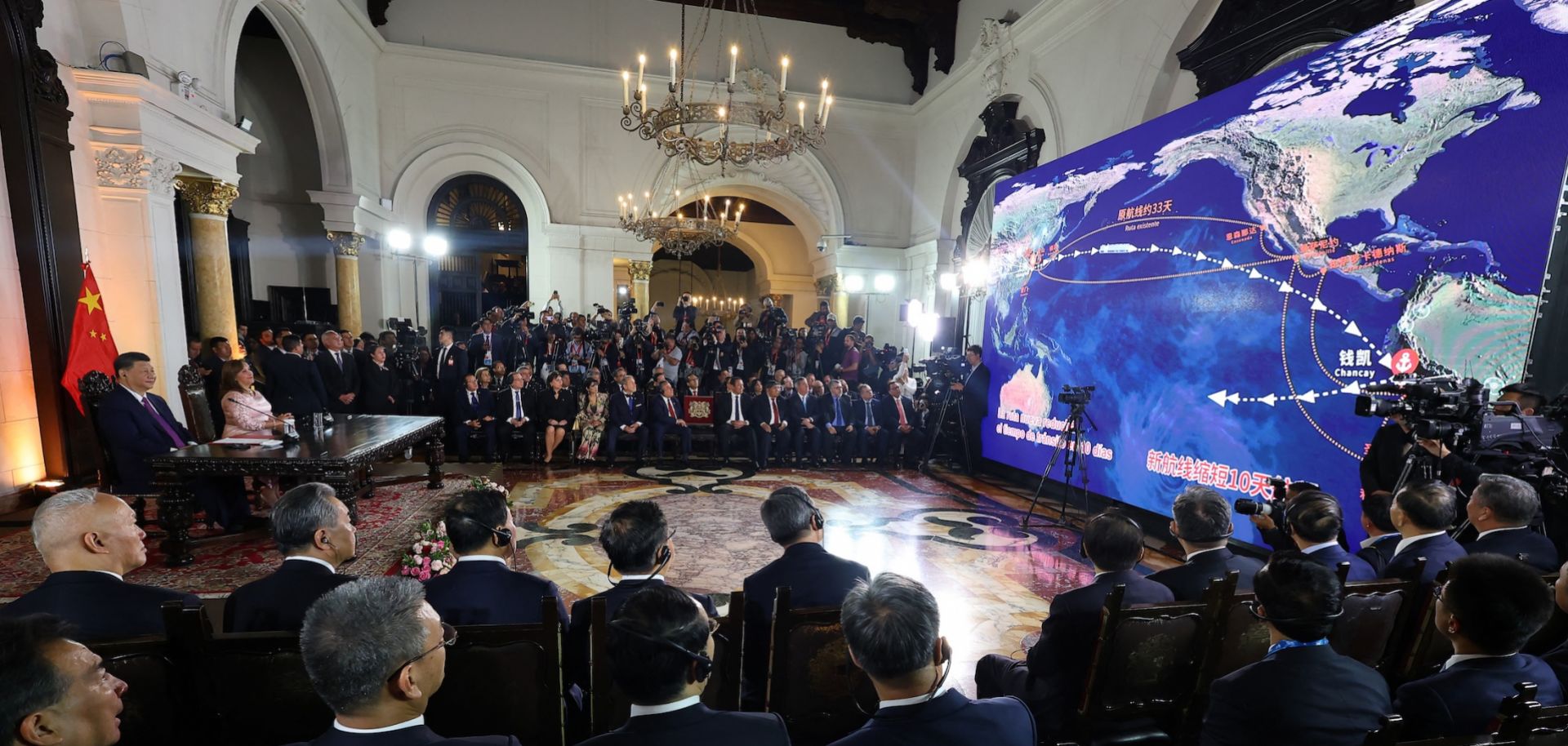
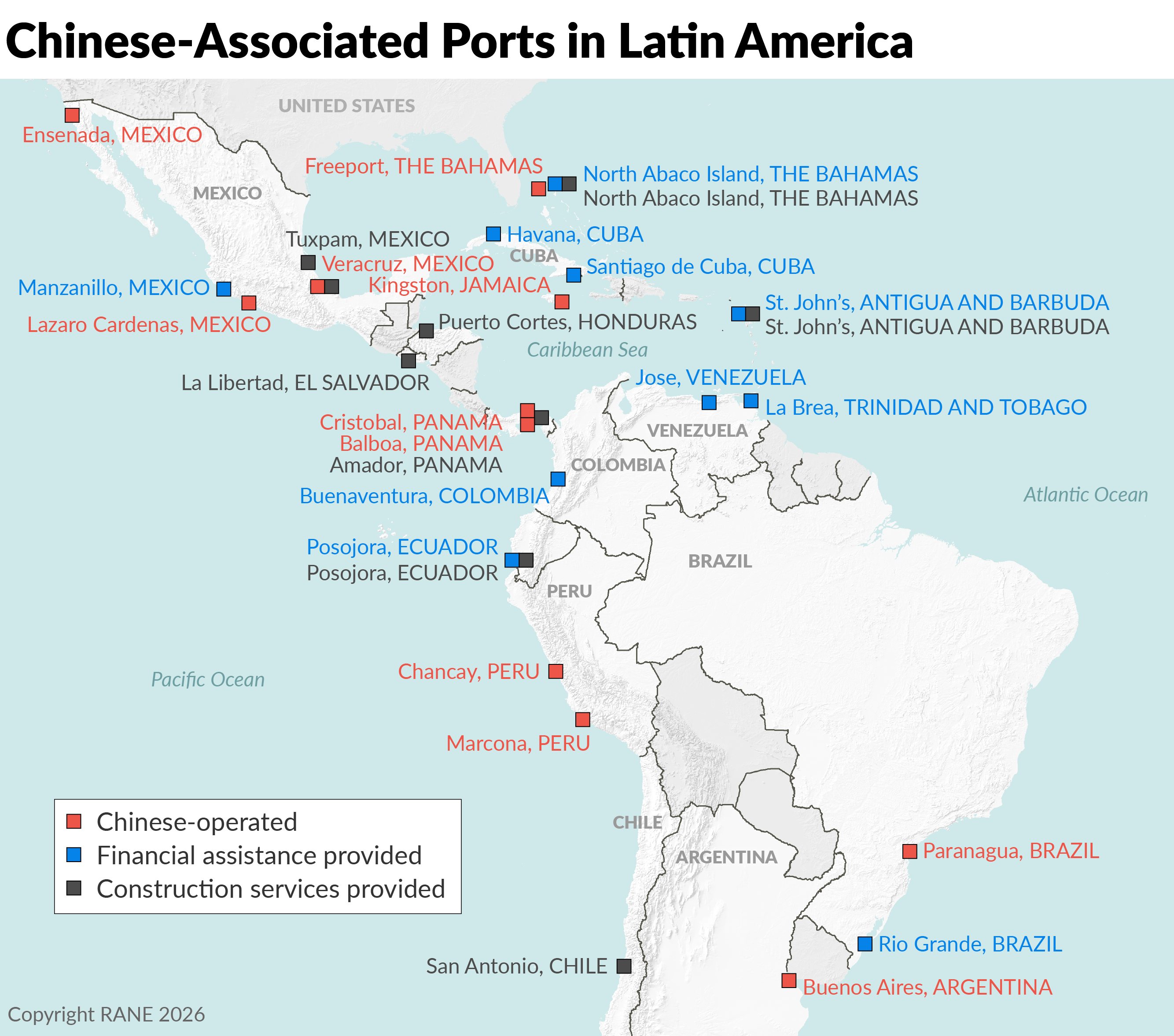
Through penalties and incentives, the United States will likely pressure countries in the region to favor U.S. interests in strategic sectors as a means to counter or deter China's influence. Washington will likely adopt a strategy that combines economic threats, visa restrictions, criminal investigations and diplomatic pressure with investment incentives and preferential access (such as trade deals with reduced tariffs) to coerce or obtain economic or business concessions in Latin America, particularly in smaller states more dependent on U.S. ties. The U.S. government will likely use these tools to influence and shape project design, partners and governance standards, aiming to curb China's presence in strategic sectors. Maritime logistics will be a major focus area given the sector's geopolitical and economic importance and U.S. claims of China's potential military dual-use of port facilities, which would also pose security concerns for Washington. The United States will likely intensify public criticism of Chinese ownership or operation of major ports or terminals (as seen in Panama, Peru and Brazil) or pressure authorities to exclude Chinese competitors, which often outbid Western counterparts in strategic bidding tenders. In the telecommunications sector, the Shield of the Americas is likely to revive or expand the 2020 Clean Network initiative, which explicitly seeks to exclude "high-risk vendors" (especially Huawei and ZTE) from 5G and data infrastructure across Latin America. U.S. pressure is also likely to extend to other areas, including submarine cables, fiber-optic and broadband networks, video-surveillance systems, data centers and digital ecosystems. The same applies to satellite and space cooperation projects, which the United States claims could become dual-use facilities, such as the Deep Space (Espacio Lejano) satellite station in Argentina. In these cases, Washington could pressure governments with visa restrictions or economic measures (ranging from tariff threats to export controls and financial penalties), which will likely serve as an example and curb some Latin American countries' appetite to develop joint projects with China. In extreme cases, U.S. pressure could lead to the suspension or cancellation of projects.
- In November 2025, the White House announced Agreements on Reciprocal Trade and Investment (ARTs) with Argentina, Ecuador, El Salvador and Guatemala. The deals were designed to "rebalance" trade deficits while ensuring regulatory convergence. They also encompassed national security cooperation elements designed to re-anchor partner economies into U.S.-aligned regulatory and supply chain ecosystems. Their provisions include a commitment to prioritize the United States in critical minerals over "non-market economies" (namely China) and alignment with U.S. sanctions and export controls.
- In recent months, U.S. diplomats have warned Peru that the Chinese-built and operated Chancay megaport, inaugurated in November, undermines the country's sovereignty. In January, the United States approved a $1.5 billion plan to support the modernization and relocation of a major Peruvian naval base located 50 miles south of the megaport. In March, a U.S. consul stated that a Chinese firm should not win an upcoming auction for a megaterminal in Brazil's largest port in Santos.
- Huawei has a deeply established presence across Latin America, supplying core infrastructure in major markets such as Brazil, Mexico, Chile, Peru and Colombia. Most Latin American countries continue to allow Huawei in their 5G networks, making the region one of its largest and least restrictive global strongholds.
- On Feb. 20, Washington restricted visas for Chilean officials involved in the Chile-China Express (CCE), a project to build a nearly 20,000-kilometer submarine fiber-optic cable intended to connect Valparaiso with Hong Kong.
The U.S. government will likely leverage its influence over multilateral institutions and development financing tools to advance its geopolitical objectives, particularly countering China's regional influence. The United States will increasingly use government agencies, such as the International Development Finance Corporation (DFC) and the Export-Import Bank, to offer loans, guarantees and refinancing packages with geopolitical conditions. These institutions will underpin Project Vault, Washington's $12 billion public-private partnership to establish a Strategic Critical Minerals Reserve. As critical minerals gain strategic importance beyond energy transition goals and become a cornerstone of the defense, aerospace and advanced technology sectors, mining companies operating in the region will likely face increased U.S. scrutiny over M&A transactions, suppliers or export destinations. As the United States aims to secure supply chains and reduce its reliance on China, especially in the supply and refining of critical minerals, financing is likely to become increasingly tied to limiting involvement with Chinese entities, as in the case of Brazil's sole rare earths mine this year. Washington will likely condition increased funds and better financial terms on companies decoupling from Chinese supply chains. Governments that are likely to close bilateral mining deals with the United States over the coming years (such as Argentina, Bolivia, Brazil, Chile and Peru) are also likely to face such pressure. The United States is likely to leverage its influence over multilateral institutions, such as the World Bank, International Monetary Fund and Inter-American Development Bank, to prioritize projects aligned with its interests or benefit allied countries with more advantageous terms, as it did with Argentina in 2025. That could benefit ongoing IMF negotiations with Bolivia, should newly inaugurated President Rodrigo Paz continue to realign the country toward Washington, even though a $20 billion swap line like the one provided to Buenos Aires is unlikely to be offered to other countries, given its risk and scale. Still, China-linked investments tend to be larger in volume than those outlined by the U.S. government and do not include preconditions. Beijing is therefore likely to be able to leverage public funds, state-owned firms and public banks to outspend Washington in Latin America should it wish to do so, even though this would require a shift in China's current investment focus.
- In 2021, the DFC announced a framework to refinance up to $3.5 billion of Ecuador's debt, which was largely owed to Chinese banks, in exchange for excluding Chinese companies from its telecommunication networks. As of 2026, Ecuador's state-owned CNT telecoms firm has explored partnerships with Nokia and Ericsson to meet U.S. demands but private operators continue to use Huawei for non-core infrastructure.
- Project Vault is a 2026 U.S. government initiative designed to reduce reliance on foreign suppliers like China and secure materials for defense and technology. It aims to create a stockpile of critical materials to ensure supply resilience for American manufacturers.
- On March 12, a day after his inauguration, Chilean President Jose Antonio Kast signed a joint declaration with the United States to strengthen cooperation on critical minerals and rare earths, aimed at reducing reliance on China and boosting supply chain security. The declaration covered investment financing, recycling and exploration for minerals like lithium and copper.
- When Brazilian mining company Serra Verde was developing its rare earths mine, it agreed to 10-year off-take deals with Chinese companies for the purchase of its concentrate. These agreements' duration clauses are usually associated with the start of the commercial phase, which was in 2024. However, as part of negotiations for a $565 million FDC loan in February 2026, the company renegotiated the contract periods of its Chinese processing deals to end in late 2026, some eight years before the original deadline.
The effectiveness of the Trump administration's regional strategy will vary according to countries' economic dependence on the United States, their ideological affinity with the current U.S. government and their trade exposure to China, though overall the White House will face limits on its ability to remove Chinese influence from the region. Given China's importance as an export market and source of foreign investment, most countries will likely avoid a binary scenario in which they are forced to entirely cut or even significantly curb trade or business ties with China because of U.S. pressure. Regional leaders will almost certainly have to navigate challenging decisions, aiming to leverage geopolitical competition and facing consequences for appeasing or displeasing superpowers on a case-by-case basis. Overall, U.S. influence will likely be strongest and most effective where economic dependence and political alignment most strongly converge. Countries that are deeply integrated into the U.S. market (particularly Mexico and much of Central America) are highly likely to make concessions under U.S. pressure, given their reliance on trade, remittances and nearshoring dynamics. In these cases, governments may adopt measures including tightening scrutiny over Chinese investments, aligning with U.S. regulatory standards and even imposing trade barriers on Chinese goods, including tariffs. In more extreme scenarios, as suggested by developments in Panama, authorities could withdraw from the BRI or make politically motivated changes to existing contracts involving Chinese firms. Ideology is also likely to play a role, with governments aligned with the Trump administration more keen to cooperate with Washington on security, economic and other issues. In contrast, larger economies with more diversified trade or exposure to the Chinese market will be less susceptible to U.S. pressure. This is especially the case of major commodity exporters, such as Brazil, Chile and Peru, with trade balances heavily dependent on Chinese demand for minerals, agricultural goods and energy — and whose priorities will likely be securing market access for its goods over geopolitical alignment. As a result, these countries are unlikely to take meaningful steps to decouple from China. In cases of extreme U.S. pressure, they may selectively limit Chinese participation in sensitive sectors or projects but are unlikely to adopt measures that significantly or structurally undermine China's interests in the long term out of fear of Beijing's retaliation, which could include reduced imports, trade investigations, limited investments, export controls or reciprocal tariffs in an escalatory scenario.
- Companies in the region will become increasingly exposed to geopolitical considerations and pressure from investors and local governments around partnerships or commercial transactions with Chinese entities. That will likely interfere with business plans for greenfield and brownfield investments or mergers and acquisitions, resulting in transactions occasionally being delayed or canceled. Such risks will be especially high for firms in strategic sectors.
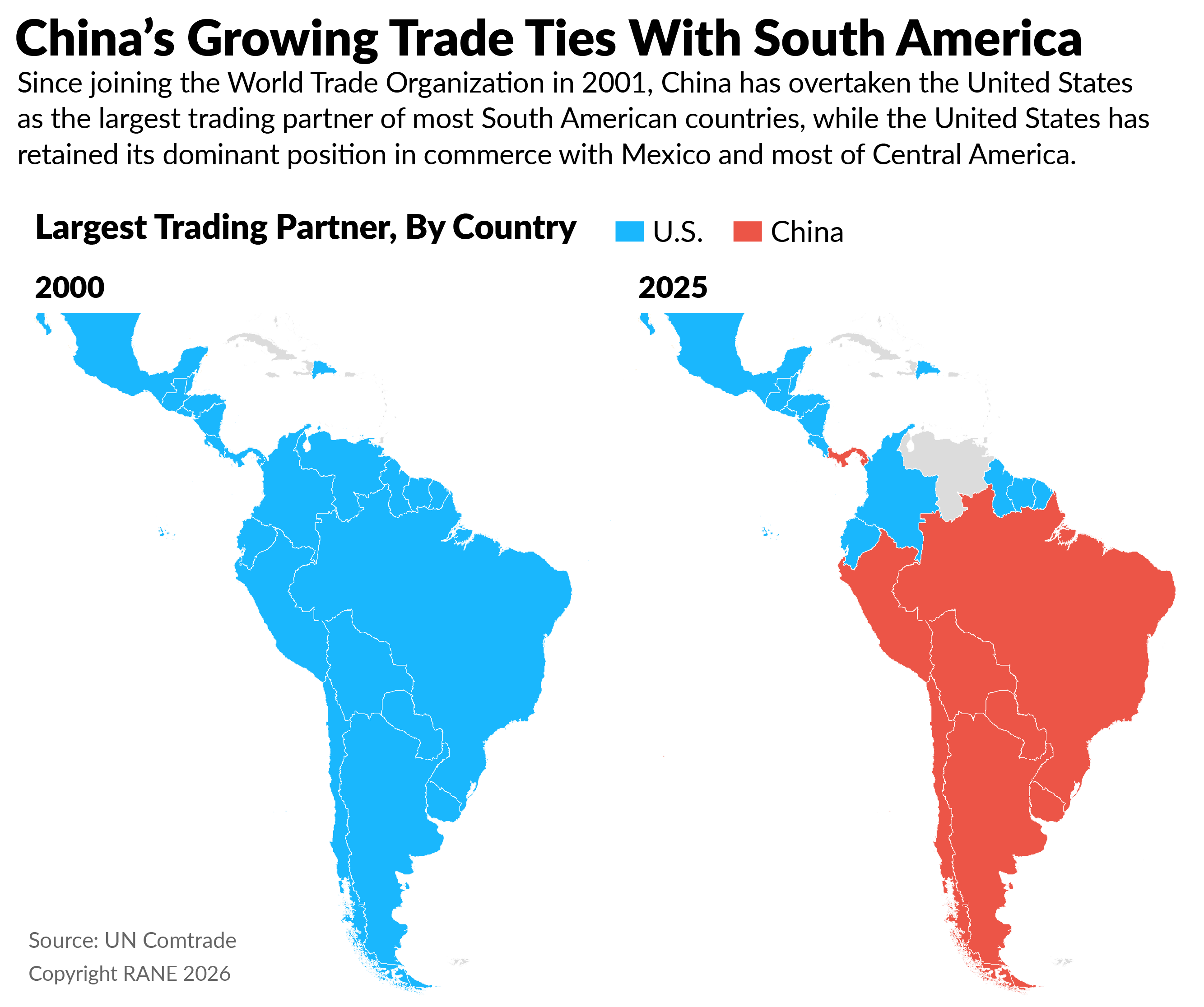
- China overtook the United States as South America's main trade partner over the past 15 years, with total bilateral trade having increased nearly 40 times between 2000 and 2024, to nearly $500 billion.
- The United States' efforts to outinvest China in key extractive industries could incentivize Beijing to abandon its low-profile approach to the region and engage in a competition by providing more funds and other benefits. However, this dynamic would most likely unfold in the long term and only after Washington and Beijing reach a trade agreement, which is the main concern in their bilateral relationship.
Domestic politics, popular opposition to U.S. perceived interference or future leadership changes could also prompt governments to avoid making significant concessions to Washington, undermining the long term sustainability of its regional approach. Backlash to U.S. pressure could fuel nationalism and popular opposition to the United States, while occasional protests, lobbying or legislative or legal checks could undermine regional leaders from pursuing a swift geopolitical realignment toward Washington. Moreover, U.S. coercive diplomatic and economic tactics to pressure regional leaders could backfire and intensify ongoing efforts to diversify trade away from the United States, ultimately undermining the White House's geopolitical goals. Lastly, the current ideological affinity between the Trump administration and several Latin American leaders could increase the chances that this regional strategy succeeds. However, such an alignment is not certain to persist, as Latin American voters frequently swing from one side of the political spectrum to another, as politicians from different stripes often fail to deliver solutions to structural problems and end up being voted out. Therefore, over the next or the following electoral cycle, it is possible that many leftist leaders return to power and, even if a Trump ally remains in the White House, such a mismatch would become a more significant obstacle to Washington consolidating its approach to the region over the long term.
