
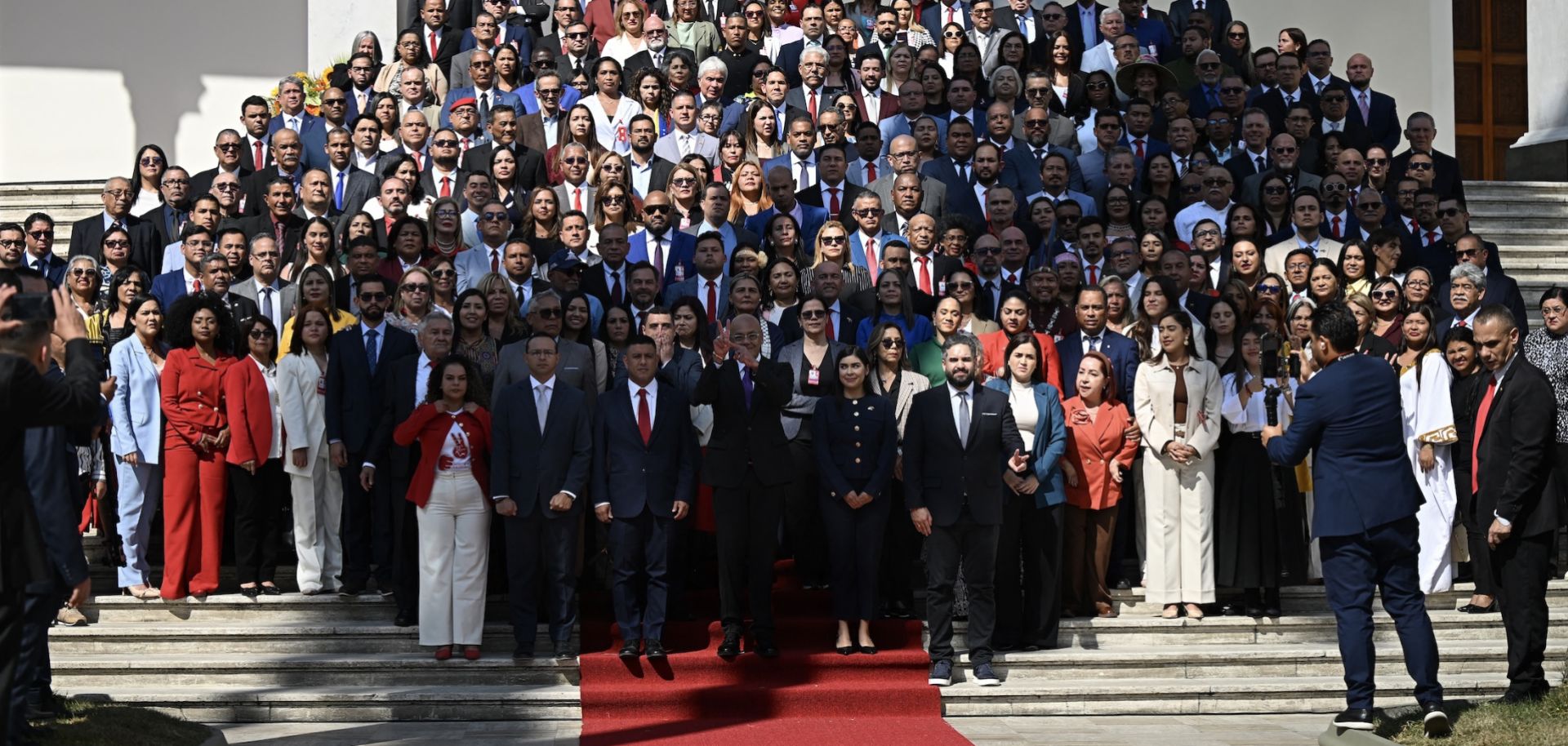
Following the U.S. capture of former President Nicolas Maduro, Venezuela will remain highly volatile and exposed to internal violence and further U.S. attacks. Acting President Delcy Rodriguez will most likely adopt a pragmatic, cooperative stance toward Washington to ensure regime survival, but alternative scenarios include her opting for a defiant stance vis-a-vis Washington, a hard-line coup, an internal civil conflict and a highly unlikely transition to democracy. There have been a number of significant developments and revelations in the days since the Jan. 3 U.S. military and law enforcement operation to carry out a series of strikes against military infrastructure in Venezuelan territory and capture then-President Nicolas Maduro and his wife, Cilia Flores. Operation Absolute Resolve involved more than 150 U.S. aircraft, including F-35 fighters, B-1 bombers, Blackhawk and Chinook helicopters, and drones. Most strikes occurred in or near the capital, Caracas, including Fuerte Tiuna, a crucial military installation that hosts defense agencies and commands, and official residences, including that of the president. In a press conference following the operation, U.S. President Donald Trump said Washington would "run" Venezuela until "a safe, proper and judicious transition" is possible. He also stated that U.S. oil companies would invest to restore Venezuela's oil infrastructure and noted that Secretary of State Marco Rubio had communicated with then-Venezuelan Vice President Delcy Rodriguez. On Jan. 4, Venezuela's Supreme Court ordered Rodriguez to assume the role of acting president for 90 days, which Defense Minister Vladimir Padrino Lopez endorsed. In the immediate hours after the U.S. strikes and Maduro's capture, Rodriguez adopted a defiant tone against the United States, demanding Maduro's and Flores' immediate release and saying that Venezuela was ready to defend its national interests and would not become a colony of an empire. However, on Jan. 4, she sent an open letter to Trump calling for dialogue, an end to hostilities and a "collaboration agenda." On Jan. 5, Maduro and Flores both entered "not guilty" pleas during their initial court appearance in New York City, where they face various criminal charges in a fresh indictment unsealed on Jan. 3.
- Trump has not ruled out deploying troops to ensure Venezuela's government meets U.S. demands, which remain vague but appear to center on cooperating with the United States to secure access to Venezuelan oil supplies. U.S. Chairman of the Joint Chiefs of Staff Dan Caine has also said that no U.S. troops are in the country, but that the large regional deployment of ground, air and naval assets would "remain in the region at a high state of readiness." The United States also has no diplomats in Venezuela, as Washington closed its embassy in Caracas in 2019 amid escalating bilateral tensions.
- Venezuela's Constitution outlines that in the president's absence, whether temporary or definitive, the vice president must take over and call elections within 30 days; the elected leader would then serve a regular six-year term.
- Rodriguez is a lawyer and has held several positions in the Venezuelan government since 2003, including deputy minister for European affairs (2005), minister of presidential affairs (2006), minister of communication and information (2013-14), minister of foreign affairs (2014-17), president of the National Constituent Assembly (2017-18), minister economy and finance (2020-24), vice president (2018-26) and oil minister (2024-26).
- The U.S. operation is the culmination of an escalating military, economic and political pressure campaign against Venezuela that began with a naval buildup in August, strikes against boats allegedly trafficking drugs in the Caribbean and eastern Pacific that began in September, a blockade of sanctioned oil tankers carrying Venezuelan oil and one drone strike on Venezuelan land, both in December.
Against this backdrop, RANE has developed five scenarios for the next three to six months, ranked from most likely to least likely:
Scenario #1: Rodriguez Cooperates With Washington and Remains in Power, Easing Political Instability (35% likely)
In this scenario, Rodriguez, who has been a loyal member of the Venezuelan regime, maintains aggressive rhetoric against the United States, at least in part to appease hard-liners within the government, the armed forces and the local population in an attempt to mitigate resistance to her leadership. However, amid likely persistent U.S. military presence in the Caribbean and Washington's pressure on her government, she seeks to establish a pragmatic relationship with the White House over the coming months. Apart from a small number of hard-liners within the Venezuelan government and military, high-ranking officials back such an approach to prevent the collapse of the regime, and Rodriguez's position may even be solidified by a stage-managed election. In this scenario, Rodriguez and Venezuela's economic, bureaucratic and security elites seek to leverage the Trump administration's alleged focus on accessing Venezuelan resources, especially oil but also likely minerals, to forestall U.S. pressure on the Venezuelan government to facilitate a democratic transition, which would expose them to legal prosecution either in Venezuela or the United States, as many have been sanctioned or indicted for crimes, such as drug trafficking and human rights violations. While bilateral tensions persist and Rodriguez eventually makes strong public statements condemning U.S. interference, she does not cut diplomatic channels with Washington or adopt policies that could trigger a harsh reaction from the White House, such as the nationalization of U.S. companies or the harassment of oil assets in neighboring countries like Guyana and Trinidad and Tobago. Although she is constantly exposed to criticism from hard-liners and even potential coup attempts, Rodriguez retains enough support within the political and military establishment to remain in power, over time reducing political instability, which incentivizes foreign investors and oil companies to return to the country, a desired outcome for the Trump administration. Still, large private sector investments are unlikely to materialize, especially over the next three to six months, amid various operational constraints ranging from the country's political landscape to technical issues around Venezuela's extra-heavy crude.
In this scenario, regardless of U.S. investments materializing, the Trump administration uses its influence over the Venezuelan government to prevent the country's oil and gas assets from being controlled by adversaries, chiefly China, while Washington also works to prevent Venezuela's commodity exports from systematically evading the U.S sanctions regime, like Russia has done. Over the next six months, Washington resorts to a mix of incentives and threats to ensure the Venezuelan government adopts measures aligned with its interests. This mix is likely to include occasional direct threats of U.S. attacks on Venezuelan territory or White House statements threatening Venezuelan government or military officials with potential arrests or extractions, juxtaposed by more U.S. licenses authorizing Western oil companies to operate in Venezuela or a gradual lifting of sanctions on Venezuela's economy, especially on the extractive sectors. In this scenario, the United States concentrates its efforts on the diplomatic front and limits military strikes to boats or planes in international waters or airspace, significantly reducing the indirect safety risks strikes in Venezuelan land would entail. However, companies willing to enter or return to Venezuela still face operational disruptions and safety threats as paramilitary groups loyal to the socialist revolution likely carry out sabotage operations or armed attacks against Western companies' assets or kidnap Western citizens to pressure the Venezuelan government not to cooperate with the United States. Parts of the public loyal to Maduro and former President Hugo Chavez are also likely to protest a cooperative position toward Washington, fueling unrest risks. Moreover, companies face persistent uncertainty and high levels of corruption, as Rodriguez is likely to maintain a patronage system that involves large swathes of the armed forces in legal and illegal activities to avoid being ousted by a military coup. Reduced political instability likely limits incentives for Venezuelans to leave the country, meaning migration outflows are minimal even though there are no incentives for large portions of the diaspora to return to the country.
Scenario #2: Rodriguez Defies Washington's Pressure and U.S. Military Campaign Resumes, Fueling Uncertainty (30% likely)
In contrast to the prior scenario, Rodriguez sticks to her historical ideological position in favor of the Bolivarian socialist revolution and refuses to cooperate with Washington, not only making rhetorical attacks against the Trump administration but also making decisions that undermine U.S. interests in Venezuela, such as restricting Chevron's operations or even carrying out new rounds of nationalizations. Authorities may go through the motions of staging a highly managed election to ensure Rodriguez's election, but she may also simply rely on emergency powers confirmed by the regime-controlled legislative and judiciary branches to avoid calling polls. Her hard-line approach has the backing of the military and parts of the local population but draws significant pushback from Washington and swathes of Venezuelans who back the opposition and favor U.S. intervention against the socialist regime. As attempts to create positive economic incentives for cooperation, such as sanctions relief, fail, the United States turns to escalating threats and eventually resumes strikes on Venezuelan territory. Targets include drug trafficking assets, such as camps, logistics hubs and military bases, but also government and security buildings in Caracas and elsewhere. An operation similar to Maduro's extraction targeting Rodriguez and other high-ranking officials (especially National Assembly President Jorge Rodriguez, who is Delcy's brother, Interior Minister Diosdado Cabello and Defense Minister Vladimir Padrino Lopez) could also occur amid the Trump administration's high-risk appetite following previous successful military operations, including Maduro's extraction and the attack on Iran's nuclear facilities in 2025. This scenario is marked by constant and high U.S.-Venezuela tensions, uncertainty over the Trump administration's appetite for additional military action in Venezuela, and operational and safety risks for companies in Venezuela. Recurring U.S. strikes would likely create at least indirect safety risks for companies in Venezuelan territory and, to a lesser extent, for those operating in neighboring countries and the Caribbean more broadly. Occasional aerial strikes would also disrupt air traffic around Venezuela and the wider Caribbean. Pro-Maduro paramilitary groups continue to support the government, given its antagonist approach vis-a-vis Washington, and likely carry out sabotage operations and armed attacks against U.S. assets and personnel in Venezuela, given that the government likely prioritizes guerrilla tactics over a direct military confrontation. In this scenario, the government leverages its repressive apparatus to crack down on opposition protesters while leveraging its supporters to stage pro-government demonstrations in an effort to show political strength.
Scenario #3: Hard-Liners Oust Rodriguez and Take Over, Consolidating Power and Hiking U.S. Tensions (20% likely)
In this scenario, Rodriguez fails to consolidate power and keep the different political and military groups aligned under her leadership, particularly if she is accused of becoming too friendly with Washington and/or failing to sufficiently crack down on alleged domestic opponents. This failure creates the conditions for her to be effectively sidelined or completely removed from office in a military coup, potentially led by Cabello or Lopez. Although paramilitary groups and other armed actors remain a challenge, the coup leader(s) successfully manage this transition by maintaining unity among the armed forces and the broader security apparatus. The result is the installation of a hard-line government that is vehemently anti-United States. This leads to further nationalizations and other actions that rankle the Trump administration, increasing the likelihood of further rounds of large-scale U.S. airstrikes and potentially new ground operations in Venezuela. This development also opens the door for Venezuelan adventurism in its near abroad, reviving threats to neighboring Guyana's Essequibo region and maritime and aerial traffic in nearby waters and airspace. Depending on the level of confrontation with the United States and the intent of the new leaders, the military-led government could also expand ties with U.S. adversaries like China, Iran and Russia, while drawing even closer to criminal groups like Tren de Aragua that are responsible for drug trafficking and other activities. At home, the military leaders double down on state-led economic policy, all but eliminating any remaining attractiveness for Western companies to invest in Venezuela and continuing to erode what is left of Venezuela's state-owned oil production capacity. The intense crackdown on anti-government protesters, arrest of opposition leaders, declining socioeconomic conditions on the back of stricter U.S. sanctions and the blockade, and safety concerns around U.S. strikes result in a new wave of migration. The large numbers of Venezuelans leaving the country trigger new humanitarian crises, especially in neighboring Colombia and Brazil, as countries in the region adopt stricter border controls to prevent a new wave of illegal Venezuelan migration like the one seen in the past decade. Nevertheless, organized criminal groups (particularly Tren de Aragua) likely find new routes and ways to smuggle people across South and Central America and the Caribbean, increasing criminal activities in the region.
Scenario #4: Regime Fractures, Plunging Venezuela Into Chaos Amid Popular Unrest and Violence From Criminal Groups (10%)
In this scenario, Venezuela faces severe internal instability and conflict as divergent factions within the government, security services, opposition groups and armed criminal syndicates descend into widespread unrest and violence. Rodriguez is unable to hold the country together and, over time, splits emerge within the ruling elite, military and security services, leading to open conflict between different factions, such as those led by Cabello or Lopez. Such a split could be triggered by a potential coup attempt against Rodriguez, U.S. efforts to encourage defections, a dispute over policy toward the United States or one of myriad other triggers. Such a split in the high rankings of the regime creates large opposing groups throughout Venezuela's public security apparatus that engage in armed confrontations across the country. The divisions within the military and paramilitary groups reduce the ruling government's repression capacity and create the conditions for a prolonged confrontation in the country's largest cities and remote areas, especially near the border with Colombia, which is widely used for drug trafficking. There, the presence of the Colombian National Liberation Army, alongside other criminal groups, compounds the internal armed conflict. Armed or explosive attacks and sabotage operations become significant obstacles for business operations in the country, while kidnapping risks significantly increase. Amid the chaos, opposition groups also likely mobilize to conduct large-scale protests, acts of sabotage and at least sporadic acts of targeted violence, further complicating the security situation. Similar to the previous scenario, increased violence and the further erosion of Venezuelans' already very poor living standards result in a spike in migration, not only to neighboring countries but across Latin America. Governments in the region likely adopt measures to curb illegal border crossings, triggering humanitarian crises across the region.
Scenario #5: Opposition Wins Elections and Begins Democratic Transition Amid Uncertainty and Instability (5% likely)
In this scenario, the Trump administration pressures the Venezuelan government to follow the country's constitution and call elections by early February, 30 days after Rodriguez took office as acting president. Despite Venezuelan officials' efforts to interfere with the electoral process and vote count, Washington ensures a minimally competitive race. Similar to what it did in Venezuela's 2024 presidential election, the opposition raises support across the country and organizes large rallies, which translate into a high turnout against the existing socialist regime and, in contrast to the rigged 2024 vote, result in the election of a U.S.-friendly leader. The new president starts reestablishing democracy in Venezuela but faces significant institutional resistance from the bureaucratic and public security apparatus, which are dominated by members of the socialist regime. Efforts to prosecute or arrest former allies of Maduro trigger demonstrations and public servants' strikes and significantly undermine the new government's capacity to implement policies, which fuels political instability and regulatory uncertainty. Moreover, some members of paramilitary groups and dissidents within the armed forces assemble an armed resistance and carry out occasional attacks against government buildings and newly elected or appointed officials, successfully assassinating some leaders and destabilizing the government. While the United States is willing to support the new administration, help is limited to equipment and training, meaning the new president has limited tools to enforce law and order and prevent guerrilla and political violence from surging. Despite security concerns, the political change in Caracas leads part of the Venezuelan diaspora to return to the country. It takes time for the government to implement business-friendly policies and for these to translate into increased economic activity, jobs and revenues for public coffers that can be used in subsidies or social programs, so the migration inflow and likely harsh economic adjustments exacerbate socioeconomic challenges in the short term. This scenario is highly unlikely partially because the Trump administration is unlikely to prioritize a democratic transition over the next six months and, even if an election is scheduled, it is unlikely that it would be be free and fair, nor that it would happen within six months given the need for a campaign period and the reestablishment of electoral institutions to ensure a minimally competitive race.
