
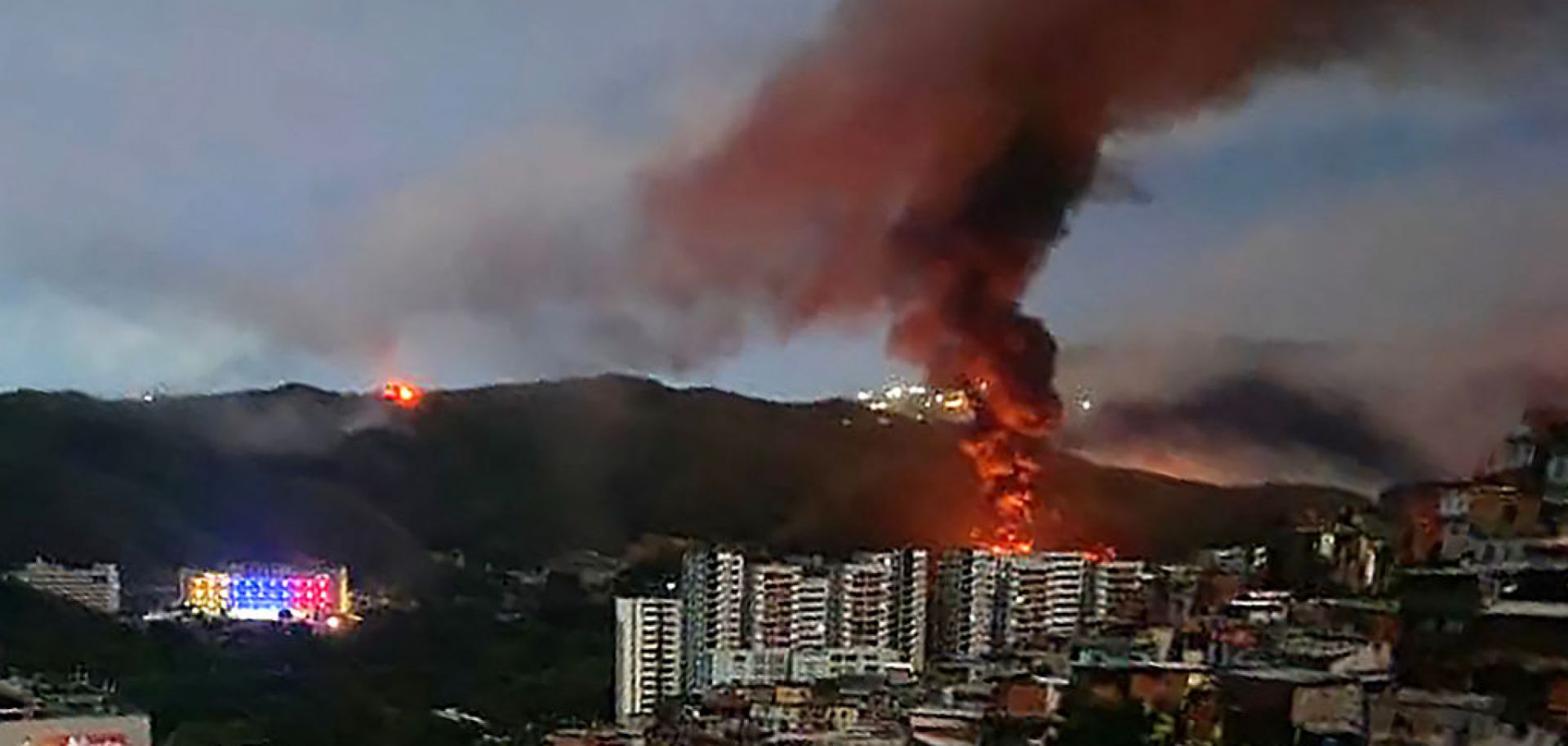
The United States' claimed capture of Venezuelan President Nicolas Maduro creates a leadership vacuum that risks leading to potentially violent instability and unrest in the coming weeks, while also keeping future U.S. strikes on Venezuela and other countries in the region on the table. On Jan. 3, U.S. President Donald Trump announced in an early morning social media post that the United States had captured Maduro and his wife, Cilia Flores, and flown them out of the country. Trump said the operation occurred with U.S. law enforcement and took place alongside U.S. military operations against Venezuela. The Venezuelan government said attacks had occurred in the capital, Caracas, as well as the surrounding states of Aragua, Miranda and La Guaira. The Venezuelan government also declared a state of emergency and called for popular armed mobilization to resist U.S. forces. President Trump announced a press conference at 11:00 a.m. EST to discuss the situation.
- Sen. Mike Lee (R-Utah) said on Jan. 3 that he had spoken to U.S. Secretary of State Marco Rubio, who said that Maduro would stand trial on criminal charges in the United States — information subsequently confirmed by Attorney General Pam Bondi. According to Lee, Rubio also does not anticipate more U.S. military operations in Venezuela now that Maduro has been captured.
- Venezuelan Vice President Delcy Rodriguez said the U.S. strikes killed several people and that the country's defense plans had been activated. She also called on Trump to provide proof of life for Maduro. Other key figures in the Venezuelan government — including Defense Minister Padrino Lopez, Interior Minister Diosdado Cabello and National Assembly President Jorge Rodriguez — all appear to be safe.
- Social media posts indicate that long lines have formed outside grocery stores, pharmacies and other locations across Venezuela. Colombian President Gustavo Petro said on social media that his country's military forces were deploying to the Venezuelan border to prepare for a potential influx of refugees.
The U.S. operation is the culmination of an escalating military, economic and political pressure campaign against Maduro. Tensions between Washington and Caracas have been building for months. The Trump administration has repeatedly accused Maduro's government of being complicit in drug trafficking, with the State Department calling Maduro the head of a "narcoterrorist" state and offering a $50 million reward for his arrest and/or conviction. The United States and many other Western countries have also accused Maduro of remaining in power illegitimately following the most recent July 2024 presidential election, which was widely seen as rigged. In addition to tightening sanctions on Maduro and his inner circle, since August the United States has been amassing military forces in the Caribbean and carrying out airstrikes against suspected drug-trafficking vessels in regional waters that have killed more than 100 people. Trump repeatedly threatened to expand these strikes to Venezuelan territory. In late December, he appeared to make good on that threat with a reported drone strike carried out by the CIA against a Venezuelan port facility allegedly used by drug traffickers. In recent weeks, U.S. authorities have also seized two oil tankers and pursued a third after President Trump ordered a blockade against sanctioned oil from the country.
- In March 2020, during Trump's first term in office, U.S. federal authorities charged Maduro with being the leader of a drug trafficking network called the "Cartel de Los Soles", or "Cartel of the Suns." Many independent analysts say the cartel does not exist as an official, unitary organization, but rather is an umbrella term to describe a complex and pervasive patronage system in which military, political and other Venezuelan elites profit from drug trafficking and other illegal activities. The term takes its name from the sun-shaped symbol on the uniforms of top Venezuelan military officials.
- International monitors widely characterized Venezuela's last presidential election as neither free nor fair. The opposition obtained evidence showing that opposition candidate Edmundo Gonzalez had won by a large margin. Gonzalez, who subsequently fled to Spain, ran as the main opposition candidate after Venezuelan authorities barred opposition leader Maria Corina Machado from participating. Machado, who escaped from Venezuela to travel to Oslo to receive the Nobel Peace Prize in December and is still abroad, has said she would like to return to Venezuela.
Though Maduro's removal opens the door for wider regime change, this path will be fraught with uncertainty, risking near-term violent fallout and potential future U.S. strikes in Venezuela and elsewhere in the region. If Rubio is accurate in his estimation that the current round of U.S. military action has ended, the next question becomes who takes over for Maduro. According to Venezuela's constitution, Vice President Rodriguez would take over and call elections within 30 days; the new president would then serve a normal six-year term. In theory, this would give an opportunity for an opposition candidate, but the two obvious contenders — Gonzalez and Machado — would both need to make a risky decision to return to the country. Some sort of managed transition, possibly led by either figure, could occur, but as of now there is no indication that pro-Maduro elites are prepared to give up power. In any election, authorities would almost certainly again stage-manage the polls to ensure victory for an establishment candidate allied with elites, thereby elevating another leader the United States would consider illegitimate. In any case, there is no guarantee that the constitutional process will be followed in this unprecedented situation, meaning the coming days and weeks could result in significant instability in which elites jockey for power. This opens the door for a range of scenarios, including popular unrest from opponents of the government, operations from armed colectivos or the Bolivarian Militia supportive of the government, as well as actions by other armed groups like Colombian guerrilla groups to take advantage of any chaos that emerges to defend their respective interests. A full Venezuelan military takeover of the government is also on the table, especially if there is major instability. At least for now, however, no matter how events play out, the U.S. capture of Maduro will keep high tensions between Caracas and Washington. Further U.S. military strikes and other operations, including covert ones, remain on the table in Venezuela, especially if the interim leader and eventual new head of state does not engage in substantive outreach to Washington. More broadly, the U.S. pressure campaign against Maduro also raises the likelihood of similar U.S. political, economic and military efforts targeting other countries in the region. Given its close ties to Venezuela and longstanding tensions with the United States, Cuba is at especially high risk, especially if the United States more aggressively enforces a blockade or a new Venezuelan government suspends oil shipments the island needs to run its outdated power grid and exchange for dollars to have access to basic imported goods. But even certain countries with generally strong U.S. ties, such as Mexico, are likely now at greater risk of U.S. aerial strikes or other operations to target criminal groups, especially since President Trump has repeatedly floated the idea of attacking drug traffickers in Mexico, Colombia and elsewhere.
- The Venezuelan government has limited avenues for any sort of a military response against the United States given its comparatively far weaker military and the fact that any sort of direct attack would almost certainly result in more substantial U.S. reprisals. However, Venezuelan authorities could take a number of other asymmetric actions, including ramping up the detainment of U.S. citizens (something that has reportedly already been occurring in recent weeks) or harass energy infrastructure and vessels, including those transporting oil and gas, in nearby waters, as previously seen off the coast of neighboring Guyana.
- From a military perspective, Venezuela could engage in guerrilla resistance or sabotage campaigns should the United States carry out additional military operations, especially any that put U.S. troops on the ground, targeting Venezuelan territory.
