
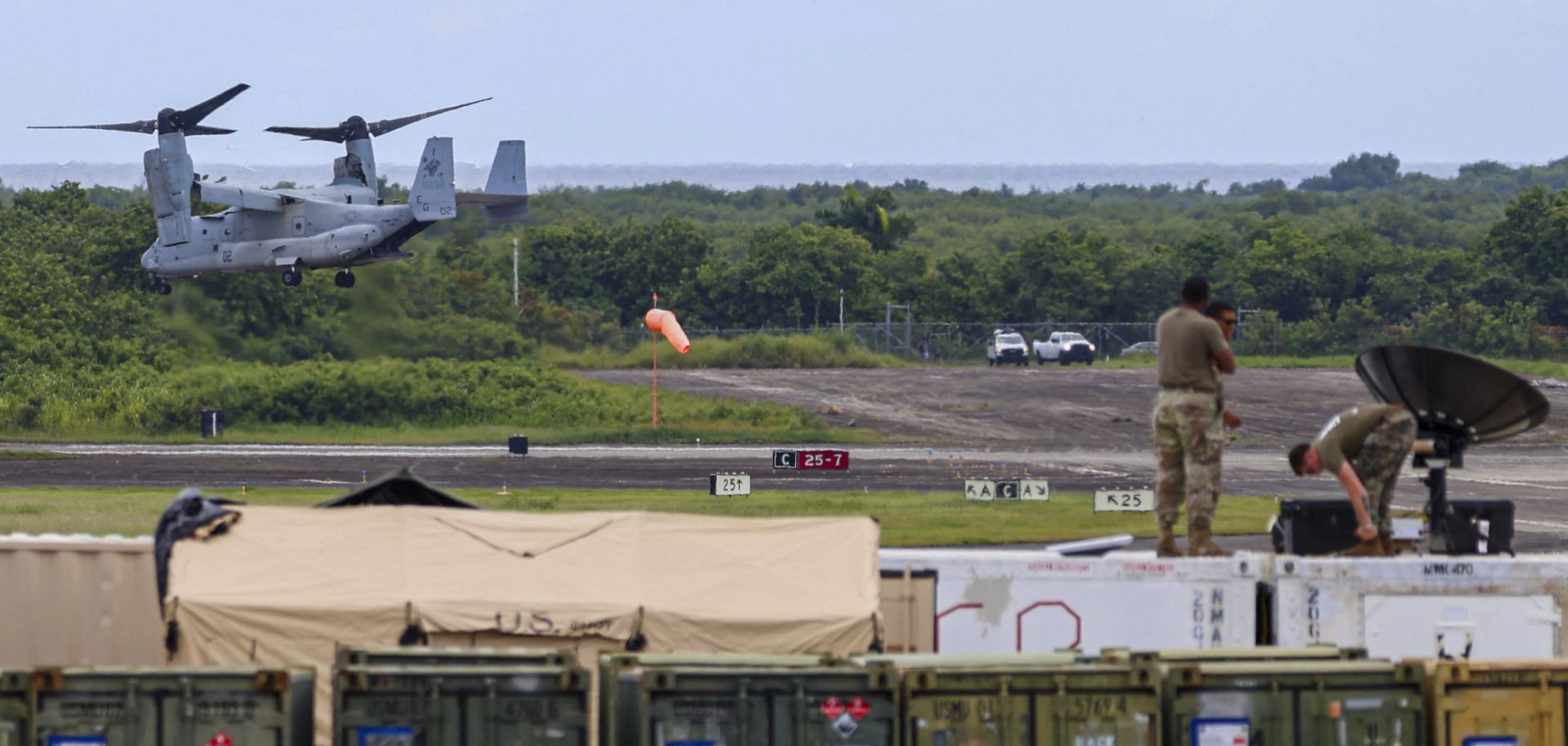
The United States will likely expand the frequency and geographic scope of strikes targeting alleged drug traffickers over the next year, with the potential for attacks to move onshore in a range of countries across Latin America and the Caribbean, creating physical safety and operating challenges for organizations, as well as compliance risks due to expanding sanctions enforcement. Since Oct. 17, U.S. military strikes targeting alleged drug traffickers in the southern Caribbean Sea have increased in frequency and geographic scope, with strikes off the coast of Colombia and in the eastern Pacific Ocean. The United States publicly acknowledged a total of eight strikes in 12 days, an escalation from the previous rate of announced strikes of approximately one every other week. The first strike, which Secretary of Defense Pete Hegseth announced on Oct. 20, occurred on Oct. 17 off the coast of Colombia, targeting alleged members of the National Liberation Army (ELN), a major Colombian insurgent group that engages in cocaine production and trafficking. On Oct. 21 and 22, the U.S. military struck alleged drug vessels in the eastern Pacific Ocean for the first time. On Oct. 23, the United States targeted another vessel in the Caribbean Sea, with the operation conducted at night. On Oct. 27, the United States conducted three strikes targeting four vessels in the eastern Pacific Ocean. Hegseth said Mexican authorities assisted in search and rescue efforts after the strike, suggesting it may have occurred near Mexico; though unconfirmed, if true, it would mark another geographic expansion. Then, on Oct. 29, the U.S. military struck another boat in the eastern Pacific Ocean. The strikes bring the total reported U.S. strikes on alleged drug trafficking vessels to 14. Meanwhile, on Oct. 23, President Donald Trump told reporters that ''the land is going to be next,'' and said that while his administration may inform Congress of plans to strike drug traffickers on shore, it would not necessarily ask for approval.
- Since U.S. leaders began announcing strikes on Sept. 2, the United States has generally provided scant details about their targets' location or evidence of their guilt.
- Since August, the United States has expanded military deployments in the Caribbean Sea, including at least eight U.S. warships, with thousands of additional military personnel deployed to the area, bringing the total to over 10,000 as of late October. On Oct. 23, the United States flew B-1 bombers near Venezuela, and on Oct. 24, the Pentagon announced it would deploy the USS Gerald Ford Carrier Strike Group, which includes stealth fighter jets and surveillance aircraft, to the region.
- Tensions between the Trump administration and the Colombian government initially spiked in January 2025 over immigration and deportation issues, leading the United States to threaten tariffs against Colombia. Since September, Colombian President Gustavo Petro has repeatedly criticized U.S. strikes in the region, leading Trump to call Petro an ''illegal drug leader'' on Oct. 19, after which his administration imposed sanctions on Petro himself and Interior Minister Armando Benedetti.
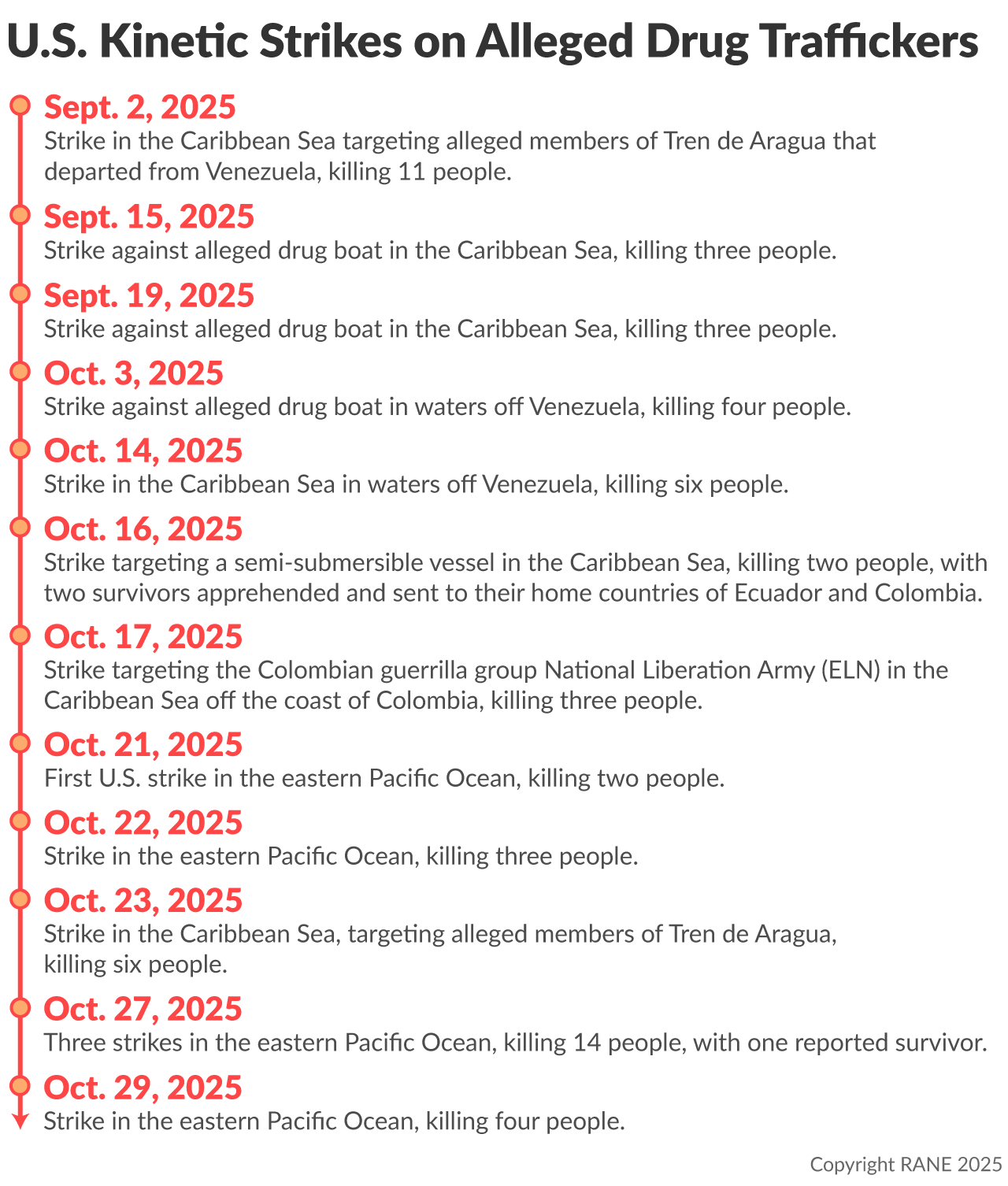
The Trump administration's growing emphasis on security and combating drug trafficking in the Western Hemisphere suggests that U.S. military operations against cartels and other criminal groups are highly likely to expand geographically and in frequency over the next year, with a rising likelihood that strikes extend to land-based targets. The recent strikes come as the White House has taken a number of steps to crack down on regional organized crime groups, including Mexican cartels. In February, the administration designated major groups like Cartel de Jalisco Nueva Generacion (CJNG), the Sinaloa cartel and Tren de Aragua as Foreign Terrorist Organizations (FTOs) and Specially Designated Global Terrorists (SDGTs), expanding legal and financial means to target the groups. Since then, additional groups have received similar designations, including smaller Mexican groups and the Ecuadorian gangs Los Lobos and Los Choneros. In August, leaks indicated that Trump secretly ordered the Pentagon to begin using force against cartels. The strikes since then are the manifestation of that order, while the recent expansion of strikes to the eastern Pacific Ocean, the escalation in the frequency of the strikes and the continuing deployment of additional resources to the region demonstrate the administration's intent to conduct further kinetic operations against groups responsible for regional drug trafficking. Furthermore, the statements in late October indicating Trump's interest in strikes against land-based targets suggest that non-maritime kinetic strikes are forthcoming. These developments indicate that, over the next year, U.S. kinetic operations against criminal groups will further expand geographically, in frequency and in terms of targets and tactics. Such operations may include strikes against drug trafficking planes and various land-based targets, potentially involving special forces operations, in addition to ongoing drone and airstrikes. The United States will likely also increase covert activity against drug trafficking groups, including intelligence collection and sabotage efforts aimed at apprehending and/or assassinating criminal leaders.
- The Trump administration has previously made comments indicating that the kinetic operations are intended to send a message to drug traffickers, with Secretary of State Marco Rubio stating after the first strike that U.S. forces could have apprehended the individuals, but chose to conduct a deadly attack instead.
- In July 2024, the United States arrested Sinaloa cartel leader Ismael ''El Mayo'' Zambada by conducting covert operations to manipulate him into boarding a plane that ultimately landed in El Paso, Texas, where U.S. authorities arrested him along with Joaquin Guzman Lopez, son of Sinaloa cartel co-founder El Chapo.
The following locations are at higher risk for U.S. military operations against drug trafficking groups in the next year, in order from most to least likely:
- Venezuela: Given the U.S. government's dual focus on combating Venezuelan drug trafficking groups such as Tren de Aragua and increasing pressure on the government of President Nicolas Maduro, strikes off the coast of Venezuela are certain to continue over the coming weeks and months. It is also likely that the United States will begin launching drone and airstrikes against such groups on the Venezuelan mainland, with the potential for strikes against Venezuelan security forces, given the connections between criminal groups and the military. Most strikes would likely occur near the Colombian border or along the coast, particularly west of Caracas, where Tren de Aragua is most active. However, areas near the border with Guyana could be targeted as well, given reports of incursions of Venezuelan criminal groups into the country in the last year. A scenario in which the United States launches operations in Venezuela aimed at overthrowing Maduro also cannot be ruled out, but this remains unlikely in the coming months, as the Trump administration does not currently appear intent on ousting Maduro directly.
- Mexico: Trump and other top officials in his administration have repeatedly discussed conducting drone strikes and/or special forces operations against Mexican cartels. Trump himself has offered to assist Mexican President Claudia Sheinbaum in cracking down on cartels, though she refused, stating it would violate Mexican sovereignty. Close U.S.-Mexico economic ties and the currently strong relationship between Sheinbaum and Trump have likely so far prevented the White House from launching strikes against Mexican cartels. However, the United States will likely conduct kinetic operations against Mexican groups within Mexican territory in the next year, given that these groups are responsible for the large majority of drug trafficking into the United States, and that Trump and other top officials have repeatedly signaled a desire to take stronger action in Mexico. Such strikes would most likely target remote areas of border states like Sonora and Chihuahua, and states with high cartel control, such as Sinaloa.
- Colombia: The U.S. military has already stated it targeted the ELN in the strike on Oct. 17, demonstrating its willingness to target Colombian groups. Colombia's role as the source of most global cocaine production further makes it an attractive target for U.S. strikes, particularly given elevated tensions between President Petro and Trump. However, U.S. strikes in Colombia are only moderately likely in the next year, as the presence of multiple U.S. energy companies in the country and the United States' generally much closer economic ties with Colombia (compared with Venezuela) make it a less attractive target. If strikes do occur, they would likely be near the Venezuelan border or in key regions for cocaine production, including Narino, Cauca and Norte de Santander departments.
- Ecuador: While the Trump administration has focused little on Ecuadorian groups compared with those from elsewhere in the region, a visit by Rubio to the country in September included signing agreements to expand security cooperation. President Daniel Noboa has himself stated multiple times in the last year that he would like U.S. assistance against local gangs, which have made Ecuador one of the most violent countries in South America in recent years. Noboa is also trying to push through a constitutional change that would allow foreign military bases in Ecuador. If the Trump administration wants local permission to conduct operations (as previously requested but denied in Mexico), Ecuador may be an attractive alternative location to more extensively target drug trafficking groups, especially since the United States has already designated two Ecuadorian gangs as terrorists. There is currently no indication that this is being actively discussed, but if the United States does conduct operations against Ecuadorian groups, they would likely occur in particularly violent provinces such as Guayas and Esmeraldas.
- Haiti: Similar to Ecuador, the Haitian government has repeatedly asked for foreign security assistance, including from the United States, in its efforts to combat extreme gang violence that has made Haiti the most violent country in the Western Hemisphere. The U.S. government has had minimal focus on Haiti recently, and Haitian gangs are not major players in regional drug trafficking, which makes direct U.S. operations in the country unlikely in the coming months. Still, local conditions suggest violence will worsen amid expanding political instability, meaning U.S. military operations in the country could become more attractive over time, especially if Haitian gangs take full control of the country.
- Additional Caribbean Islands: Caribbean island nations are often critical nodes in regional drug trafficking, as traffickers commonly travel between multiple islands before reaching Mexico, where Mexican groups handle the trafficking of drugs across the border into the United States. However, these trafficking operations are not uniform, with a majority of drug traffickers not passing through a single country, complicating efforts to identify a single location on which the U.S. military could focus its efforts. Still, there are a few countries that would be more attractive for U.S. kinetic operations. First, Trinidad and Tobago may be attractive due to its close proximity to Venezuela, as well as the government's comments praising U.S. military strikes in the region and its participation in U.S. military drills from Oct. 26 to 30; this suggests the government may also invite U.S. operations against Trinidadian gangs, as well as Tren de Aragua, which is reportedly expanding its presence in the country. Strikes would most likely be concentrated on the island of Trinidad, which has a significantly higher presence of criminal groups compared with Tobago. Separately, the Trump administration named Jamaica, the Bahamas and the Dominican Republic (as well as Haiti and Belize) as either major drug transit or illicit drug-producing states in September, indicating potential U.S. interest in targeting groups there. Finally, Cuba may also be targeted, despite its relatively small role in drug trafficking activities, due to the Trump administration's opposition to Cuba's left-wing authoritarian government (U.S. opposition to Maduro's leftist regime in Caracas is a major factor behind the ongoing strikes on Venezuelan groups). However, the Trump administration has not demonstrated a high focus on Cuba recently, making this unlikely in the near term.
- Honduras, Guatemala and El Salvador: These so-called "Northern Triangle" countries have historically been home to a range of transnational drug trafficking groups, including MS-13, Barrio 18 and Mexican cartels. El Salvador has seen activities by criminal groups and homicides plummet since the March 2022 implementation of a state of emergency cracking down on crime, making the country an unlikely target for operations (though the government of President Nayib Bukele may opt to assist the United States' anti-cartel activities elsewhere). Guatemala and Honduras, meanwhile, still have high levels of violence, and criminal groups are known to traffic drugs north to Mexico. This makes them potential future targets for U.S. strikes, which would most likely occur in remote areas known to have high criminal presence, including the Guatemala-Mexico border and coastal areas.
Despite expanded strikes, U.S. operations against Latin American criminal groups are unlikely to substantially reduce drug trafficking to the United States, which means most targeted groups are unlikely to retaliate significantly against U.S. targets, though this risk could grow if U.S. attacks pose existential threats to specific criminal groups. The primary focus of regional drug trafficking organizations is revenue generation, and there are substantial profits to be made from the U.S. market. These strong financial incentives, in addition to criminal groups' already high tolerance for physical threats to their members and ability to continuously adapt their tactics in the face of pressure, make it unlikely that the expanded U.S. strikes across Latin America will result in a substantial, sustained drop in drug trafficking to the United States. While some groups may adjust their activities to avoid U.S. strikes, they will not stop moving drugs to the United States, and in the extremely low likelihood scenario that they do, another criminal group would step in to fill the gap in the market within months. Given that these criminal groups seek to operate as secretly as possible, they are also unlikely to retaliate against U.S. strikes by targeting American government interests, citizens or businesses, since such actions would draw significant U.S. attention to their specific activities. However, such retaliation could become more likely over the next year — especially if U.S. operations start posing an existential threat to specific criminal groups, which could occur if a single group faces particularly high casualties (e.g., the deaths of over 100 members within a few months), or if strikes weaken a group to the point where it begins to fracture into multiple smaller groups. In this event, U.S. operations would raise the risk of individual members conducting a retaliatory strike without the sanction of central leadership. While a low risk of this happening persists for any group, major internal destabilization would elevate this threat.
- Complete data on the size of the U.S. illegal drug market does not exist, given the nature of the industry. But in 2013, the United States' Office of National Drug Control Policy estimated that the illegal drug market in the United States was worth $100 billion. The U.S. Congress' Commission on Combating Synthetic Opioid Trafficking's 2022 report estimated that cartels annually earn between $700 million and $1 billion in revenue from fentanyl (a significantly cheaper drug to produce in comparison to cocaine).
- Some groups would be more willing to conduct retaliatory attacks against U.S. targets. These include Colombian left-wing guerrilla groups like the ELN, which are comparatively more ideologically driven, and Haitian gangs, which have already demonstrated a willingness to specifically attack U.S. targets and kidnap American citizens for ransom.
U.S. strikes and broader operations targeting regional drug trafficking groups will create safety threats for personnel, increase operating costs and raise compliance challenges related to terrorist financing for businesses in affected countries. Expanded U.S. military strikes will raise concerns for businesses operating in the region by creating uncertainty about the safety of local staff and corporate travelers, as well as potentially causing indirect damage to companies' local facilities or logistical disruptions. This concern will be particularly pronounced for entities like humanitarian organizations and extractive industries that typically operate in more remote areas, where attacks on land are highly likely to remain concentrated. Risks would also rise in the low-likelihood event that U.S. strikes target more populated areas. Rising insurance premiums and the need for further oversight and security presence would further raise operating costs. Any sustained U.S. campaign targeting a specific country may also lead some companies to pause the expansion of operations and investments there. This could damage local economies, exacerbating persisting challenges from slow GDP growth and unemployment sustained since the COVID-19 pandemic, particularly in countries already facing substantial economic challenges such as Venezuela, Honduras, Haiti and Jamaica. Furthermore, as the United States expands kinetic strikes across the region, it will raise the likelihood of disputes with local governments over sovereignty violations. Based on previous Trump administration behavior toward Colombian President Petro, such disputes could result in expanded U.S. tariffs and/or sanctions that create additional supply chain and compliance concerns. While some countries may threaten retaliatory measures against the United States, the importance of the U.S. market for the exports of most regional countries' economies makes it unlikely that any will take significant and sustained measures. Finally, the United States is likely to complement kinetic strikes by using FTO and SDGT designations to crack down on designated groups' support networks. As U.S. enforcement efforts increase, this strategy will raise compliance burdens on companies to ensure they do not interact with criminal groups or related financial institutions.
- In June, the U.S. Department of the Treasury used the 2024 FEND Off Fentanyl Act to prohibit some transactions with the Mexico-based financial institutions CIBanco, Intercam Banco and Vector Casa de Bolsa over their alleged money-laundering for Mexican cartels, including the Gulf cartel and CJNG. The U.S. restrictions also triggered ripple effects on Mexico's financial system, as lenders increased internal oversight and even cut some clients to lower the risk of being similarly targeted.
